Consumer Startup Team Slide: Real Pitch Deck Examples
How consumer startups present the team in a pitch deck: show who can reach customers, who can build the product and why these people understand the buyer.
Consumer Startup Team Slide: Real Pitch Deck Examples
Eight team slides from consumer startups, shown in full, compare how each shows that the founders can reach customers, build and ship the product, and understand the person buying it.
TL;DR
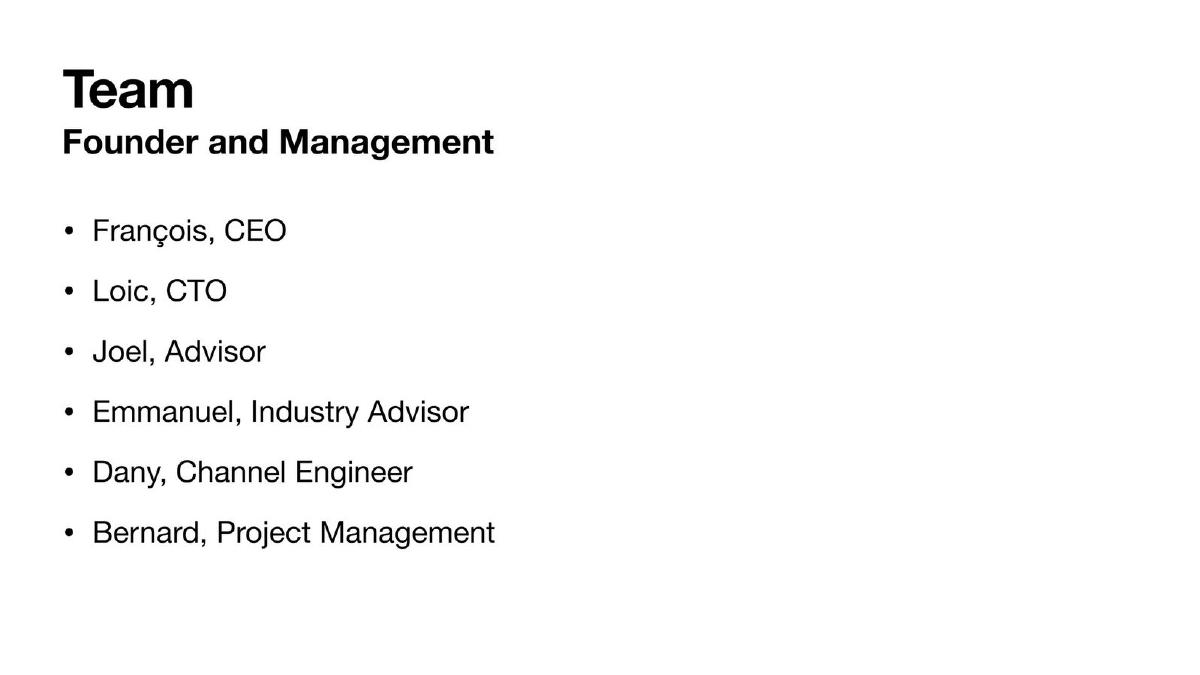
A consumer team slide should answer three questions: who can get this in front of customers, who can build it, and why do these people understand the buyer? Arya pairs a CEO with a "$660m Exit to Digital Turbine" with a co-founder who has "~2M followers" and appears in Netflix's Too Hot to Handle, so both building and reach are covered. Bloom Community notes that its whole team "were members of Bloom Community first." Fakespot opens with the founder's mission, then names who runs engineering and data science. Ajinomatrix lists six first names and job titles with no background at all, which tells an investor nothing about why this team will win.
Consumer team slides from real pitch decks
Each example shows the exact stored slide above its analysis and links to the full teardown. Claims are as shown on the slides; we have not verified them.
Arya team slide — slide 2
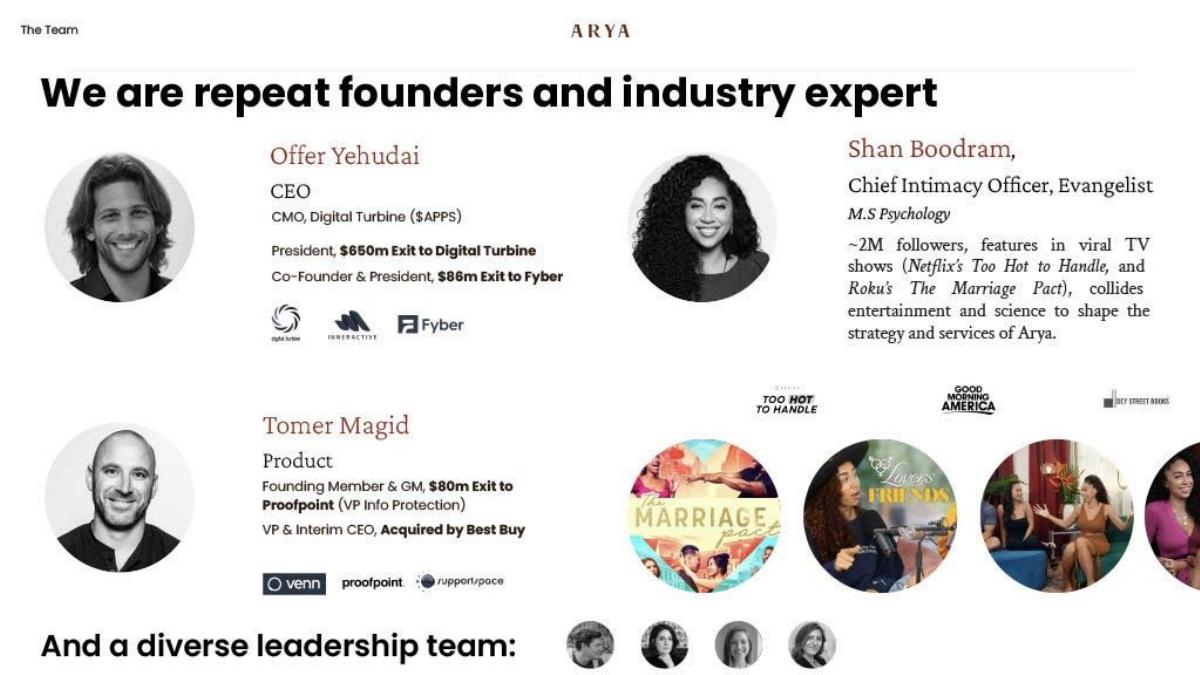
A relationship app. Three founders with photos, one line of proof each, and TV show stills.
Arya deck, slide 2. Exact stored slide matched to this analysis.
Our analysis: The headline makes the claim and each person proves one part: exits (build and sell), an audience (reach), product.
Evidence and limitation: Exit values and follower count as stated; not verified.
What a founder can adapt: Give each founder one number that proves their part of the plan.
Supporting analysis
What the deck claims: "We are repeat founders and industry expert." Offer Yehudai, CEO: "President, $660m Exit to Digital Turbine", "Co-Founder & President, $86m Exit to Fyber." Shan Boodram, Chief Intimacy Officer: "~2M followers, features in viral TV shows (Netflix's Too Hot to Handle, Roku's The Marriage Pact)." Tomer Magid, Product: "$80m Exit to Proofpoint."
Presentation choice: Shan Boodram's following answers the consumer investor's first worry, how customers will find the app, before the go-to-market slide.
When it does not fit: Fix the headline's grammar ("industry expert"), and name the "diverse leadership team" or drop the row of unnamed photos.
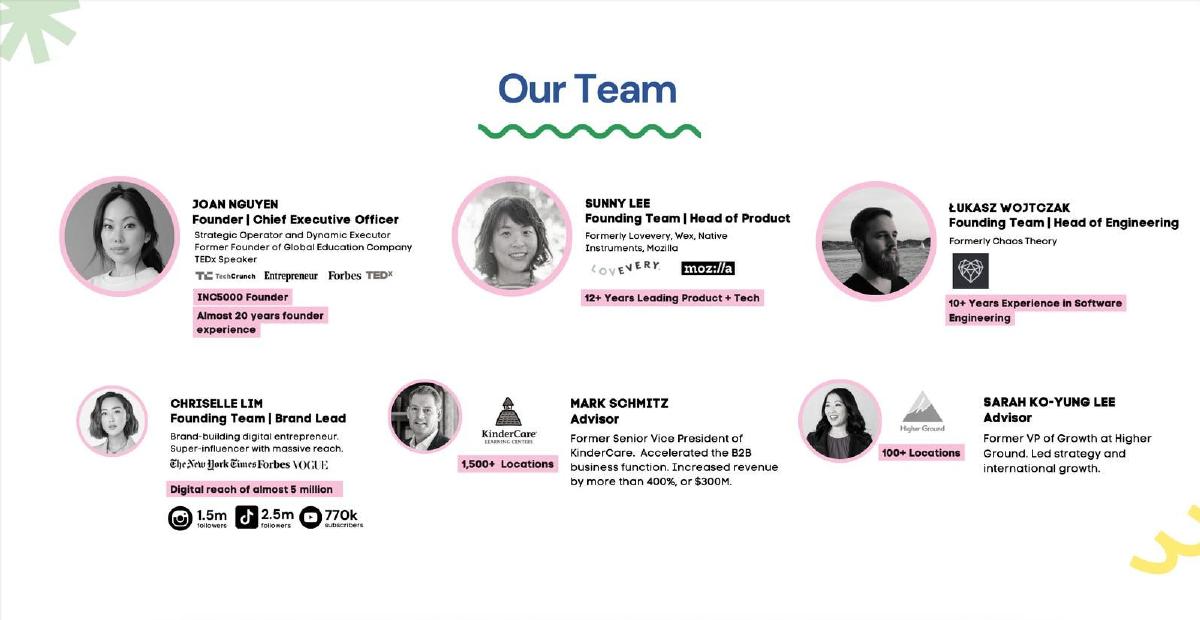
A childcare booking app for parents. Six people: three founding team, one brand lead, two advisors.
Bumo deck, slide 2. Exact stored slide matched to this analysis.
Our analysis: It covers reach (an influencer who talks to parents), product (a head of product from Lovevery, a children's brand) and industry knowledge (a former childcare executive).
Evidence and limitation: Follower counts and revenue figures as stated; not verified.
What a founder can adapt: Choose advisors who know your customer, and label them clearly as advisors.
Supporting analysis
What the deck claims: Joan Nguyen, Founder & CEO: "INC5000 Founder", "Almost 20 years founder experience." Sunny Lee, Head of Product: "Formerly Lovevery, Wex, Native." Chriselle Lim, Brand Lead: "Super-influencer with massive reach", with 1.5m, 2.5m and 770k follower counts. Mark Schmitz, advisor: "Former Senior Vice President of KinderCare… Increased revenue by more than 400%, or $300M."
Presentation choice: Every person connects to the same customer, parents of young children.
When it does not fit: The text is too small to read when projected; cut each person to one line.
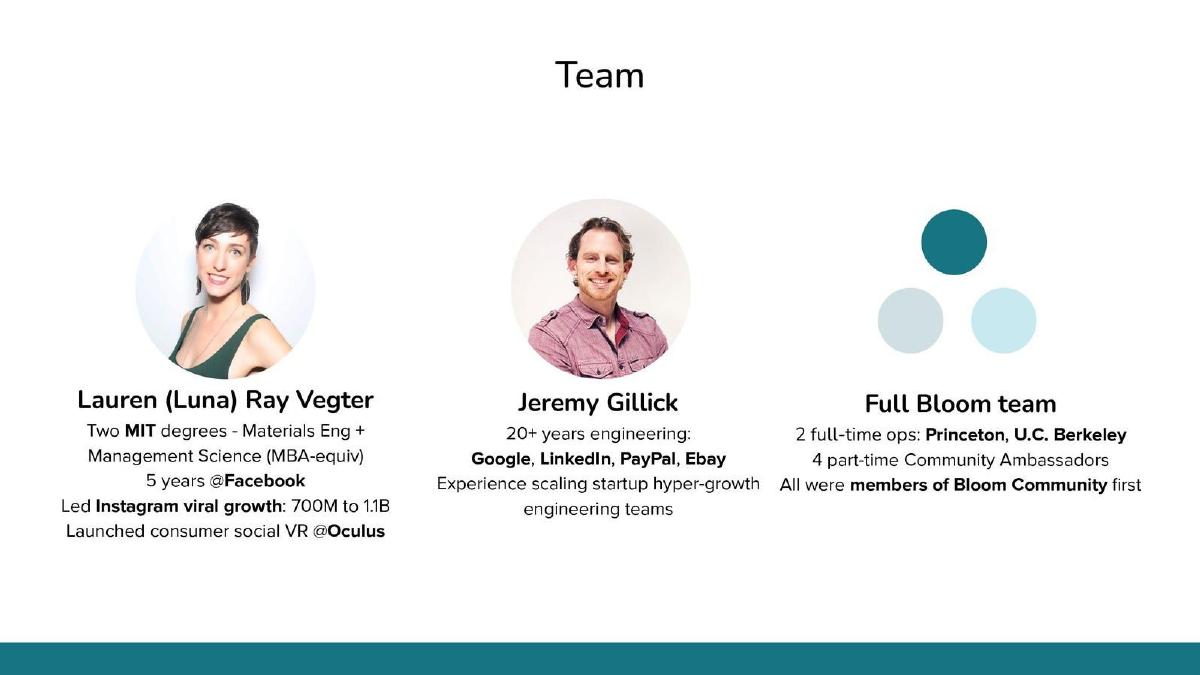
A community app. Two founders and the wider team, on one uncluttered slide.
Bloom Community deck, slide 2. Exact stored slide matched to this analysis.
Our analysis: Growth, engineering and buyer insight, one per column.
Evidence and limitation: Career claims as stated; not verified.
What a founder can adapt: If your team uses the product, say so in one line.
Supporting analysis
What the deck claims: Lauren (Luna) Ray Vegter: "Two MIT degrees", "5 years @Facebook", "Led Instagram viral growth: 700M to 1.1B", "Launched consumer social VR @Oculus." Jeremy Gillick: "20+ years engineering: Google, LinkedIn, PayPal, Ebay." "Full Bloom team: 2 full-time ops… 4 part-time Community Ambassadors… All were members of Bloom Community first."
Presentation choice: "All were members of Bloom Community first" is buyer insight in six words: the team are its own customers.
When it does not fit: Say what Lauren led at Instagram (the growth figure is the platform's, not hers alone) so an investor doesn't have to guess.
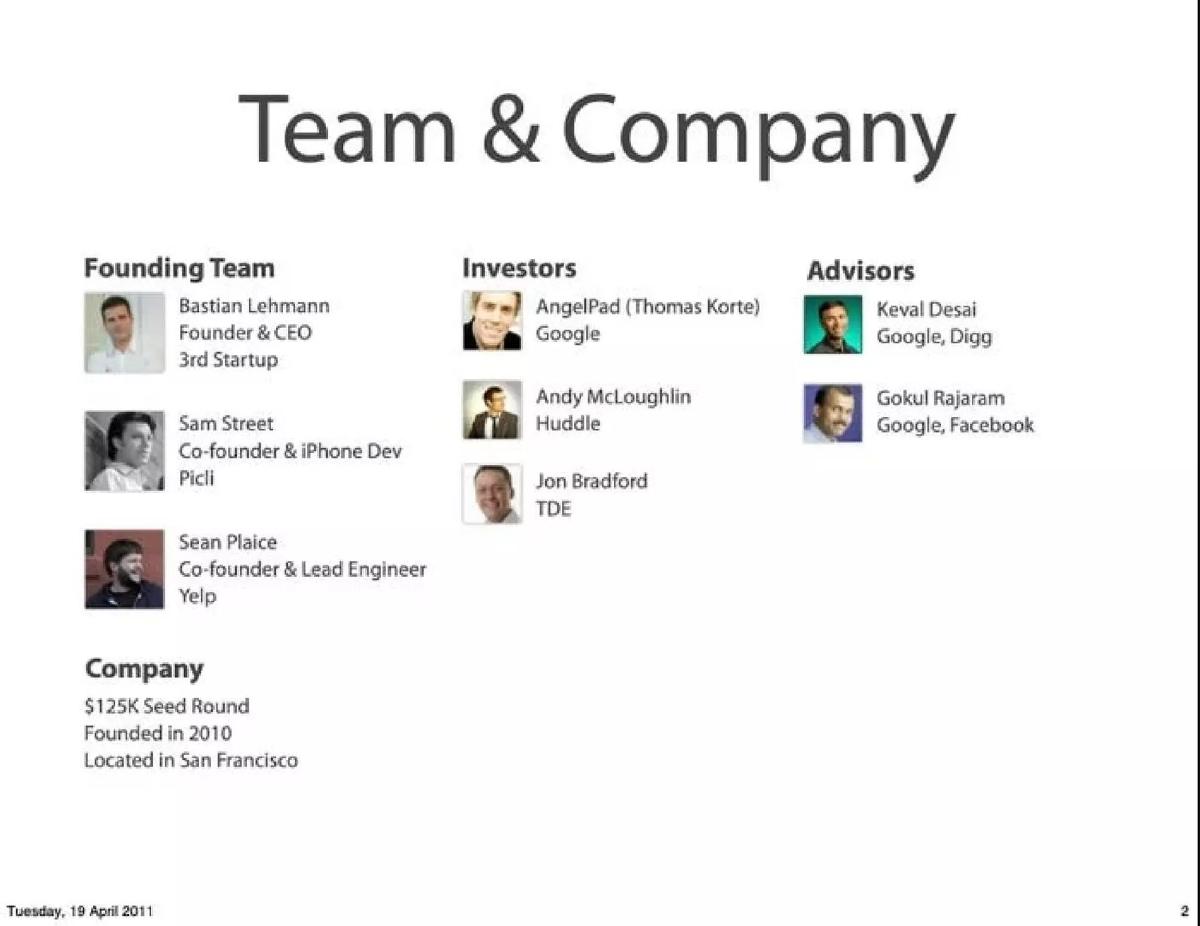
An early (2011) delivery deck. Founders, investors and advisors in three columns, with the company's key facts.
Postmates deck, slide 2. Exact stored slide matched to this analysis.
Our analysis: Three words per person ("3rd Startup", "iPhone Dev", "Lead Engineer, Yelp") are enough to show a team that has shipped consumer apps.
Evidence and limitation: A $125K seed round and names; no metrics.
What a founder can adapt: At seed, a short line per founder plus named backers and advisors can carry the slide.
Supporting analysis
What the deck claims: Founding team: Bastian Lehmann, "Founder & CEO, 3rd Startup"; Sam Street, "Co-founder & iPhone Dev, Picli"; Sean Plaice, "Co-founder & Lead Engineer, Yelp." Investors: AngelPad, Andy McLoughlin, Jon Bradford. Advisors: Keval Desai (Google, Digg), Gokul Rajaram (Google, Facebook). "$125K Seed Round, Founded in 2010, Located in San Francisco."
Presentation choice: It puts the team on slide 2 with the investors who already backed it, a strong signal at seed.
When it does not fit: Say who runs couriers and city operations, the hardest part of a delivery business.
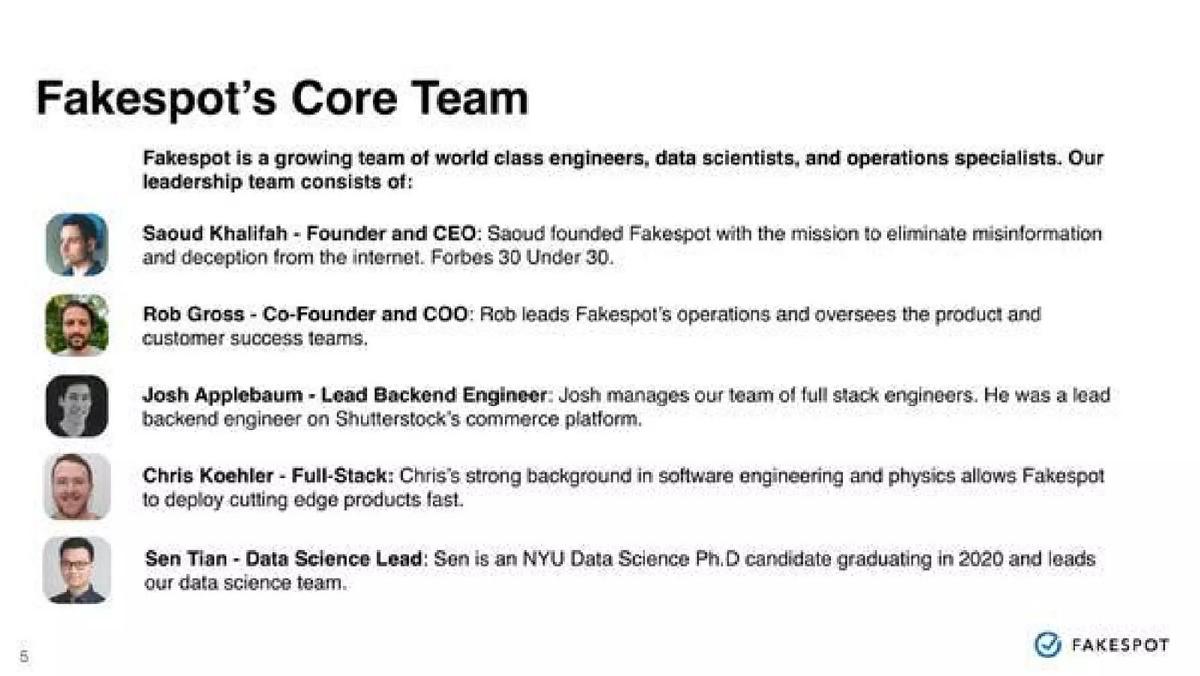
A browser tool that flags fake online reviews for shoppers. Five people, one sentence each.
Fakespot deck, slide 5. Exact stored slide matched to this analysis.
Our analysis: For a product that must spot fake reviews reliably, it leads with who builds the detection: engineering and data science.
Evidence and limitation: Forbes 30 Under 30 and prior roles as stated; no metrics.
What a founder can adapt: Write each line as "[name] runs [area]; before, [one proof]."
Supporting analysis
What the deck claims: "Fakespot is a growing team of world class engineers, data scientists, and operations specialists." "Saoud Khalifah - Founder and CEO: Saoud founded Fakespot with the mission to eliminate misinformation and deception from the internet. Forbes 30 Under 30." "Josh Applebaum - Lead Backend Engineer… a lead backend engineer on Shutterstock's commerce platform." "Sen Tian - Data Science Lead: … NYU Data Science Ph.D candidate."
Presentation choice: Each line names what the person runs at Fakespot, not just where they worked.
When it does not fit: Say how shoppers will find the tool. Nobody on the slide owns growth, and "world class" is an adjective, not proof.
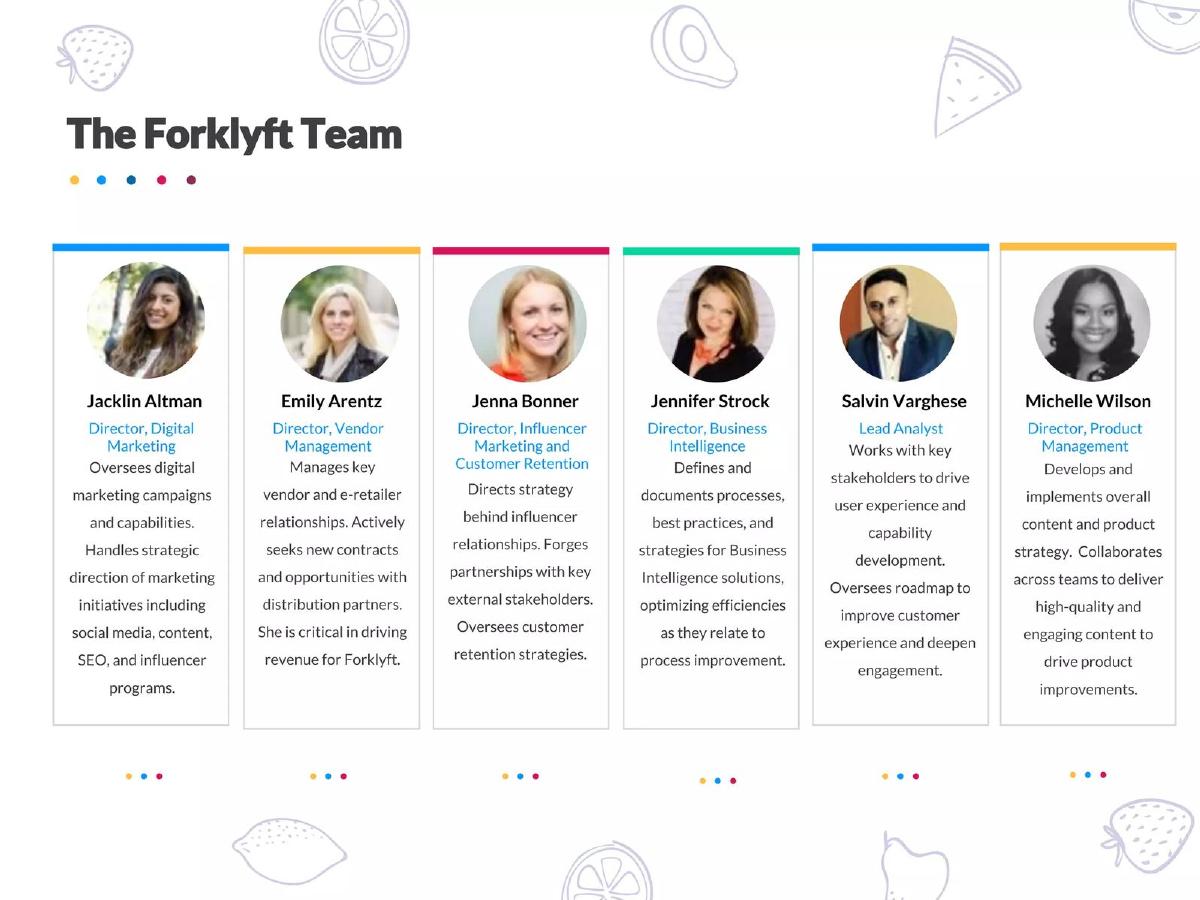
Shoppable recipes from food bloggers. A partial example: six directors, each with a job description.
Forklyft deck, slide 2. Exact stored slide matched to this analysis.
Our analysis: The roles fit the business (influencers, retailers, retention), but each line says what the person will do, not why they can do it.
Evidence and limitation: No prior roles, results or figures.
What a founder can adapt: Keep the role, and add one line of proof: a past company, a campaign result or a number.
Supporting analysis
What the deck claims: Jacklin Altman, "Director, Digital Marketing: Oversees digital marketing campaigns… social media, content, SEO, and influencer programs." Jenna Bonner, "Director, Influencer Marketing and Customer Retention." Emily Arentz, "Director, Vendor Management… She is critical in driving revenue for Forklyft." Also directors of business intelligence and product management, and a lead analyst.
Presentation choice: It shows the gap between a job description and proof: an investor learns the org chart, not the track record.
When it does not fit: Name the founder or CEO; the slide has six directors and no one leading.
Whether each slide shows reach to customers, the ability to build the product, and first-hand knowledge of the buyer.
Example
Reach
Build
Buyer insight
Arya
Yes (~2M followers, TV)
Yes (three exits)
Partly (intimacy expert)
Bumo
Yes (influencer counts)
Partly (head of product)
Yes (childcare executive)
Bloom Community
Partly (Instagram growth)
Yes (Google, Facebook)
Yes (team were members)
Postmates
No
Yes (Yelp, iPhone dev)
No
Fakespot
No
Yes (engineering, data)
Partly (founder mission)
Mivesta
Partly (advertising, sales)
Partly (outside developers)
Partly (a cook on the team)
Forklyft
Partly (influencer role)
No proof given
No
Ajinomatrix
No
No
No
Key Takeaways
Show reach: a following, a brand the founder built, or a growth record in consumer products.
Show who builds and ships the product, with one credential each.
Say why the team understands the buyer: they were customers, or served them for years.
One line per person, written as proof, not a CV.
Full names, photos and a clear founder label. First names and titles alone say nothing.
Build your consumer team slide
One line per person, each proving one part of the plan.
Reach. Who can get the product in front of customers cheaply? What number proves it?
Build. Who has built and shipped a consumer product before? Where, and with what result?
Buyer insight. Why does this team understand the customer? Were you customers, or did you serve them?
Gaps. Which of the three is missing, and who (hire or advisor) covers it?
Copyable framework: [Full name], [role]: [one result in reach, build or customer knowledge, with a number]. Repeat for each founder; advisors on a separate row.
Illustrative example 1 — written by us
Before: Sarah, CEO. Tom, CTO. Passionate team of creatives and engineers.
After: Sarah Kim, CEO: grew a skincare brand's Instagram to 400k followers. Tom Reyes, CTO: built the checkout used by 2 million shoppers at a fashion retailer. Both are customers: we started this after struggling to find sensitive-skin products.
What improved: Our illustrative rewrite; names and figures are invented for the example. Each line proves reach, build or buyer insight.
What this guide adds
The general team slide guide covers presenting founders in any business. In a consumer company the hardest problem is usually getting noticed by customers at an affordable cost, so investors read a consumer team slide for reach and taste as much as for engineering credentials. This guide compares how consumer decks show that.
Forklyft also appears in the consumer problem and consumer solution guides, so you can read its problem, solution and team slides side by side.
Three things a consumer team slide proves
Reach: someone can get the product in front of customers cheaply (Arya, Bumo, Bloom Community).
Build: someone has built and shipped consumer products before (Arya, Bloom Community, Postmates, Fakespot).
Buyer insight: the team knows the customer first-hand (Bloom Community, Bumo).
Strong slides cover all three. Most real slides cover one or two.
Common mistakes
No one owns reach. Consumer investors ask how customers will find you; the team slide should hint at the answer.
Job descriptions instead of proof. Say what each person has done, not only what they will do.
First names or titles only. Use full names and photos so investors can look people up.
Adjectives in the headline. "World class" and "creative & smart" prove nothing; a result does.
Advisors mixed with founders. Label advisors and put them on their own row.
Diagnostic checklist
Every founder has a full name, photo and role.
Someone on the slide can reach customers, with a number.
Someone has built and shipped a consumer product before.
One line says why the team understands the buyer.
Advisors are labelled and kept separate from founders.
Frequently asked questions
How we chose these examples
Corpus: published pitch deck teardowns on StartupFundraising.com. Founder-uploaded private decks are excluded.
Selection (2026-09-25): we searched extracted text of slides 2–6 for team and founder slides in decks whose recorded sector is consumer, food and beverage, fashion, beauty, pets, travel, fitness, social or e-commerce. About thirty candidates were read; business-facing, investment-highlight and logo-only slides were set aside. Two otherwise strong candidates (Modzify and Vintage Wine Estates) were set aside because the slides are marked confidential. Ajinomatrix is kept as a weaker contrast.
Overlap check: none of these eight slides appears in another guide. Forklyft appears in the consumer problem and consumer solution guides with different slides.
Review: all eight stored slide images were inspected on 2026-09-25 and matched to company, deck and slide number (editorial model review). No person has yet completed an editorial review of this page.
Claims are as shown on the slides; we have not verified them. We make no claim that any slide caused a fundraising outcome.