Mivesta is a social collaboration platform targeting the 'online foodie' market by enabling users to cook along with friends or professional chefs via interactive video. The deck, dated 2011, outlines a transition from a $75,000 founder-funded pre-beta stage to a $20,000 early rollout supported by the Miami Innovation Fund. The product aims to move beyond static social updates to 'real life' activity-based connections. While the deck identifies a large addressable market—citing that 81% of US adults enjoy cooking at home—it lacks a specific financial model or revenue projections. The team is…
Key takeaways
- The platform is described as a social collaboration portal for sharing experiences in real time, specifically interactive video 'meet-ups' for cooking (Slide 4).
- The team consists of five individuals, including a 'Visionary Cofounder' who is a UF Senior in Advertising and a 'Make it Happen CoFounder' with an MBA (Slide 3).
- Market data cites FoodBuzz as a primary competitor with 14.0 million users, followed by FoodNetwork at 7.8 million (Slide 5).
- The company identifies its specific target audience as Miami foodies, active on social networks, aged 20-55, with middle income or higher (Slide 5).
- Historical funding includes $75,000 in founder capital and $15,000+ from friends and family (Slide 8).
- The deck mentions a $20,000 investment from the Miami Innovation Fund for the early rollout stage between July and October 2011 (Slide 8).
- The exit strategy includes an ambitious goal of an IPO within five years post-angel investment, followed by VC funding (Slide 9).
- The competitive matrix claims Mivesta is the only player offering the full suite of written recipes, user video libraries, pro videos, social sharing, live streaming, and interactive video streams (Slide 6).
Executive Summary and Mission
Slide 1: Title Slide
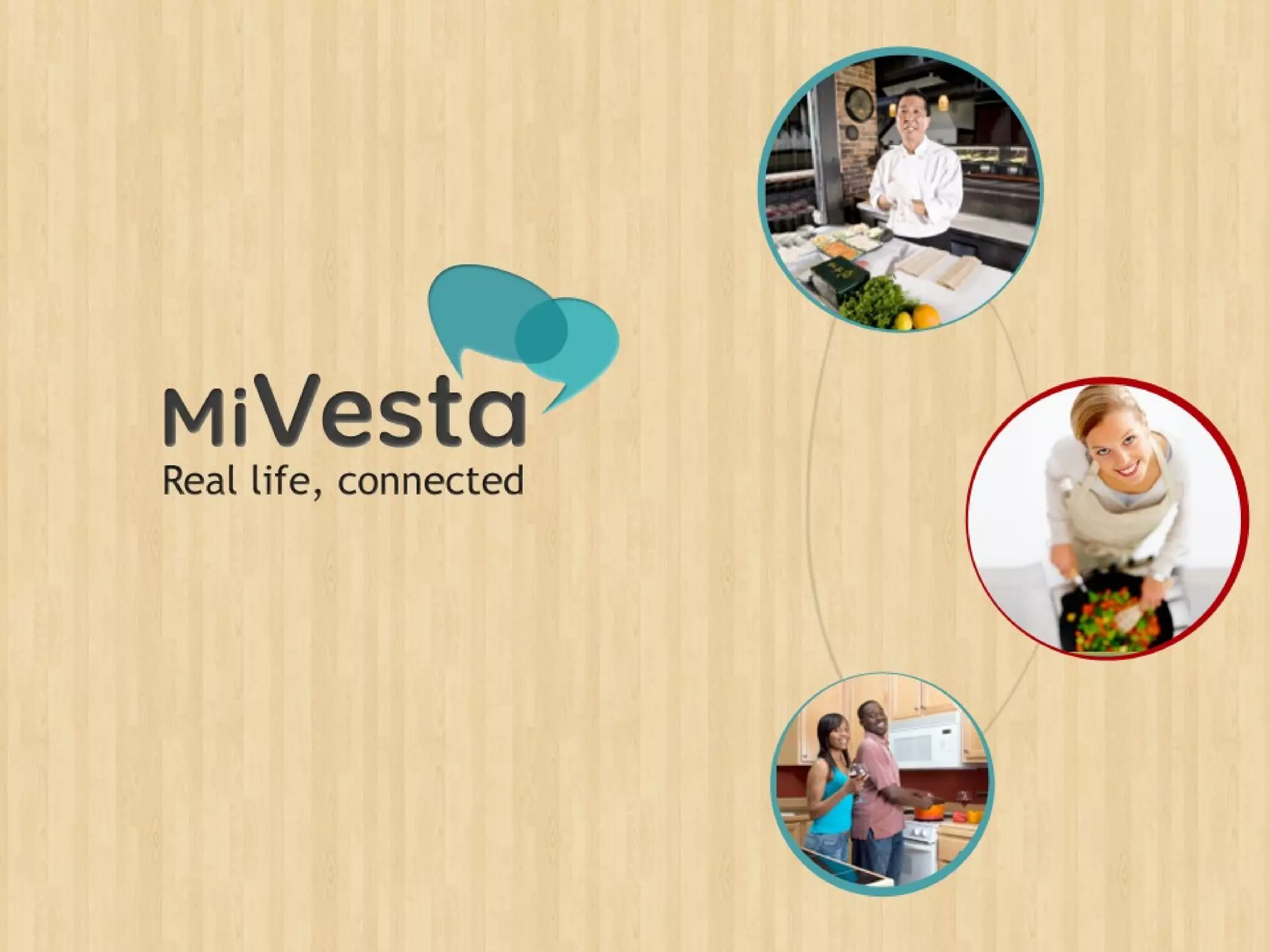
The title slide introduces the company name, MiVesta, accompanied by the tagline 'Real life, connected.' The visual branding features a speech bubble logo in two shades of teal. To the right, three circular images depict people engaged in cooking activities: a professional chef in a kitchen, a woman preparing vegetables, and a couple cooking together in a home kitchen. The background is a light wood grain texture.
Slide 2: Mission Statement
This slide formalizes the company's purpose through three bullet points. It states that Mivesta connects people to 'the things they love and the people who love to do them.' It emphasizes creating an environment for sharing past experiences and creating new ones, ultimately concluding that they 'facilitate the human connection.' The imagery from the title slide is repeated on the right margin.
The Team and Product
Slide 3: Team Mivesta: Creative & Smart
The team slide introduces five key members. Richard Velasquez is listed as the 'Visionary Cofounder,' a UF Senior in Advertising with sales experience. Andrea Fuentes is the 'Make it Happen CoFounder,' described as a business generalist, cook, artist, and educator with an MBA and prior startup experience. Roberto Andrade & Greg Bachrach are the developers from Synthovation Tech Partners (equity-based), bringing 17 and 22 years of experience respectively in IT infrastructure. Amanda Sanchez serves as Art Director with 7+ years of experience in online, offline, and mobile media. Amy Jhie Zhao is a System Analyst/Intern with 5 years of experience in development and testing. The slide is copyrighted 2011.
Slide 4: Product Service Offering
This slide provides a visual mockup of the platform and lists three core value propositions. The mockup shows a 'Cook along' interface with a primary video feed and smaller participant windows, a chat box, and a recipe section. The text highlights: 1. A social collaboration portal for real-time experience sharing. 3. Interactive video 'meet-ups' to cook with friends or pro chefs. 5. Inspiration to 'DO things together' rather than just posting updates. A note at the bottom right indicates the 'Application in progress.'
Market Opportunity and Competition
Slide 5: Market for Cooking, Connected
Mivesta quantifies the market opportunity using data from Quantcast 2010, CNN-app downloads, and Harris Poll. A table lists 'Online Foodies' by service: FoodBuzz (14.0M users), FoodNetwork (7.8M users), Allrecipes.com (7.3M users), Food.com (4.8M users), Epicurious (1.1M apps, 1.5M users), and Big Oven (2.0M apps, 0.5M users). The slide notes that 81% of US adults enjoy cooking at home and 15% watch cooking TV 'very often.' The specific target market is defined as Miami foodies, active on social networks, aged 20-55, with middle income or higher.
Slide 6: Competition
A competitive matrix compares Mivesta against Food Network, AllRecipes & FoodBuzz, SocialEyez & Stickam, and Ustream & YouTube. The matrix tracks six features: Written recipes/photos, User video library, Educational Chef/Pro videos, Social sharing/commentary, Live video streaming events, and Interactive Video streams. Mivesta is the only entity checked for all six categories. The slide also mentions Bakespace.com and Justin.tv as other startups in the related space.
Slide 7: Competitive Advantages
This slide lists three qualitative advantages: being an early entrant in the 'Alive Web' (activity-based), targeting a 'sticky niche ripe for disruption,' and providing an advantage for sponsors to engage fans and create content. The visual element is a photo of gingerbread men, reinforcing the culinary theme.
Financials and Exit Strategy
Slide 8: Use of Proceeds
This slide provides a breakdown of funding stages and planned expenditures. Pre-Beta: $75,000 in Founder Capital was used for startup costs and building the MVP. Stage 1 (Pre-Launch Beta): $15,000+ from Friends & Family through July 2011 was allocated for IT infrastructure, load testing, promotion, and completing the MVP. Stage 2 (Early Rollout July-Oct 2011): $20,000 from the Miami Innovation Fund was designated for ramping up infrastructure, Android optimization, and growth support. The slide concludes that 'Angel investment will be to hire key team members, and to build the iOS apps.'
Slide 9: Exit Strategy
The exit strategy slide outlines three paths. First, horizontal expansion into fitness and other areas. Second, an IPO within five years post-angel investment, followed by VC funding. Third, a strategic acquisition by a 'major food network or recipe site.' It also notes that founders may continue in their roles or retire.
Slide 10: Questions & Answers
The final slide is a standard Q&A placeholder featuring a plate of colorful macarons. No contact information or specific call to action is visible on this slide.
Analysis of the Mivesta Pitch Deck
The Mivesta pitch deck is a product of its time, reflecting the early 2010s focus on 'social' and 'real-time' web applications. It successfully identifies a massive, engaged audience—home cooks—and attempts to bridge the gap between static recipe sites and live video interaction. The deck is structured logically, moving from mission to team, product, market, and finally, the financial ask.
What works: The competitive matrix (Slide 6) is a strong visual tool that clearly differentiates Mivesta from established players like Food Network by highlighting the lack of interactive video streams in the existing market. The inclusion of specific user numbers for competitors (Slide 5) gives investors a sense of the potential scale, even if Mivesta only captures a small percentage of the 'foodie' market. The 'Use of Proceeds' (Slide 8) is also notably transparent, showing exactly how much skin the founders have in the game ($75,000) and how they have utilized small amounts of capital to reach the MVP stage.
What is missing: The most significant omission is a business model. While the deck mentions 'sponsors' on Slide 7, there is no explanation of how the company intends to generate revenue. Is it a subscription model, ad-supported, or a marketplace for professional chef classes? Without this, the 'IPO within 5 years' claim on Slide 9 feels speculative. Additionally, the team slide (Slide 3) lists an intern as a key team member, which may signal a lack of senior depth to some investors. There is also no mention of user traction or beta test results, despite the 'Stage 1' pre-launch beta being mentioned as completed or underway.
Founder Takeaways: Founders should emulate the clear breakdown of historical funding seen on Slide 8. Showing that you have successfully reached milestones with limited capital (like the $20,000 from the Miami Innovation Fund) builds credibility. However, founders should avoid the 'IPO in 5 years' exit strategy unless they have the revenue growth to back it up; most early-stage investors prefer to see a list of potential acquirers and why those companies would find the technology or user base valuable. Finally, always include a slide detailing the revenue model—investors need to know how their capital will eventually turn into a profit.
Frequently asked questions
- What is the primary problem Mivesta aims to solve?
- According to Slide 4, Mivesta aims to move social interaction beyond just 'updating or tweeting stuff.' The platform seeks to facilitate 'human connection' by allowing people to do things together in real time, specifically focusing on the shared activity of cooking through a social collaboration portal.
- How much capital has the company raised prior to this deck?
- Slide 8 details the 'Use of Proceeds' and historical funding. The founders contributed $75,000 in capital (excluding sweat equity). An additional $15,000+ was raised from friends and family through July 2011, and $20,000 was secured from the Miami Innovation Fund for the stage 2 rollout.
- What are the key technical milestones mentioned in the deck?
- The deck outlines several technical goals on Slide 8, including building the MVP, setting up IT infrastructure, load testing, and optimizing for Android. A primary goal for the requested angel investment is to build the iOS applications, as the application was 'in progress' at the time of the deck (Slide 4).
- Who are the main competitors identified by Mivesta?
- Slide 5 and 6 list several competitors in the cooking and video space. These include FoodBuzz, FoodNetwork, Allrecipes.com, Food.com, Epicurious, and Big Oven. The deck also mentions SocialEyez, Stickam, Ustream, YouTube, Bakespace.com, and Justin.tv as related startups or platforms in the space.
- What is the proposed exit strategy for investors?
- Slide 9 outlines three potential outcomes: expanding outside of cooking into fitness and other areas, an IPO within five years of angel investment followed by VC funding, or a strategic acquisition by a 'major food network or recipe site.' The slide also notes that founders might continue in product development or retire.