MoBagel raised $20.5 million in 2015 with a deck that prioritizes market pain and validated demand over technical jargon. The presentation identifies a specific $8,000,000 loss in product returns for hardware manufacturers (Slide 5) and positions their 'Google Analytics for IoT' as the solution. The deck's strength lies in its transparency regarding sales; it explicitly names a $4.8M three-year contract with a top-tier Asian vacuum manufacturer (Slide 9) and a $19M pipeline including Panasonic (Slide 12). While the deck lacks a formal 'Ask' slide or detailed unit economics, the sheer scale of…
Key takeaways
- The deck uses a clear analogy, 'Google Analytics for the Internet of Things', to instantly define a complex product (Slide 1).
- It quantifies the cost of the problem specifically, citing $8,000,000 wasted in product returns (Slide 5).
- MoBagel demonstrates speed to value, claiming a 2-week implementation period for their cloud solution (Slide 7).
- The presentation features a massive anchor tenant: a $4.8M 3-year contract with an unnamed top-tier Asian vacuum manufacturer (Slide 9).
- Market size is framed through device volume, projecting 50.1 billion smart devices by 2020 (Slide 10).
- Traction is further validated by a $19 million sales pipeline featuring logos like Panasonic and TAITRA (Slide 12).
- The team slide uses logo associations with Salesforce, Stanford, and NVIDIA to build technical credibility (Slide 13).
- The deck omits a specific funding ask, valuation, or breakdown of how the $20.5M would be spent.
Introduction: The Power of High-Signal Traction
MoBagel’s 2015 Series A pitch deck is a study in brevity and high-impact messaging. In just 14 slides, the company managed to secure $20.5 million by focusing on a massive, unaddressed pain point in the hardware industry: the lack of actionable data. By framing their solution as the 'Google Analytics for IoT,' they leveraged a familiar mental model to explain a complex AI-driven backend. The deck relies heavily on large-scale financial figures and recognizable corporate logos to build a narrative of inevitable growth.
The Hook and the Problem (Slides 1-5)
Slide 1 opens with a strong tagline: "Google Analytics for the Internet of Things." This is a classic 'X for Y' pitch that immediately tells the investor what the product does without requiring a deep dive into the technology. The visual of interconnected devices reinforces the sector focus.
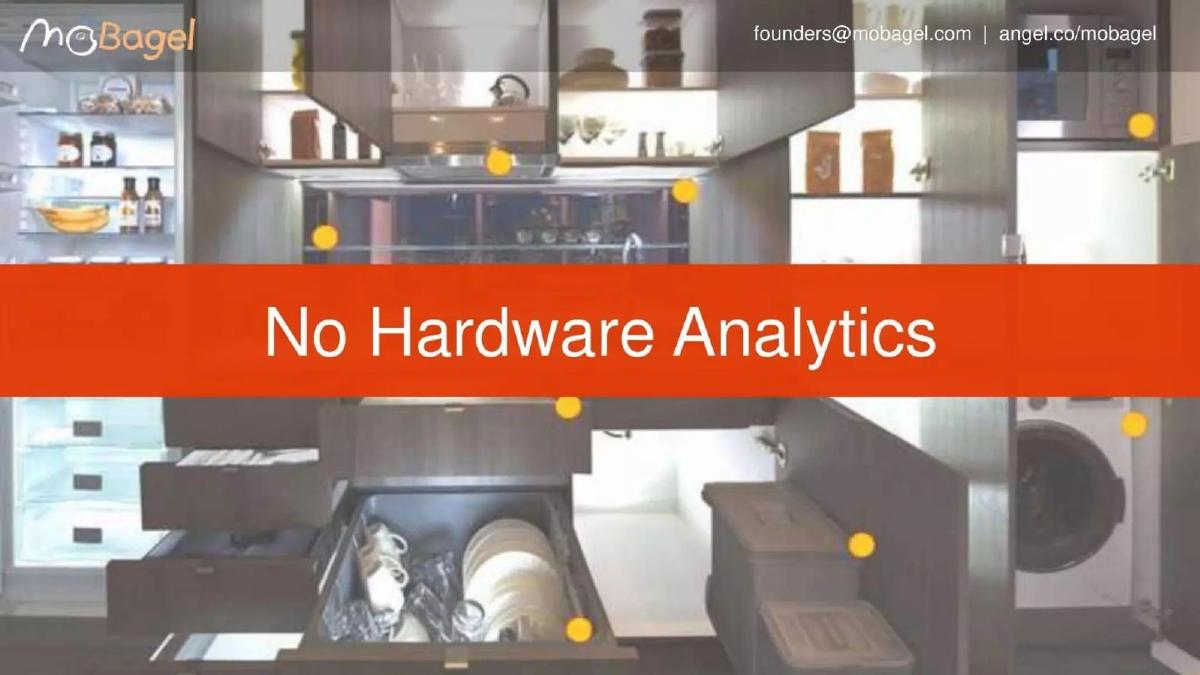
Slide 2 establishes the philosophy that "Analytics Drive Decisions," showing a hand interacting with a tablet displaying growth charts. This transition leads directly into the problem statement on Slide 3 : "No Hardware Analytics." The background image of a modern kitchen with yellow dots suggests a multitude of 'dumb' appliances that aren't reporting data.
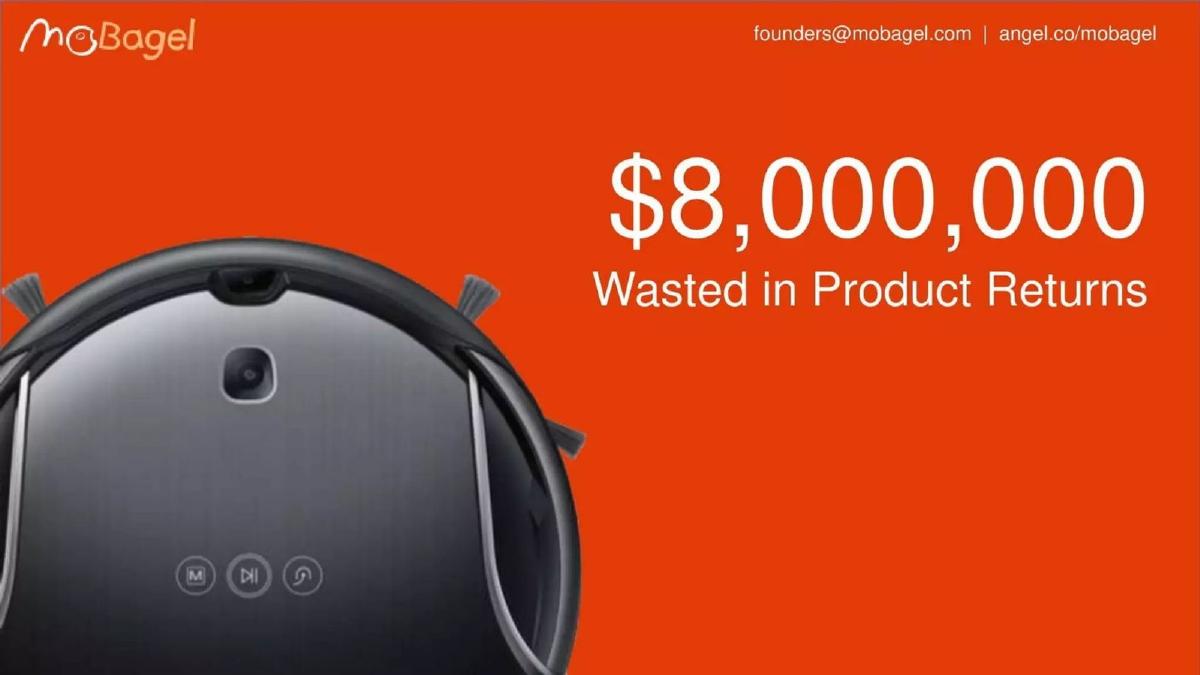
Slide 4 uses humor and shock value—a cat being vacuumed—with the caption "Really?!!" to highlight the absurdity of how hardware is currently used or misused without data. This leads to the first major metric on Slide 5 : "$8,000,000 Wasted in Product Returns." By attaching a specific dollar amount to the problem, MoBagel moves the conversation from a technical 'nice-to-have' to a financial 'must-have.'
The Solution and Implementation (Slides 6-8)
Slide 6 visualizes the 'broken' state of current IoT, showing a cracked cloud icon disconnected from devices across a world map. Slide 7 introduces the MoBagel solution, showing the devices now connected to the MoBagel cloud. The key metric here is "2 Weeks," which promises investors and customers a rapid deployment cycle, a significant competitive advantage in the often slow-moving world of enterprise hardware.
Slide 8 showcases the product's utility with a "Real-time Customer Service" map. The map displays heat zones over the San Francisco Bay Area (Palo Alto, Mountain View, Sunnyvale) with specific numbers like 4013 and 3192 . This slide demonstrates that the platform isn't just for internal data scientists; it has a functional application for customer support teams to identify and resolve issues geographically.
Traction and Market Opportunity (Slides 9-12)
Slide 9 is the 'money slide.' It features a large image of a robotic vacuum and the text: "$4.8M 3-year contract with a top-tier Asian vacuum manufacturer." This provides concrete proof of product-market fit. It shows that a major player is willing to pay millions for this specific analytics solution.
Slide 10 addresses the Total Addressable Market (TAM) with a bold projection: "50.1 Billion Smart devices by 2020." This frames the $4.8M contract as just the tip of the iceberg. Slide 11 returns to the human element, showing a frustrated user next to a washing machine with the caption "Improved Customer Service," implying that MoBagel solves this emotional and operational friction.
Slide 12 reinforces the traction narrative by stating there is "$19 Million In pipeline." The inclusion of the Panasonic logo, alongside ARING and TAITRA , gives the pipeline credibility. For a Series A investor, seeing a pipeline that is nearly 4x the size of their largest current contract is a strong indicator of scaling potential.
Team and Conclusion (Slides 13-14)
Slide 13 introduces the founders: Adms Chung (CEO), Ken Lin (CTO), and Iru Wang (VP US). Rather than listing long biographies, the slide uses logos to communicate their background. The presence of Salesforce, Stanford, NVIDIA, and Chunghwa Telecom suggests a team that has both the academic rigor and the industry experience to execute on a global scale. The photo of the team in MoBagel t-shirts gives a sense of company culture and unity.
Slide 14 serves as the contact slide, but it also functions as a summary, repeating the two most important figures from the deck: the "$4.8M Contract" and the "$19M Pipeline." This ensures that the final impression left on the investor is one of financial momentum.
What Works in the MoBagel Deck
The Analogy: Comparing themselves to Google Analytics immediately clarifies their business model and value prop. · Quantified Pain: Stating that $8 million is wasted on returns makes the problem urgent and expensive. · Anchor Traction: The $4.8M contract is a massive signal for a 2015-era Series A company. It proves that their 'no-code AI' isn't just a prototype. · Speed to Value: Highlighting a 2-week implementation time addresses the biggest fear in enterprise software sales: long, failed integration periods.
What is Missing from the MoBagel Deck
The Ask: The deck never specifies how much money they are raising or what they plan to do with it. While the catalogue facts state they raised $20.5M, the deck itself is silent on the terms. · Competition: There is no mention of other IoT platforms (like AWS IoT or GE Predix) that were emerging at the time. · Unit Economics: There is no data on the cost to acquire these large contracts or the margins on the $4.8M deal. · Product Depth: The deck is very 'high-level.' It doesn't show the actual dashboard or explain how the 'no-code AI' works for a data scientist versus a business stakeholder.
What a Founder Should Copy
Use a 'Money Slide': If you have a large contract, give it its own slide with a large font. Don't bury your best news in a bullet point. · Visual Problem Statements: Use images that evoke the frustration of your target customer. The 'cat and vacuum' and 'frustrated laundry man' slides are memorable and humanize a technical product. · Pipeline Transparency: If you are in the enterprise space, showing a dollar-valued pipeline with recognizable logos is the fastest way to build investor confidence. · Pedigree by Association: If your team doesn't have a long history of exits, use the logos of the prestigious companies and universities they have touched to build 'borrowed' authority.
Frequently asked questions
- What is the primary value proposition of MoBagel according to the deck?
- MoBagel positions itself as 'Google Analytics for the Internet of Things.' The deck argues that hardware manufacturers currently lack data-driven insights, leading to massive financial losses. By providing real-time analytics and customer service tools, MoBagel helps companies reduce product returns and improve user satisfaction through a cloud-based platform that can be deployed in just two weeks.
- How does MoBagel quantify the market problem?
- The deck uses a specific, high-stakes example on Slide 5, stating that $8,000,000 is 'Wasted in Product Returns.' It further illustrates this on Slide 6 with a 'broken cloud' icon over a map of hardware devices, suggesting that without their analytics, manufacturers are flying blind, resulting in the frustration shown on Slide 11.
- What evidence of traction does the deck provide?
- Traction is the core of this deck. Slide 9 highlights a $4.8M three-year contract with a 'top-tier Asian vacuum manufacturer.' Slide 12 expands on this by showing a $19 million pipeline, explicitly naming Panasonic, ARING, and TAITRA as part of their business development efforts. This combination of closed revenue and a large pipeline is a strong signal for Series A investors.
- Who are the founders and what is their background?
- The leadership team consists of Adms Chung (CEO), Ken Lin (CTO), and Iru Wang (VP US). While their individual bios aren't detailed in text, Slide 13 uses corporate and academic logos to establish pedigree. These include Salesforce, Stanford University, NVIDIA, and Chunghwa Telecom, suggesting a mix of high-level enterprise software experience and technical research backgrounds.
- What critical fundraising information is missing from the slides?
- The deck is notably missing a 'The Ask' slide. There is no mention of how much capital they are seeking, the intended use of funds, or their current valuation. Additionally, the deck lacks a detailed competitor analysis, a roadmap for future product features, and specific unit economics like Customer Acquisition Cost (CAC) or Lifetime Value (LTV).