Matia’s 11-slide deck, which secured a $10.5M Seed round in 2024, centers on the thesis that the modern data stack is overly fragmented and inefficient. By positioning themselves as a 'Unified DataOps Platform,' Matia aims to replace or consolidate tools across ingestion, reverse ETL, and observability. The deck relies heavily on macro-economic pain points, such as the $3.1 trillion lost annually in the U.S. due to poor data quality, and the operational burden of managing dozens of disparate tools. While the deck is light on specific product screenshots or financial projections, it leans into…
Key takeaways
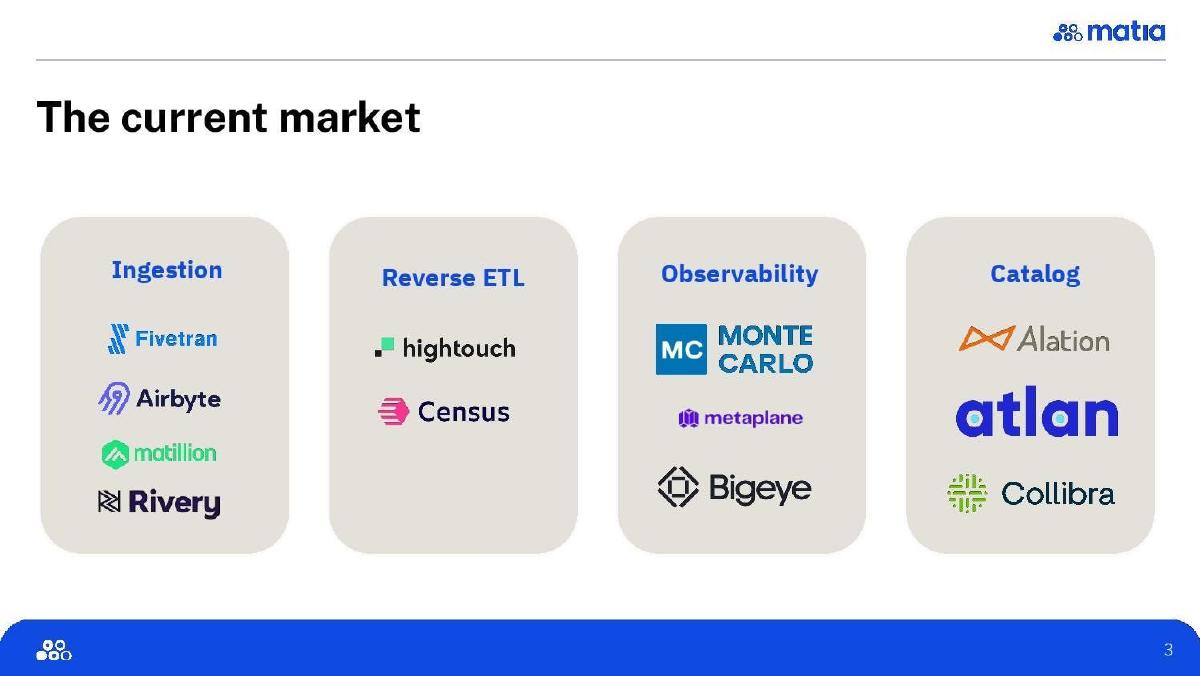
- Matia identifies a fragmented market across four key pillars: Ingestion, Reverse ETL, Observability, and Catalog (Slide 3).
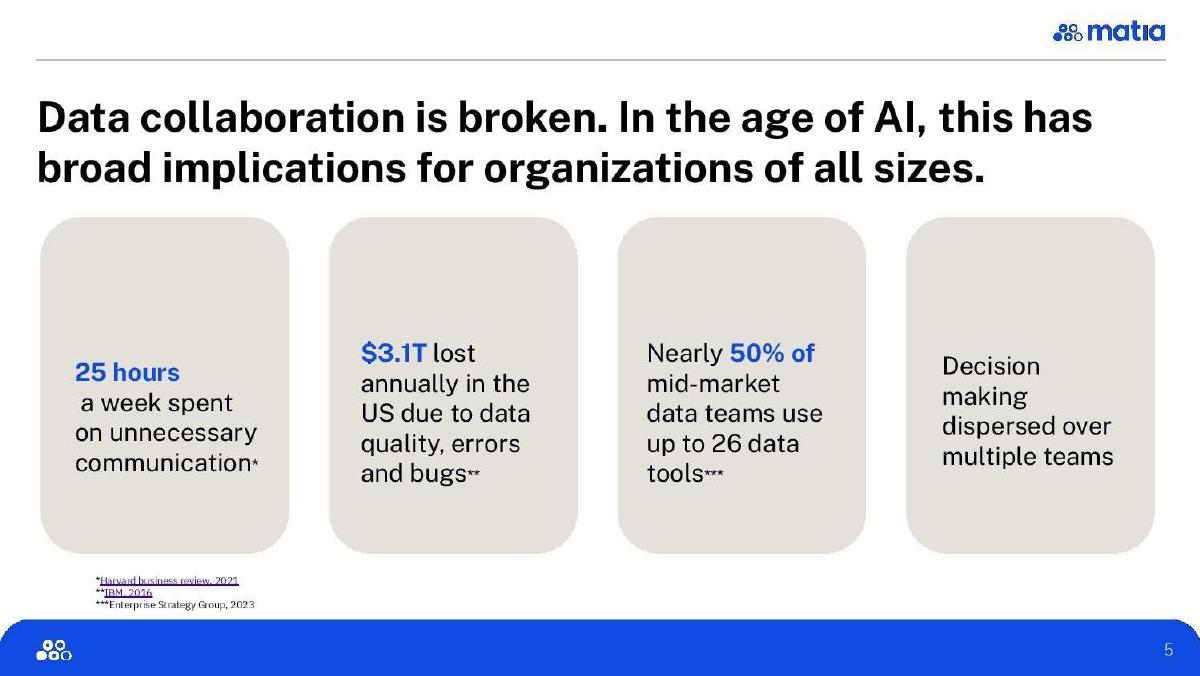
- The company cites a Harvard Business Review study stating that 25 hours a week are spent on unnecessary communication due to broken data collaboration (Slide 5).
- Poor data quality, errors, and bugs cost the U.S. economy an estimated $3.1 trillion annually (Slide 5).
- Nearly 50% of mid-market data teams are currently forced to use up to 26 different data tools (Slide 5).
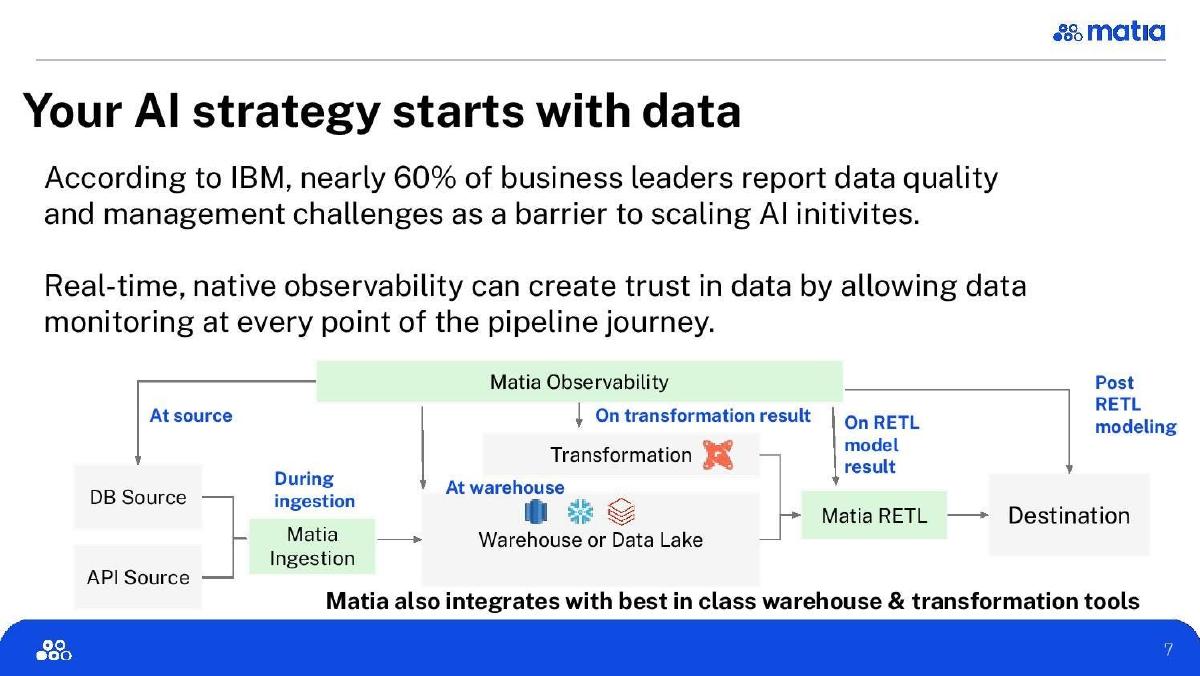
- The platform architecture integrates observability at every stage: source, ingestion, warehouse, and post-RETL modeling (Slide 7).
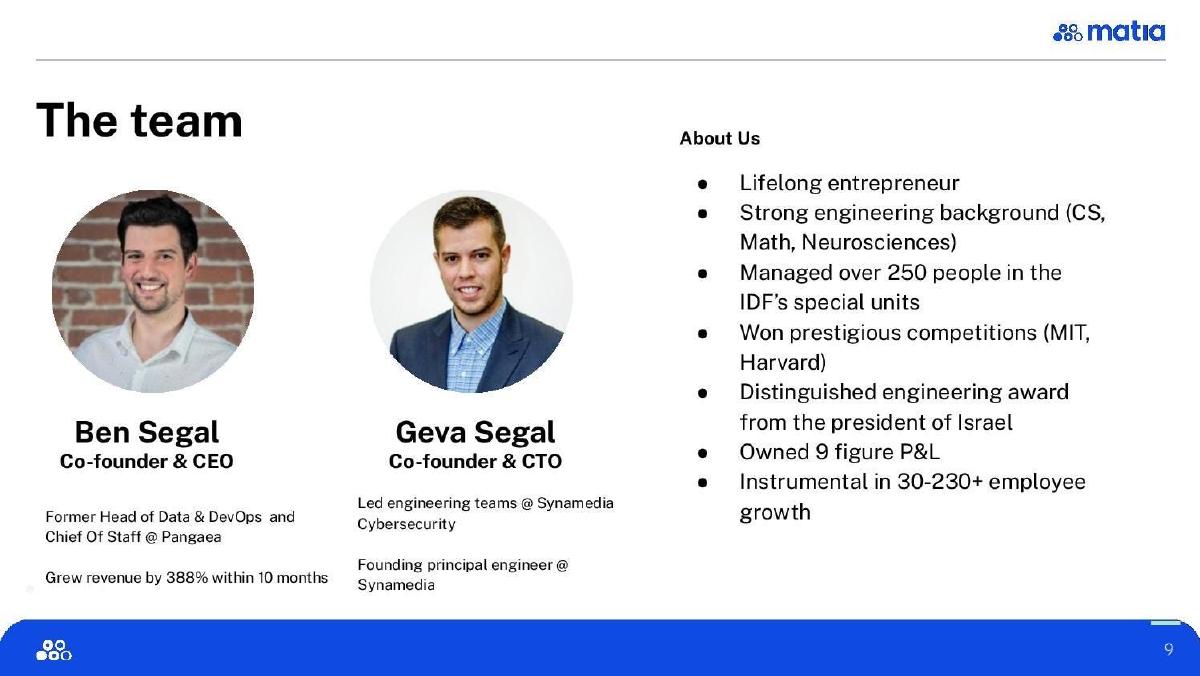
- CEO Ben Segal previously grew revenue by 388% within 10 months in a former role (Slide 9).
- CTO Geva Segal brings experience managing over 250 people in the IDF's special units and a background in CS, Math, and Neurosciences (Slide 9).
- The deck emphasizes that 60% of business leaders see data quality as a primary barrier to scaling AI initiatives (Slide 7).
The Unified DataOps Thesis
Matia’s pitch deck is a masterclass in the 'unification' narrative. In the enterprise software world, markets often swing between best-of-breed point solutions and all-in-one platforms. Matia is betting that the data management sector has become so fragmented that the pendulum is swinging back toward a unified platform. As reported by Business Insider, the company successfully raised $10.5M in a 2024 Seed round to build this vision in Miami.
Slide 1-2: Branding and Identity
The deck opens with a minimalist aesthetic. Slide 1 introduces the company name and the tagline: 'The Unified DataOps Platform.' This immediately tells the investor two things: the category (DataOps) and the unique value proposition (Unified). Slide 2 is a repeat of the brand name, serving as a transition into the market analysis.
Slide 3: Mapping the Fragmented Market
This is one of the most critical slides in the deck. It categorizes the current landscape into four silos: Ingestion (Fivetran, Airbyte, Matillion, Rivery), Reverse ETL (Hightouch, Census), Observability (Monte Carlo, Metaplane, Bigeye), and Catalog (Alation, Atlan, Collibra). By listing these established, well-funded competitors, Matia isn't just showing who they compete with; they are showing the 'tool sprawl' that their potential customers face. The implication is that a customer currently needs four different vendors to do what Matia intends to do in one.
Slide 5: The Cost of Fragmentation
Matia uses Slide 5 to quantify the pain. They cite three major data points to build urgency. First, they quote Harvard Business Review to note that 25 hours a week are spent on 'unnecessary communication,' likely referring to the back-and-forth between data engineers and analysts when pipelines break. Second, they cite IBM's figure of $3.1 trillion lost annually in the U.S. due to poor data quality. Finally, they highlight a stat from Enterprise Strategy Group: nearly 50% of mid-market data teams use up to 26 data tools. This slide effectively moves the conversation from 'we have a cool tool' to 'we are solving a trillion-dollar efficiency problem.'
Slide 7: The Architecture of Trust
Slide 7 bridges the gap between the problem and the solution. It introduces the concept that an AI strategy is only as good as the underlying data. The slide features a technical diagram showing 'Matia Observability' as a horizontal layer that sits across the entire pipeline. It monitors data 'At source,' 'During ingestion,' 'At warehouse,' 'On transformation result,' and 'On RETL model result.' This visualizes the 'Unified' part of their pitch, showing that by owning the ingestion and RETL (Reverse ETL) layers, they can provide 'native' observability that third-party tools cannot match.
Slide 9: The Execution Team
For a Seed round, the team slide is often the most important. Matia presents two co-founders, Ben Segal and Geva Segal. The credentials listed are high-signal: experience in IDF special units, awards from the President of Israel, and academic success at MIT and Harvard. Crucially, they include business metrics: Ben Segal is credited with growing revenue by 388% in 10 months and owning a '9 figure P&L.' This suggests that the founders aren't just technical experts, but also understand the commercial side of scaling a SaaS business.
Slide 11: The Conclusion
The deck ends simply with a 'Thank You' and the company's URL. There is no explicit 'Ask' slide in this version of the deck, which is common in decks released to the public after a round has closed. However, the narrative arc from 'market chaos' to 'unified solution' to 'elite team' is complete.
What Matia Does Well
Clarity of Category: Matia doesn't try to invent a new word. They take the existing 'DataOps' category and add a modifier ('Unified') that describes their specific approach. This makes it easy for investors to bucket them while understanding their differentiator.
Third-Party Validation: The deck is heavy on external citations (IBM, HBR, Enterprise Strategy Group). For a Seed stage company that may not have years of internal case studies, leveraging the authority of major research firms to prove the market pain is a smart move.
Visualizing the 'Why Now': By linking their data management platform to the 'Age of AI' on Slide 5 and Slide 7, they tap into the current investment climate. They aren't just a data tool; they are the infrastructure required for the AI revolution to actually work in a corporate setting.
What is Missing from the Deck
Product Screenshots: While the architecture diagram on Slide 7 is helpful, the deck lacks actual visuals of the platform interface. Investors often want to see how 'collaborative' the platform actually feels, especially since 'broken collaboration' was a primary pain point mentioned on Slide 5.
Business Model and Unit Economics: There is no mention of how Matia charges (e.g., seat-based, consumption-based, or volume-based). In the data world, pricing is a major point of friction, and showing a more customer-friendly model could have been a strong selling point.
Traction and Roadmap: The deck is very high-level. It doesn't list current design partners, beta users, or a timeline for when specific modules (like the Catalog mentioned in the market slide) will be released. For a $10.5M round, one would expect a more detailed roadmap of how that capital will be deployed over the next 18-24 months.
Founder Lessons
Sell the Consolidation: If you are entering a crowded market, don't just be 'better.' Be 'simpler.' Matia’s strongest argument is that 26 tools are too many. If your startup can replace three or four existing line items in a budget, that is a very compelling pitch in a 'do more with less' economy.
Quantify the 'Soft' Problems: 'Communication is broken' is a soft problem. '25 hours a week spent on unnecessary communication' is a hard problem. Whenever possible, find a study or a metric that turns a qualitative frustration into a quantitative cost.
Highlight Scaling Experience: If you have managed large teams or significant revenue in the past, put it front and center. Matia’s team slide focuses less on 'we like data' and more on 'we have managed 250+ people and 9-figure P&Ls.' This gives investors confidence that the founders can handle the operational complexity of a fast-growing company.
Frequently asked questions
- What specific problem does Matia solve?
- Matia addresses the 'broken' state of data collaboration and the fragmentation of the modern data stack. According to Slide 5, mid-market teams use up to 26 different tools, leading to $3.1 trillion in annual losses due to data quality issues. Matia provides a unified platform that combines ingestion, observability, and reverse ETL to reduce communication overhead and improve data reliability.
- How does Matia differentiate itself from existing tools like Fivetran or Monte Carlo?
- Rather than being a point solution, Matia positions itself as a 'Unified DataOps Platform.' Slide 3 lists competitors in silos (Ingestion, Reverse ETL, etc.), while Slide 7 shows Matia's architecture spanning the entire journey from source to destination, offering native observability at every point rather than as a third-party add-on.
- What are the key team credentials mentioned in the deck?
- The team slide (Slide 9) highlights significant scaling experience. CEO Ben Segal is a former Head of Data & DevOps who achieved 388% revenue growth in 10 months. CTO Geva Segal managed 250+ people in IDF special units, won competitions at MIT and Harvard, and received a distinguished engineering award from the President of Israel.
- Does the deck include financial projections or a specific 'Ask'?
- No. The 11-slide deck provided does not include a slide for financial projections, current revenue, or a specific funding ask. It focuses primarily on the market problem, the architectural solution, and the team's ability to execute. The $10.5M Seed round was reported by external publishers.
- How does Matia relate its product to the current AI boom?
- Slide 7 explicitly states that an 'AI strategy starts with data.' It cites IBM research showing that 60% of leaders view data quality as a barrier to AI. Matia positions its real-time observability as the mechanism to create the 'trust in data' necessary for organizations to scale their AI initiatives.