MAUI Imaging’s Series D deck is a masterclass in technical validation for a hardware-software hybrid in the healthcare space. Rather than relying on flashy marketing, the 17-slide deck leans into clinical proof, comparing its 'Computed Echo Tomography' (CET) directly against CT scans and traditional ultrasound. By highlighting the ability to image through bone and gas—barriers that render traditional ultrasound useless—MAUI establishes a clear 'why now' for trauma and battlefield applications. The deck is anchored by a massive intellectual property moat of over 160 patents and a leadership te…
Key takeaways
- The deck highlights a massive IP moat, citing over 160 US and OUS patents on Slide 9 and Slide 13.
- MAUI uses side-by-side clinical comparisons to demonstrate superiority, such as imaging through the skull on Slide 5 and Slide 6.
- The technology is branded as 'Computed Echo Tomography' (CET), which uses low-energy unfocused pings instead of traditional high-energy ballistic pulses (Slide 11).
- Initial market targets are clearly segmented into ER/Trauma ($1.7B opportunity) and Interventional ($2.18B opportunity) on Slide 15.
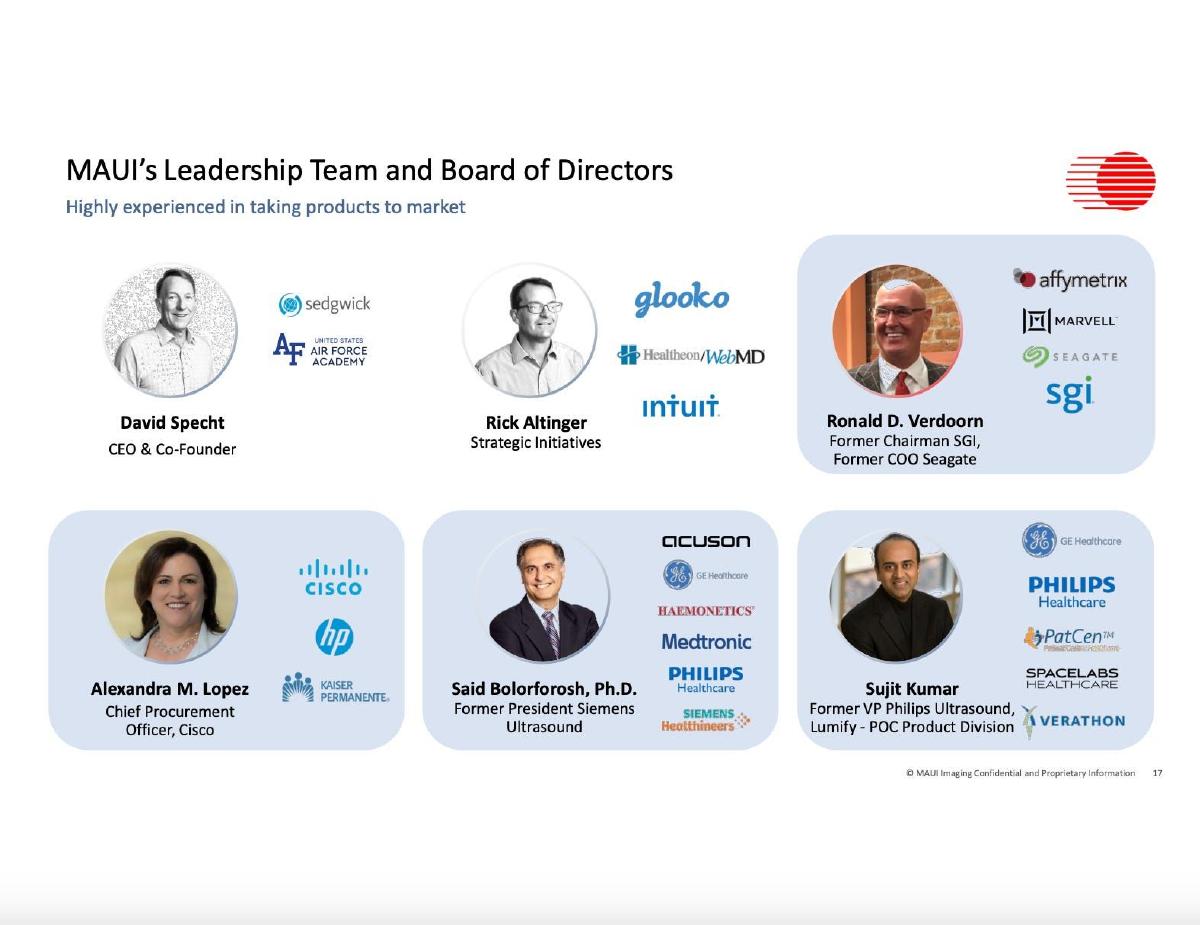
- The team slide (Slide 17) features heavyweights from the ultrasound industry, including the former President of Siemens Ultrasound and former VP of Philips Ultrasound.
- The deck emphasizes FDA clearance as a key milestone already achieved (Slide 2 and Slide 9).
- A 'Trauma Use Case' on Slide 3 directly addresses military and battlefield needs, supported by MRDC Military Project Funding mentioned on Slide 10.
- The presentation lacks a specific 'Ask' slide detailing the $14M round's terms or use of proceeds.
The Series D Technical Narrative
MAUI Imaging’s 17-slide deck is a highly specialized document designed for sophisticated healthcare investors. As a Series D company, MAUI is no longer selling a dream; they are selling a validated, FDA-cleared technology with a massive intellectual property moat. The deck focuses heavily on the 'physics' of their solution, contrasting their 'Computed Echo Tomography' (CET) against the decades-old limitations of traditional ultrasound. By the time an investor reaches the team slide, the company has already established that they can see through bone and gas—the 'holy grail' of portable imaging.
Slide 1: The MAUI System
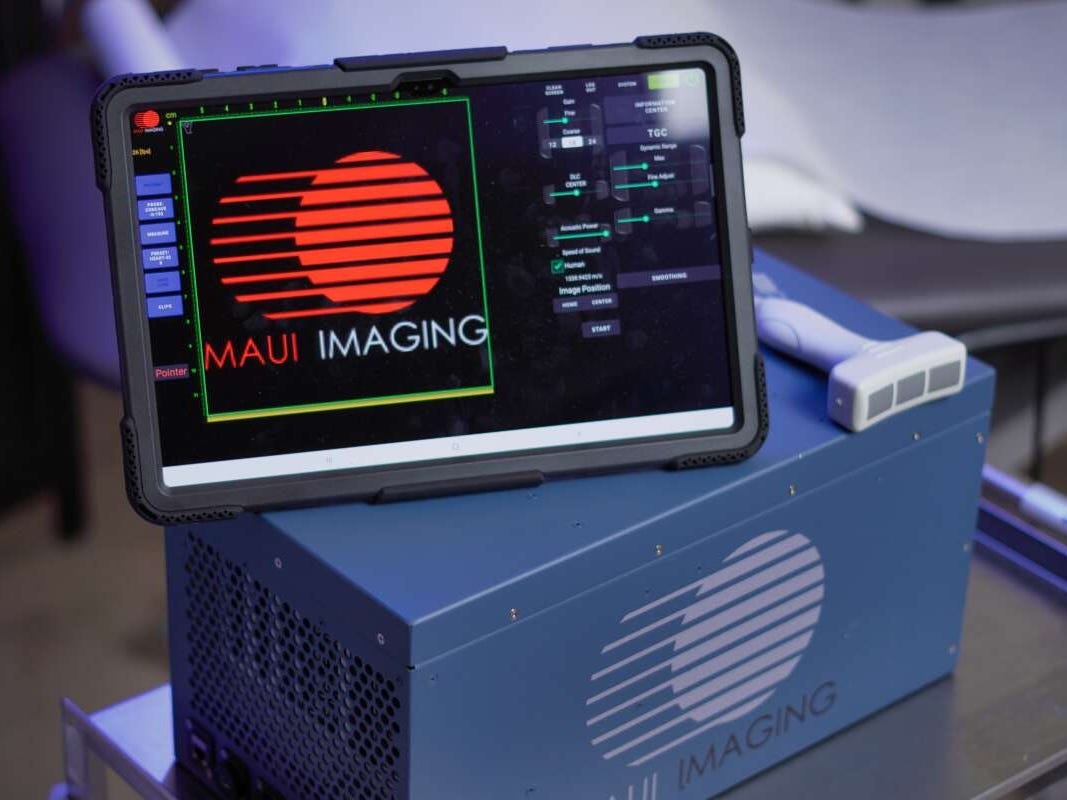
The title slide features a high-resolution photograph of the hardware. It shows a ruggedized tablet interface sitting atop a blue processing unit, with a specialized ultrasound probe resting on the side. This immediately establishes that the product is real, physical, and ready for clinical environments. There is no fluff here; the focus is entirely on the device itself.
Slide 2: Value Proposition and Regulatory Status
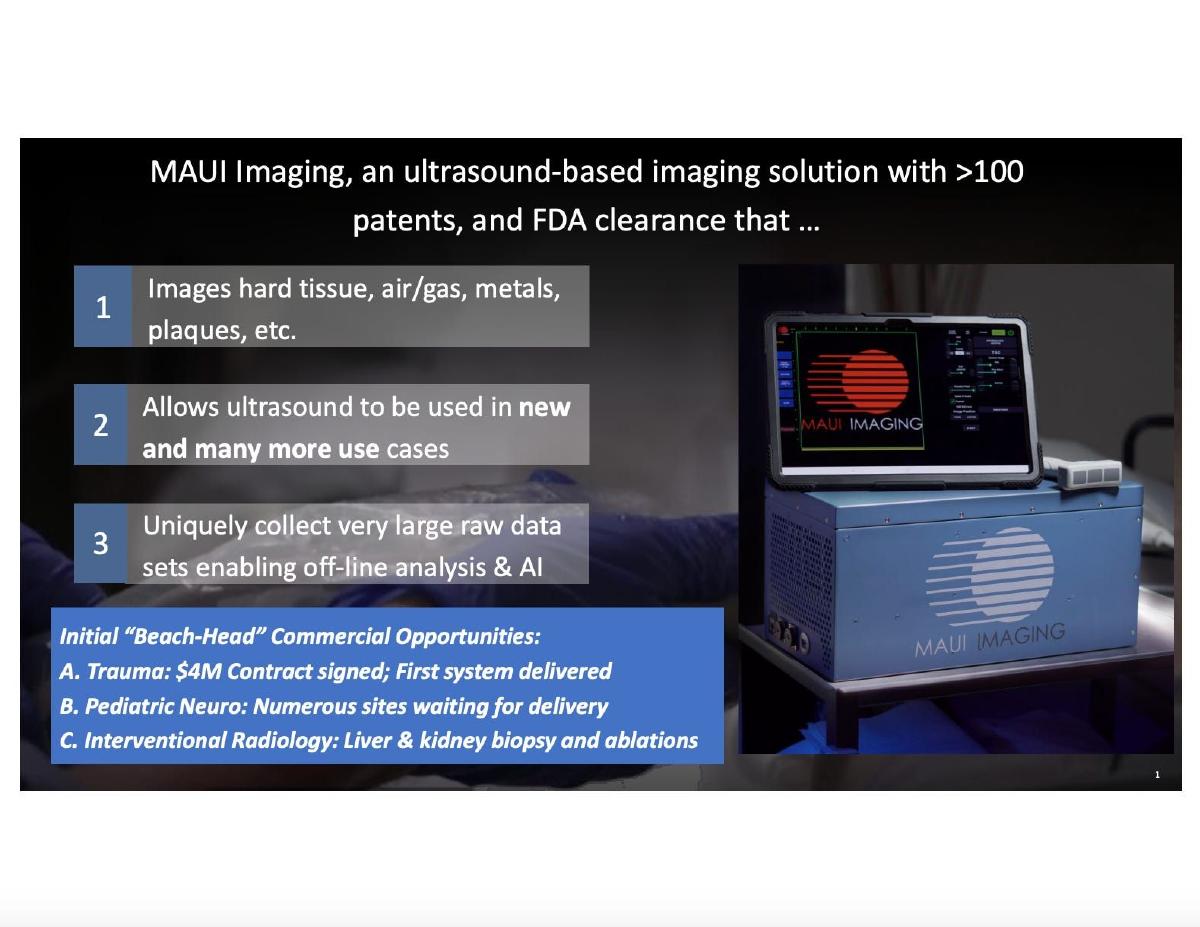
Slide 2 serves as the executive summary. It defines MAUI as an 'ultrasound-based imaging solution' and highlights two critical de-risking factors: over 100 patents and FDA clearance. For a Series D round, confirming FDA clearance early is vital, as it shifts the investment risk from 'will it be allowed?' to 'how fast can it scale?'
Slide 3: The Trauma Use Case
This slide introduces the primary pain point. It features an image of a soldier on a stretcher, asking why trauma triage is still done by physical exam in the field. Below the text are three ultrasound images labeled 'Inside the Skull,' 'Inside the Lung,' and 'Long Bones.' This is a direct challenge to the status quo, as traditional ultrasound typically cannot image through the skull or through gas in the lungs.
Slides 4-7: Clinical Evidence and CT Comparisons
These slides form the technical heart of the deck. Slide 4 compares CT imaging planes to MAUI CET imaging planes. Slide 5 and 6 show cranial imaging of a 62-year-old adult and a 16-year-old male, respectively. The use of specific patient cases (e.g., 'Status Post Chiari Grade 1.5 Decompression') signals that the technology is already being used in complex clinical scenarios. Slide 7 shows a 3-month-old with an arachnoid cyst, explicitly noting that images were obtained 'without utilizing anterior or posterior fontanelle(s)'—meaning they imaged directly through the bone, a feat impossible for standard ultrasound.
Slide 8: Overcoming Physical Barriers
Slide 8 addresses a specific clinical workflow: endotracheal tube (ET) placement. It states that traditional ultrasound cannot image below the sternum due to air/gas interference, but MAUI allows for bedside guidance. This is positioned as a way to reduce the need for X-rays, saving time and reducing radiation exposure in emergency settings.
Slide 9: The 'Why MAUI?' Summary
This slide acts as a bridge between the clinical evidence and the business case. It features quotes from a Trauma Physician and a Professor of Neurosurgery. The Trauma Physician quote is particularly powerful, stating that the four areas MAUI addresses (skull, thoracic cavity, long bones, and abdomen below bowel gas) are where they spend '80% of our time.' The slide also reiterates the IP count, now updated to 'Over 160 US and OUS Patents.'
Slide 10: Military Funding
Slide 10 mentions the 'MRDC Military Project Funding Effort.' This suggests that the technology has been vetted and partially funded by the Department of Defense, providing a non-dilutive validation of the technology's utility in harsh, 'battlefield' environments.
Slide 11: The Physics of Computed Echo Tomography
This slide explains the technical differentiator. It contrasts the 'Traditional Ultrasound Process' (high-energy, ballistic pulses) with 'MAUI’s Patent Ultrasound Process' (low-energy, unfocused pings). The diagram shows how MAUI's approach uses reflected energy from multiple flight paths, processed with proprietary algorithms. This is the 'secret sauce' that explains how they bypass traditional imaging barriers.
Slide 12: Data and AI
MAUI positions itself as more than just a hardware company. Slide 12 explains that by aggregating and storing the 'entire raw dataset,' they can win with AI toolsets. This is a common Series D play: moving from a device sale to a data/software platform play to justify a higher valuation.
Slide 13: The IP Moat
This is one of the most complex slides in the deck, featuring a 'bubble map' of their 163 patents. It categorizes patents into 'Core,' 'Peripheral,' and 'Filed & Pending.' The sheer density of this slide is intended to intimidate potential competitors and reassure investors that the technology is legally defensible.
Slides 14-16: Market Analysis
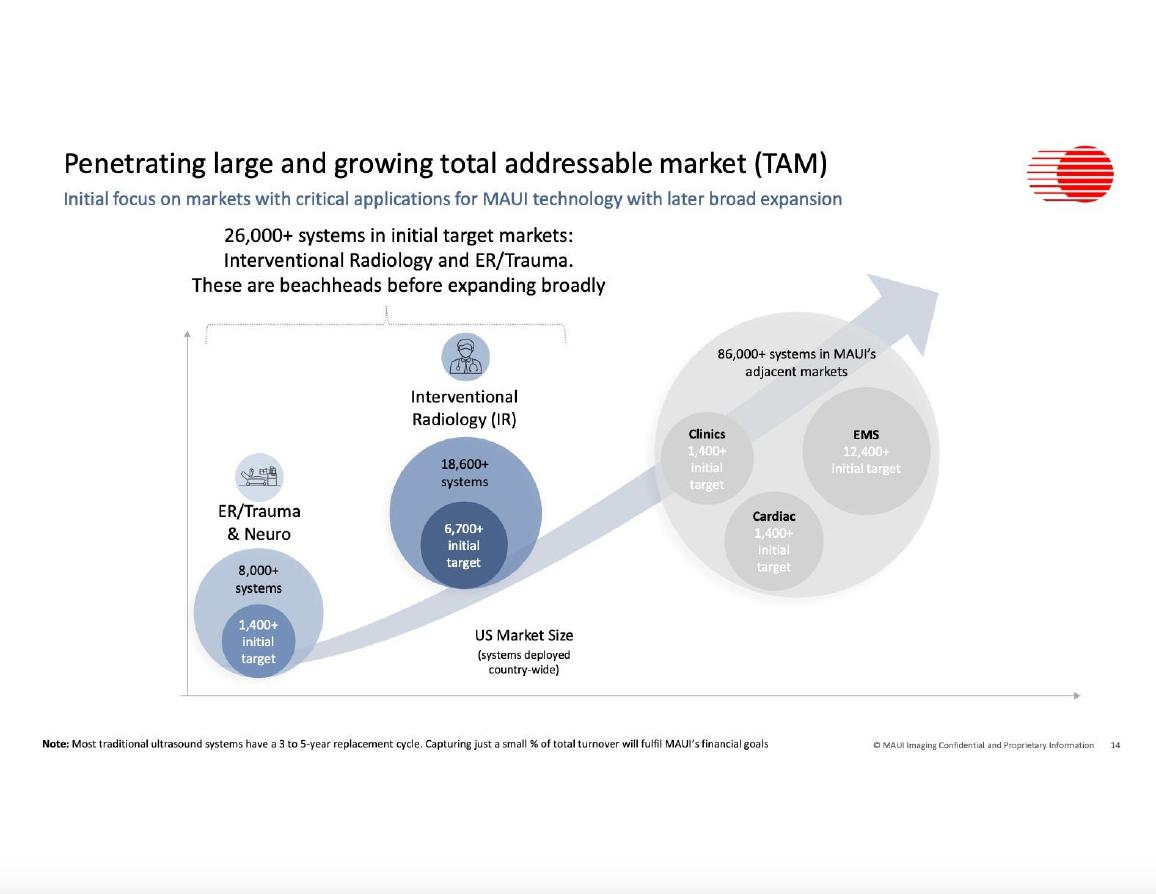
Slide 14 and 15 break down the TAM. MAUI isn't just looking at the $9.7B ultrasound market; they are targeting the $17B CT and MR market and the $22.8B interventional radiology market. Slide 15 provides specific penetration targets: a 10% opportunity in CT/MR ($1.7B) and a 35% penetration into existing ultrasound applications ($3.4B). Slide 16 provides a vendor analysis of the 2024 ultrasound market, likely to show where MAUI fits among giants like GE, Philips, and Siemens.
Slide 17: Leadership and Board
The final slide is a 'who's who' of the medical imaging industry. The presence of former top executives from Siemens Ultrasound and Philips Ultrasound is a massive signal of credibility. It suggests that the people who built the current industry leaders believe MAUI is the next evolution of the technology.
What MAUI Imaging Does Well
The deck is exceptionally strong on technical validation . In the medical device space, 'seeing is believing,' and MAUI provides ample side-by-side comparisons with CT scans and traditional ultrasound. They don't just claim to be better; they show the specific clinical instances where they succeed and others fail.
The IP positioning is also handled with a level of detail rarely seen in earlier-stage decks. By Slide 13, an investor is convinced that MAUI owns the 'Computed Echo Tomography' space entirely. Furthermore, the team slide is perfectly tailored for a Series D round, showing that the company has the 'adult supervision' and industry connections necessary to scale a complex hardware business.
What is Missing from the Deck
Despite the $14M raise, the deck has several notable omissions that would be standard in most fundraising presentations. First, there is no 'Ask' slide . We know from publisher reports that they raised $14M, but the deck itself does not state the amount sought or the intended use of funds. This suggests this version of the deck may have been used for clinical partnerships or as a 'teaser' for deep-dive due diligence.
Second, there are no unit economics or financial projections . There is no mention of the cost to manufacture the device, the expected sales price, or the current revenue run rate. While they mention 'Initial Targets' and 'Addressable Market,' they don't show a clear path to profitability or even a historical growth chart. For a Series D, one would expect to see some evidence of commercial traction beyond clinical trials and military grants.
Finally, the competitive landscape is only hinted at. While they compare themselves to 'Traditional Ultrasound,' they don't name specific startups or emerging technologies that might also be working on adaptive beamforming or portable CT-like solutions.
Lessons for Founders
1. Lead with the 'Impossible': If your technology solves a problem that was previously thought to be a law of physics (like ultrasound not going through bone), make that the center of your deck. MAUI’s repeated use of cranial imaging slides is their strongest selling point.
2. Use Industry Giants as Validation: If you can’t get a pilot with a major player yet, recruit their former leaders. Having the former President of Siemens Ultrasound on the board is a shorthand way of saying, 'The experts in this field think this is the future.'
3. Map Your IP: For hardware and deep-tech companies, a simple 'we have patents' bullet point isn't enough at later stages. A visual map of your IP portfolio, as seen on Slide 13, demonstrates a strategic approach to protecting your innovations across multiple sub-sectors.
4. Segment Your TAM by 'Beachhead': Don't just give one big number. MAUI breaks their market down into ER/Trauma, Interventional, and Traditional Ultrasound, with specific dollar amounts and penetration percentages for each. This shows a sophisticated understanding of how they will actually go to market.
Frequently asked questions
- What is the core technology behind MAUI Imaging?
- MAUI Imaging utilizes a proprietary method called Computed Echo Tomography (CET), also referred to as Adaptive Beamforming. Unlike traditional ultrasound that uses high-energy focused scan lines, CET uses low-energy unfocused 'pings' to collect raw data from multiple flight paths. This allows the system to image through barriers like bone, gas, and fat that typically block ultrasound waves, as detailed on Slide 11.
- How does MAUI Imaging compare itself to CT scans?
- On Slides 4, 5, and 8, MAUI provides side-by-side comparisons of its CET imaging against traditional CT scans. The deck argues that MAUI can provide CT-like imaging planes at the bedside, specifically for cranial imaging and endotracheal tube placement, without the radiation exposure or logistical hurdles associated with moving a patient to a CT suite.
- What is the status of MAUI's intellectual property?
- MAUI Imaging claims a very strong IP position. Slide 13 shows a complex map of their portfolio, which includes 163 US and foreign patents with 33 pending. Their patents cover core areas like 'Ping TX', 'Multiple Aperture Ultrasound Imaging', and 'Cloud-based Imaging', creating a significant barrier to entry for competitors.
- Who are the key people leading MAUI Imaging?
- The leadership team, shown on Slide 17, includes CEO David Specht and Strategic Initiatives lead Rick Altinger. Crucially, the board and advisors include industry veterans like Said Bolorforosh, Ph.D. (Former President of Siemens Ultrasound) and Sujit Kumar (Former VP of Philips Ultrasound), lending significant sector credibility to the Series D round.
- What market segments is MAUI targeting first?
- According to Slide 15, MAUI's initial beachhead is the ER/Trauma market, which they value at a $1.7B opportunity. They also plan to expand into the Interventional market ($2.18B opportunity) and traditional Ultrasound market ($3.4B opportunity), leveraging their technology to penetrate existing applications and create new point-of-care categories.