MBE Academy (Mindset Business & Entrepreneurship Ltd) is a Nigerian vocational training institute targeting high school leavers and unemployed graduates. Their model functions as a marketplace, onboarding trainers to deliver skills via an apprenticeship program while taking a 25% commission on fees. The deck highlights a significant market opportunity driven by a 42.5% youth unemployment rate in Nigeria, projecting an annual revenue of N75,000,000 based on 2,000 trainees. While the deck provides clear financial targets and a specific N10,000,000 ask, it lacks detailed competitive analysis and…
Key takeaways
- The company identifies a critical problem in Nigeria: 4 out of every 10 youths are unemployed (Slide 4).
- MBE Academy operates on a commission-based revenue model, taking 25% of the average N100,000 fee per trainee (Slide 9).
- The Total Addressable Market (TAM) is valued at $2,751,931,910.4 dollars, though the calculation methodology is not detailed (Slide 6).
- The go-to-market strategy relies on a web portal to onboard trainers and trainees for an apprenticeship-style program (Slide 8).
- Traction is currently lopsided, with 50% of trainers onboarded but only 5% of the trainee goal met (Slide 10).
- The financial ask is N10,000,000, with 55% allocated to the purchase of training equipment and workshop space (Slide 12).
- The company is officially registered with the Agency For Adult and Non-formal Education (AANE) in Akwa Ibom State (Slide 13).
- Revenue projections show a steep growth curve, aiming for N75,000,000 in income by 2024 (Slide 11).
Executive Summary: Tackling the Nigerian Unemployment Crisis
Mindset Business & Entrepreneurship Ltd, known as MBE Academy, presents a pitch deck focused on the vocational training sector in Nigeria. The deck is structured to highlight a massive social and economic problem—youth unemployment—and proposes a scalable marketplace solution. By connecting skilled craftsmen and trainers with a large pool of unemployed youth, MBE Academy seeks to create a self-sustaining ecosystem of skill acquisition and job creation.
Slide 1-3: Introduction and Mission
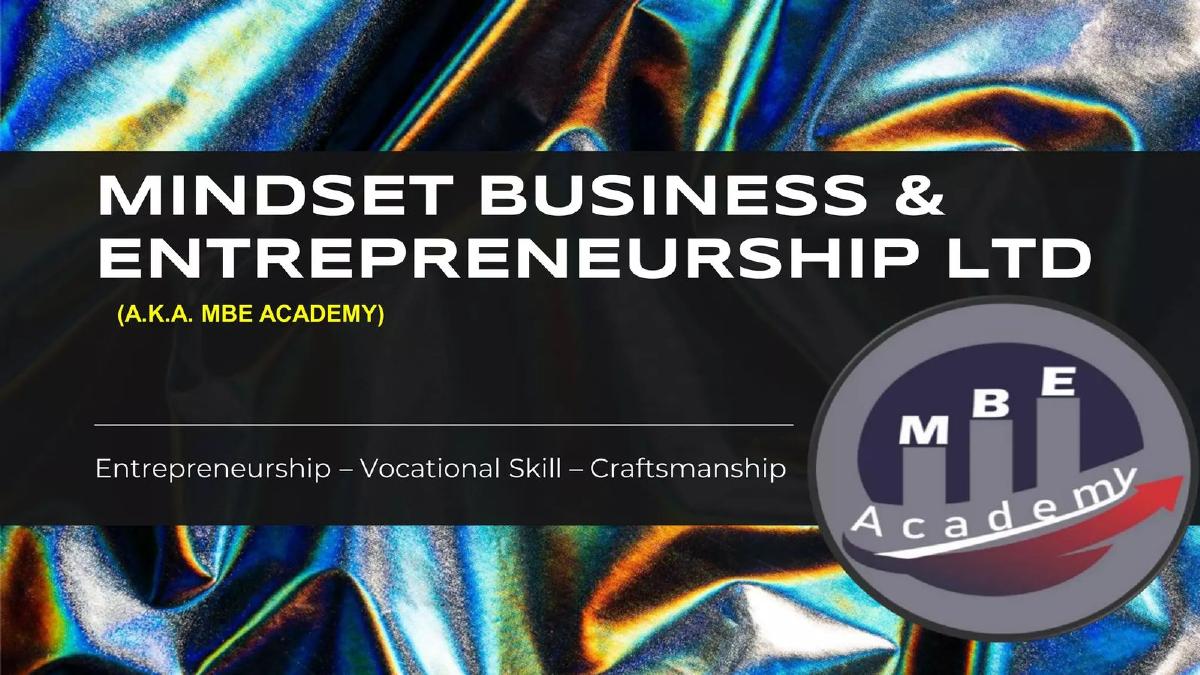
The deck opens with the full legal name of the entity, Mindset Business & Entrepreneurship Ltd, and its acronym, MBE Academy. The subtitle on slide 1 establishes the core pillars: Entrepreneurship, Vocational Skill, and Craftsmanship. Slide 3 provides a formal introduction, defining the company as a vocational training institute aiming to eradicate youth unemployment in Nigeria. The stated goal is to help high school leavers and unemployed graduates own their businesses and achieve financial independence.
Slide 4-5: Defining the Problem and Solution
Slide 4 provides the statistical backbone of the pitch. It cites a 42.5% youth unemployment rate and a 21.0% youth under-employment rate in Nigeria. The slide simplifies this for the reader, stating that 4 out of every 10 Nigerian youths are unemployed. Slide 5 presents the solution: vocational education designed to build human capital for self-reliance. A 'Training Overview' slide follows, featuring a collage of photos showing students engaged in various trades, including tailoring, carpentry, hair styling, and electronics repair. The slide includes contact information and a physical address in Uyo, Akwa Ibom State, Nigeria.
Slide 6-7: Market Size and Customer Profile
The market analysis on slide 6 presents large figures. It lists a 'Market Size' of 137,596,595.52 (presumably a population count) and a Total Addressable Market (TAM) of $2,751,931,910.4 dollars. The youth unemployment segment is quantified at 92,092,209.6. Slide 7 breaks down the target customer by age (15-35) and gender. It also includes an 'Interest' metric, claiming 70% of their target audience is interested in education, though only 30% are high spenders.
Slide 8-9: Strategy and Revenue Model
Slide 8 outlines the Go-To-Market strategy. The company aims to 'rebrand' vocational education to add 'pride and prestige.' The operational 'How' involves partnering with trainers via an apprenticeship program and using a web portal for onboarding. Slide 9 details the business model: a 25% commission on each trainee. With an average fee of N100,000 and a goal of 2,000 trainees annually, the company projects N75,000,000 in annual revenue.
Slide 10-12: Traction, Growth, and The Ask
Slide 10 uses progress bars to show traction. Licensing is at 100%, the web portal at 90%, and trainer onboarding at 50%. However, trainee enrollment is only at 5%. Slide 11 shows a growth chart with 'expected income' rising from N50,000,000 in 2023 to N75,000,000 in 2024, with the curve continuing upward through 2026. Slide 12 presents 'The Ask': ten million naira (N10,000,000). A pie chart shows that 55% of this will go toward training equipment and workshops, while 20% goes to marketing, 20% to admin, and 5% to software.
Slide 13-16: Company, Team, and Proof
Slide 13 confirms the company's registration with the Akwa Ibom State Ministry of Education. Slide 14 introduces the team: Itoro Udoinyang (Founder/CEO), Idongesit Asuquo (Co-Founder/CFO), and Chris Ubuo (Administrative Manager). The deck concludes with a 'Testimonials' slide showing photos of the 2022 graduating class holding certificates, and a final contact slide.
What Works in the MBE Academy Deck
Clear Revenue Model: Slide 9 is exceptionally clear. By stating the average fee, the commission percentage, and the volume target, the founders make it easy for an investor to audit their math and understand the unit economics. · Specific Use of Funds: The ask on slide 12 is not a vague number. The pie chart provides a clear breakdown of where the N10,000,000 will be spent, showing a heavy emphasis on physical infrastructure (equipment and workshops) which is necessary for vocational training. · Localized Problem Statement: The deck does a good job of contextualizing the problem within the Nigerian economy, using specific percentages to highlight the urgency of the solution.
What Is Missing from the MBE Academy Deck
Competitive Landscape: There is no mention of other vocational schools, government programs, or digital learning platforms that might compete for the same students. · Detailed Unit Economics: While the revenue is clear, the costs are not. We know the commission, but we don't know the Cost of Customer Acquisition (CAC) or the ongoing costs of maintaining the web portal and administrative staff. · Trainer Incentives: The deck mentions onboarding trainers, but it doesn't explain why a skilled craftsman would choose to partner with MBE Academy instead of taking apprentices privately. · Scalability Plan: The projections on slide 11 show growth, but the deck doesn't explain how they will scale from one location in Uyo to the rest of Nigeria.
Founder Takeaways: Lessons to Copy
Transparency in Traction: Slide 10 is a great example of honesty. By showing that trainee enrollment is only at 5%, the founders identify exactly where the bottleneck is. This tells an investor that the money requested for 'Marketing' (20% of the ask) is directly addressing the company's biggest current weakness. · Visual Proof: Including photos of actual students and graduation ceremonies (Slides 5 and 15) provides social proof that the business is operational and not just a theoretical concept. · Regulatory Compliance: Highlighting registration with the Ministry of Education (Slide 13) is crucial for businesses in the education sector to build trust with both investors and students.
Frequently asked questions
- What is the primary business model of MBE Academy?
- MBE Academy acts as a vocational training intermediary. According to slide 9, they take a 25% commission on each trainee's fees. With an average fee of N100,000 and a target of 2,000 trainees annually, they project an annual revenue of N75,000,000. This suggests they provide the platform, certification, and oversight while partnering with external trainers for the actual instruction.
- How does the company define its target market?
- Slide 7 specifies their target customers as high school leavers and unemployed graduates, primarily in the 15-35 age range. They use a 'Spend and Interest' metric showing that 70% of their target demographic has a high interest in education, while only 30% have high spending power, highlighting the need for affordable or high-ROI vocational training.
- What is the specific funding request and its allocation?
- On slide 12, the company asks for ten million naira (N10,000,000). The largest portion of this (55%) is earmarked for the 'Purchase of Training Equipment and workshop.' The remainder is split between Marketing (20%), Administrative Costs (20%), and Software Development (5%).
- What is the current state of their technology and operations?
- Slide 10 provides a traction status report. Their registration and licensing are 100% complete, and their web portal is 90% finished. However, while they have onboarded 50% of their intended trainers, they have only reached 5% of their trainee capacity, indicating a significant need for student recruitment.
- Does the deck address competition or market risks?
- The deck includes a SWOT analysis on slide 7. It lists 'Pandemic' as a threat and 'Funding' as a weakness. It does not explicitly name competitors, instead focusing on the 'High Unemployment rate' as an opportunity. The lack of a dedicated competitor slide is a notable omission for investors looking to understand the landscape.