MedX is a TSX-V listed company (Stock Symbol: MDX) with a market capitalization of $30 - $35 million as of the deck's publication. The company operates two divisions: therapeutic lasers and SIAscopy skin assessment technology. The core value proposition centers on reducing skin cancer assessment wait times from months to just 72 hours using their DermSecure platform. By transitioning from a pure hardware play to a SaaS model, MedX aims to capture a share of the 420 million people at high risk of melanoma. The deck outlines a tiered pricing strategy (Gold, Platinum, Diamond) and claims to be i…
Key takeaways
- MedX is a publicly traded company on the TSX-V with 131 million shares outstanding and a market cap between $30M and $35M (Slide 2).
- The company operates in 34 countries with regulatory approvals in the USA, Canada, EU, Australia, and Turkey (Slide 2).
- A critical problem identified is the shortage of specialists; Canada has only 565 dermatologists for 37 million people, leading to wait times of 5 to 18 months (Slide 4).
- MedX claims their technology can reduce patient wait times for skin cancer assessments to 72 hours (Slide 4).
- The cost of treating Stage 1 Melanoma is $2,500 with a 97% survival rate, compared to $1,000,000 for Stage 4 with a 15% survival rate (Slide 4).
- The business model is shifting to SaaS, with monthly charges ranging from $200 to $400 per installation (Slide 7).
- The deck lacks a team slide, financial history, or a specific funding 'ask' amount (Slides 1-9).
- Future growth is predicated on 15,000 potential installations, estimated to generate $84 million in top-line revenue (Slide 8).
MedX Investor Presentation: A Slide-by-Slide Analysis
Slide 1: Title Slide
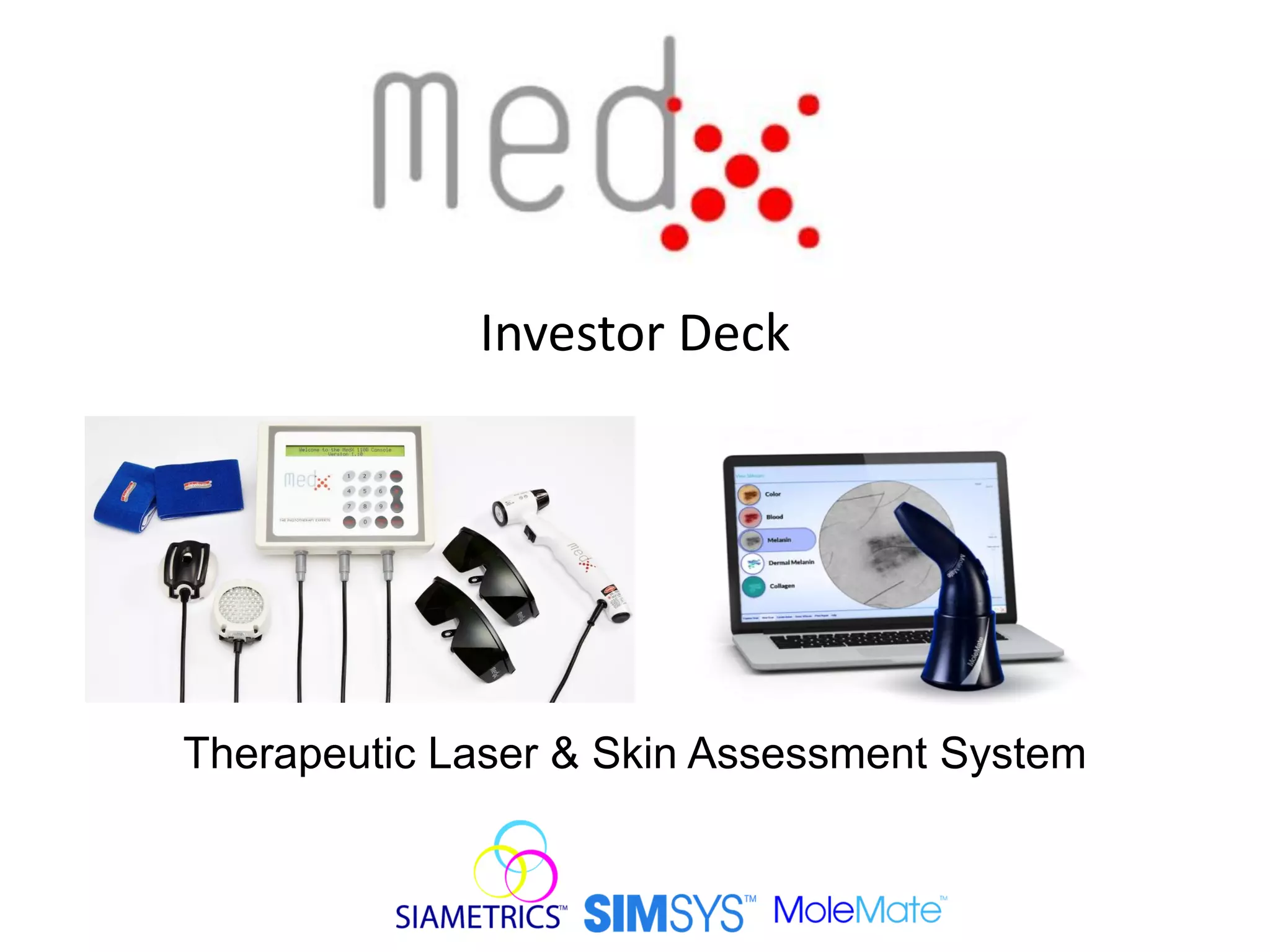
The title slide introduces the company as MedX (stylized as medx with a red dot grid logo). It identifies the presentation as an "Investor Deck" and specifies the core product categories: "Therapeutic Laser & Skin Assessment System." Three sub-brands are listed at the bottom: SIAMETRICS, SIMSYS, and MoleMate. The slide features photographs of the hardware components, including a console, handheld scanners, and a laptop displaying the skin imaging software.
Slide 2: MedX – Short Overview
This slide provides corporate status and operational highlights. It notes that MedX is a TSX-V listed company under the stock symbol MDX, with 131 million shares outstanding and a market cap of $30 - $35 million. The business is divided into two segments: Therapeutic Lasers (described as steady growth/cash flow) and SIAscopy (described as a global market opportunity/SaaS model). Key metrics for SIAscopy include presence in over 200 pharmacies across 4 countries and regulatory approvals in 34 countries, including the USA, Canada, and the EU. The slide also mentions a manufacturing facility in the Greater Toronto Area (GTA) with ISO 13485 certification.
Slide 3: Market Problem – Skin Cancer Growth
Slide 3 uses a World Health Organization map from 2016 to illustrate the prevalence of skin cancer. The headline states that skin cancer is one of the fastest-growing cancers. The slide claims there are more than 420 million people at "high risk of Melanoma." The map uses a color-coded system (red, green, purple, grey) to show death rates per 100,000 people globally, though the specific legend values for the colors are not detailed beyond "High" and "Low."
Slide 4: Problems Impacting Successful Outcome
This slide focuses on the Canadian market to illustrate systemic inefficiencies. It states that Canada has only 565 dermatologists serving 37 million people, resulting in wait times between 5 to 18 months. It highlights a specific regional issue in Quebec, which accounts for 23% of the population but 40% of skin cancer deaths due to sun exposure and wait times. The slide presents a financial argument for early detection: Stage 1 Melanoma costs $2,500 to treat with a 97% survival rate, while Stage 4 costs ~$1,000,000 to treat with only a 15% survival rate. MedX claims its technology reduces wait times to 72 hours.
Slide 5: The MedX Solution
Slide 5 details the technical advantages of the MedX system. It claims to be the only Class 2 device that captures a dermascopic image plus four pathophysiology views 2mm below the skin's surface. The slide contrasts this with competitors who allegedly use Class 1 devices with "poor image quality" and a "40% rejection rate" by dermatologists. The solution includes a patient management system designed by dermatologists that integrates with existing EMR platforms and a device-agnostic telemedicine platform with AI capability.
Slide 6: Telemedicine Software Platform (DermSecure)
This slide uses a flowchart to explain the "Hub & Spoke Model" of the DermSecure platform. The process begins with a scan by a trained technician, which takes minutes. The data is sent to the DermSecure cloud-based platform (noted as HIPAA and PIPEDA compliant). A contracted dermatologist then performs a SIAscan assessment in less than two minutes. The final output is a medical report delivered to the clinic, patient, and family physician within a 2-day turnaround. Three possible outcomes are listed: not suspicious, needs to be watched, or suspicious (expedited appointment).
Slide 7: Software as a Service (SaaS) Model
Slide 7 outlines the revenue strategy. It presents a tiered pricing model for DermSecure: Gold ($200/mo, 20 scans, $2,500 device cost), Platinum ($300/mo, 30 scans, $2,000 device cost), and Diamond ($400/mo, 40 scans, $1,500 device cost). The slide projects potential revenue based on 1,500 installs: $5.4 million in ARR from monthly charges and $3.0 million from device sales. Additional revenue streams mentioned include service and maintenance fees and clinical research data.
Slide 8: Short Term Growth Strategy
The growth strategy focuses on the launch of the DermSecure platform across Canada, the Netherlands, and the US, targeting groups like the VA, DND, and hospital groups. It also mentions expansion into Mexico, Spain, Latin America, France, and Germany through channel partners. A significant claim is made that MedX is in discussions for over 15,000 potential installations, which would represent approximately $84 million in top-line revenue. The slide also notes that AI functionality will be added within the next 12 months.
Slide 9: Summary
The final slide summarizes the investment case: proven technology with regulatory approvals, a "game-changer" telemedicine platform for global market access, recurring revenue from a large installed base, and a cash-flow-positive laser business to support growth. The slide repeats the logos for SIAMETRICS, SIMSYS, and MoleMate.
What MedX Does Well
The deck excels at defining a clear, quantifiable problem. By comparing the $2,500 cost of Stage 1 treatment to the $1,000,000 cost of Stage 4 treatment, the company creates a compelling economic argument for healthcare payers and providers. The transition from a hardware-only model to a SaaS model is clearly articulated on Slide 7, showing how the company intends to move from one-time sales to recurring revenue. Furthermore, the inclusion of specific regulatory milestones (34 countries) and the distinction between Class 1 and Class 2 medical devices provides a level of technical credibility often missing in early-stage medtech decks.
Omissions and Weaknesses
The most glaring omission in this deck is the Team Slide . There is no mention of the founders, management, or medical advisory board. For a medical technology company, the credentials of the clinical and engineering leadership are paramount. Additionally, the deck lacks a Financial History slide; while it mentions being a public company with a $30M-$35M market cap, it does not provide historical revenue, burn rate, or profitability figures. There is also no specific Ask . While it is an "Investor Presentation," it does not state how much capital is being raised or how those funds will be allocated. Finally, the "15,000 potential installations" mentioned on Slide 8 is a large figure that lacks a breakdown of the sales pipeline or a timeline for conversion, making the $84 million revenue projection feel speculative.
Lessons for Founders
Founders can learn from MedX's use of comparative economics . Instead of just saying "early detection is better," they used specific dollar amounts and survival percentages to prove the value proposition. This is highly effective for B2B and healthcare pitches. However, founders should avoid the mistake of omitting the team. Investors buy into people as much as products, especially in highly regulated fields. If you are a public company or a late-stage startup, ensure your deck includes a clear bridge between your current financial state and your future projections. MedX jumps from a $30M market cap to an $84M revenue projection without showing the intermediate steps or the capital required to get there.
Note: This teardown is based solely on the 9 slides provided in the presentation dated 2018.
Frequently asked questions
- What is the primary technology MedX uses for skin assessment?
- MedX utilizes SIAscopy, a skin assessment technology that captures images 2mm below the skin's surface. According to Slide 5, it is a Class 2 device that provides four pathophysiology views, which the company claims results in higher image quality and lower rejection rates by dermatologists compared to Class 1 competitors.
- How does the DermSecure platform work?
- DermSecure is a cloud-based telemedicine platform. As shown on Slide 6, a trained technician performs a scan in minutes, which is then uploaded to a HIPAA/PIPEDA compliant network. A contracted dermatologist then reviews the scan in less than two minutes, providing a medical report to the clinic and patient within a 2-day turnaround.
- What is the current market valuation of the company according to the deck?
- Slide 2 states that MedX is listed on the TSX-V under the symbol MDX. It reports 131 million shares outstanding (201 million fully diluted) with a market capitalization ranging between $30 million and $35 million.
- What are the different pricing tiers for the MedX SaaS model?
- Slide 7 outlines three tiers: Gold ($200/month, 20 scans), Platinum ($300/month, 30 scans), and Diamond ($400/month, 40 scans). Device costs decrease as the monthly subscription tier increases, ranging from $2,500 for Gold to $1,500 for Diamond.
- What are the stated growth targets for the company?
- Slide 8 indicates that MedX is in discussions for over 15,000 potential installations. The company estimates that reaching this scale under their SaaS model would represent approximately $84 million in top-line revenue, with a significant portion being recurring.