Symend’s 15-slide deck is a masterclass in repositioning a traditionally 'dirty' industry—debt collection—as a sophisticated, empathy-driven SaaS category. By framing their solution as 'The Science of Engagement,' the company successfully moved the conversation away from aggressive recovery and toward customer retention and lifetime value. The deck leans heavily on social proof, highlighting over $100M raised to date and a leadership team with deep pedigree from firms like Salesforce, Oracle, and FICO. While the deck is light on specific financial projections and competitive landscape details…
Key takeaways
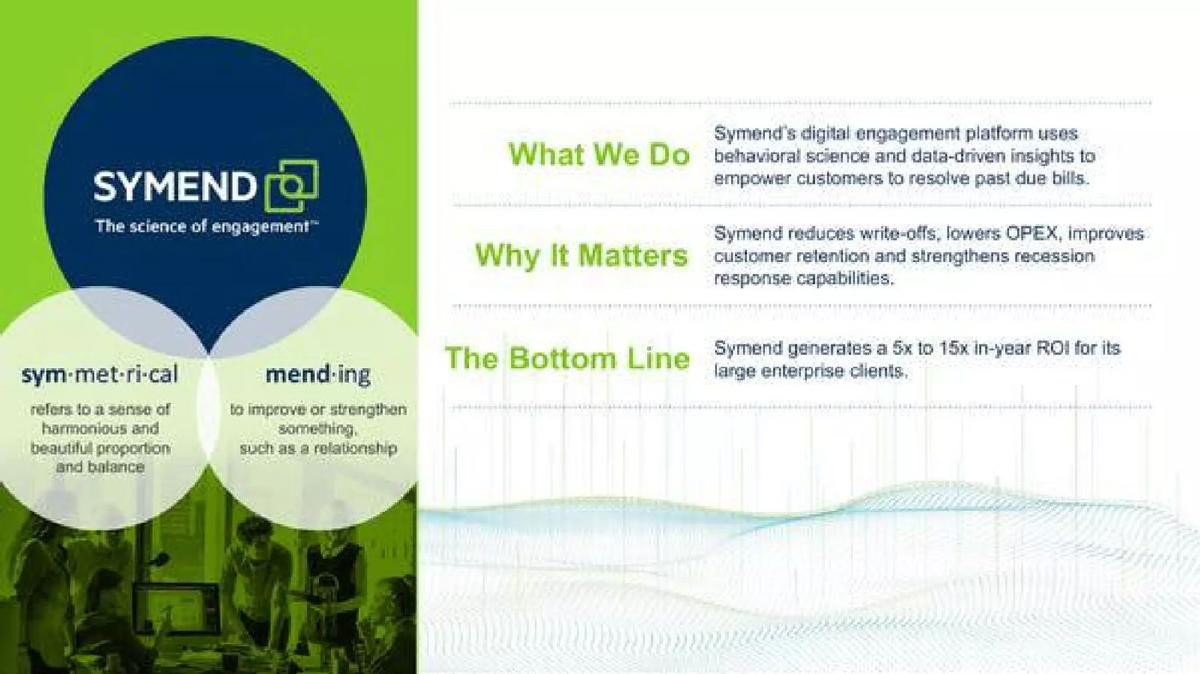
- The company claims a significant in-year ROI of 5x to 15x for its large enterprise clients on slide 3.
- Symend positions 'empathy' as the core output of its behavioral science and AI stack on slide 2.
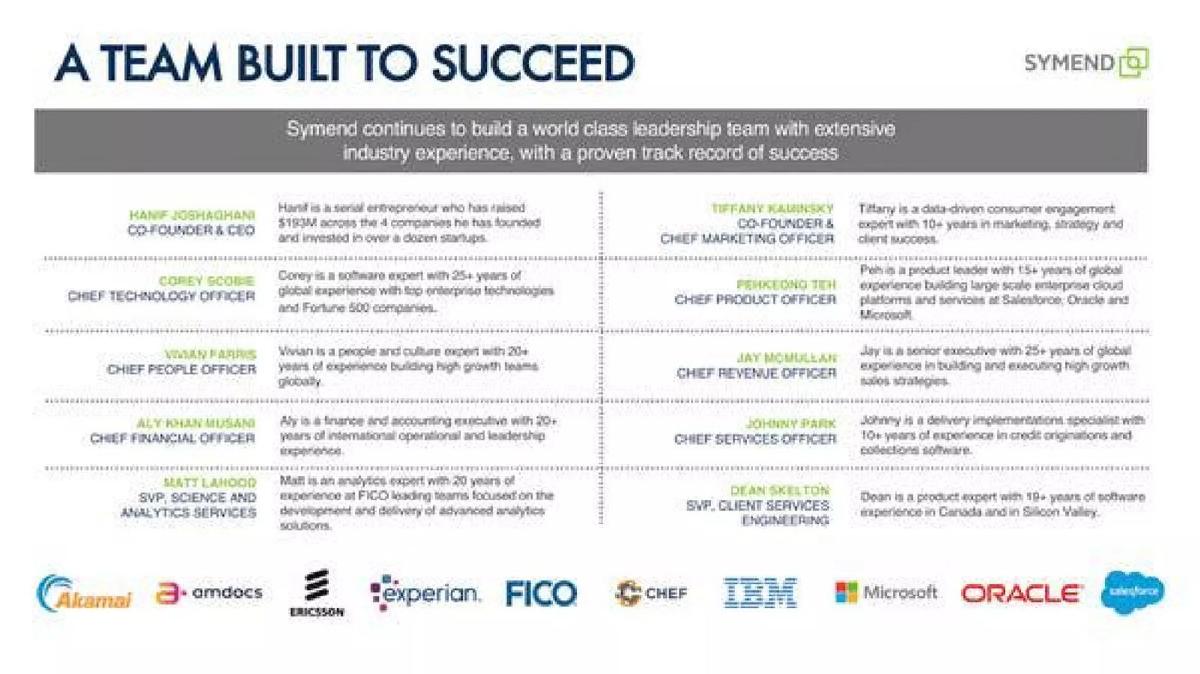
- The leadership team features extensive enterprise experience, including a CEO who has raised $193M across four companies as noted on slide 4.
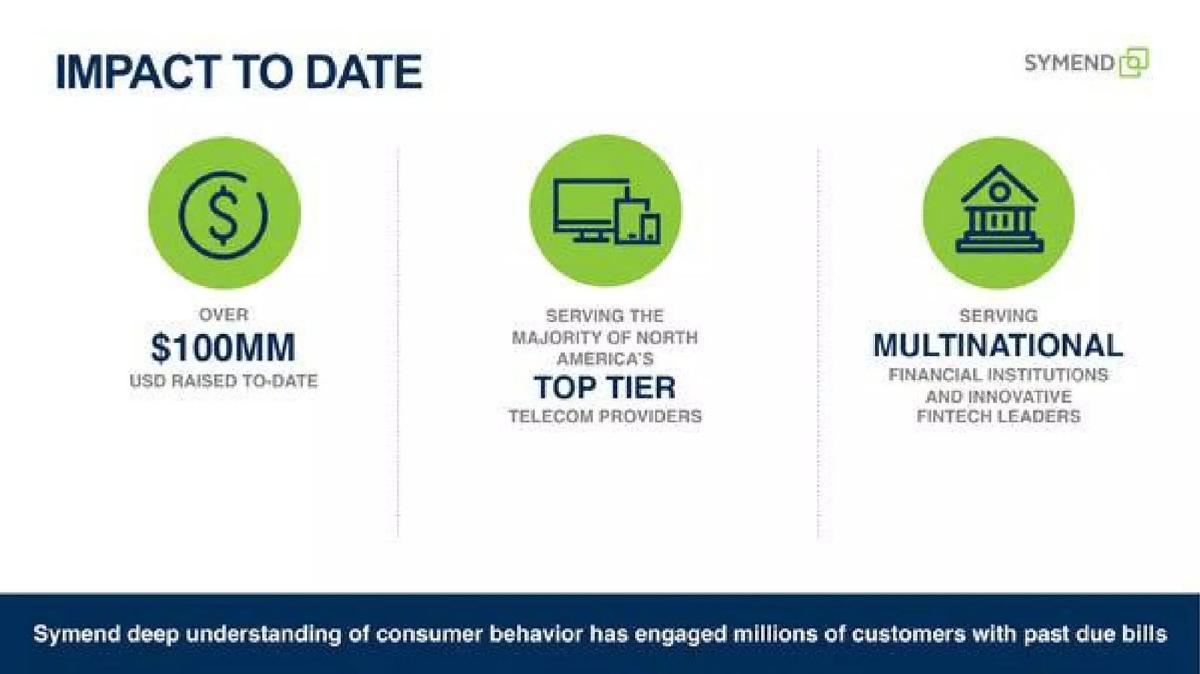
- The deck highlights substantial capital validation, stating over $100MM USD raised to date on slide 6.
- The current collection process is criticized as a 'one size fits all' model with little-to-no digital outreach on slide 8.
- Symend’s solution is built on a triad of Data Science, Engagement Science, and a Platform for real-time experiments as shown on slide 11.
- The company targets high-value sectors including telecommunications, financial services, utilities, and media on slide 14.
- The deck omits a specific 'Ask' slide, financial forecasts, and a direct competitor comparison table.
The Narrative: From Collections to Engagement
Symend’s pitch deck is a sophisticated example of how to rebrand a legacy business process. Debt collection is historically viewed as a high-friction, low-tech industry. Symend shifts this narrative by leading with The Science of Engagement . By the second slide, they have already introduced the concept of 'empathy' as a powerful business tool, backed by AI and predictive analytics. This positioning is designed to appeal to enterprise ESG (Environmental, Social, and Governance) goals while promising hard-line ROI.
Slides 1-3: The Hook and The Bottom Line
Slide 1: Title The deck opens with a clean, professional aesthetic. The subtitle, "Using behavioral science and data-driven insights to empower customers to resolve past due bills before they reach collections," immediately identifies the niche and the value prop: prevention over recovery.
Slide 2: Empathy This is a high-impact emotional slide. It features a close-up black-and-white portrait of an older woman with the text: "After all the behavioral science, predictive analytics and AI, you’ll be equipped with a very powerful solution: empathy." This serves to humanize the end-user—the person in debt—and differentiates Symend from the 'bad guy' image of traditional collectors.
Slide 3: What We Do / Why It Matters This slide provides the executive summary. It defines the name (Symmetrical + Mending) and delivers the most important metric in the deck: "Symend generates a 5x to 15x in-year ROI for its large enterprise clients." This is a bold claim that justifies the high-touch enterprise sales cycle.
Slides 4-6: Credibility and Social Proof
Slide 4: A Team Built to Succeed Symend showcases a deep bench. CEO Hanif Joshaghani is highlighted as a serial entrepreneur who has raised $193M across four companies. The slide includes logos from Akamai, Amdocs, Ericsson, Experian, FICO, IBM, Microsoft, Oracle, and Salesforce, signaling that this team understands the complexity of enterprise software.
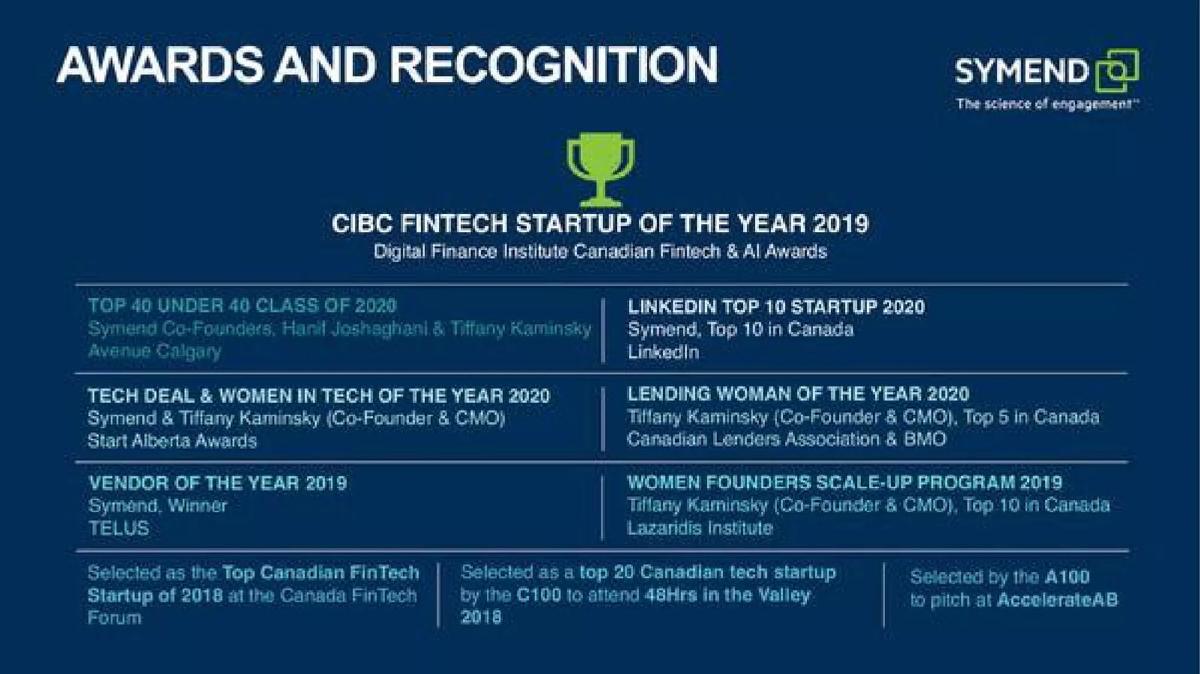
Slide 5: Awards and Recognition This slide is a wall of social proof, listing accolades such as "CIBC Fintech Startup of the Year 2019" and "LinkedIn Top 10 Startup 2020." For an enterprise buyer or a late-stage investor, this reduces perceived risk.
Slide 6: Impact to Date The company reinforces its scale here. They state they have raised over $100MM USD to date (at the time of the February 2021 deck) and serve the majority of North America’s top-tier telecom providers. The footer mentions they have engaged "millions of customers with past due bills."
Slides 7-9: Defining the Problem
Slide 8: Current Collection Process This slide visualizes the inefficiency of the status quo. It maps out a 180-day timeline dominated by voicemails and form letters. It labels the current system as "One Size Fits All" and lists limitations like "Little-to-no digital outreach" and "Static data warehousing."
Slide 9: Collections Needs to Evolve Symend argues that every customer is unique—ranging from the "loyal customer who forgets" to the "customer struggling to make ends meet." They point out that sending the same generic message to all these segments leads to disengaged and dissatisfied customers, which ultimately hurts the enterprise's brand equity.
Slides 10-12: The Solution and Differentiation
Slide 10: Solution Overview (Divider) A simple transition slide.
Slide 11: Our Solution The solution is presented as a virtuous cycle of Engage, Measure, and Optimize . It breaks the platform into three pillars: Data Science (AI/ML), Engagement Science (Psychology/Behavioral Economics), and the Platform itself (Real-time experiments and business logic control).
Slide 12: The Symend Difference (Divider) A simple transition slide.
Slides 13-15: Scalability and Conclusion
Slide 13: Behavioral Science and Digital Engagement This slide reiterates the core methodology. It emphasizes that their strategies are "scientifically validated" and "continuously iterated." This is a key selling point for enterprises that are wary of static, unproven outreach tactics.
Slide 14: Built to Scale The deck concludes its argument by highlighting five pillars of scale: serving complex global enterprises, deep customer insights, leading with empathy, a strong team, and a differentiated product. It specifically mentions target sectors: telecommunications, financial services, utilities, and media.
Slide 15: Closing A simple logo slide with the tagline "The science of engagement."
What Works in This Deck
The ROI Claim: Stating a 5x to 15x in-year ROI (Slide 3) is the strongest possible hook for an enterprise SaaS product. It moves the product from a 'nice to have' to a 'must have' financial tool. · Team Pedigree: The team slide (Slide 4) is exceptionally strong. By listing the specific years of experience and the blue-chip companies they came from, Symend establishes immediate authority in the enterprise space. · Category Reimagination: They successfully move the conversation from "debt collection" to "behavioral engagement." This allows them to command SaaS multiples rather than being valued like a service-based collection agency. · Visual Consistency: The deck uses a consistent color palette and clean iconography, which reflects the professional, data-driven nature of the business.
What is Missing
The Ask: There is no slide indicating how much capital is being raised in this specific round or how those funds will be allocated. · Financials: While they mention ROI for clients, they do not show their own revenue growth, ARR, or unit economics (CAC/LTV). · Competition: The deck operates in a vacuum. It does not address other fintech players or internal recovery teams that might be seen as competitors. · Go-To-Market Strategy: There is no detail on how they plan to expand into the mentioned sectors (utilities, media) or new geographic regions.
What a Founder Should Copy
The 'Problem' Visualization: Slide 8 is an excellent way to show the 'Old Way' vs. the 'New Way.' Using a timeline to show where the current process fails makes the solution's necessity obvious. · Social Proof Integration: Symend doesn't just list awards; they integrate their fundraising success and client tier-status (Slide 6) to build a narrative of inevitable success. · Humanizing the Data: Using a slide like Slide 2 ("Empathy") to anchor a technical product in a human outcome is a powerful way to make a deck memorable.
Frequently asked questions
- What is Symend's primary value proposition?
- Symend's primary value proposition is reducing write-offs and lowering operating expenses for enterprises while improving customer retention. They achieve this by using behavioral science to engage customers with past-due bills in a personalized, digital-first manner, preventing the need for aggressive third-party collection agencies. Slide 3 explicitly states they deliver a 5x to 15x in-year ROI for their clients.
- Who are the key members of the Symend leadership team?
- The team is led by Co-Founder & CEO Hanif Joshaghani, a serial entrepreneur with a history of raising $193M, and Co-Founder & CMO Tiffany Kaminsky. The broader executive suite includes veterans from major tech and finance firms like Salesforce, Oracle, FICO, and IBM, providing the enterprise-grade credibility necessary for their target market.
- How does Symend differentiate itself from traditional collection agencies?
- Unlike traditional agencies that rely on 'one size fits all' methods like form letters and voicemails (Slide 8), Symend uses 'Engagement Science.' This involves leveraging psychology and behavioral economics to create hyper-personalized digital outreaches that adapt as customer behavior changes, focusing on 'empathy' rather than pressure.
- What market traction has Symend demonstrated in this deck?
- Symend claims to serve the majority of North America’s top-tier telecom providers and multinational financial institutions. Slide 6 notes they have engaged millions of customers and raised over $100M USD (at the time of the deck's creation) to support their scaling efforts.
- What critical fundraising elements are missing from the deck?
- The deck is notably missing a specific 'Ask' slide detailing how much they are currently raising and the intended use of funds. It also lacks a detailed competitor analysis, a clear go-to-market strategy for new territories, and granular financial projections or unit economics like CAC and LTV.