The SynapseMX pitch deck is a concise, 10-slide presentation from 2015 that targets the highly specialized niche of commercial aircraft maintenance. Rather than relying on dense text, the deck uses high-impact imagery of cockpits, manual logbooks, and complex spreadsheets to illustrate a '$21B Compliance Headache' (Slide 7). The narrative is built entirely on the contrast between archaic, fragmented communication methods—fax, voicemail, and paper—and a modern, integrated cloud solution. While the deck is notably light on financial projections, competition analysis, and a specific funding 'ask…
Key takeaways
- The deck identifies a specific $21 billion market inefficiency caused by fragmented maintenance data and compliance requirements (Slide 7).
- Visual evidence of the problem is prioritized, using photos of handwritten maintenance logs and complex spreadsheets to show the 'before' state (Slides 5 and 6).
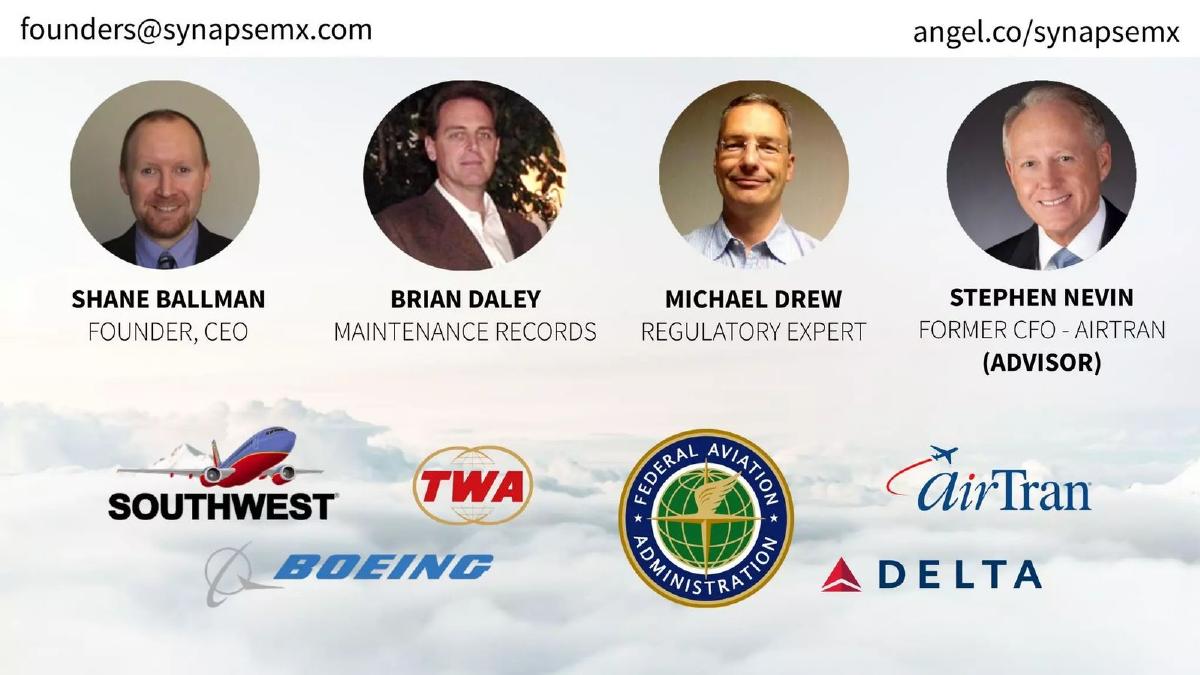
- The team slide highlights deep domain expertise with logos from Southwest, Boeing, Delta, and the FAA to establish immediate credibility (Slide 3).
- The product is positioned as a cross-platform solution, showing the interface on desktop, tablet, and mobile devices simultaneously (Slide 8).
- The deck claims the platform is 'Approved for Commercial Aviation,' a critical regulatory hurdle in this specific industry (Slide 9).
- The presentation concludes by emphasizing '100+ Years in Commercial Aviation' among the four key leaders, reinforcing the founder-market fit (Slide 10).
- There is a complete absence of a business model, pricing strategy, or financial roadmap within the 10 slides.
- The deck lacks a formal 'Ask' slide, omitting the amount of capital being raised or the intended use of funds.
The Vision: Digital Transformation for the Hangar
SynapseMX entered the market in 2015 with a clear mission: to modernize the archaic systems governing aircraft maintenance. The aviation industry is a paradox of high-tech engineering and low-tech administration. While the planes themselves are marvels of modern technology, the processes used to keep them flying often rely on faxes, carbon-copy paper logs, and siloed Excel sheets. This 10-slide deck is a masterclass in identifying a 'hair-on-fire' problem within a niche vertical, even if it leaves many of the standard financial questions unanswered.
Slides 1-3: Identity and Credibility
Slide 1: Title Slide The deck opens with the SynapseMX logo—a brain half-composed of circuitry—and the tagline 'A Modern Aircraft Maintenance Platform.' The contact information includes a generic 'founders' email and an AngelList link, suggesting this was used for early-stage outreach.
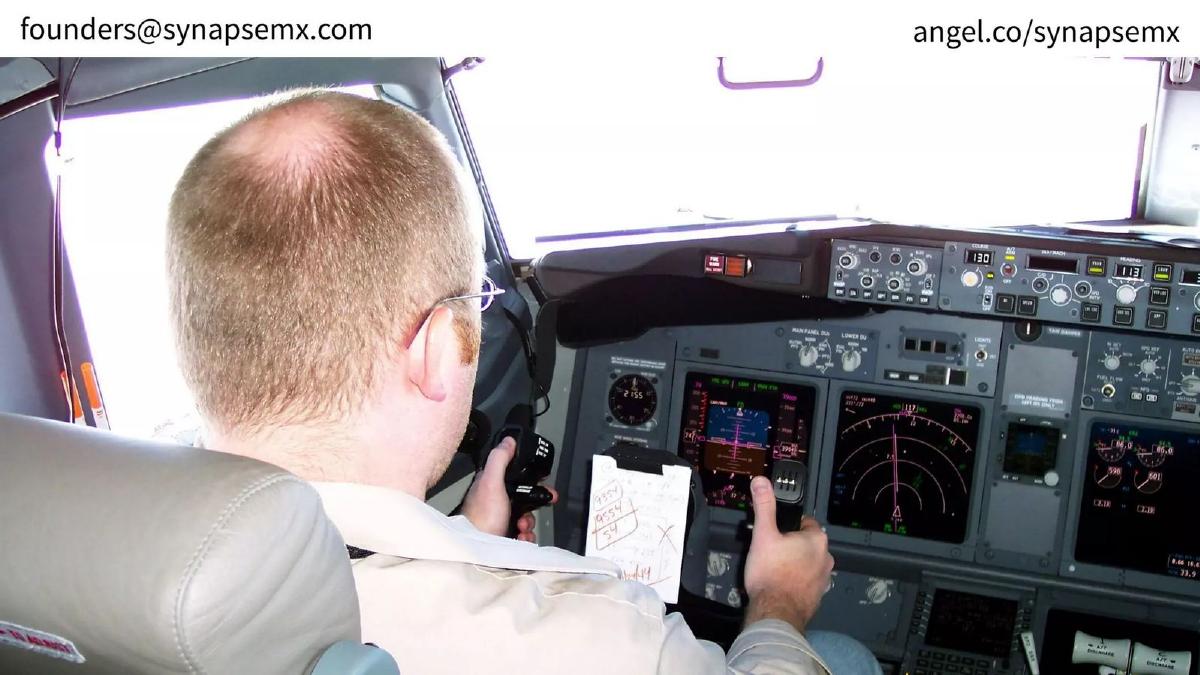
Slide 2: The Reality of the Cockpit This slide is a full-bleed photograph of a pilot at the controls of a commercial jet. The focal point is not the digital displays, but a small, handwritten piece of paper clipped to the yoke. This immediately establishes the 'analog' problem in a 'digital' environment without using a single word of text.
Slide 3: The Team and Pedigree The third slide introduces the core team: Shane Ballman (CEO), Brian Daley (Maintenance Records), Michael Drew (Regulatory Expert), and Stephen Nevin (Advisor and former CFO of AirTran). Below their headshots are the logos of Southwest, TWA, Boeing, the FAA, AirTran, and Delta. This is a high-authority slide intended to signal that the founders aren't just 'tech guys'—they are industry veterans who have lived the problem at the world's largest airlines.
Slides 4-7: The $21 Billion Problem
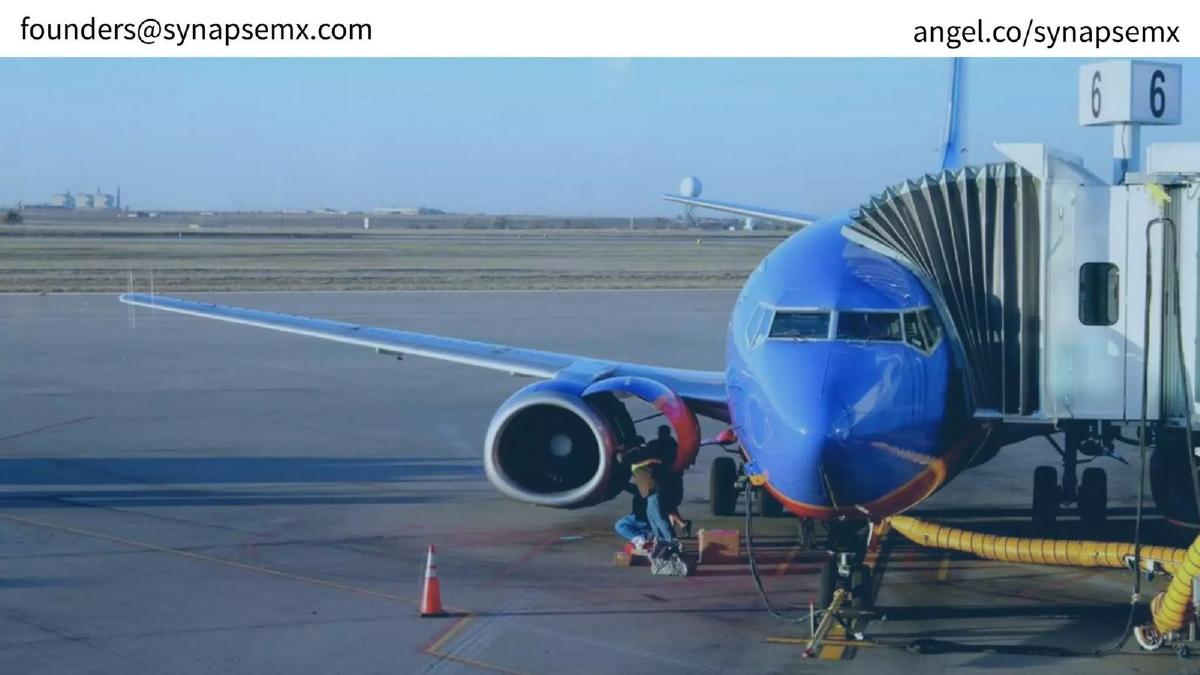
Slide 4: Operational Context A photo of a Southwest Airlines jet at a gate with maintenance crews working on an engine. This slide grounds the pitch in the physical reality of 'dispatch-ready' aircraft and the pressure of turn-around times.
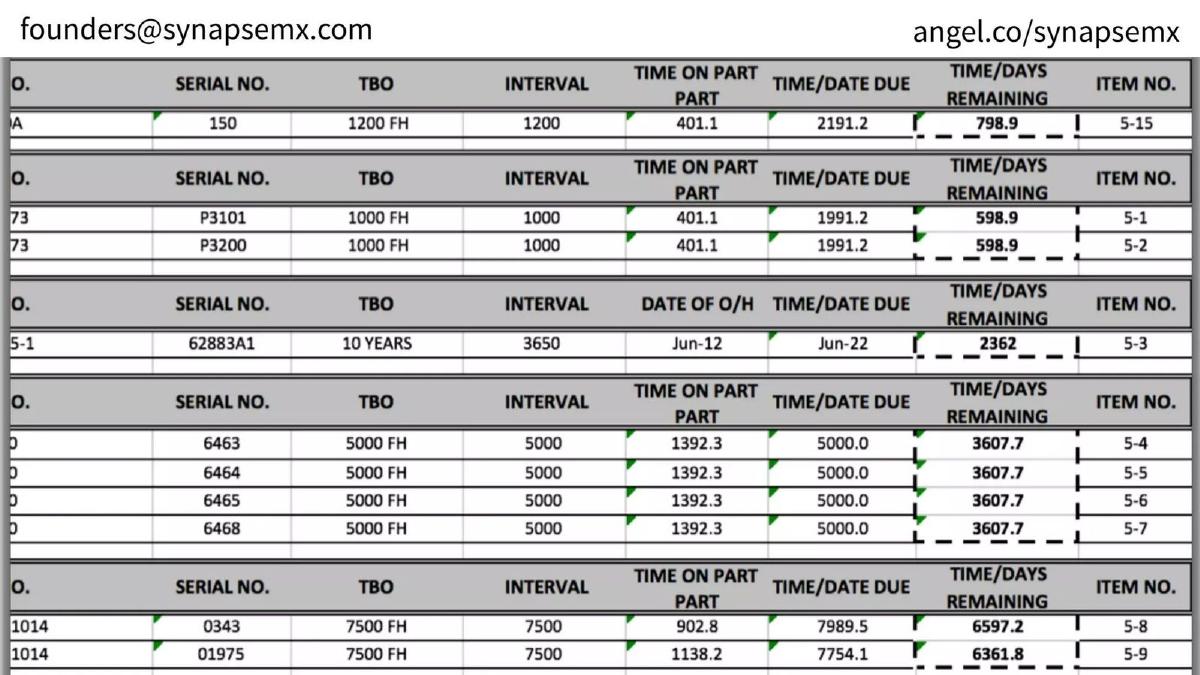
Slide 5: The Spreadsheet Trap This slide shows a screenshot of a complex maintenance tracking spreadsheet. It lists serial numbers, 'Time on Part,' and 'Days Remaining.' By showing this, SynapseMX illustrates the current 'solution'—fragile, manual data entry that is difficult to scale or audit across a fleet.
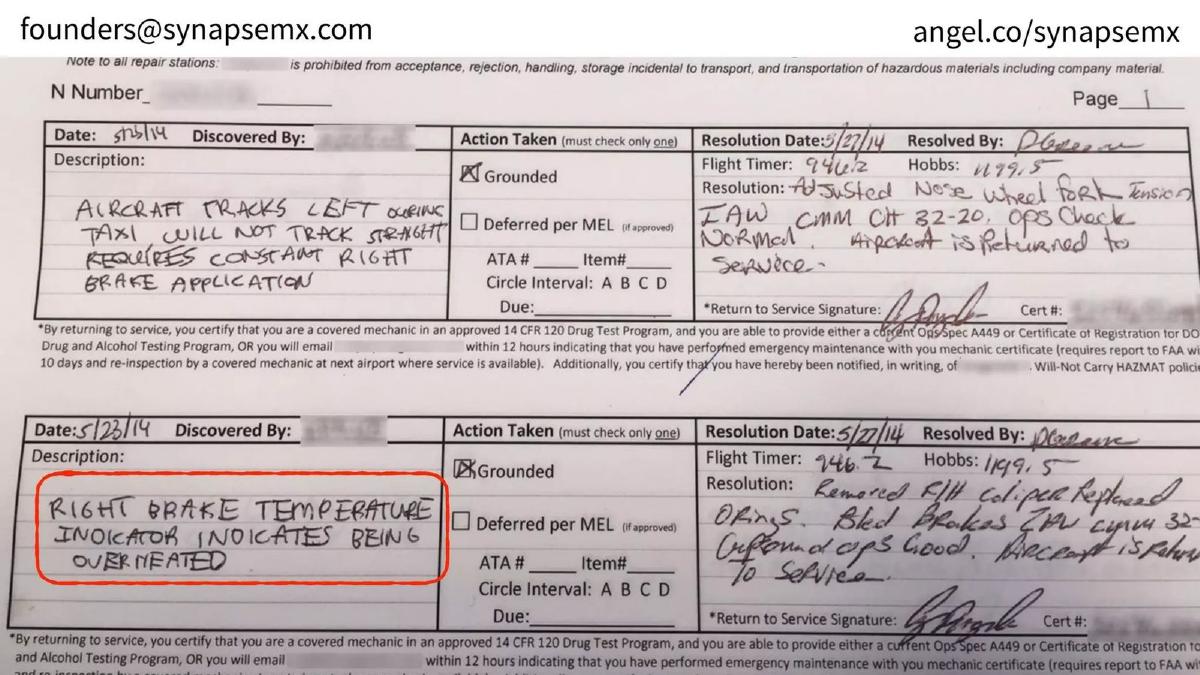
Slide 6: The Paper Trail A photograph of a physical maintenance log for an aircraft that was 'Grounded.' The handwriting is difficult to read, and a red circle highlights a specific fault: 'Right brake temperature indicator indicates being overheated.' This slide is a powerful indictment of the status quo; if this paper is lost or the handwriting is misread, the safety and financial implications are massive.
Slide 7: The Compliance Headache This is the 'Money Slide.' It features a large '$21B' figure next to the words 'COMPLIANCE HEADACHE.' To the right is a chaotic web of icons representing Fax, Excel, Voicemail, Email, and Text Messages. This slide synthesizes the previous images into a quantifiable market pain point. It argues that the lack of a centralized system isn't just annoying—it is a multi-billion dollar drain on the industry.
Slides 8-10: The Solution and Final Proof
Slide 8: The Product SynapseMX finally shows its interface. The software is displayed on a desktop monitor, a tablet, and a smartphone. The UI looks clean and modern, featuring 'Engineering Orders,' 'Task Cards,' and 'Signoff Chains.' This slide promises a 'single source of truth' that works wherever the technician or engineer happens to be—whether in the office or on the tarmac.
Slide 9: Regulatory Validation In aviation, software isn't just 'bought'; it must be 'approved.' Slide 9 features the text 'APPROVED FOR COMMERCIAL AVIATION' over a cloud background. This is a critical de-risking statement for investors, as it implies the platform has cleared the necessary FAA or industry regulatory hurdles to be used in live environments.
Slide 10: The Closing Argument The deck ends by revisiting the team, but with a new headline: '100+ YEARS IN COMMERCIAL AVIATION.' It repeats the headshots from Slide 3, reinforcing the idea that this is a team with unparalleled domain expertise. The SynapseMX logo sits at the bottom, centering the company as the culmination of that century of experience.
What Works in the SynapseMX Deck
Visual Storytelling: The use of Slide 2 (the pilot's note) and Slide 6 (the messy logbook) is excellent. It allows the investor to 'see' the problem without needing to be an expert in aviation maintenance. It creates an emotional connection to a very dry, technical subject.
Extreme Domain Authority: For a Seed stage company, credibility is everything. By placing the team and their former employers (Delta, Boeing, FAA) on Slide 3, they answer the 'Why you?' question before the investor even has a chance to ask it.
Focus on a Singular Metric: The '$21B' figure on Slide 7 provides a clear anchor for the scale of the opportunity. It moves the conversation from 'this is a better way to track parts' to 'this is a solution for a massive global inefficiency.'
What is Missing from the SynapseMX Deck
The Business Model: There is no mention of how SynapseMX charges its customers. Is it per aircraft, per user, or a flat SaaS fee? In a high-stakes industry like aviation, pricing structures can be complex, and their absence here is notable.
The 'Ask': A standard pitch deck usually concludes with a slide detailing how much money is being raised, the valuation (sometimes), and exactly what those funds will be used for (e.g., 'Hire 5 engineers, expand to 3 more airlines'). This deck simply stops after the team slide.
Traction and Roadmap: While they mention being 'Approved,' they don't list any current pilot programs, signed contracts, or a timeline for future feature releases. Investors generally want to see that the '100 years of experience' has already translated into some early market interest.
What a Founder Should Copy
The 'Status Quo' Slide: Founders should copy the layout of Slide 7. Showing the 'messy' reality of how a problem is currently solved (using icons for fax, email, and spreadsheets) is a highly effective way to justify why a new platform needs to exist.
Device Agnostic Display: Slide 8 is a great example of how to show a product. By showing the same data synced across a phone, tablet, and computer, you communicate 'mobility' and 'cloud-sync' visually, which is much more effective than listing those as bullet points.
Leading with the Team: If you have deep industry experience, don't hide it at the end of the deck. SynapseMX put their team on Slide 3 and Slide 10. For 'unsexy' industries like aircraft maintenance or logistics, the team's pedigree is often the most valuable asset the company has in its early days.
Frequently asked questions
- What is the primary problem SynapseMX is solving?
- SynapseMX addresses the inefficiency and high cost of commercial aircraft maintenance. According to Slide 7, this is a '$21B Compliance Headache.' The problem is characterized by a reliance on disconnected communication tools like fax, voicemail, Excel, and paper logs, which leads to downtime and productivity losses. The deck uses Slide 6 to show actual handwritten logs, highlighting how manual and prone to error the current systems are.
- How does the deck demonstrate product-market fit?
- The deck focuses on 'Founder-Market Fit' rather than traditional traction metrics. By showing the team's history with major industry players like Delta, Southwest, and the FAA on Slide 3, and then summarizing their collective '100+ Years' of experience on Slide 10, they argue that they are the only ones qualified to build this. They also show a functional UI on Slide 8 that mimics the complex data needs of an aviation engineer.
- Is there any mention of competition in the deck?
- No. The deck completely omits a competitive landscape slide. It implies that the 'competition' is the status quo—specifically the mess of faxes, emails, and spreadsheets shown on Slide 7. By not mentioning other software providers, the founders focus the narrative on the transition from analog to digital rather than a feature-war with other startups.
- What are the biggest omissions in this pitch deck?
- This deck is missing several standard venture capital requirements: a business model (how they make money), a market size breakdown (TAM/SAM/SOM), a go-to-market strategy, and a funding ask. There are no financial projections or mentions of current revenue or customer counts. It functions more as a high-level vision and credibility deck than a comprehensive business plan.
- Why does the deck show a photo of a pilot and a handwritten note?
- Slide 2 and Slide 6 serve as 'empathy' slides. Slide 2 shows a pilot in a cockpit with a small, handwritten scrap of paper tucked into the controls. Slide 6 shows a 'Grounded' aircraft report with messy handwriting. These images prove to an investor that even in a high-tech industry like aviation, the actual workflow is dangerously dependent on manual, unsearchable, and fragile paper-based systems.