Swit's pitch deck is a comprehensive 41-slide document (21 analyzed here) that secured a $12.3 million Seed round in 2017. The deck excels at contextualizing the 'collaboration tax'—the inefficiency caused by using disparate tools for chat and tasks. It uses Gartner data to validate the $2T enterprise IT market and positions Swit as the first company-wide collaboration suite. While the deck is unusually long for a Seed round, it compensates with high-fidelity product screenshots and a granular competitive matrix against Asana, Trello, and Notion. The narrative focuses on 'Digital Transformati…
Key takeaways
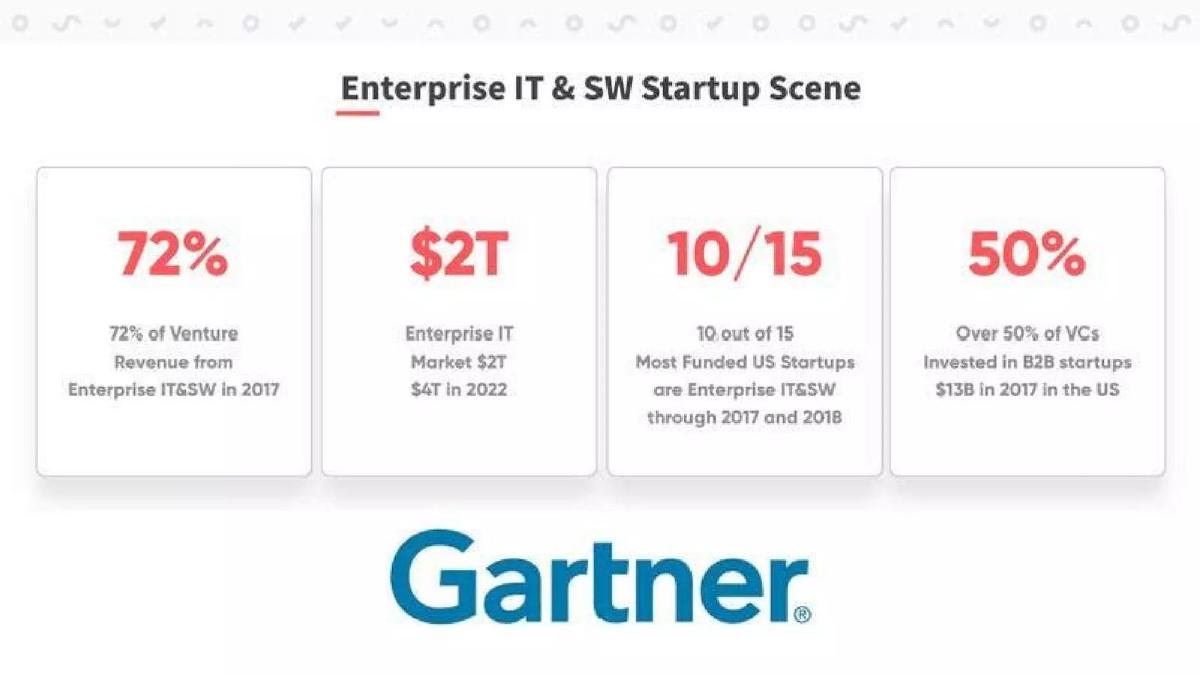
- The deck cites Gartner data on slide 2, noting the Enterprise IT market was $2T in 2017 and projected to reach $4T by 2022.
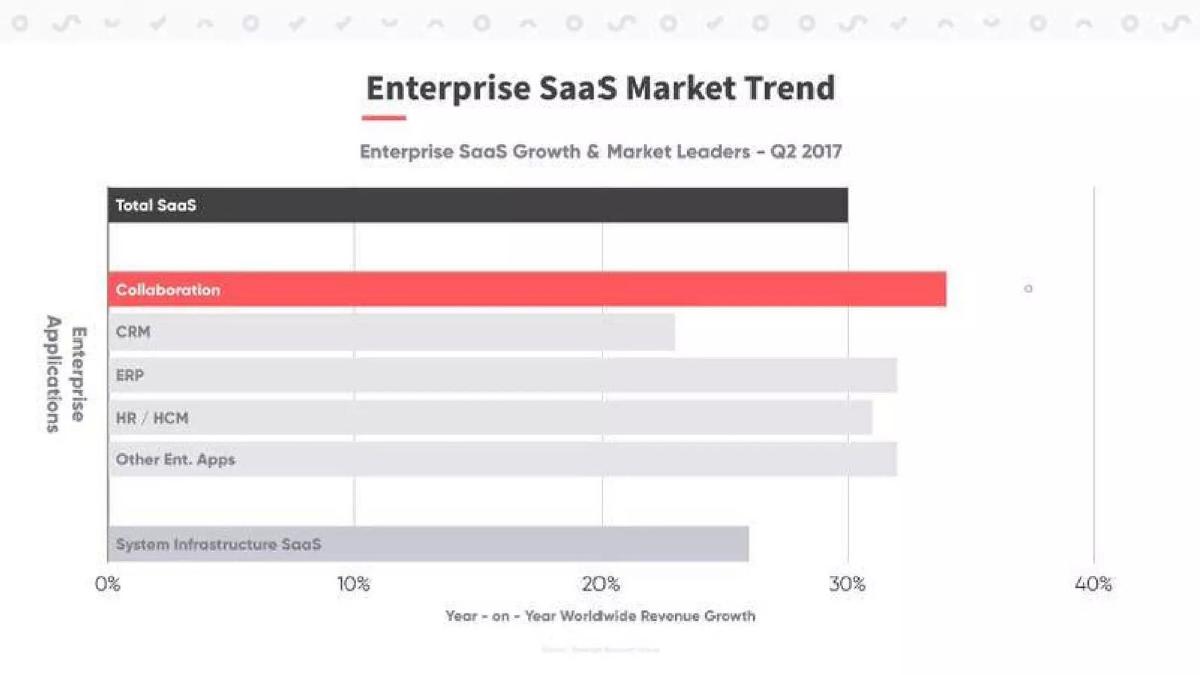
- Slide 3 highlights that 'Collaboration' was the fastest-growing enterprise SaaS segment in Q2 2017, outpacing CRM and ERP.
- A critical pain point is identified on slide 5: 92% of teams use multiple apps within their company, leading to a 'disjoint multi-app environment.'
- Slide 7 positions Swit against major market events, including Slack's $26B IPO and Trello's $425M acquisition.
- The product is defined on slide 13 as a 'Digital Workplace Platform' designed for the 'Team of Teams' corporate culture.
- Slide 15 claims a massive market opportunity by noting 90% of enterprises use Microsoft Office 365 while 8.5% use G Suite.
- Technical defensibility is emphasized on slide 19, listing 19 patents, 6 program copyrights, and 28 trademarks across multiple global regions.
- Slide 20 provides a 12-point feature comparison against Asana, Trello, and Notion, claiming Swit is the only one with 'Panel Chat' and 'Integrated Search.'
The Macro View: Market Timing and Validation
Slides 1-3: Setting the Stage
Swit opens with a clean, minimalist title slide (Slide 1) identifying itself as a Team Collaboration Suite . It immediately moves into heavy market validation. Slide 2 uses Gartner data to establish the massive scale of the opportunity, noting that the Enterprise IT Market was $2T in 2017 and expected to double to $4T by 2022. By highlighting that 72% of Venture Revenue came from this sector in 2017, Swit is signaling to investors that they are playing in the most proven arena for outsized returns.
Slide 3 narrows the focus to SaaS trends. It shows a bar chart where Collaboration is the clear leader in year-on-year worldwide revenue growth (exceeding 30%), outperforming established categories like CRM, ERP, and HR/HCM. This establishes 'Why Now': the market is not just large; it is the fastest-growing segment of the enterprise software world.
Slides 4-6: The Problem of Fragmentation
Slide 4 is a visual metaphor—a melting ice cream cone—likely representing the 'melting' productivity of teams. This leads into Slide 5, which is a powerful 'logo soup' slide. It states that 92% of teams use multiple apps and displays icons for Slack, Trello, Asana, Zoom, Jira, and others. The message is clear: the current ecosystem is fragmented. Slide 6 reinforces this by mentioning the Negative effects of Disjoint Multi-app Environment , though it uses abstract patterns rather than text to convey the 'chaos' of the current state.
The Competitive Landscape and Positioning
Slides 7-9: Market Context and Culture
Slide 7 provides a 'Market Map' of sorts, but instead of a standard quadrant, it links Swit to major industry milestones: Slack's $26B IPO , Trello's $425M acquisition , and Asana's $1.5B valuation . This anchors Swit's potential exit value in the minds of investors. Slide 8 is a collage of the team in action, providing a human element to the technical pitch. Slide 9, titled 6 Reasons to switch to Swit , uses a comparison table to contrast 'Everything Without Swit' (described as 'Hair on fire stuff everywhere') with 'Nothing But Swit' (an 'All-in-one Command Center'). Notably, it quotes a price of $36.66/user/month for a multi-app stack versus a consolidated Swit experience.
Slides 10-12: Product Deep Dive
These slides showcase the actual interface. Slide 10 shows a high-fidelity screenshot of the Partnership Management view, demonstrating how chat and task cards coexist in a single pane. Slide 11 shows the Content Writing Timeline , highlighting a calendar/Gantt view. These slides are crucial for a Seed deck because they prove the product isn't just a concept—it is a functional, sophisticated platform capable of handling complex workflows.
The Strategic Pivot: 'Team of Teams'
Slides 13-16: Enterprise Architecture
Slide 13 rebrands the company from a 'Collaboration Suite' to a Digital Workplace Platform . This is a significant step up in enterprise positioning. Slide 14 introduces the Team of Teams concept, showing a transition from rigid hierarchies to fluid, interconnected networks. Slide 15 addresses the 'Big Two' (Microsoft and Google), claiming that Swit facilitates these platforms rather than replacing them, noting 90% Microsoft and 8.5% Google market shares. Slide 16 explicitly targets larger Enterprises , arguing that existing software was designed for small, single teams only, whereas Swit enables 'Team to Team Communication.'
Slides 17-19: Defensibility and IP
Slide 17 uses a '60% Awake Time at work' statistic to emphasize the 'Lifelong Communication' market. Slide 18 breaks down competitive advantages into Usability, Performance, and Customizing . Slide 19 is a strong 'Moat' slide, listing 19 Patents, 6 Program Copyrights, and 28 Trademarks across the US, UK, South Korea, China, Japan, Canada, Vietnam, Indonesia, and Hong Kong. For a Seed stage company, this level of intellectual property protection is highly unusual and suggests a very mature technical foundation.
The Business Model and Comparison
Slides 20-21: Feature Parity and Pricing
Slide 20 is a Task Management Comparison matrix. Swit gives itself 'checkmarks' (represented by red circles) across 12 features, while competitors like Asana, Trello, and Notion have significant gaps, particularly in Panel Chat, Create Task in Chat, and Integrated Search . Finally, Slide 21 details the pricing tiers: Free ($0), Standard ($9.99), Premium ($19.99), and Premium Plus ($29.99) . The table is granular, detailing storage limits (from 5GB to 1TB) and enterprise features like SAML-based SSO and Active Directory sync , which are essential for the 'large enterprise' strategy mentioned earlier.
What Works in the Swit Deck
1. Market Anchoring: By leading with Gartner data and the valuations of Slack and Asana, Swit makes the case that they are in a 'winning' category. They don't have to prove the market exists; they only have to prove they have a better way to capture it.
2. The 'Collaboration Tax' Argument: The deck effectively argues that the current status quo (using 15 different apps) is a problem. The pricing comparison on slide 9, showing the cost of a fragmented stack versus a unified one, is a compelling economic argument for enterprise buyers.
3. Technical Maturity: The inclusion of a detailed IP slide (Slide 19) and high-fidelity screenshots (Slides 10-11) suggests that this is not a 'vaporware' startup. The product appears ready for enterprise deployment.
What is Missing from the Swit Deck
1. Traction Metrics: In the 21 slides analyzed, there is no mention of current user counts, MRR (Monthly Recurring Revenue), or growth rates. While this may have been in the latter half of the 41-slide deck, its absence in the first half is notable for a $12M round.
2. The Team Slide: While there is a photo collage on slide 8, a formal team slide detailing the founders' backgrounds, previous exits, or technical pedigree is missing from this selection. In a Seed round, the 'Who' is often as important as the 'What.'
3. The 'Ask': There is no slide in this selection detailing how much they are raising or what the use of funds will be. This is a standard requirement for a fundraising deck.
What a Founder Should Copy
1. The Feature Matrix: Slide 20 is an excellent example of how to do a competitive comparison. Instead of just 'Yes/No,' it uses specific features that highlight the product's unique integration of chat and tasks.
2. The 'Why Now' Framing: Using a 'Market Trend' slide (Slide 3) that shows your specific niche is the fastest-growing part of a larger industry is a classic, effective way to build urgency.
3. Strategic Narrative: The shift from 'Command' to 'Team of Teams' (Slide 14) is a brilliant way to sell a philosophy alongside a product. It makes the software feel like a necessary part of a broader cultural shift in business.
Conclusion: Swit's deck is a dense, professional, and highly strategic document. It avoids the 'small thinking' of many Seed decks by positioning itself as a global enterprise platform from day one, backed by a significant IP portfolio and a clear understanding of the 'app fatigue' currently plaguing modern teams.
Frequently asked questions
- How does Swit justify entering a crowded market like team collaboration?
- Swit uses slide 5 and 6 to argue that the current market is 'disjoint.' By showing a logo cloud of 15+ competitors (Slack, Asana, Zoom, etc.), they argue that 92% of teams are suffering from 'app-hopping.' Their solution isn't just another tool, but a 'Digital Workplace Platform' that combines chat and tasks to eliminate the 'collaboration tax' teams pay when switching between single-function apps.
- What market data does the deck use to build investor confidence?
- The deck relies heavily on third-party validation from Gartner. Slide 2 states that 72% of venture revenue came from Enterprise IT & SW in 2017 and that 10 out of the 15 most funded US startups were in this sector. This framing shifts the conversation from 'is this a good product?' to 'this is the most lucrative sector in venture capital.'
- How does the deck handle the 'Microsoft and Google' threat?
- Rather than viewing them as direct competitors to be killed, slide 15 positions Swit as a facilitator for these platforms. By citing that 90% of the market is on Office 365 and 8.5% on G Suite, Swit suggests it sits on top of these ecosystems to provide the 'Team of Teams' collaboration layer that the base suites lack.
- What is the significance of the 'Team of Teams' concept in this deck?
- Slide 14 illustrates a shift from traditional 'Command' hierarchies to a 'Team of Teams' structure. This is a sophisticated sales narrative. It suggests that Swit isn't just a software utility, but an organizational transformation tool. This allows them to target larger enterprise contracts rather than just small teams, which they claim on slide 16 is a weakness of existing software.
- Does the deck provide enough detail on unit economics or traction?
- In the 21 slides provided, there is no mention of current revenue, user growth rates, or CAC/LTV metrics. The deck focuses almost entirely on the 'Why Now' (market trends), the 'What' (product features), and the 'How' (technical architecture and IP). For a $12.3M Seed round, the lack of traction data in these slides suggests it may have been in the remaining 20 slides or that the round was raised on the strength of the team and vision.