Buffer's seed deck worked because it proved the business before asking for money. The founders presented $150K in ARR, strong month-over-month growth, and a LTV of $240. This traction made up for a weak opening and a crowded market slide. The deck teaches one lesson above all: metrics beat narrative every single time.
Key takeaways
- Lead with Traction: The deck's strength is its traction slide. $150K ARR and 800 paying users instantly de-risked the investment. Today, this level of traction could command a multi-million dollar seed round.
- Unit Economics Are Non-Negotiable: The Business Model slide was specific: 2% conversion, 5% churn, LTV of $240. This proved the founders understood SaaS fundamentals and had a sustainable model, not just a popular free tool.
- Elevate from Feature to Platform: Buffer wasn't just another scheduler. The 'sharing standard' vision, backed by API plans and integration talks, showed a path to becoming essential infrastructure.
- Quantify Your Value Proposition: 'Increase Clicks by 200%' is a powerful statement. It translates a product feature into a direct, measurable ROI for the customer. Founders must answer 'so what?' for their users.
- Strong Data Forgives Weak Storytelling: The first few slides about 'social' being a trend are generic. The deck doesn't find its footing until it presents hard numbers, proving that real data can overcome a fluffy opening.
- Credibility Comes from Execution & Advisors: The team slide worked because it showed a builder (Joel) and a marketer (Leo) who had already executed. Adding advisors like Guy Kawasaki and Hiten Shah provided critical third-party validation.
- Acknowledge Competition Strategically: The deck did not hide from a crowded market. It segmented competitors into four distinct categories and then defined Buffer's unique position as a platform, turning a weakness into a strategic advantage.
The Anti-Hype Deck That Built a $20M ARR Business
In 2011, Joel Gascoigne and Leo Widrich set out to raise capital for their new social media tool, Buffer. The market was already noisy with social media dashboards. The concept—a tool to schedule social media posts—was not, on its face, revolutionary. Yet, they secured a $450,000 seed round from a group of 18 angel investors. In today’s world, where seed rounds can easily top $3 million, this number seems small. But this round was never about a massive cash infusion. It was about strategic capital to fuel a specific, well-understood growth engine.
What followed is a story rarely seen in venture-backed SaaS. Instead of chasing hyper-growth at all costs, Buffer focused on sustainable, profitable growth. They became pioneers of company transparency, famously publishing everything from salaries to revenue numbers. Today, Buffer is a roughly $20 million ARR, profitable company that never raised a Series A. They bought out their Series A investors in 2018 in a complex deal, cementing their path as an independent, founder-controlled business.
This teardown analyzes the exact deck that secured that pivotal seed funding. It is a masterclass in substance over style. The deck is minimalist, almost sparse. But beneath the simple text lies a powerful narrative of product-market fit, precise unit economics, and founder execution. It is a direct refutation of the idea that a seed pitch needs to be a slick, over-designed document full of TAM charts and five-year fantasies. It is a deck built on proof, not promises.
The Problem (or Lack Thereof)
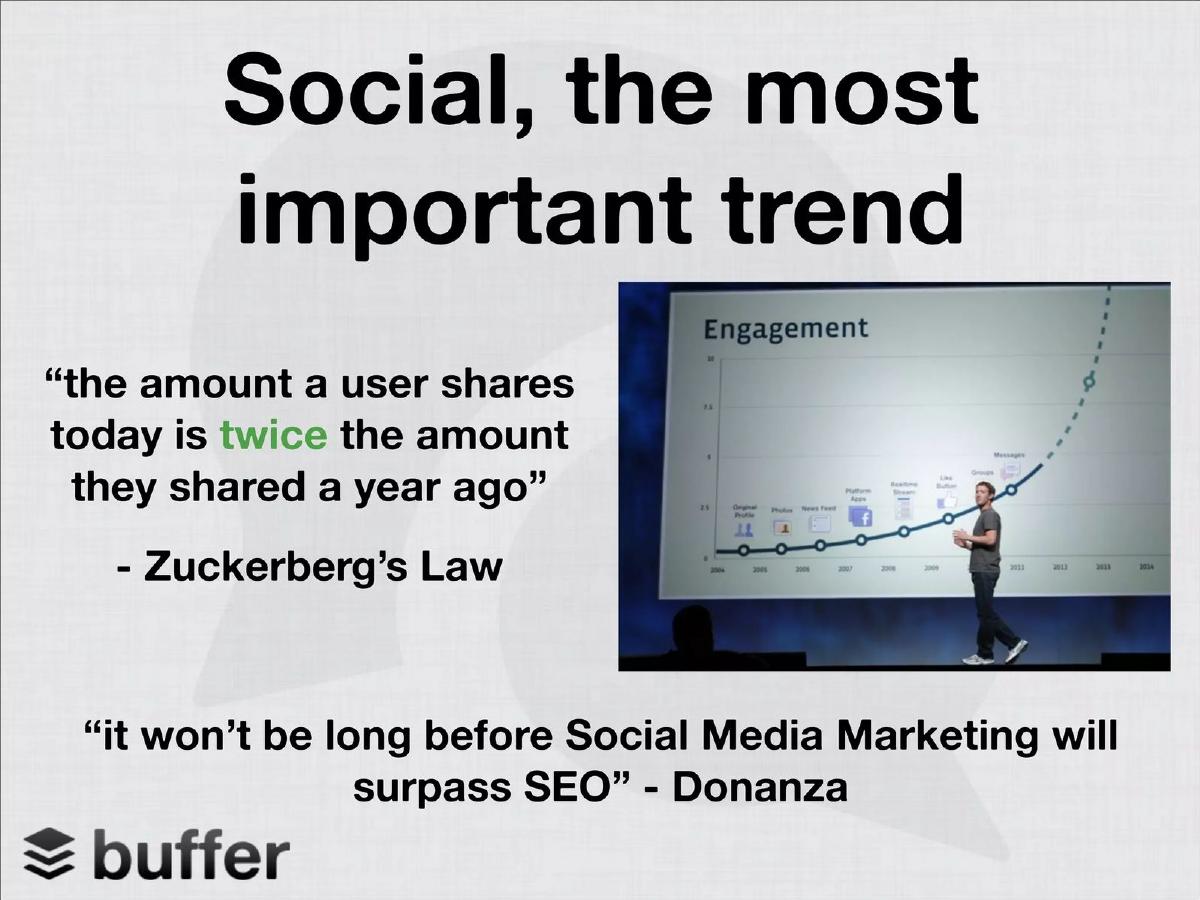
The deck opens not with a user’s pain point, but with a macro trend. It presents quotes about the exponential growth of social sharing from Mark Zuckerberg and the idea that social media marketing will surpass SEO. It then asks a simple question: “How do you use social to drive traffic?”
This is an unusual and, by today's standards, weak opening. It doesn't articulate a clear problem. A modern investor would expect a slide titled "The Problem" that details the specific agony of the target user. For Buffer, that problem was the inefficiency of social media marketing. You post a link, it gets a brief spike in traffic, and then it’s gone. To maintain a presence, you have to be online constantly, manually posting. The timing of those posts is guesswork. The result is a lot of effort for inconsistent results.
The deck implies this problem rather than stating it. It uses the macro trend of increased sharing to suggest a need for better tools. In 2011, when social media marketing was still a relatively new discipline, this was likely sufficient. The audience of investors was living this trend. They understood the context. Today, this would be a critical miss. You cannot assume an investor understands your customer’s pain. You must state it clearly, specifically, and with conviction.
The Solution
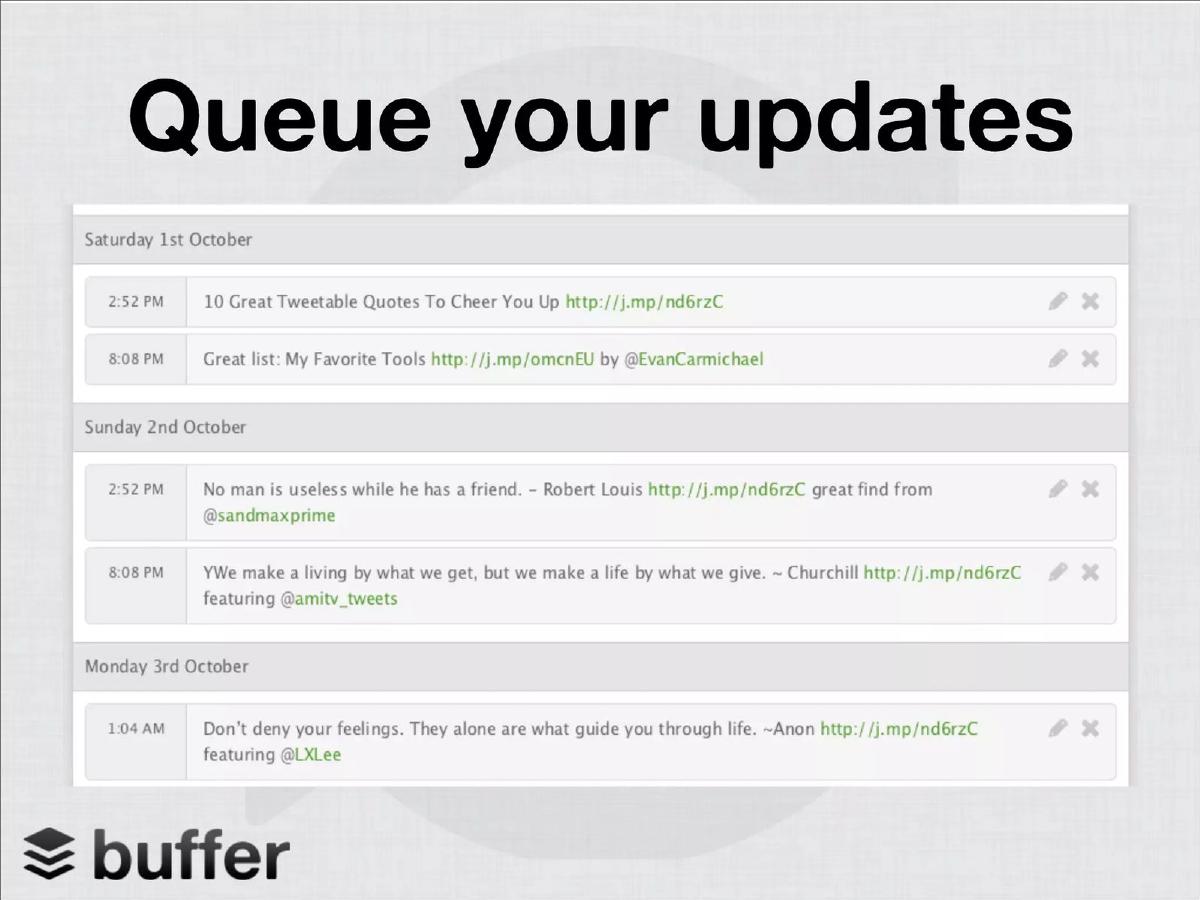
The solution is presented with extreme brevity: “Queue your updates.” That’s it. Three words. There are no screenshots, no mockups, no lengthy feature descriptions. This is followed later by another slide, “The effect of Buffering,” which makes a specific claim based on their own data:
This pairing of a simple action (“queue”) with a powerful, quantifiable outcome (“200% more clicks”) is the core of the pitch. They are not selling a complex dashboard; they are selling a better result. The solution is not the software itself, but the outcome the software enables. It reframes the activity from “scheduling posts” to “getting more traffic.”
This is a lesson in focus. The temptation for early-stage founders is to list every feature they have built or plan to build. Buffer resisted this. They identified the single most compelling part of their value proposition and put it front and center. The simplicity is effective. It leaves no room for confusion. The investor immediately understands the core utility of the product. While it would need more visual support in a 2026 pitch, the principle of leading with a simple verb and a quantifiable benefit remains powerful.
The Market
Buffer’s approach to market sizing is entirely top-down and trend-based. The “Social Media Landscape” slide is a collection of impressive, but vague, statistics:
Of 200M daily Tweets, 55% contain links · 4 billion items shared on Facebook per day · Zuckerberg’s Law shows exponential growth of sharing · Traffic through social is soon to surpass traffic from search
This is not a market sizing analysis; it is a market justification. They are not calculating a Total Addressable Market (TAM) in dollars. They are simply stating that the river of social media content is turning into a flood, and they are selling buckets. In 2011, for a utility tool that cost a few dollars a month, this was enough. The sheer scale of the platforms (Twitter, Facebook) provided all the market validation needed.
This would not fly today. An investor in 2026 would demand a bottom-up analysis. How many potential users are there (e.g., social media managers, small business owners, content creators)? What is their willingness to pay? This leads to a Serviceable Addressable Market (SAM) and a Serviceable Obtainable Market (SOM). You have to show not just that a market is large, but that you have a credible plan to capture a specific, valuable segment of it. Relying on "Zuckerberg's Law" is no longer a substitute for rigorous market math.
The Product
The deck dedicates very little space to the product itself. Beyond the "Queue your updates" slide, the only other product-focused slide is titled "A sharing standard." This slide reveals a much larger vision. It lists existing integrations and highlights conversations with major apps like Reeder, Pocket, and Feedly. Their goal was explicit:
This is the most strategic slide in the deck. It repositions Buffer from a simple SaaS tool for end-users to a potential infrastructure player. They weren’t just building a destination; they were building a utility that could be embedded everywhere. This is a classic platform play. By integrating the "Buffer" button into other apps, they could acquire users, increase utility, and build a powerful moat.
This was an incredibly savvy move. It answered the unspoken question: "How does this simple feature become a big business?" The answer was through distribution and integration, becoming a fundamental part of the content-sharing ecosystem. It showed investors a vision far larger than a scheduling tool. While the deck lacked product screenshots, it made up for it by clearly articulating a brilliant product and distribution strategy.
The Business Model
This is where the deck truly shines and separates itself from the vast majority of seed-stage pitches, both then and now. The "Business Model" slide is a crisp, data-driven summary of their engine for growth.
Freemium model with consistent 2% conversion from Free to Paid plans · 5% churn equates to a LTV of $240 and allows us to pay up to $5 to acquire a free user · At 1M users, our projected revenue is $3.6M
This is exceptional for a seed-stage company. Most founders talk about wanting to use a freemium model. Buffer came to investors with proof that it worked. They knew their conversion rate (2%), their churn rate (5%), and had calculated the resulting Lifetime Value (LTV) of a customer ($240). Crucially, this allowed them to define an allowable Customer Acquisition Cost (CAC). They knew they could spend up to $5 to acquire a free user and still run a profitable model. This demonstrates a level of financial and operational discipline that is rare at this stage.
This slide de-risked the investment significantly. It showed that the business was not a guessing game. It was a machine with understandable inputs and predictable outputs. Add more free users at the top of the funnel for less than $5 each, and the machine produces revenue. The projection of $3.6M at 1M users wasn't a fantasy; it was simple math based on their proven conversion rate. This is what gives investors confidence to write a check.
Traction and Validation
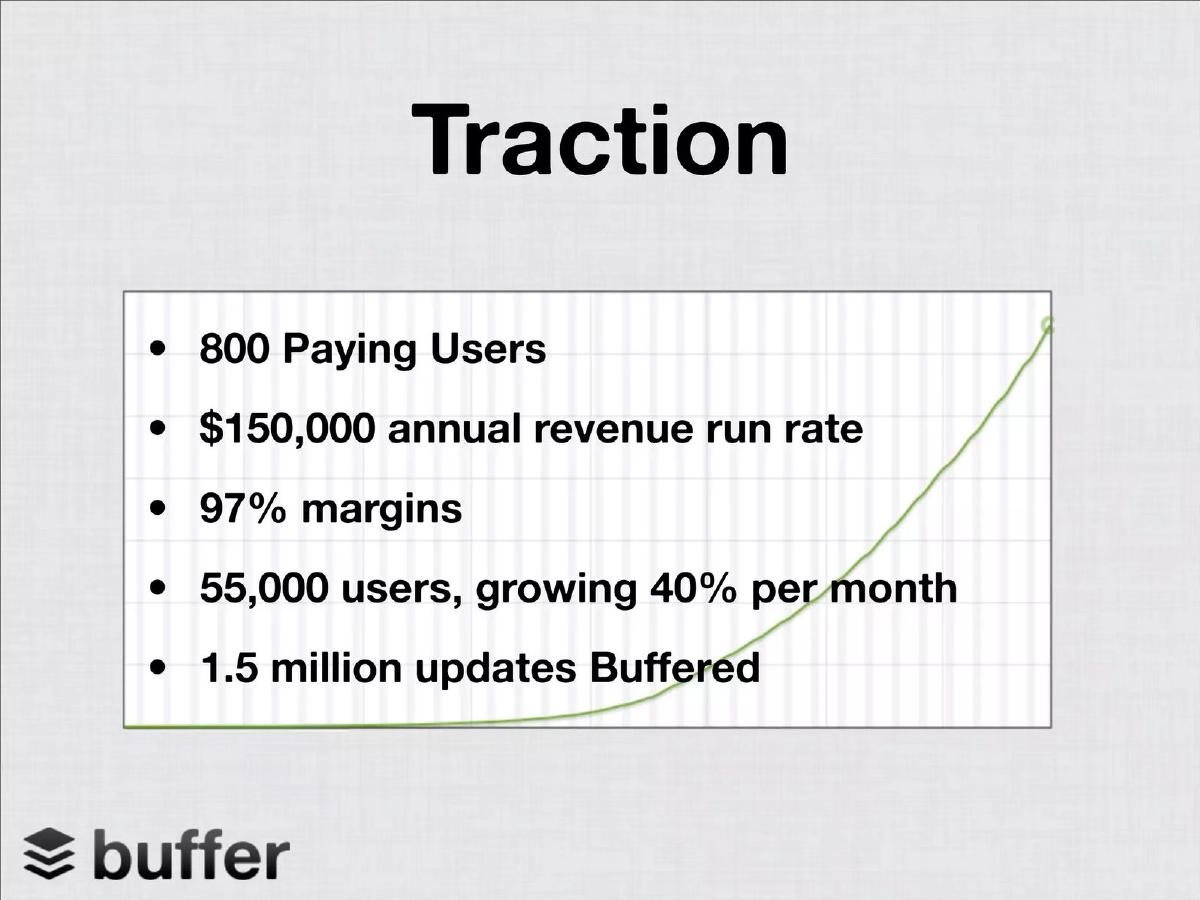
If the business model slide was the brain, the traction slide was the heart of the pitch. The numbers speak for themselves:
800 Paying Users · $150,000 annual revenue run rate · 97% margins · 55,000 users, growing 40% per month · 1.5 million updates Buffered
These metrics are phenomenal for a seed round, especially in 2011. A $150k ARR is a business, not an experiment. It proves people are willing to pay for the solution. A 40% month-over-month user growth rate signaled strong product-market fit and an effective marketing engine. The 97% margins highlighted the capital efficiency of a pure software business. This single slide likely did 80% of the work in getting the deal done. It is irrefutable proof that the founders had built something people wanted and were willing to pay for.
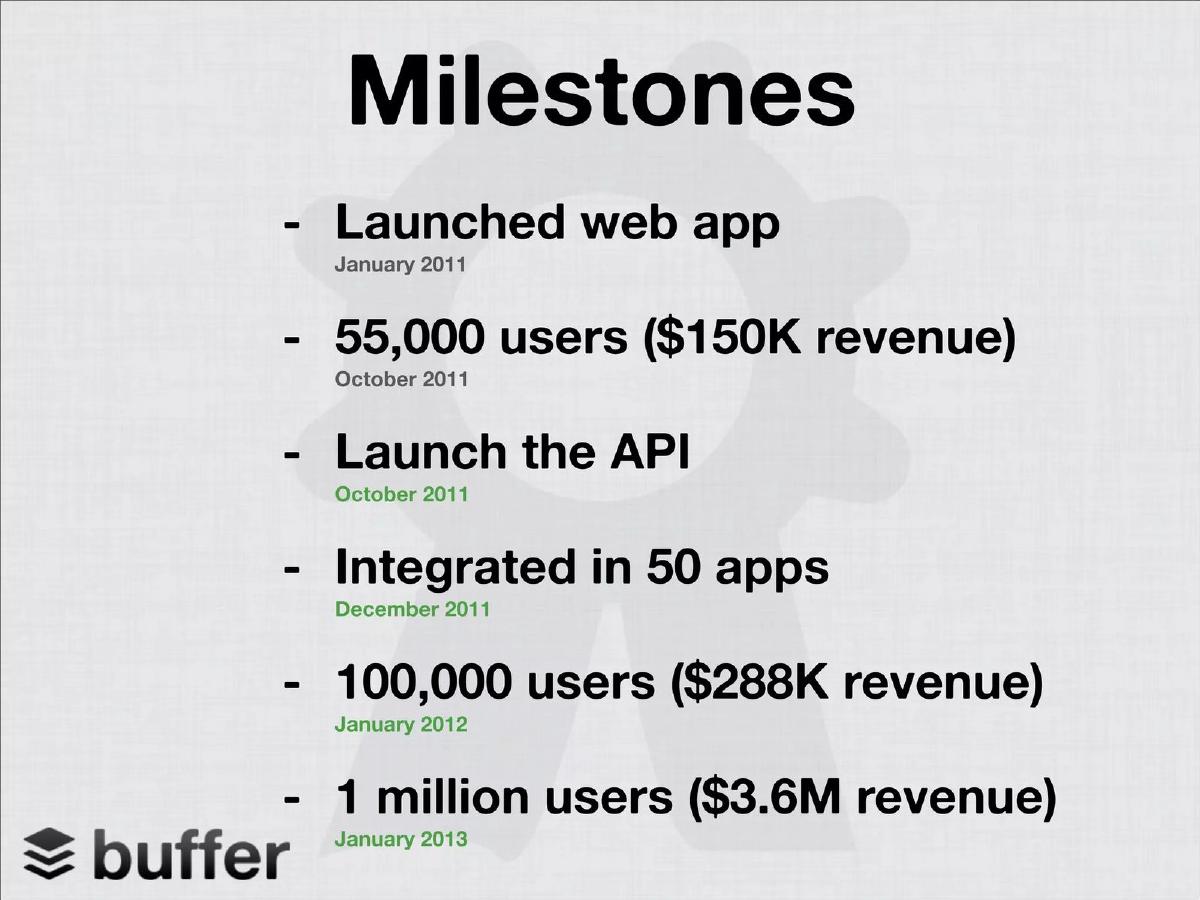
The "Milestones" slide reinforces this narrative by showing a timeline of execution. It charts their progress from launch in January 2011 to 55,000 users by October 2011. It then lays out future revenue and user goals. This creates a powerful sense of momentum. It shows that the founders set goals and hit them. When they project reaching 1 million users and $3.6M in revenue, it feels achievable because it is anchored to a track record of past performance.
The Competition
Buffer's competition slide is effective because it demonstrates strategic thinking, not fear. They break the landscape into four distinct categories: Dashboards (e.g., Hootsuite), Intelligent sharing (e.g., SocialFlow), Publishers (e.g., Shareaholic), and Scheduling apps. They place themselves in three of these categories, acknowledging they compete on multiple fronts.
The most important part of the slide is the explicit statement of their differentiation: "Our differentiation: a platform approach." This connects directly back to the "sharing standard" product slide. They are not trying to out-feature Hootsuite or build a better scheduling algorithm than SocialFlow. Their strategy is to bypass direct competition by becoming an integrated utility within the ecosystem. This shows a deep understanding of the market and a clear, defensible strategy. It tells investors they are not just another "me-too" product. They have a unique angle of attack.
The Team
The team slide is a model of efficiency and impact. It presents the two co-founders, Joel Gascoigne and Leo Widrich, and connects them directly to the company's key achievements:
Joel Gascoigne: Co-Founder, took the idea to revenue in 7 weeks, Masters in CS · Leo Widrich: Co-Founder, marketeer, took Buffer from 200 to 55,000 users
This is how a founding team should be presented. It's not about their degrees or previous employers in the abstract. It's about what they have accomplished with Buffer. Joel is the builder who can ship and generate revenue quickly. Leo is the marketer who can acquire users at scale. It’s the classic hacker and hustler pairing, and the slide provides concrete proof of their capabilities. This isn’t a resume; it's a record of performance.
The addition of high-profile advisors like Guy Kawasaki (Apple's former Chief Evangelist) and Hiten Shah (co-founder of KISSmetrics and CrazyEgg) lent significant third-party validation. These were respected figures in the tech world, and their association signaled that knowledgeable insiders believed in the team and the product. It was a powerful form of social proof.
The Ask
The deck has a glaring omission: there is no "Ask" slide. The final slide is simply an email address. The deck does not state how much money the founders are seeking, what valuation they are targeting, or how they plan to spend the funds. This is a cardinal sin in fundraising. For this deck to be used in an actual pitch meeting, a slide detailing the raise amount (which we know was ~$450k), the proposed use of funds (e.g., hiring 2 engineers, marketing spend), and the resulting runway would have been required.
While the Milestones slide gives a sense of the roadmap, it is not a budget. Investors need to know precisely how their capital will be deployed to achieve the next set of goals. Leaving this out creates uncertainty and forces the investor to ask basic questions that should have been proactively answered. It’s the one part of this otherwise solid deck that is a clear misstep.
What Worked
Unambiguous Traction: $150k ARR and 40% MoM user growth was undeniable proof of product-market fit. This was the centerpiece of the entire pitch. · Crystal-Clear Unit Economics: Demonstrating a deep understanding of LTV, churn, conversion, and allowable CAC showed a level of operational rigor that is rare at seed stage. · Focused Value Proposition: The "Queue your updates" solution paired with the "200% more clicks" outcome was a simple, powerful, and easy-to-understand message. · A Vision Beyond the Product: The "sharing standard" strategy showed investors a path to becoming an essential piece of internet infrastructure, not just another SaaS app. · Execution-Focused Team Narrative: The founders were defined by what they had already built and achieved, making them a proven commodity, not a speculative bet. · Strategic Competitive Framing: They didn't just list competitors; they segmented the market and used their unique "platform approach" to define a defensible position.
What Would Fail in 2026
No Explicit "Ask" or "Use of Funds": Showing up to a pitch today without a slide that clearly states how much you're raising and how you'll spend it is a non-starter. · Top-Down, Trend-Based Market Sizing: Citing "Zuckerberg's Law" would be seen as lazy. Investors now demand a rigorous, bottom-up TAM/SAM/SOM analysis. · Lack of Financial Projections: Beyond a single revenue projection, the deck contains no forecast model (P&L, cash flow). A basic 18-24 month projection is now standard for a seed round. · Absence of Product Visuals: A text-only description of the solution is no longer sufficient. A modern deck would require polished product screenshots, a UI/UX walkthrough, or a link to a live demo. · The Implied Valuation: A company with $150k ARR and 40% MoM growth would be raising a much larger seed round (likely $2M-$4M) at a valuation well north of $10M in today's market, not $450k.
Lessons for Founders Raising in 2026
Traction Is the Ultimate De-risker: Stop optimizing your pitch deck and start optimizing your revenue. The single best thing you can bring to a fundraise is a cohort of customers who are happily paying you. · Master Your Unit Economics Early: Know your LTV, CAC, churn, and payback period. Building a spreadsheet model isn't just for investors; it's the dashboard for your business. Buffer knew their numbers in 2011; it is non-negotiable today. · Sell the Outcome, Not the Features: Users—and investors—buy a better version of themselves. Buffer sold "200% more clicks," not a "scheduling tool." Define and quantify the transformation your product provides. · Show, Don't Just Tell, Your Team's Strength: Frame your team slide around what you have tangibly accomplished together. "Grew from 0 to $150k ARR in 10 months" is infinitely more powerful than a list of logos from previous jobs. · Have a Clear Platform Strategy: Even if you start with a simple tool, demonstrate how it serves as a wedge into a larger, defensible market. Are you a tool, or are you the start of an ecosystem? Investors fund the latter. · State Your Ask Unambiguously: Do not make investors guess. Tell them exactly how much you need, what specific milestones you will hit with that capital, and how long it will last you. Confidence comes from clarity.
The Buffer seed deck is a study in authenticity. It is unadorned, direct, and ruthlessly focused on what matters: proof. In an era when many founders believe fundraising is about storytelling and vision-casting, this deck is a powerful reminder that the most compelling story is one that is already backed by data. Joel and Leo weren't selling a dream; they were selling a finely tuned engine and asking for just enough fuel to get to the next level. While some elements are dated, its core lesson is timeless. Build a great business first. The fundraising will follow.
Frequently asked questions
- What was the strongest part of the Buffer deck?
- The Traction slide, without question. Showing $150,000 in annual recurring revenue and 40% month-over-month user growth in 2011 was definitive proof of product-market fit. Investors invest in lines, not dots, and Buffer showed a steep line going up and to the right.
- How would this deck perform in today's (2024-2026) seed market?
- With these metrics—$150K ARR, 97% margins, and strong growth—Buffer would raise a much larger seed round today, likely in the $2M-$4M range. However, investors would push harder on defensibility against larger platforms and the vague problem statement. The deck would need a stronger narrative upfront.
- What was the deck's biggest weakness?
- The opening slides. 'Social, the most important trend' is not a problem. It's a generic observation anyone could make. The deck fails to define a specific pain point for a specific user and only worked because the later traction slides were so undeniable.
- How did Buffer overcome the crowded competitive landscape?
- By defining a unique position. Instead of competing head-to-head as another dashboard, they framed Buffer as a 'sharing standard'—a fundamental utility that other apps would integrate. The plan to launch an API and partner with apps like Pocket and Feedly made this vision credible.
- What can founders learn from Buffer's business model slide?
- Know your numbers cold. Buffer did not just show revenue; they showed the engine behind it: 2% freemium conversion, 5% churn, and a resulting LTV of $240. This proved they understood their customer acquisition and retention economics, which is the core of any sustainable SaaS business.