The April 2014 deck for Bitcoin Shop, Inc. (now BTCS) serves as a bridge between traditional ecommerce and the then-nascent virtual currency market. Operating as an inventory-light drop-shipper, the company leveraged vendor resources to offer over 140,000 products for Bitcoin. The deck focuses heavily on market education, dedicating significant space to the U.S. online retail forecast ($279 billion by 2015) and the market caps of early altcoins like Peercoin and Dogecoin. While it lacks specific unit economics or a detailed financial ask, it leans on its status as one of the first U.S. public…
Key takeaways
- The company positioned itself as an inventory-light business, leveraging vendor logistics to scale without capital-intensive infrastructure (Slide 3).
- At the time of the presentation, the platform offered over 140,000 products across 400 categories (Slide 19).
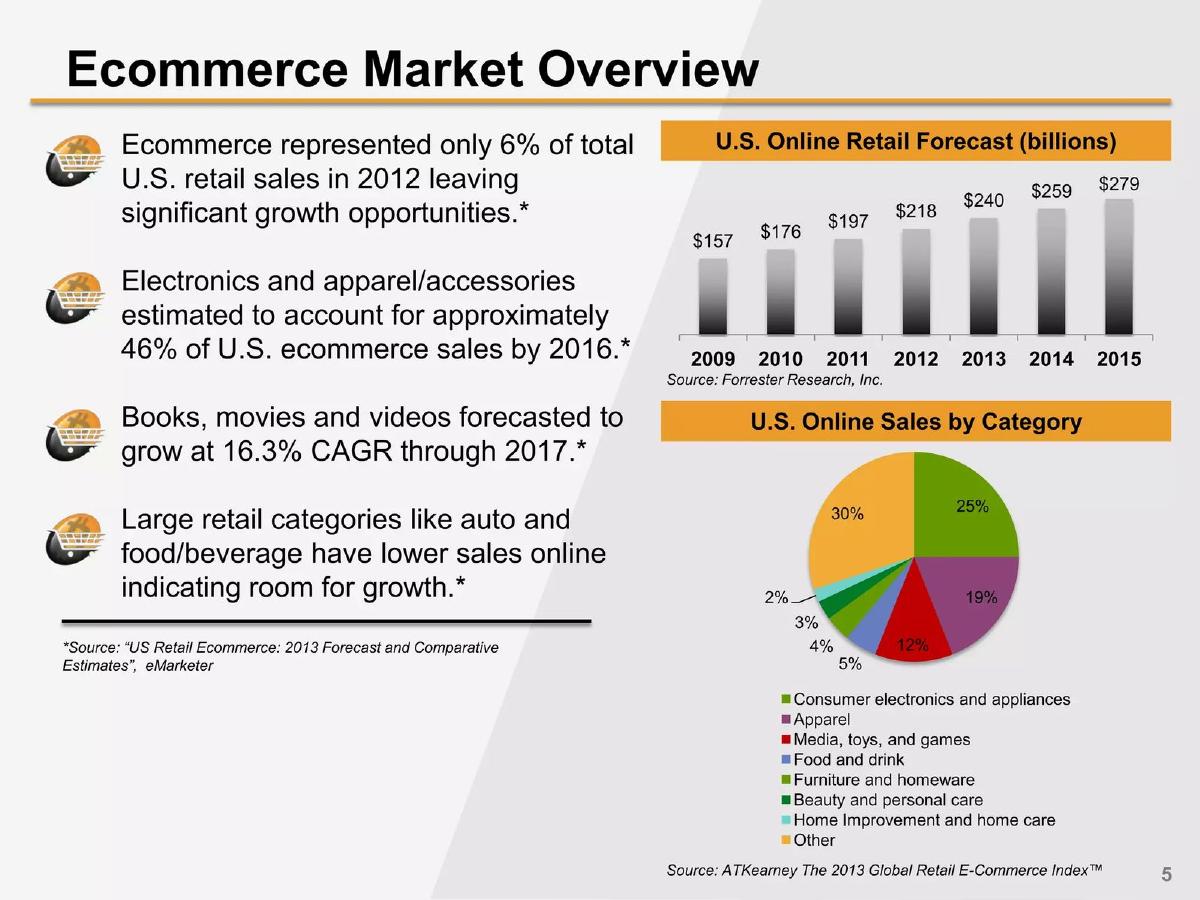
- The deck relies on 2012-2013 data to project a $279 billion U.S. online retail market by 2015 (Slide 5).
- BTCS provided a rare comparison of 2014-era 'virtual currencies,' including Nxt and DogeCoin, when Bitcoin's market cap was just under $10 billion (Slide 7).
- The business model acted as a middleman between major retailers like Amazon and Walmart and customers wanting to spend crypto (Slide 11).
- Competitive positioning placed the company as a high-convenience, mid-price alternative compared to Overstock.com and TigerDirect (Slide 13).
- The deck omits a specific funding ask, valuation, or detailed team biographies, focusing instead on high-level corporate strategy (Slide 17).
- Growth was predicated on diversifying the vendor base and expanding into new global geographies based on currency acceptance (Slide 17).
Introduction: The 2014 Crypto-Commerce Time Capsule
The April 2014 corporate presentation for Bitcoin Shop, Inc. (OTCQB: BTCS) is a fascinating look at the early attempts to commercialize blockchain technology. At a time when Bitcoin was primarily viewed as a speculative asset or a niche experiment, BTCS was attempting to build a functional bridge to mainstream retail. This teardown examines how the company pitched a 'middleman' ecommerce model to investors during the first major wave of crypto volatility.
Slide 1: Title and Public Status
The cover slide establishes the company's identity as Bitcoin Shop, Inc. and prominently displays its ticker symbol, otcqb: BTCS . The date, April 2014, is critical context; this was just months after the Mt. Gox collapse, a period of intense scrutiny for the industry. The logo, featuring a shopping cart superimposed on a Bitcoin symbol, clearly communicates the core value proposition: crypto-enabled commerce.
Slide 3: Investment Highlights
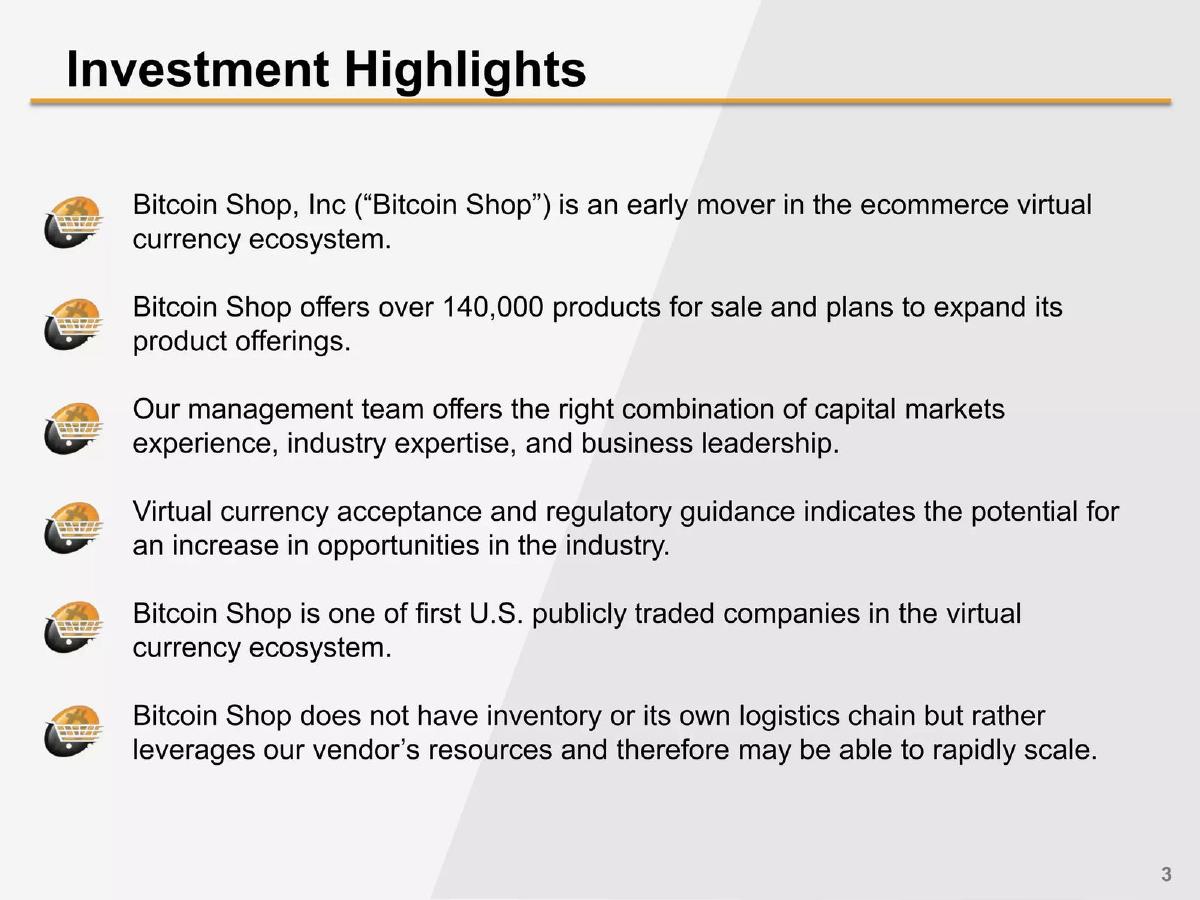
This slide serves as the executive summary. The company identifies as an 'early mover' and emphasizes its scale, claiming to offer over 140,000 products . A key operational detail is revealed here: the company does not have inventory or its own logistics chain . By leveraging vendor resources, they argue they can 'rapidly scale.' This is a classic drop-shipping pitch, rebranded for the virtual currency era. They also lean heavily on their status as one of the first U.S. publicly traded companies in the space, which was a significant differentiator for institutional investors seeking regulated exposure to crypto.
Slide 5: Ecommerce Market Overview
BTCS spends significant time justifying the 'Ecommerce' half of their name. Citing Forrester Research and eMarketer, they note that ecommerce represented only 6% of total U.S. retail sales in 2012 . The slide includes a bar chart projecting U.S. online retail to reach $279 billion by 2015 . By highlighting that large categories like auto and food/beverage have low online penetration, they suggest a massive 'room for growth.' This slide is standard market-sizing, intended to show that the underlying 'container' for their business is expanding rapidly.
Slide 7: Virtual Currency Landscape
This is perhaps the most historically significant slide in the deck. It provides a snapshot of the market as of February 4, 2014 . It lists six currencies, including DogeCoin (DOGE) with a market cap of $58.6 million and Bitcoin (BTC) at $9.98 billion. The 'Features' column is particularly telling of the era's sentiment, describing Peercoin as 'socially responsible' due to its energy-efficient algorithm and Nxt as the 'first nationally sponsored currency (Cyprus).' For a 2014 investor, this slide acted as an educational primer on the 'altcoin' market.
Slide 9: Bitcoin Ecommerce Overview
This slide maps the ecosystem. It places Bitcoin Shop, Inc. at the center of a flow between Payment Processors (BitPay, Coinbase, GoCoin), Major Retailers (Overstock, TigerDirect, OkCupid), and Bitcoin Shoppers . It visualizes the company's role as the connective tissue in a fragmented market. It is interesting to note the inclusion of competitors like Overstock.com in this ecosystem map, suggesting that BTCS viewed the growth of any crypto-accepting merchant as a net positive for the 'ecosystem' they inhabited.
Slide 11: Company Profile – What We Do
This slide clarifies the mechanics of the business. The company provides a 'seamless shopping and transaction experience' for users who have 'few alternatives' for spending virtual currency. The diagram shows Amazon as an 'Existing Seller' and lists Best Buy, Target, PetSmart, JCPenney, and Walmart as 'Targeted Sellers.' The implication is that BTCS acts as a gateway, allowing users to effectively spend Bitcoin at these major retailers by acting as the purchasing agent.
Slide 13: Competitive Landscape
The competitive matrix uses 'Price' and 'Convenience' as its axes. BTCS positions itself in the High Convenience quadrant, grouped with 'Major Online Retailers' like Overstock.com. They distance themselves from 'Branded Sites' (like bitcoinstore) and 'Liquidators' (like BitDazzle), which they categorize as having lower convenience. This positioning is meant to signal that BTCS is a 'one-stop-shop' rather than a niche or discount outlet.
Slide 15: Customer Information and Feedback
To prove traction and product-market fit, Slide 15 shows 'Fun Orders' and 'Customer Feedback.' The 'Fun Orders' list includes items like a 578lb gun safe (Heaviest) and Lady Gaga Fame perfume (Most Fragrant). The feedback section includes quotes from customers like 'Anthony' and 'Nikki,' praising the prompt email service and the ability to work 'above the border.' While anecdotal, these testimonials aim to humanize the brand and prove that real people are using crypto for everyday (and unusual) purchases.
Slide 17: Growth Strategy
The growth strategy is presented as five bullet points. The focus is on diversifying the vendor base and expanding to new geographies . There is a mention of maintaining an 'agile and scalable technology platform,' but the slide lacks specifics on how these goals will be achieved. It is a high-level strategic roadmap rather than a tactical execution plan.
Slide 19: Summary
The deck concludes by reiterating the 'first mover advantage' and the 140,000 products across 400 categories . It reinforces the management team's 'capital markets experience' and the inventory-light model. The final takeaway for the investor is that BTCS is a scalable, public vehicle for capturing the growth of both ecommerce and virtual currency.
What Works in This Deck
Clarity of Model: The deck does an excellent job of explaining the drop-shipping model without using jargon. By showing the logos of Amazon and Walmart, they make a complex crypto-transaction layer feel familiar to traditional investors.
Market Education: In 2014, most investors didn't know what a 'Litecoin' was. Slide 7 provides a necessary and concise comparison table that adds legitimacy to the broader asset class, not just the company.
Asset-Light Positioning: Emphasizing that they don't hold inventory (Slide 3 and 19) was a smart move. It signaled to investors that the company could scale without the massive overhead typically associated with retail, focusing instead on the 'transactional' upside of crypto.
What Is Missing
The Team: While the summary mentions 'management team' expertise, there is no dedicated slide for the founders or board. In early-stage or emerging tech, the pedigree of the team is often the most important factor for investors.
Financial Performance: There are no slides showing revenue, transaction volume (GMV), or margins. For a company that was already publicly traded on the OTCQB, the absence of even basic top-line growth figures is a significant omission.
The Ask: The deck never explicitly states how much money is being raised or what the specific use of proceeds will be. This suggests the deck may have been used for general investor relations or 'roadshow' purposes rather than a specific private placement round.
Founder's Lessons
Use Ecosystem Maps: If you are building in a new or confusing sector, use a slide like Slide 9 to show where you sit in the value chain. It helps investors visualize your 'moat' and your dependencies.
Leverage Macro Trends: BTCS successfully tied their success to the growth of ecommerce as a whole (Slide 5). If your specific niche is small, show that the 'ocean' you are swimming in is huge.
Address Regulatory Headwinds: The deck mentions 'regulatory guidance' as a highlight (Slide 3). For any startup in a 'grey' area (like crypto in 2014 or AI today), acknowledging the regulatory environment is a sign of maturity that investors appreciate.
Final Note: This deck is a reminder that being 'first' is a powerful narrative, but it must eventually be backed by the unit economics and team details that this specific presentation left out.
Frequently asked questions
- What was the primary business model of Bitcoin Shop in 2014?
- Bitcoin Shop operated as a drop-shipping ecommerce platform. According to Slide 3 and Slide 11, the company did not hold its own inventory or manage a logistics chain. Instead, it acted as a transaction layer, allowing customers to purchase products from major retailers like Amazon, Target, and Walmart using virtual currencies, while leveraging those retailers' existing fulfillment infrastructure.
- How did the company differentiate itself from competitors like Overstock?
- On Slide 13, the company used a 2x2 matrix of 'Price to Convenience.' It positioned itself alongside Overstock.com in the 'High Convenience' category but suggested a slightly different price point. Unlike specialty retailers or liquidators like BitDazzle, Bitcoin Shop aimed for the 'Major Online Retailer' segment by offering a massive catalog of 140,000+ products.
- What virtual currencies did the platform support or track at the time?
- Slide 7 provides a snapshot of the 'Virtual Currency Landscape' as of February 2014. It lists Bitcoin (BTC), Ripples (XRP), Litecoin (LTC), Peercoin (PPC), Nxt (NXT), and DogeCoin (DOGE). The slide notes Bitcoin as the 'first and biggest player' with a market cap of approximately $9.98 billion at the time.
- What are the most notable omissions in this pitch deck?
- The deck is missing several standard venture components. There is no 'Team' slide detailing the specific backgrounds of the management team, no 'Financials' slide showing historical revenue or burn, and no 'The Ask' slide indicating how much capital they were raising or at what valuation. It functions more as a corporate overview for public market investors than a traditional startup pitch.
- What was the stated growth strategy for the company?
- According to Slide 17, the growth strategy focused on five pillars: diversifying the vendor and customer base, developing exclusive vendor relationships, expanding into new global geographies, maintaining an agile technology platform, and leveraging customer testimonials to build a 'solid reputation' in a skeptical market.