The BrowserStack deck is a high-signal, low-noise presentation that prioritizes traction and market positioning over traditional problem-solution narratives. With only 9 slides, it manages to showcase a decade of growth, culminating in 4 million registered users and a presence in more than half of the Fortune 500. The deck is notably light on financial specifics, unit economics, and a formal 'ask,' suggesting it was used as a high-level overview for a late-stage round where the company's reputation preceded it. It relies on massive social proof—citing logos like Amazon, Google, and Microsoft—…
Key takeaways
- The company claims a massive developer footprint with 4 million registered users and 2,500 open source projects (Slide 3).
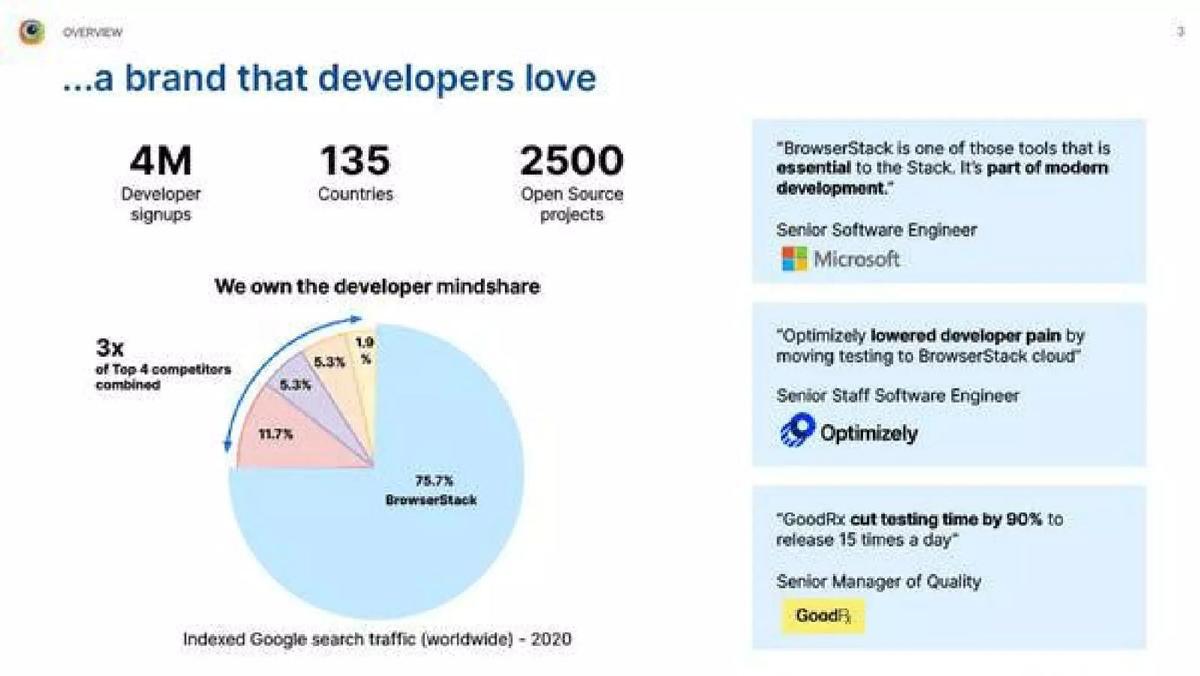
- BrowserStack uses Google search traffic data to claim 75.7% of developer mindshare compared to its top 4 competitors (Slide 3).
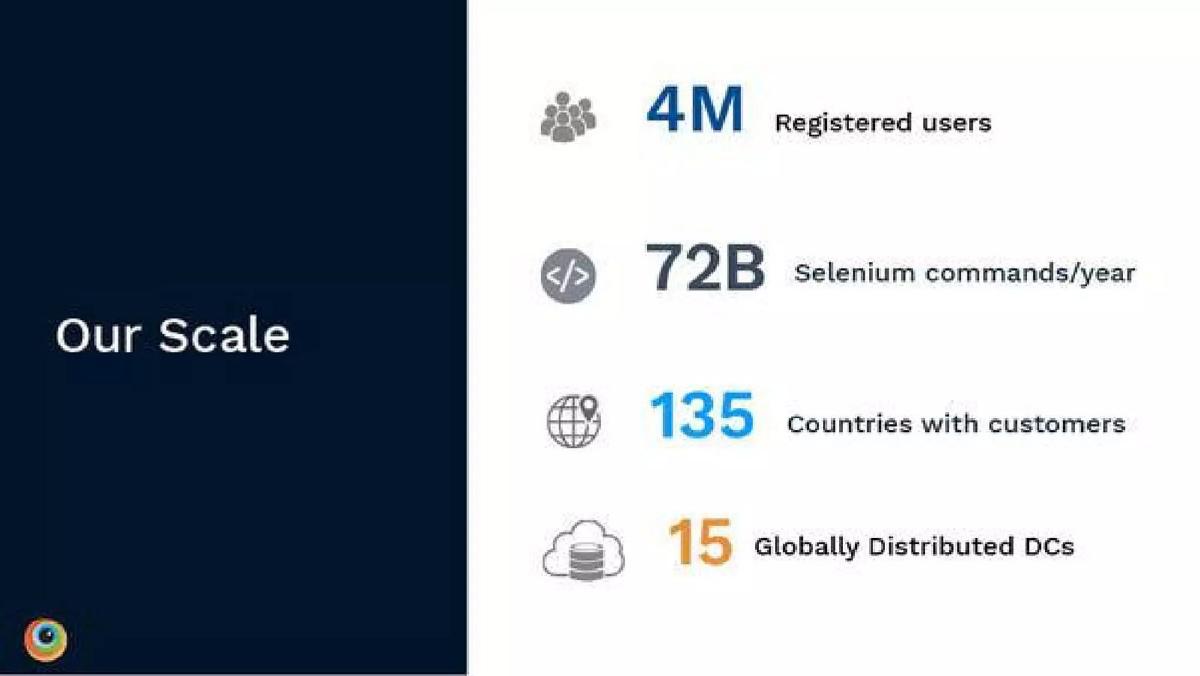
- Scale is quantified by 72 billion Selenium commands per year and 15 globally distributed data centers (Slide 4).
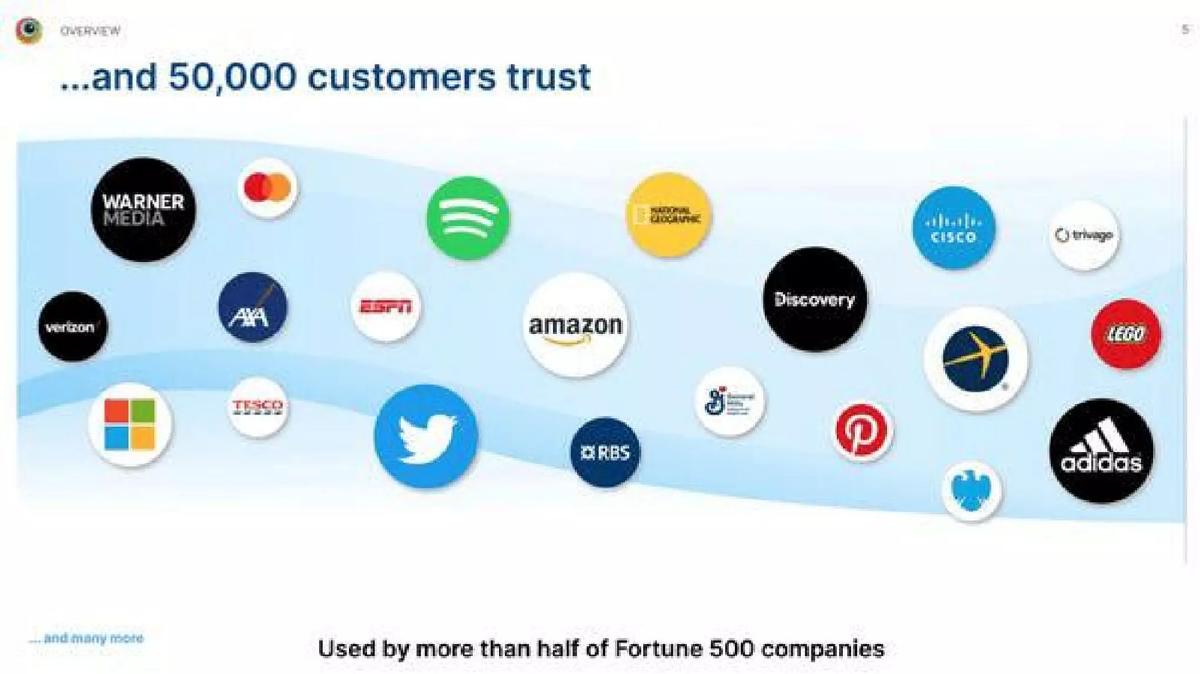
- The customer base includes over 50,000 organizations, including more than half of the Fortune 500 (Slide 5).
- Strategic positioning places BrowserStack as the 'Test' equivalent to Atlassian (Plan) and GitHub (Code) in the DevOps loop (Slide 7).
- The infrastructure supports 10,000 real devices and 2,500 UI combinations for testing (Slide 8).
- The deck highlights a history of capital efficiency, showing a 2018 Series A from Accel followed by the acquisition of Percy in 2020 (Slide 2).
- There is no mention of revenue, burn rate, or the specific dollar amount being raised in this deck (Omitted).
The Power of Market Dominance
BrowserStack’s pitch deck is a study in 'show, don’t tell.' For a company that had already achieved massive scale by the time this deck was produced, the goal wasn't to explain why software testing matters, but to prove that BrowserStack had already won the category. The deck is remarkably short at only 9 slides, yet it manages to overwhelm the reader with data points that suggest inevitability. By focusing on developer mindshare and Fortune 500 adoption, BrowserStack moves the conversation away from technical features and toward its status as a critical piece of global internet infrastructure.
Slide 1: Title Slide
The deck opens with a minimalist title slide featuring the BrowserStack logo against a background of what appears to be a modern glass office building or data center structure. There is no tagline or introductory text. This sets a professional, corporate tone, signaling that the company is past the 'scrappy startup' phase and is now an established enterprise player.
Slide 2: Timeline and Team
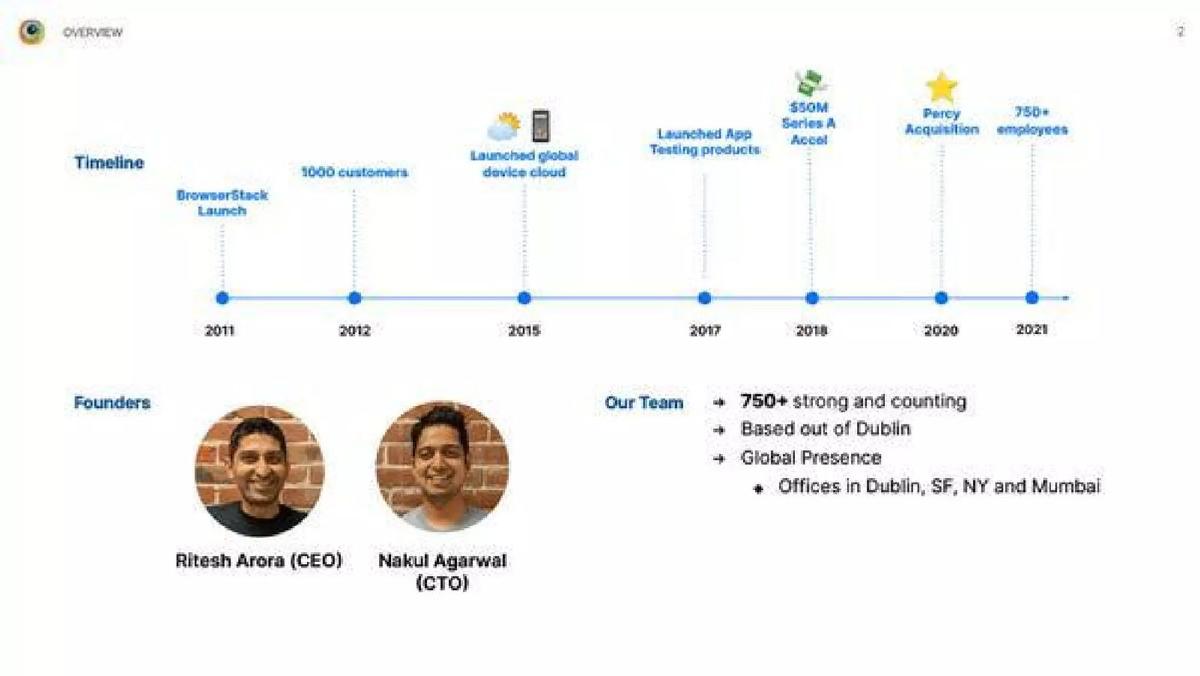
Slide 2 provides a comprehensive overview of the company’s journey. The timeline spans from the 2011 launch to 2021, highlighting key growth markers. Notable entries include reaching 1,000 customers just one year after launch (2012) and the 2018 Series A of $50M from Accel. The timeline also notes the acquisition of Percy in 2020, showing the company’s ability to grow through M&A. Below the timeline, the founders, Ritesh Arora (CEO) and Nakul Agarwal (CTO), are introduced alongside a note that the team is 750+ strong with a global presence in Dublin, San Francisco, New York, and Mumbai.
Slide 3: Developer Mindshare
This slide is perhaps the most aggressive in the deck. Under the header '...a brand that developers love,' it lists 4 million developer signups and 2,500 open source projects. The centerpiece is a pie chart of 'Indexed Google search traffic (worldwide) - 2020,' where BrowserStack claims 75.7% of the search volume. The slide explicitly states this is '3x of Top 4 competitors combined.' To anchor this data in reality, the right side of the slide features testimonials from Senior Engineers at Microsoft, Optimizely, and GoodRx, focusing on how the tool is 'essential to the Stack.'
Slide 4: Quantifying Scale
Slide 4, titled 'Our Scale,' uses four massive numbers to illustrate the platform's reach. It repeats the 4 million registered users figure but adds a staggering technical metric: 72 billion Selenium commands per year. It also notes customers in 135 countries and a physical infrastructure of 15 globally distributed data centers. This slide is designed to reassure investors of the platform's reliability and its ability to handle enterprise-grade workloads at a massive scale.
Slide 5: Enterprise Traction
If Slide 3 was about 'developer love,' Slide 5 is about 'corporate trust.' It features a 'wall of logos' including Warner Media, Mastercard, Spotify, Amazon, Twitter, and Adidas. The footer of the slide contains the most important claim: 'Used by more than half of Fortune 500 companies.' This demonstrates that BrowserStack has successfully navigated the transition from a developer tool to an enterprise-wide standard.
Slide 6: Cloud Provider Partnerships
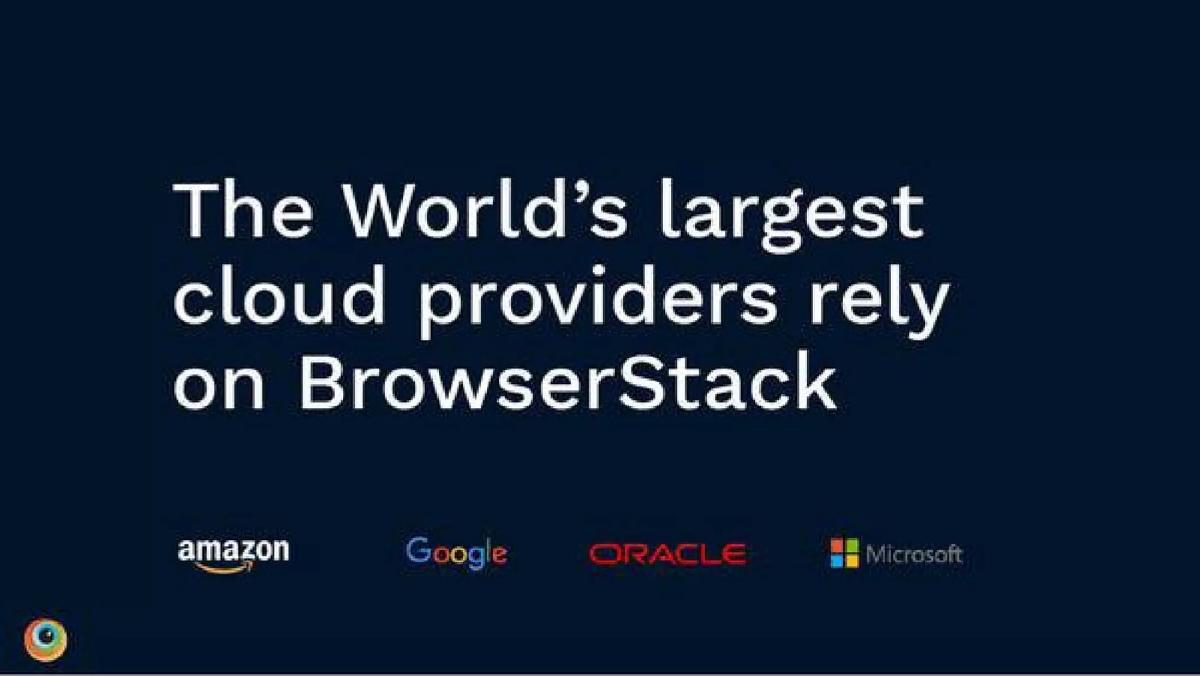
Slide 6 is a simple, high-impact statement: 'The World’s largest cloud providers rely on BrowserStack.' It features the logos of Amazon, Google, Oracle, and Microsoft. This is a strategic inclusion; if the companies building the world's cloud infrastructure are using BrowserStack to test their own software, it implies there is no higher tier of validation available.
Slide 7: The DevOps Loop
Slide 7 moves into strategic positioning. It uses the familiar infinity loop of DevOps (Plan, Code, Build, Test, Release, Deploy, Operate, Monitor) and places BrowserStack firmly in the 'Test' quadrant. It places other industry giants in their respective spots: Atlassian for Plan, GitHub/GitLab for Code/Build, AWS for Deploy, and Datadog for Monitor. The text at the bottom makes the analogy explicit: 'Like Atlassian is to plan and GitHub is to code, BrowserStack is to test!' This is a classic 'category king' argument.
Slide 8: The Unified Platform
Slide 8 details the product architecture. It describes a 'unified platform for Testing' that covers a wide array of use cases, from compatibility and visual testing to security and regression. It splits the offering into Manual Testing (Live, App Live, SpeedLab) and Automated Testing (Automate, App Automate, Percy). The bottom of the slide highlights the underlying infrastructure: 15 data centers, 10,000 real devices, and 2,500 UI combinations. This slide explains the 'how' behind the scale mentioned earlier.
Slide 9: Product Breakdown
The final slide provides a more granular look at the product suite. It categorizes offerings into Web testing, Mobile Application testing, and Free Tools. Each product (Live, Automate, Percy, App Live, App Automate) is given a brief description. The inclusion of free tools like 'Screenshots,' 'Responsive,' and 'SpeedLab' hints at the company’s product-led growth strategy, showing how they top-of-funnel developers before converting them to paid users.
What Works in This Deck
Unassailable Social Proof: The deck uses logos and testimonials from the world's largest tech companies (Amazon, Google, Microsoft) to create an aura of market leadership. When more than half of the Fortune 500 are customers, the 'risk' for an investor is significantly mitigated.
Clear Category Positioning: By placing themselves in the same DevOps loop as GitHub and Atlassian, BrowserStack isn't just asking to be seen as a 'testing tool.' They are positioning themselves as a fundamental pillar of the software development lifecycle, which justifies a much higher valuation.
Data-Driven Competition: Using Google search traffic as a proxy for market share is a clever way to show dominance without needing access to competitors' private financial data. It speaks to the 'mindshare' that is so critical in developer-focused businesses.
What Is Missing
Financials and Unit Economics: There is no mention of Revenue, ARR, Gross Margins, or Net Revenue Retention. While the '50,000 customers' figure is impressive, investors usually want to see the quality of that revenue and the efficiency of the sales motion (CAC/LTV).
The 'Ask': The deck does not state how much money the company is looking to raise or what the specific valuation expectations are. This suggests the deck was likely used for a Series B or later round where these details were handled in a separate data room or term sheet.
Future Roadmap: The deck focuses almost entirely on what BrowserStack has already built and achieved. There is very little information on where the company is going next—whether that is moving into new parts of the DevOps loop or expanding into new verticals.
What a Founder Should Copy
The 'Category King' Analogy: Founders should look at Slide 7. If you can convincingly place your logo next to the undisputed leaders of adjacent categories, you immediately elevate the perceived value of your company. It simplifies a complex product into a simple 'X for Y' mental model.
Quantifying Technical Scale: Don't just say your platform is 'scalable.' BrowserStack uses '72 billion Selenium commands' and '10,000 real devices.' Specific, large-scale technical metrics are much more persuasive to technical investors than vague adjectives.
Focusing on the 'Standard': If your product has high adoption, lean into the idea that you are the industry standard. BrowserStack’s use of search traffic data and Fortune 500 penetration creates a 'fear of missing out' (FOMO) for investors, as it suggests the market has already chosen a winner.
Frequently asked questions
- What is the primary value proposition of BrowserStack according to the deck?
- BrowserStack positions itself as a unified platform for both manual and automated testing. According to Slide 8, it provides the infrastructure (15 data centers and 10,000 real devices) to handle various use cases like compatibility, visual, and performance testing, allowing developers to move faster without maintaining their own device labs.
- How does BrowserStack compare itself to competitors?
- Rather than a feature-by-feature comparison, BrowserStack uses 'mindshare' as its primary competitive metric. Slide 3 shows an indexed Google search traffic chart where BrowserStack holds 75.7% of the volume, which it claims is 3x the top 4 competitors combined. This frames the company as the de facto industry standard.
- What major milestones are highlighted in the company's history?
- Slide 2 provides a timeline starting with the 2011 launch. Key milestones include reaching 1,000 customers in 2012, launching a global device cloud in 2015, a $50M Series A from Accel in 2018, the acquisition of Percy in 2020, and growing to over 750 employees by 2021.
- Which customer segments does BrowserStack serve?
- The deck emphasizes a dual-track success model: bottom-up developer love and top-down enterprise adoption. Slide 3 highlights 4 million developer signups, while Slide 5 showcases logos like Spotify, Amazon, and Mastercard, explicitly stating that more than half of the Fortune 500 uses the platform.
- What is missing from this pitch deck that investors usually expect?
- This deck is missing several standard components: a clear problem statement, financial projections, unit economics (CAC/LTV), a detailed competitive landscape, and a specific 'ask' or use of funds. Its brevity suggests it is a supplemental deck for a well-known company in a competitive bidding environment.