Bright.md presents a compelling case for healthcare automation by first dismantling the perceived solutions of the era: EMRs and video-based telehealth. The deck highlights a projected 130,600 physician shortage by 2025 and argues that video visits do not actually save clinician time. Their solution, SmartExam, claims to automate 90% of the work, reducing clinician time to under two minutes per encounter. With a 15-20x multiplier on physician capacity and a reported 90% patient satisfaction rate, the deck leans heavily on efficiency metrics and third-party validation from Gartner and Chilmark…
Key takeaways
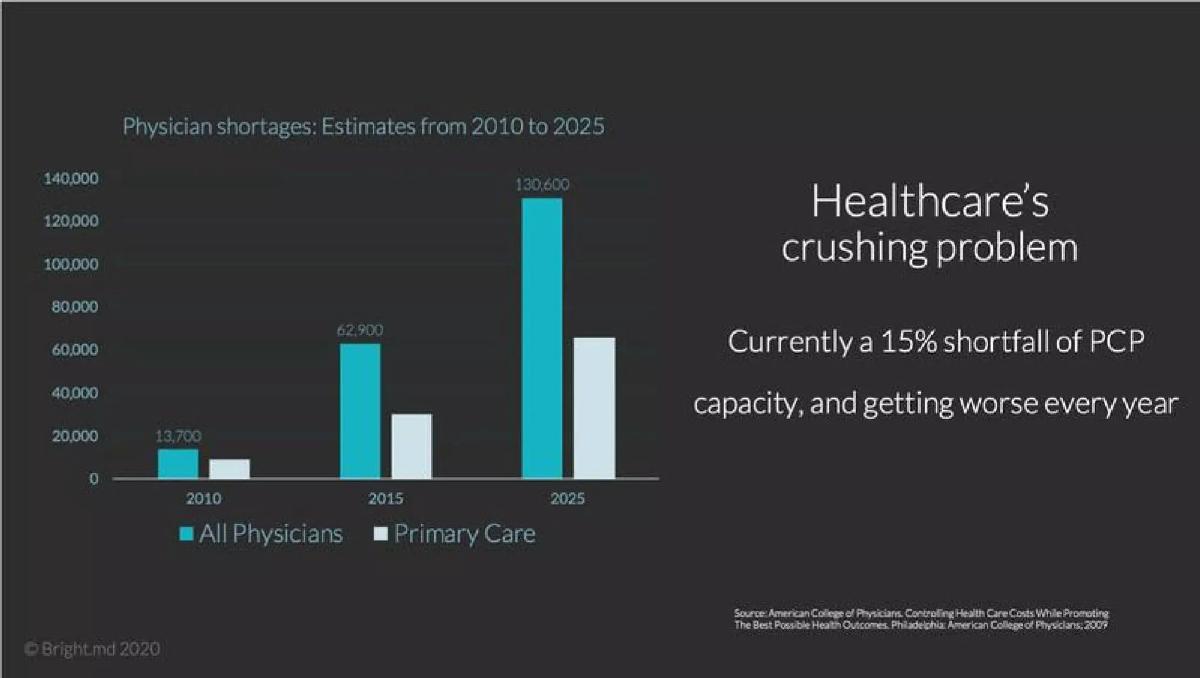
- The deck identifies a 15% shortfall in Primary Care Physician (PCP) capacity as the core market driver (Slide 3).
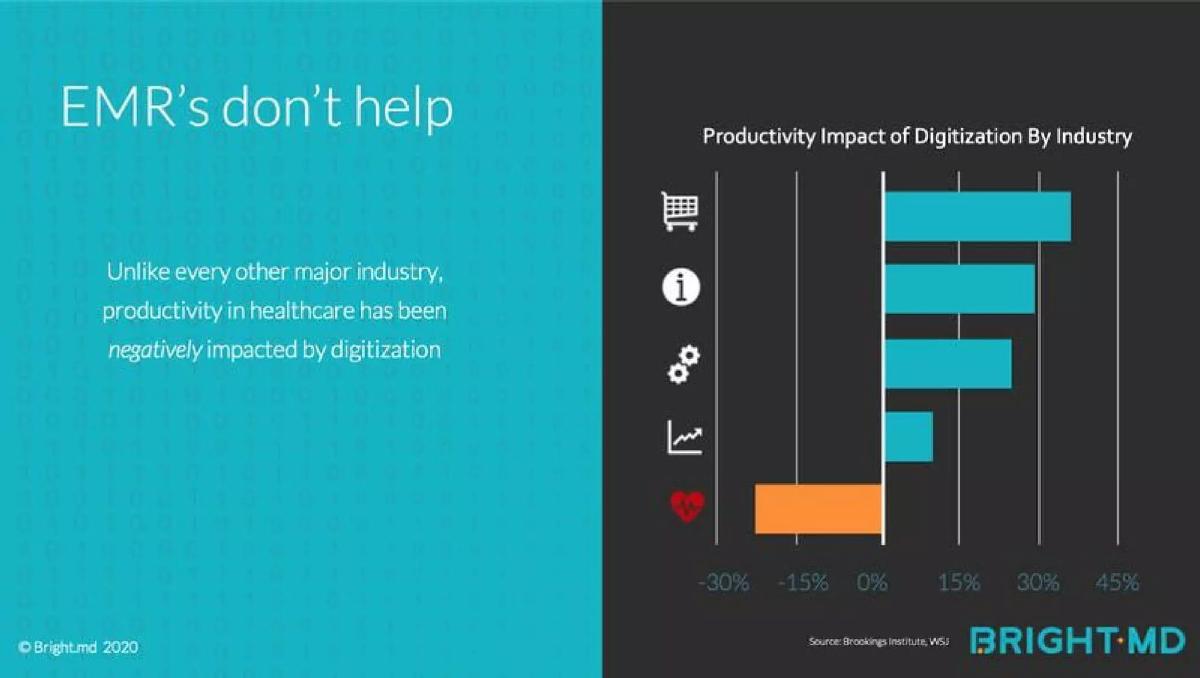
- It explicitly critiques current technology, stating that healthcare productivity has been negatively impacted by digitization unlike any other industry (Slide 4).
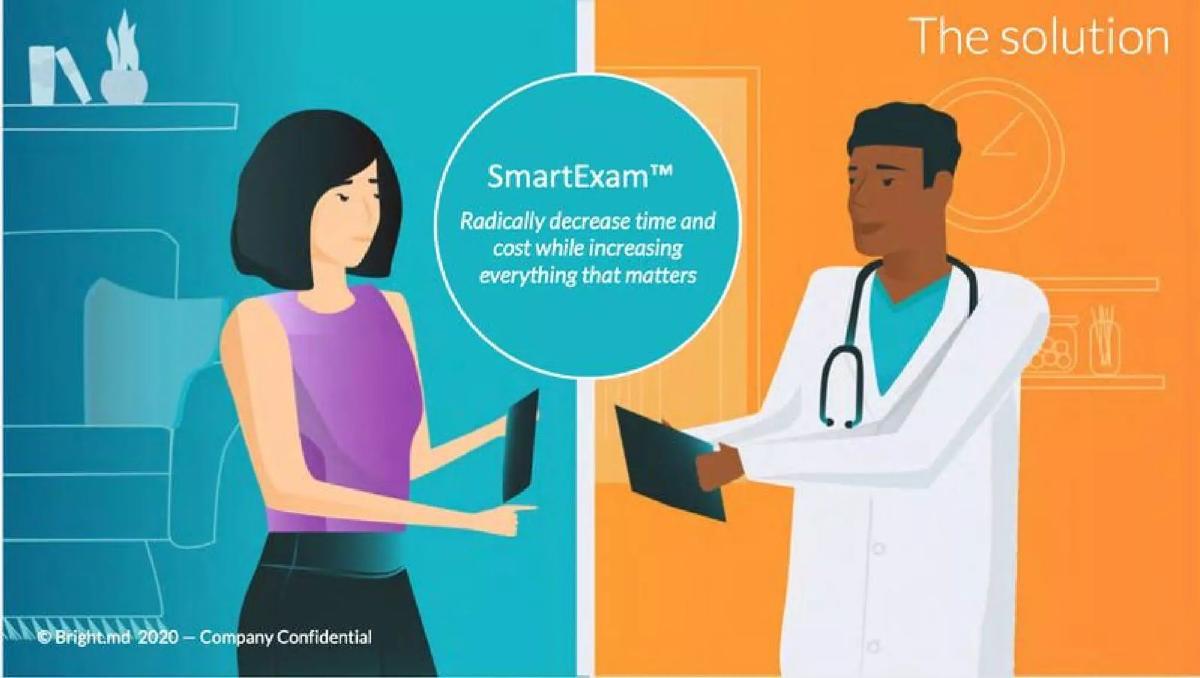
- The solution, SmartExam, is positioned as an automation tool that handles 90% of the administrative and clinical workflow (Slide 7).
- Efficiency gains are quantified as reducing clinician time to less than 2 minutes per encounter (Slide 7).
- The platform offers a 15-20x multiplier on physician capacity, a critical metric for scaling healthcare systems (Slide 11).
- Bright.md claims a positive ROI for healthcare systems in less than one year (Slide 12).
- The company leverages significant third-party validation, including being named a 'Gartner Cool Vendor' (Slide 17).
- The competitive landscape slide uses a bubble chart to show Bright.md as the high-efficiency, high-platform-scale leader (Slide 18).
Executive Summary: The Automation of Care
Bright.md’s 2020 pitch deck is a masterclass in 'problem-first' storytelling. At a time when the world was pivoting toward video-based telehealth, Bright.md took a contrarian stance, arguing that video visits are just as inefficient as in-person care. By focusing on the 15% shortfall in physician capacity, they positioned their SmartExam product not as a communication tool, but as an efficiency engine. The deck uses a clean, professional aesthetic to move from a macro-economic crisis (physician shortages) to a micro-level solution (2-minute clinician encounters).
The Macro Problem: A System at Breaking Point
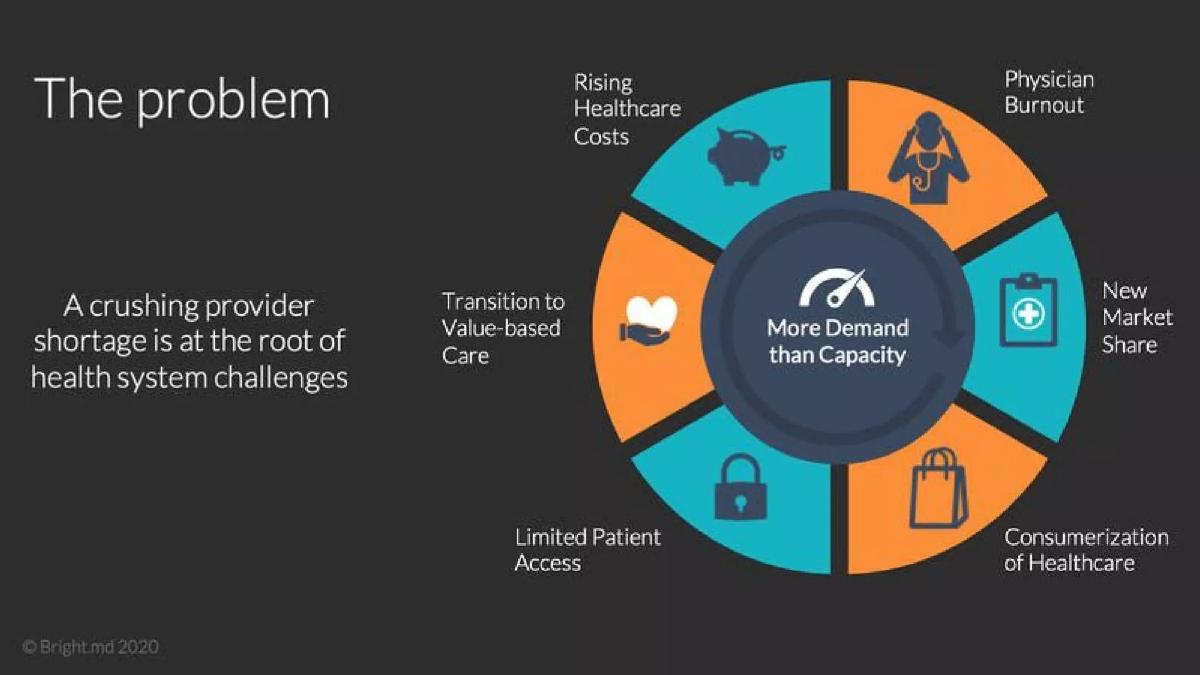
Slides 1-3 establish the gravity of the situation. The title slide, 'Automating Healthcare Delivery,' immediately sets the stage for a technology-led efficiency play. Slide 2 uses a circular infographic to link rising costs, physician burnout, and limited patient access to a central hub: 'More Demand than Capacity.' This is a classic supply-demand imbalance argument. Slide 3 provides the data to back this up, citing the American College of Physicians to show a projected shortage of 130,600 physicians by 2025. By framing the problem as 'crushing,' Bright.md creates a sense of urgency that transcends simple software upgrades.
The Critique of Current Solutions
Slides 4-5 are perhaps the most strategic in the deck. Slide 4 contains a jarring chart showing that while digitization has boosted productivity in retail and manufacturing by 30-45%, it has actually had a negative impact on healthcare productivity (approximately -15%). This directly attacks the efficacy of Electronic Medical Records (EMRs). Slide 5 doubles down by stating that 'Telehealth' (specifically video visits) does not help because they take the same amount of clinician time as in-person visits. This is a vital pivot; it tells the investor that the current 'hot' sector of telehealth is fundamentally flawed, clearing the path for Bright.md’s asynchronous model.
The Solution: SmartExam™
Slides 6-8 introduce the product. Slide 7 is the 'money slide' for the product's value proposition. It breaks down the workflow: the patient spends 10 minutes on an interview, the clinician spends less than 2 minutes reviewing, and the software automates 90% of the administrative burden (billing, charting, ordering). This is the '15-20x multiplier' mentioned later in the deck. Slide 8 details the patient experience, emphasizing that it isn't just a form, but a comprehensive clinical interview that results in personalized diagnosis, treatment, and even work excuse notes.
Clinical and Operational Depth
Slides 9-11 provide the clinician's perspective and the unique benefits of the platform. Slide 9 shows a 'chart-ready SOAP note,' which is a specific pain point for doctors. Slide 11 introduces a timely element for 2020: COVID-19 evaluations based on CDC guidelines. This slide also highlights 'real-time medically certified translation,' which addresses the needs of a diverse patient population. The claim of 'less than 1h to clinician proficiency' is a strong rebuttal to the 'EMRs don't help' argument from earlier, suggesting that their software is the exception to the rule of difficult healthcare IT.
Traction and Market Validation
Slides 12-17 focus on proof. Slide 12 quantifies the value: 'Deliver care for half the cost of a nurse advice line call' and 'Positive ROI in less than a year.' These are the metrics that CFOs of major health systems care about. Slide 13 shows the versatility of the product across different healthcare models (ACOs, for-profit, rural). Slides 14-17 are dedicated to social proof, featuring testimonials from both patients and providers, a list of major media recognitions (WSJ, Gartner, Bloomberg), and a deep dive into a report by Chilmark Research. The inclusion of the 'Gartner Cool Vendor' status on Slide 17 serves as a high-level endorsement of their category-defining potential.
Competition and Leadership
Slides 18-19 address the 'Why Us?' question. The competitive landscape on Slide 18 is a standard 2x2 matrix, but it uses 'Efficiency' and 'Business Model' (Service vs. Platform) as its axes. Bright.md places itself in the top-right corner—high efficiency, platform-based—while relegating competitors to the low-efficiency 'Service' quadrant. Slide 19 introduces the leadership team. Notably, the CEO, Ray Costantini, is an MD, which provides the necessary clinical credibility for a product that generates 'provisional diagnoses.'
Capitalization and Conclusion
Slide 20 provides a brief capitalization history. It notes a total of $20M raised prior to this deck, with the most recent round being $8M in August 2017. This indicates a three-year gap between major rounds, suggesting the company was likely focused on scaling its proven model before returning to the market. The list of investors—B Capital Group, Pritzker Group, Seven Peaks Ventures—shows strong institutional support. The deck concludes on Slide 21 with contact information, maintaining the minimalist, professional tone found throughout.
What Works in the Bright.md Deck
The 'Anti-Telehealth' Angle: By arguing that video visits are inefficient, they differentiate themselves from a crowded market of Zoom-for-doctors clones. · Quantified Efficiency: Moving from 'we save time' to 'less than 2 minutes of provider time' and '15-20x multiplier' gives investors hard numbers to model. · Third-Party Validation: The heavy use of Gartner, Chilmark Research, and Advisory Board quotes (Slide 15-17) builds significant trust in a high-stakes industry like healthcare. · Problem Urgency: The use of the 130,000 physician shortage figure (Slide 3) makes the solution feel like a necessity rather than a 'nice-to-have.'
What is Missing from the Bright.md Deck
The Financial Ask: There is no slide stating how much they are raising in this specific 2020 round or what the specific milestones for that capital will be. · Revenue Data: While they mention ROI for customers, they do not disclose their own ARR, growth rates, or churn metrics. · Forward-Looking Projections: The deck is very focused on the 'now' and the 'past.' It lacks a 3-5 year vision of where the platform goes beyond simple exam automation. · Unit Economics: There is no mention of Customer Acquisition Cost (CAC) or Lifetime Value (LTV), which are standard for SaaS-style platforms.
What a Founder Should Copy
The 'Productivity Gap' Argument: If you are in an industry where technology has historically failed to improve efficiency (like education or construction), use a chart like Slide 4 to show why your solution is different. · Workflow Visualization: Slide 7 is an excellent way to show how a complex process is simplified. It clearly separates the 'Patient' and 'Clinician' roles and highlights the 'Automation' that happens in between. · The 2x2 Matrix with Meaningful Axes: Don't just use 'Price' and 'Quality.' Bright.md used 'Efficiency' and 'Business Model' (Slide 18), which directly relates to their core value proposition. · Timely Relevance: The inclusion of a COVID-19 specific slide (Slide 11) showed that the company was agile and could adapt its core technology to immediate market needs.
Frequently asked questions
- What is the primary problem Bright.md is solving?
- Bright.md addresses the 'crushing provider shortage' in healthcare. According to slide 3, there was a 15% shortfall in primary care physician capacity in 2020, which is projected to grow to a shortage of over 130,000 physicians by 2025. They argue that existing tools like EMRs and video telehealth have failed to improve productivity.
- How does the SmartExam product actually work?
- As shown on slide 7, the patient spends about 10 minutes completing a digital interview on a smartphone or computer. The system then automates 90% of the work by generating a provisional diagnosis, treatment plan, and chart note. The clinician then reviews and signs off in under 2 minutes, with the system handling billing and EMR integration.
- What are the key performance indicators (KPIs) for the platform?
- The deck highlights several key metrics on slide 12: over 30% new patient acquisition, under 2 minutes of provider time per visit, 90% patient satisfaction, and the creation of 7 full-time equivalent (FTE) clinical capacity per implementation, valued at $1.75M.
- Who are the target customers for Bright.md?
- Slide 13 indicates a broad market approach, targeting 'all types of healthcare systems.' This includes Fee for Service, Accountable Care Organizations (ACOs), Virtual-only providers, small rural systems, for-profit and not-for-profit entities, and large multi-state academic medical centers.
- What is missing from this pitch deck?
- The deck omits a specific 'Ask' slide detailing how much capital they are currently seeking and how it will be used. It also lacks detailed financial projections (revenue, EBITDA), a granular breakdown of the sales pipeline, and a specific slide on unit economics (CAC/LTV), though it does mention a sub-one-year ROI.