Brewtopia presents a 9-slide franchise-focused deck aimed at expanding its specialty coffee and artisan pizza brand across India. The company positions itself as a bridge between South Indian coffee expertise and North Indian consumer tastes. The deck is structured specifically for prospective franchisees rather than venture capital investors, emphasizing three distinct outlet models: Kiosk, QSR, and Fine Dine. With existing locations in Rajasthan and Haryana, the brand highlights a 'proven profitable model' with ROI periods ranging from 14 to 36 months. While the deck provides clear financia…
Key takeaways
- The brand focuses on a hybrid menu of specialty coffee and artisan pizzas to differentiate itself in the Indian café market (Slide 2).
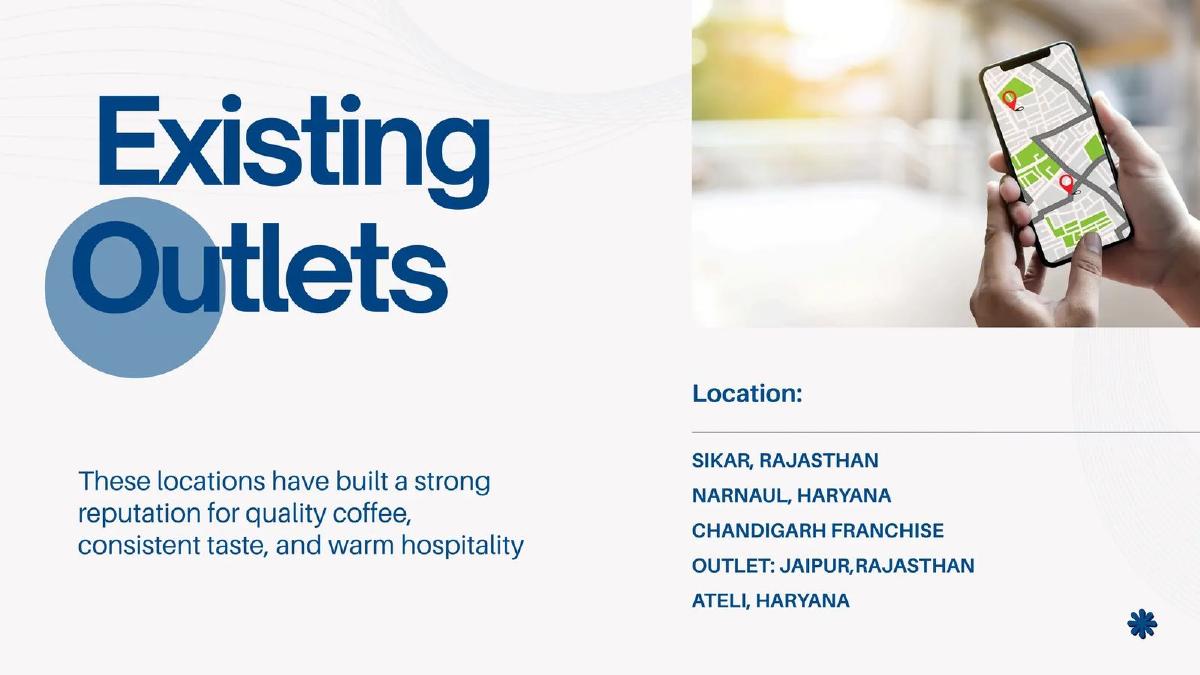
- Brewtopia has established a physical footprint in Sikar, Narnaul, Chandigarh, Jaipur, and Ateli (Slide 4).
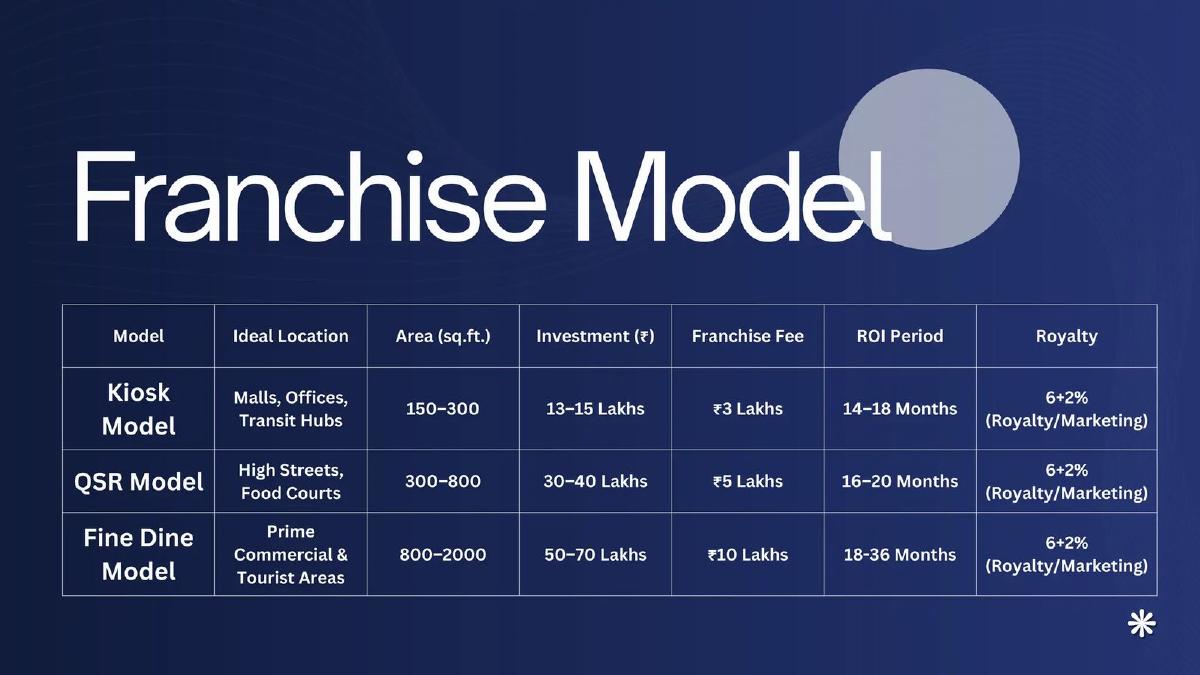
- The franchise model offers three entry tiers: Kiosk (13-15 Lakhs), QSR (30-40 Lakhs), and Fine Dine (50-70 Lakhs) (Slide 6).
- Royalty fees are standardized across all models at 6% plus a 2% marketing fee (Slide 6).
- Projected ROI periods vary significantly by model, with the Kiosk model estimated at 14-18 months and Fine Dine at 18-36 months (Slide 6).
- Operational support includes site selection, staff training, and a centralized supply chain to ensure consistency (Slide 8).
- The deck omits a team slide, failing to identify the founder or the management team's professional background.
- There is no mention of the total addressable market (TAM) or competitive analysis against established players like Blue Tokai or Third Wave Coffee.
Executive Summary: The Franchise-First Approach
Brewtopia’s pitch deck is not a traditional Silicon Valley startup deck aimed at raising equity capital from VCs. Instead, it is a business-to-business (B2B) sales tool designed to recruit franchise partners. The narrative focuses on the scalability of the brand, the reliability of the supply chain, and the projected return on investment (ROI) for individual operators. By targeting the North Indian market with South Indian coffee traditions, the brand attempts to fill a perceived gap in the regional specialty coffee landscape.
Slide 1: Title and Brand Identity
The cover slide introduces the Brewtopia logo—a minimalist hourglass or dripper icon—and the company website. The design is clean, using a deep blue and white palette that suggests a professional, corporate-ready brand. There is no specific 'ask' or date on this slide, keeping it evergreen for various franchise inquiries.
Slide 2: Who We Are
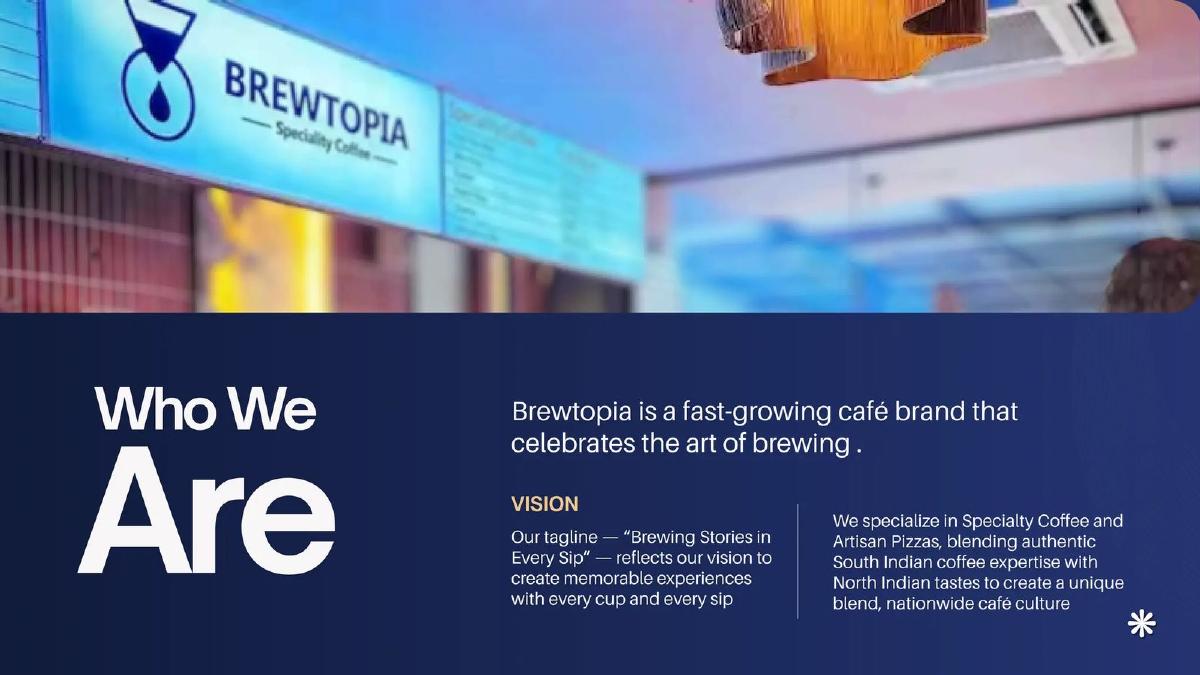
This slide establishes the brand's core identity. It defines Brewtopia as a "fast-growing café brand" and introduces the tagline: "Brewing Stories in Every Sip." The most important piece of information here is the product mix: Specialty Coffee and Artisan Pizzas . By blending South Indian coffee expertise with North Indian tastes, they are signaling a localized product-market fit strategy.
Slide 3: Brand Story
The narrative arc on Slide 3 explains the founder's inspiration. During visits to Hyderabad, the founder identified the "richness of South Indian coffee culture" and sought to bring that "aroma, depth, and craft" to North India. The slide claims the first café "quickly became profitable," though it provides no specific dates or margin data to support this claim. The stated mission is to bring Brewtopia to "every city in India."
Slide 4: Existing Outlets
Traction is demonstrated through a list of current locations. The brand has a presence in:
Sikar, Rajasthan · Narnaul, Haryana · Chandigarh · Jaipur, Rajasthan · Ateli, Haryana
This list suggests a regional focus on the NCR and surrounding states, providing a logical base for a centralized supply chain.
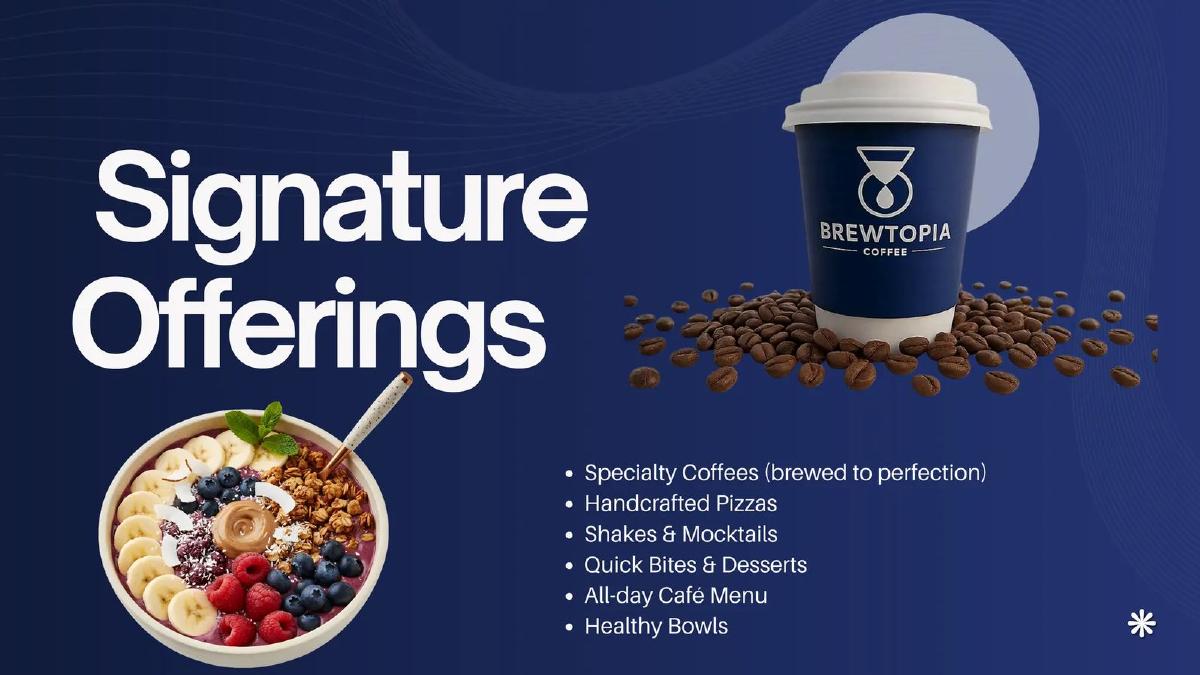
Slide 5: Signature Offerings
This slide serves as a high-level menu overview. Beyond coffee and pizza, the brand includes:
Shakes & Mocktails · Quick Bites & Desserts · All-day Café Menu · Healthy Bowls
The inclusion of "Healthy Bowls" suggests an attempt to capture the wellness-conscious demographic, while pizzas and shakes cater to the traditional high-margin café crowd.
Slide 6: The Franchise Model
This is the most critical slide in the deck, providing a detailed breakdown of the three investment tiers. The data is presented as follows: Kiosk Model: 150-300 sq. ft., 13-15 Lakhs investment, 3 Lakhs fee, 14-18 months ROI. QSR Model: 300-800 sq. ft., 30-40 Lakhs investment, 5 Lakhs fee, 16-20 months ROI. Fine Dine Model: 800-2000 sq. ft., 50-70 Lakhs investment, 10 Lakhs fee, 18-36 months ROI.All models carry a 6% Royalty and 2% Marketing fee . This transparency is helpful for potential partners to self-qualify based on their available capital.
Slide 7: Franchise Benefits
Slide 7 lists the value proposition for the franchisee. It highlights a "Centralized Supply Chain for Consistency" and "Menu Innovation." These are standard franchise selling points, emphasizing that the partner is buying into a system rather than just a name.
Slide 8: Franchisee Support System
This slide expands on the operational assistance provided. It mentions "Site Selection & Layout Planning" and "Operations Manual & SOPs." For a service-heavy business like a café, the mention of "Tech & POS Integration" is vital, as it implies the franchisor has oversight of sales data and inventory management.
Slide 9: Contact Information
The deck concludes with a call to action: "Let’s Create Something Amazing Together." It provides a phone number, website, and email address. The absence of a specific person's name or title reinforces that this is a general-purpose marketing document.
What Works in This Deck
Clear Financial Tiers: The table on Slide 6 is excellent. It removes ambiguity regarding the cost of entry and the expected timeline for recovering capital. This is exactly what a prospective franchisee needs to see first. Regional Strategy: The brand story clearly explains why they exist—to bridge the gap between South Indian coffee craft and North Indian consumers. This gives the brand a specific "reason to be" in a crowded market. Operational Focus: By dedicating two slides (7 and 8) to support and supply chain, the deck addresses the primary fear of new business owners: that they will be left to figure out operations on their own.
What Is Missing
The Leadership Team: There is no mention of who is running Brewtopia. Investors and franchisees alike want to know the pedigree of the founders. Do they have experience in F&B, logistics, or real estate? Unit Economics: While the ROI period is mentioned, there are no examples of average monthly sales, COGS (Cost of Goods Sold), or EBITDA margins for an existing outlet. Market Data: The deck assumes the reader knows the specialty coffee market is growing. Including data on the rise of coffee consumption in India would strengthen the macro-case for the business. Competitor Analysis: India’s specialty coffee scene is highly competitive. Acknowledging competitors and explaining how Brewtopia wins against them (perhaps on price point or food quality) is a missed opportunity.
Founder's Playbook: What to Copy
Standardized Formatting: The use of a consistent grid and table for financial data (Slide 6) makes complex information easy to digest. Founders should always use tables for multi-tiered offerings. Visual Consistency: The deck uses a limited color palette and consistent iconography. This makes a small brand look larger and more established than it might actually be. Direct Call to Action: The final slide is simple and provides multiple ways to get in touch. Many decks fail by not making the next step obvious.
Frequently asked questions
- What is the primary business model of Brewtopia?
- Brewtopia operates as a franchise-led café chain. According to Slide 6, they offer three distinct formats: Kiosks for high-traffic areas like malls, QSR (Quick Service Restaurant) models for high streets, and Fine Dine models for prime commercial areas. They generate revenue through franchise fees (ranging from 3 to 10 Lakhs) and ongoing royalties (8% total).
- How does Brewtopia differentiate its product offering?
- The company emphasizes a 'unique blend' of South Indian coffee expertise tailored for North Indian tastes. Slide 5 lists their signature offerings as specialty coffees, handcrafted pizzas, shakes, mocktails, and healthy bowls. This combination of specialty beverage and hot food (pizza) is their primary market differentiator.
- What are the financial requirements to open a Brewtopia franchise?
- As detailed on Slide 6, the minimum investment is 13-15 Lakhs for a Kiosk (150-300 sq. ft.). The mid-tier QSR model requires 30-40 Lakhs (300-800 sq. ft.), and the flagship Fine Dine model requires 50-70 Lakhs (800-2000 sq. ft.). These figures include the franchise fee but likely exclude real estate deposits.
- What kind of support does Brewtopia provide to its partners?
- Brewtopia promises 'end-to-end support' as shown on Slide 8. This includes site selection and layout planning, staff training and onboarding, providing operations manuals and SOPs, marketing and brand promotions, and integration with their technology and POS systems.
- Where is Brewtopia currently operating?
- Slide 4 lists five specific locations: Sikar (Rajasthan), Narnaul (Haryana), Chandigarh, Jaipur (Rajasthan), and Ateli (Haryana). The brand story on Slide 3 indicates they started with one café and are now looking to build a national chain across India.