Breakout’s 13-slide Seed deck is a study in high-signal minimalism. Eschewing the dense text typical of enterprise SaaS pitches, the company focuses on a singular value proposition: converting website visitors into qualified pipeline. The deck relies on two primary pillars to justify its $3.3M raise: a detailed technical 'Tech Stack' slide that outlines a sophisticated multi-modal embedding and emotion-mapping architecture, and a 'Why Us?' section dominated by logos from tier-one tech firms like Google, Meta, and Zoom. While the deck lacks traditional slides for competition, go-to-market stra…
Key takeaways
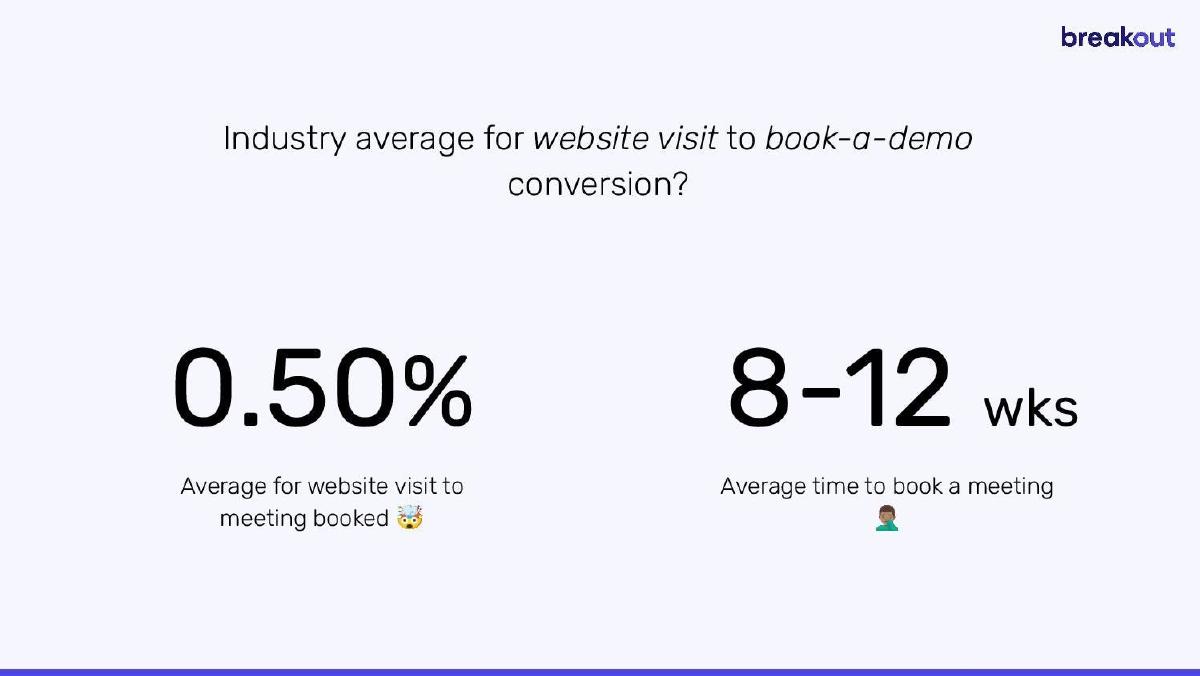
- The deck identifies a specific industry conversion rate of 0.50% from website visit to meeting booked as the core problem (Slide 2).
- Breakout quantifies the sales cycle friction by stating the average time to book a meeting is 8-12 weeks (Slide 2).
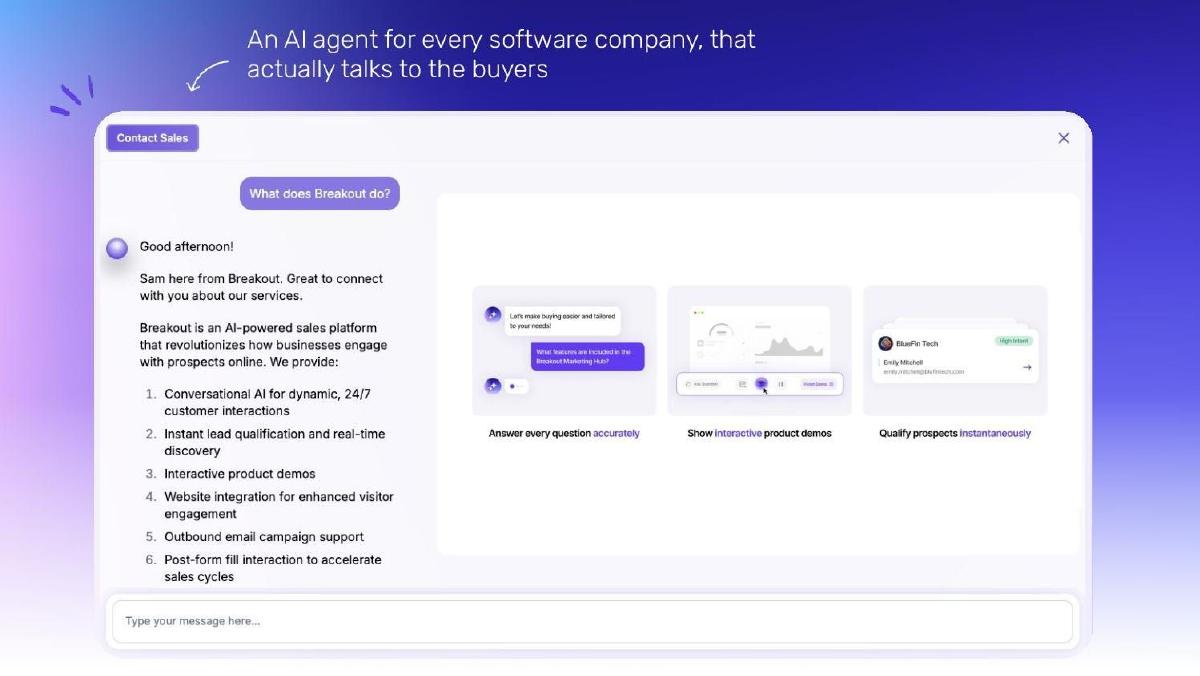
- The product is positioned as an 'AI agent for every software company' that handles 24/7 interactions and real-time discovery (Slide 3).
- Technical differentiation is highlighted through a 'Model Layer' featuring multi-modal embedding for video data and buyer emotion mapping (Slide 4).
- The company omits a traditional 'Team' slide, opting instead for an 'Advisors from top companies' slide featuring 14 major tech logos (Slide 6).
- The deck contains no mention of current revenue, customer count, or specific pricing models.
- There is no explicit 'Ask' slide detailing the $3.3M raise amount or the intended use of funds within the 13-slide sequence.
- Breakout was reported by Business Insider to have raised $3.3M in a 2024 Seed round for its AI sales software.
The Breakout Seed Deck Analysis
Breakout, a North American AI startup, raised $3.3M in 2024 to automate the 'top of the funnel' for software companies. In an era where 'AI agents' are a crowded category, Breakout’s deck stands out for what it doesn't include: there are no complex charts, no long-winded mission statements, and no competitive matrices. Instead, the deck uses a 13-slide sequence to establish a clear pain point and a high-tech solution. This teardown examines the specific slides used to secure their Seed round.
Slide 1-3: The Hook and the Friction
The deck opens with a minimalist title slide (Slide 1) featuring the tagline: "Convert website visitors to qualified pipeline." This is a direct, results-oriented value proposition that avoids technical jargon in the first five seconds of the presentation.
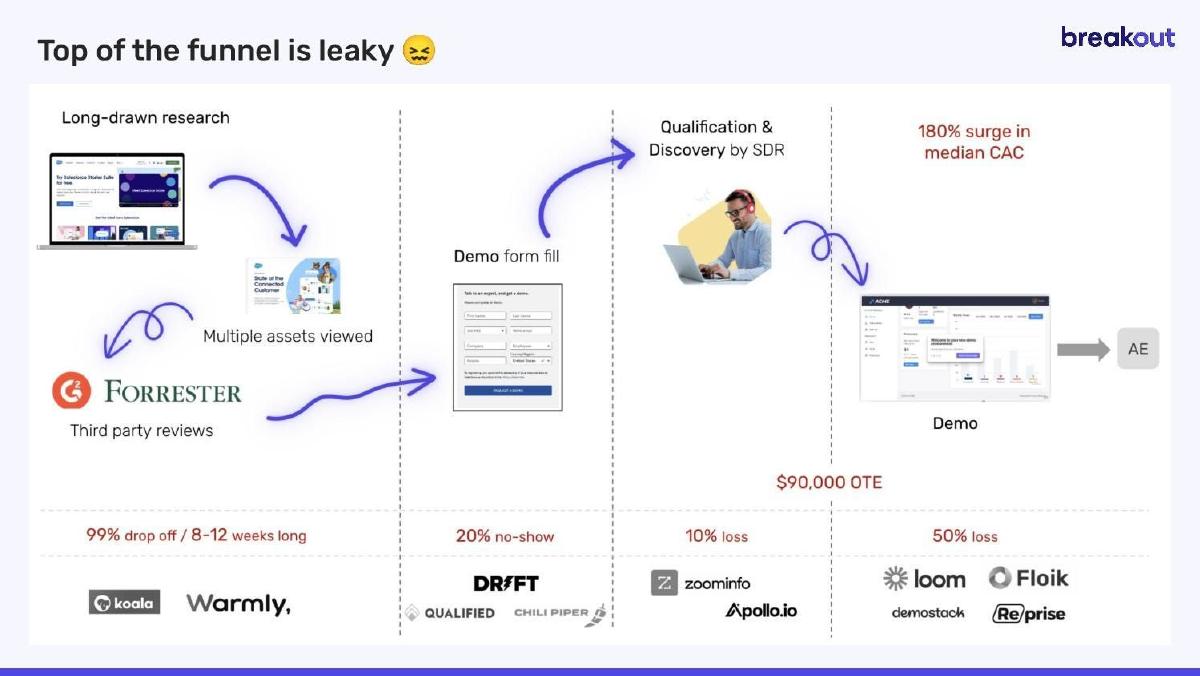
Slide 2 introduces the 'Problem' through two specific industry metrics. It asks, "Industry average for website visit to book-a-demo conversion?" and provides the answer: "0.50%" . Next to this, it lists "8-12 wks" as the "Average time to book a meeting." By using these figures, Breakout defines the market inefficiency not as a lack of tools, but as a failure of speed and conversion volume. The use of emojis (an exploding head and a person shrugging) keeps the tone informal, typical of early-stage Seed decks.
Slide 3 presents the solution: "An AI agent for every software company, that actually talks to the buyers." The slide features a product mockup showing a chat interface. The text lists six core capabilities: 1. Conversational AI for 24/7 interactions, 2. Instant lead qualification, 3. Interactive product demos, 4. Website integration, 5. Outbound email support, and 6. Post-form fill interaction. This slide is crucial because it moves the product beyond a simple chatbot, positioning it as a full-cycle sales assistant.
Slide 4: The Technical Moat
Slide 4, titled "Tech Stack," is the most dense slide in the deck. It is designed to prove that Breakout is not just a wrapper around a Large Language Model (LLM). The architecture is split into two sections: the "Customer Layer" and the "Model Layer."
The Customer Layer includes GTM intelligence, configurable controls, dashboards, and integrations with platforms like Salesforce, HubSpot, and Slack (represented by logos). The Model Layer is where the differentiation lies. It lists "Contextual Dynamic Retrieval," "Ground truth validation," and "Multi-modal Embedding space for Video data." Most notably, it includes a vertical bar for "Buyer Emotion Mapping." This suggests a level of sophistication in how the AI perceives user intent, which is a significant step up from standard rule-based lead qualification tools.
Slide 5-6: Social Proof Over Bio Slides
Slide 5 is a simple transition slide that reads "Why Us?" . In a traditional deck, this would be followed by a slide detailing the founders' previous exits or academic credentials. Breakout takes a different path.
Slide 6, titled "Advisors from top companies," relies entirely on logo-based social proof. It features 14 logos, including Google, Meta, Zoom, Twilio, BCG, and Postman. By showcasing these logos, the company implies that experts from the world's leading software and consulting firms are vetting the technology. This is a common tactic for early-stage teams who may be first-time founders or who want to emphasize their industry connections over their individual resumes.
Slide 7-13: The Missing Pieces
The remaining slides in the sequence provided (Slides 7 through 12) are listed as repeats of the company name or blank placeholders, leading to a final "Thank You" on Slide 13. This indicates that the core of the pitch was delivered in the first six slides.
No Business Model: There is no mention of how Breakout charges (per seat, per lead, or flat SaaS fee). · No Market Size (TAM): The deck assumes the investor understands that the B2B sales software market is large. · No Competition: There is no mention of incumbents like Drift or Intercom, nor other AI-native competitors. · No Traction: The deck does not list current revenue, pilot programs, or user growth. · No Financial Ask: The specific $3.3M figure and the use of proceeds are absent from these slides.
What Breakout Does Well
Specific Metrics for the Problem: By citing the 0.50% conversion rate and the 8-12 week delay, Breakout makes the problem tangible. Investors can easily calculate the ROI if those numbers are even slightly improved.
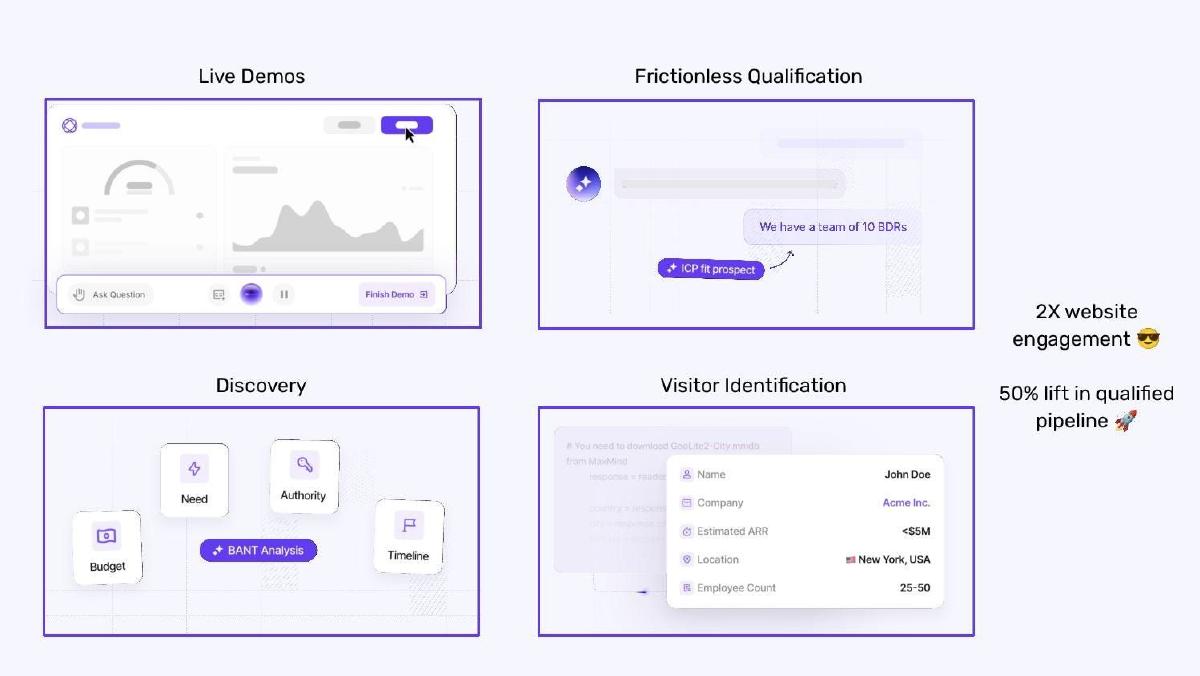
Visualizing the 'Agent': Slide 3 does a good job of showing the product in action. The three sub-images—"Answer every question accurately," "Show interactive product demos," and "Qualify prospects instantaneously"—clearly define the user experience.
Technical Depth: The Tech Stack slide (Slide 4) provides enough 'buzzword' density to satisfy a technical due diligence officer at a VC firm. Terms like "Multi-modal Embedding" and "Feature Extraction (ISP)" signal that the team is thinking about the underlying infrastructure, not just the user interface.
Weaknesses and Omissions
The primary weakness of this deck is the total absence of the founding team's identity. While advisors are great, VCs at the Seed stage are primarily betting on the founders. Relying solely on advisor logos can sometimes be seen as a way to mask a lack of direct industry experience, though in this case, the $3.3M raise suggests the founders likely had strong reputations that were communicated outside of the slide deck.
Furthermore, the lack of a competitive landscape slide is risky in the AI Agent space. With dozens of startups claiming to automate sales, Breakout’s deck doesn't explicitly state why their "Buyer Emotion Mapping" is superior to a competitor's "Intent Scoring."
Lessons for Founders
Quantify the Pain: Don't just say the process is "slow." Say it takes "8-12 weeks." Specificity builds credibility. · Use a Tech Stack Slide: If you are building in a crowded AI field, show your architecture. Prove you are building a proprietary layer (like Breakout's Model Layer) rather than just calling an API. · Social Proof is a Shortcut: If you don't have a 10-year track record, surround yourself with advisors who do. Logos from Google and Meta act as a proxy for quality. · Keep it Lean: Breakout’s core message is delivered in under 10 slides. For a Seed round, you don't need a 40-page document; you need a clear problem, a credible solution, and a reason to believe in the tech.
Frequently asked questions
- What is the primary problem Breakout aims to solve?
- Breakout targets the inefficiency of B2B sales funnels. According to Slide 2, the industry average for converting a website visitor to a booked demo is only 0.50%, and the process typically takes 8 to 12 weeks. The company aims to compress this timeline and increase conversion rates using autonomous AI agents.
- How does Breakout describe its technical architecture?
- Slide 4 outlines a sophisticated 'Tech Stack' divided into a Customer Layer and a Model Layer. Key components include 'Contextual Dynamic Retrieval,' 'Multi-modal Embedding space for Video data,' and 'Buyer Emotion Mapping.' This suggests the AI is designed to process more than just text, potentially analyzing video demos or emotional cues during interactions.
- Who is behind the company according to the deck?
- The deck is notably missing a standard founders' slide. Instead, Slide 6 lists 'Advisors from top companies,' displaying logos for Zoom, Twilio, BCG, Postman, Google, Fletch, Mindtickle, Ontra, C2FO, Meta, BrowserStack, Elastic, Hasura, and Clari. This indicates a strategy of using external social proof to build credibility.
- What specific features does the AI sales agent offer?
- As detailed on Slide 3, the platform provides conversational AI for 24/7 interaction, instant lead qualification, interactive product demos, website integration, outbound email support, and post-form fill interactions to accelerate sales cycles.
- Is there a financial roadmap or 'The Ask' in this deck?
- No. The 13-slide deck provided does not include financial projections, unit economics, or a specific funding request. While Business Insider reports a $3.3M Seed raise, the deck itself focuses entirely on the problem, product vision, and technical infrastructure.