Seyna’s 9-slide Series A deck is a study in high-level strategic positioning. Rather than getting bogged down in the minutiae of actuarial tables, the company frames itself as the 'Shopify for insurance,' providing both the risk carrier capacity and the SaaS tools necessary for brokers and retailers to launch products. The deck highlights a massive €565bn TAM and a proven ability to update products 36x faster than the industry average. While the deck lacks a traditional team slide or detailed financial projections, it leans heavily on social proof from major partners like Swiss Re and Allianz…
Key takeaways
- Seyna positions itself as a dual-threat platform: a risk carrier and a SaaS provider for brokers (Slide 2).
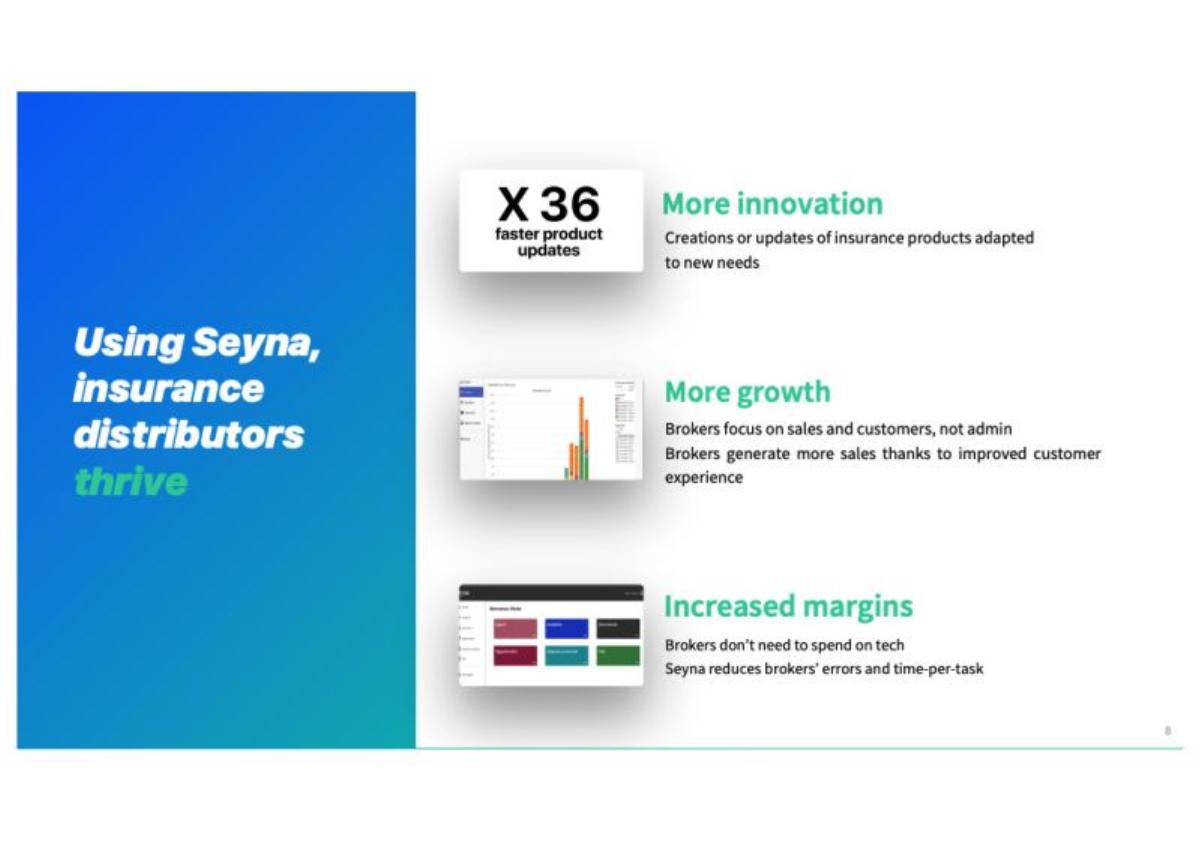
- The company claims a 36x increase in the speed of insurance product updates compared to industry standards (Slide 4).
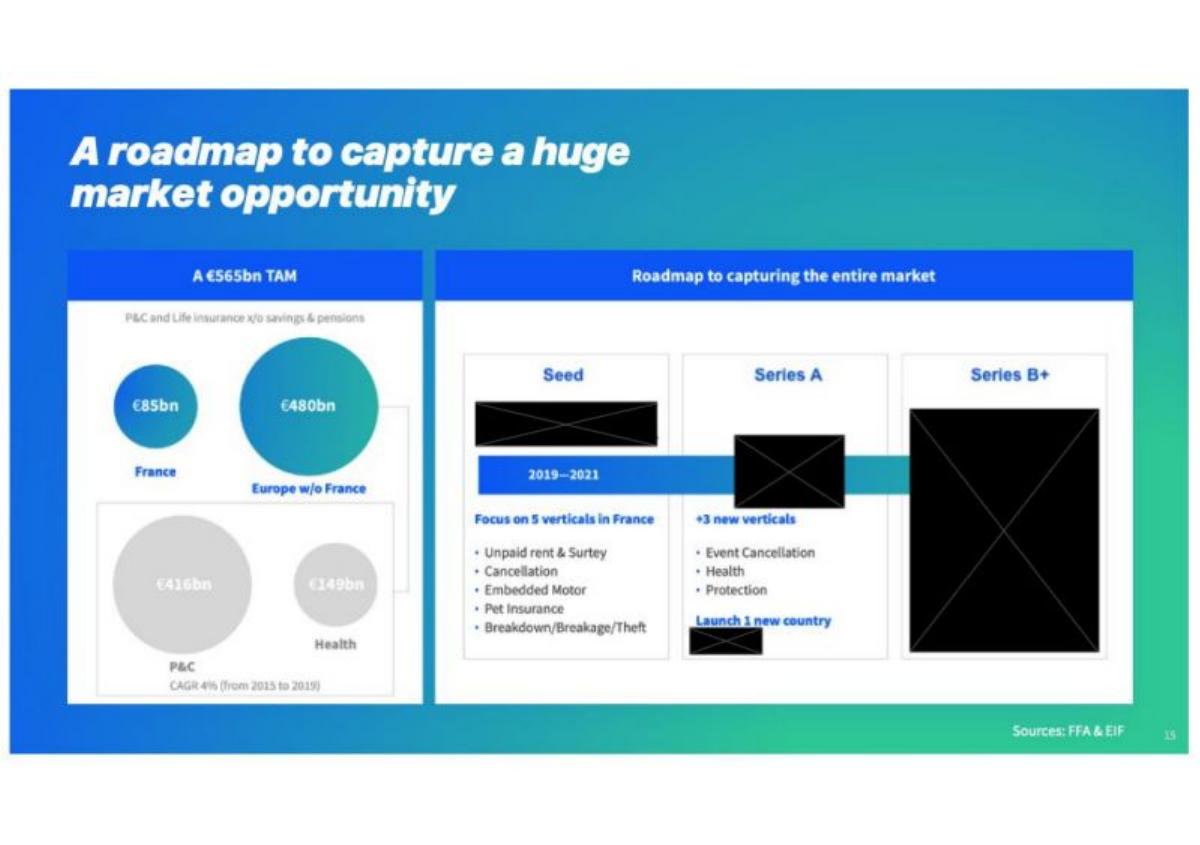
- Seyna targets a total addressable market (TAM) of €565bn across Europe (Slide 6).
- The platform provides four distinct SaaS modules: products, business operations, distribution, and policies/claims (Slide 3).
- The roadmap outlines a transition from five initial verticals in France to international expansion and three new verticals (Slide 6).
- Strategic partnerships with top-tier reinsurers like Swiss Re, Munich Re, and Hannover Re provide significant institutional credibility (Slide 7).
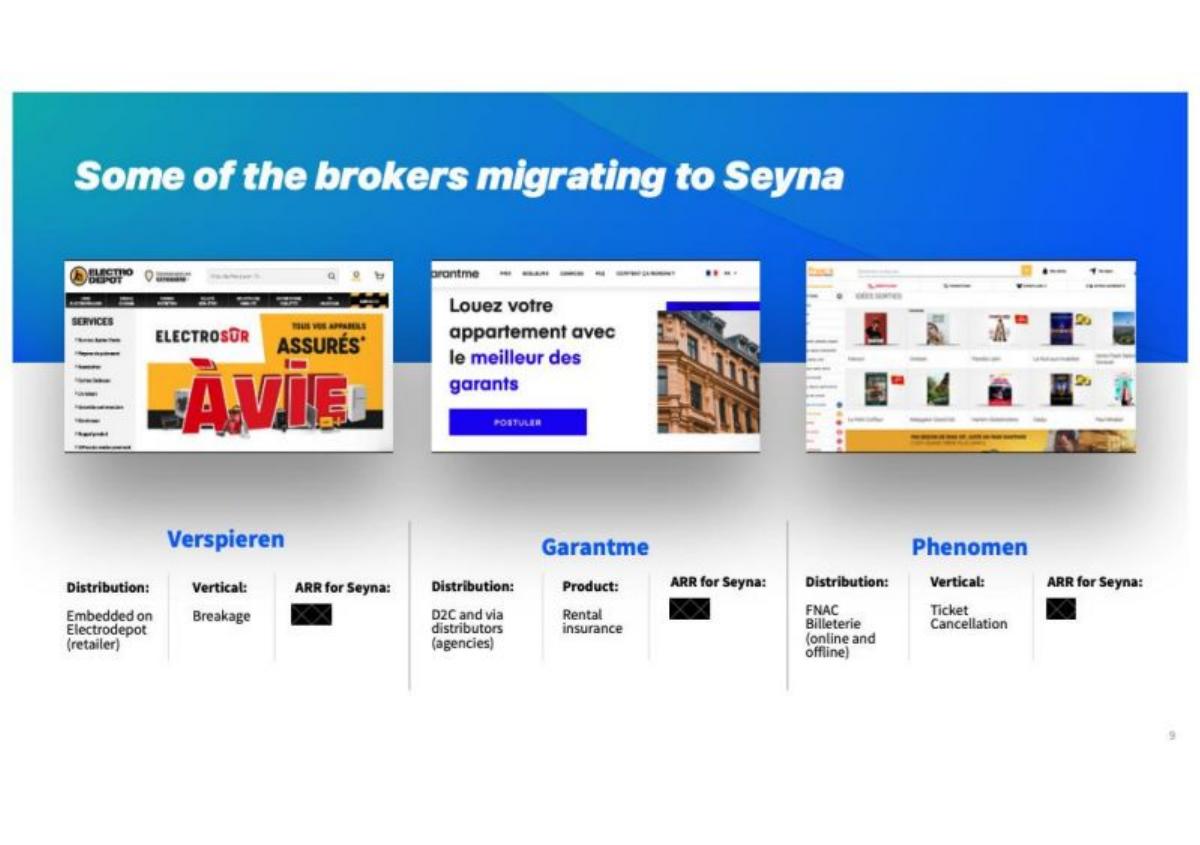
- The deck highlights existing customer migration from diverse sectors including retail (Electrodepot) and rental insurance (Garantme) (Slide 5).
- The vision for the next five years focuses on becoming an 'operating system' for the entire insurance value chain (Slide 8).
The Infrastructure Play: Rebuilding Insurance from the Ground Up
Seyna’s Series A deck is a masterclass in 'Infrastructure-as-a-Service' positioning. In an industry as regulated and slow-moving as insurance, Seyna doesn't pitch itself as just another broker or a niche provider. Instead, it presents itself as the foundation upon which the next generation of insurance products will be built. By raising $37M with a relatively short 9-slide deck, Seyna demonstrated that for sophisticated investors, a clear strategic moat and massive TAM often outweigh the need for a 30-page slide deck.
Slide 1: Title Slide
The deck opens with a minimalist title slide. The branding is clean, using a professional blue-to-green gradient. There are no taglines or mission statements here, just the company name and the designation 'Investor Deck.' This sets a tone of efficiency and confidence.
Slide 2: The Platform Overview
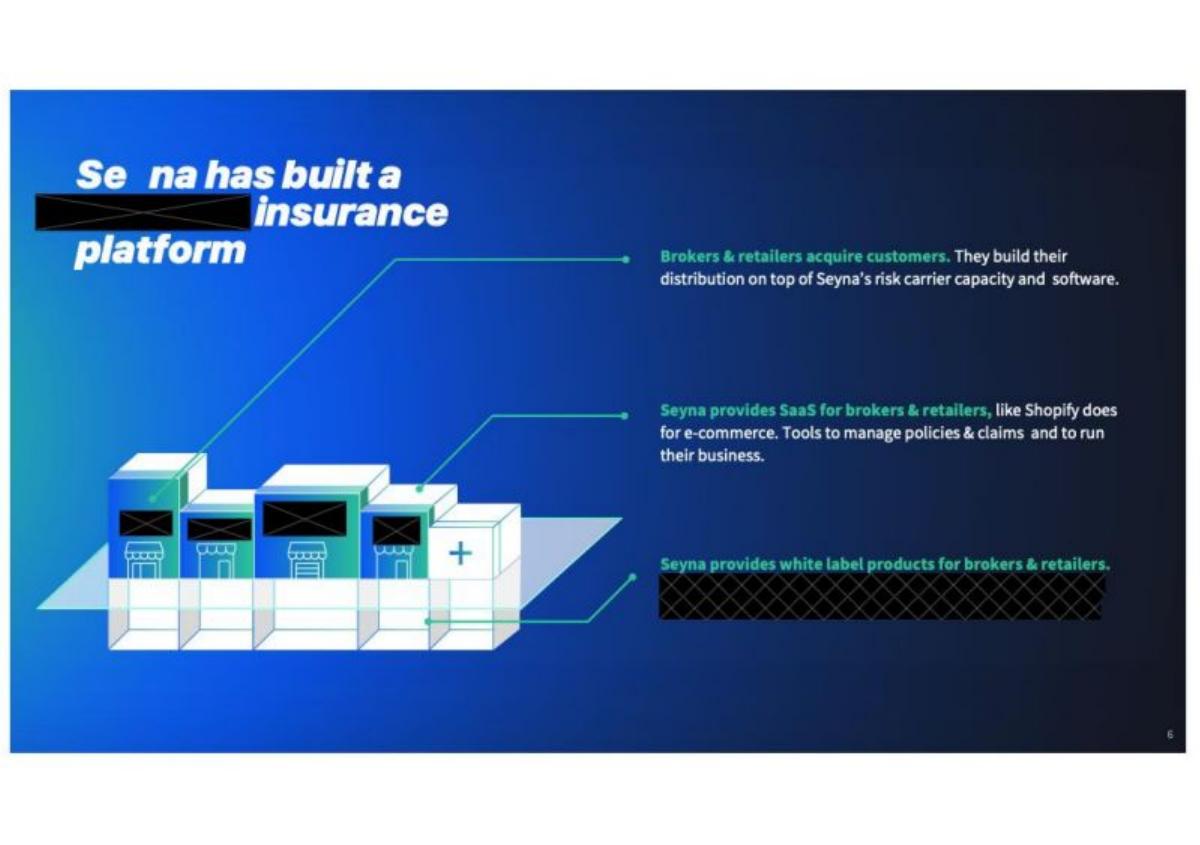
Slide 2 introduces the core value proposition: 'Seyna has built an insurance platform.' The slide uses a 3D block metaphor to show how different players interact with the system. It breaks the offering into three pillars: 1. Risk carrier capacity for brokers and retailers to build on, 2. SaaS tools to manage policies and claims (explicitly comparing themselves to Shopify), and 3. White-label products . This is a crucial slide because it explains that Seyna isn't just software; they are a licensed entity that takes on risk, which is a much higher barrier to entry than pure SaaS.
Slide 3: The Four Pillars of Value
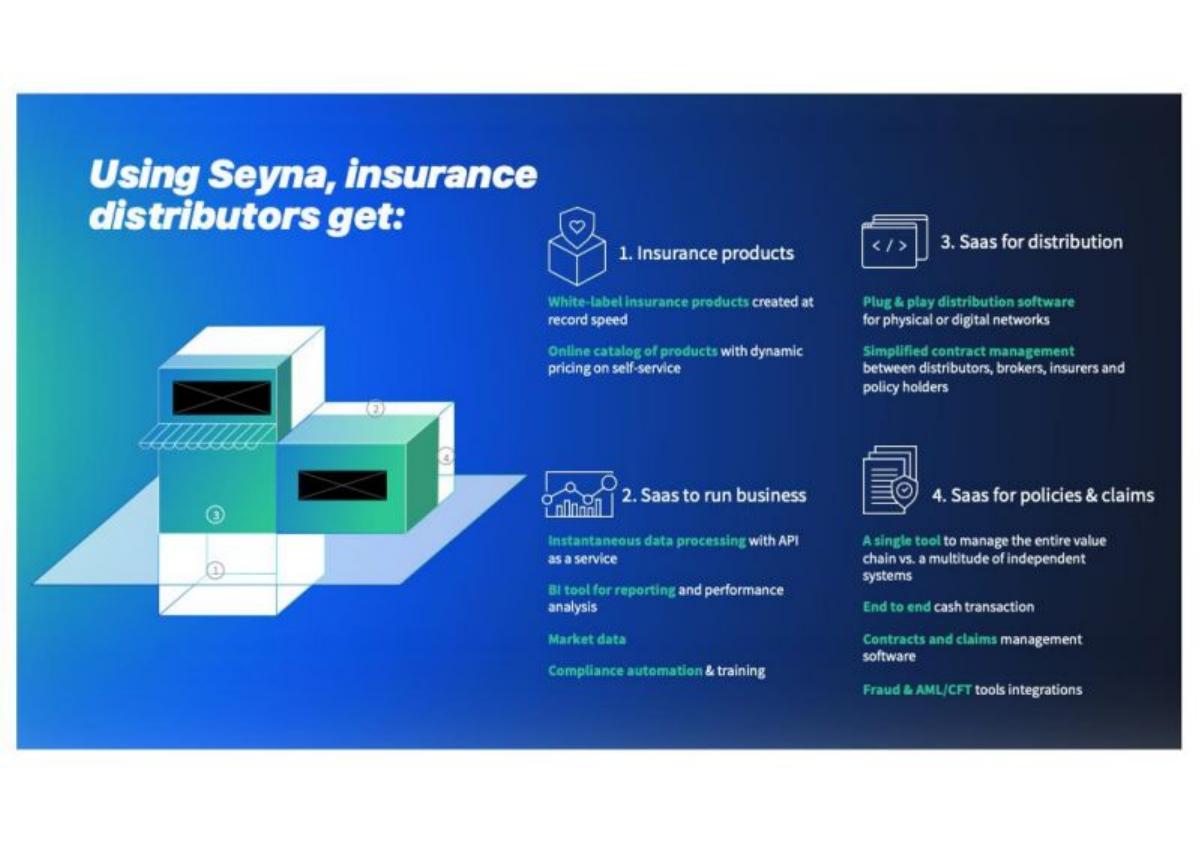
This slide gets into the functional specifics of what distributors get when they use Seyna. It categorizes the offering into four quadrants:
Insurance products: White-label products created at 'record speed' with dynamic pricing. · SaaS to run business: API-driven data processing, BI tools, and compliance automation. · SaaS for distribution: Plug-and-play software for physical or digital networks. · SaaS for policies & claims: A single tool for the entire value chain, including fraud and AML/CFT integrations.
The emphasis here is on replacing a 'multitude of independent systems' with one unified platform.
Slide 4: The 'Thrive' Metrics
Slide 4 focuses on the outcomes for customers. The standout figure is 'X 36 faster product updates.' This is a powerful metric because it speaks directly to the primary pain point of the insurance industry: inertia. The slide also promises 'More growth' by allowing brokers to focus on sales rather than admin, and 'Increased margins' by reducing tech spend and errors. The inclusion of small dashboard screenshots provides a visual hint of the product's UI.
Slide 5: Customer Traction and Migration
To prove the platform works, Slide 5 shows real-world examples of brokers migrating to Seyna. It highlights three distinct use cases:
Verspieren: Embedded insurance for breakage on Electrodepot (retailer). · Garantme: Rental insurance via agencies and D2C. · Phenomen: Ticket cancellation for FNAC Billeterie.
By showing these diverse verticals (Breakage, Rental, Ticket Cancellation), Seyna proves their platform is horizontal and adaptable. Note: The specific ARR figures for these clients are redacted in this version of the deck.
Slide 6: TAM and Roadmap
This slide addresses the scale of the opportunity. It cites a €565bn TAM for P&C and Life insurance in Europe. The roadmap section is divided into Seed, Series A, and Series B+ phases. During the Seed phase (2019-2021), they focused on 5 verticals in France (Unpaid rent, Cancellation, Motor, Pet, and Breakdown). For the Series A phase, they aim to add 3 new verticals (Event Cancellation, Health, Protection) and launch in one new country. This shows a disciplined, step-by-step approach to capturing a massive market.
Slide 7: Institutional Credibility
Slide 7 is all about de-risking the investment. It lists their investors— GFC, Allianz, and Financiere Saint James —and their reinsurance partners. Partnering with Swiss Re, Munich Re, Hannover Re, and Scor is a significant signal; these are the giants of the industry, and their willingness to work with a startup suggests that Seyna’s technical and regulatory foundations are solid. The slide also mentions a 'Freedom of Services' application with the ACPR, indicating they are ready for pan-European expansion.
Slide 8: The Five-Year Vision
The final content slide, titled 'Seyna in 5 years: an industry transformed,' summarizes the long-term goal. It reiterates the '10X Better' theme and the 'Platform' identity. A key quote here is: 'The world didn't need yet another balance sheet, we don't plan on building one.' This clarifies their capital-light strategy; they connect policyholders to existing strong balance sheets via their reinsurance marketplace rather than hoarding risk themselves.
What Seyna Does Exceptionally Well
Seyna excels at analogy-based positioning . By calling themselves the 'Shopify for insurance,' they instantly communicate a complex business model to tech investors. They also focus heavily on velocity as a competitive advantage . In a sector where launching a new product can take years, the '36x faster' claim is a compelling reason for both customers to join and investors to fund.
The deck is also very effective at vertical validation . By showing they can handle everything from pet insurance to ticket cancellations, they demonstrate that their software is a true 'operating system' rather than a point solution. This justifies the high valuation typically associated with infrastructure plays.
What is Missing from the Seyna Deck
The most glaring omission is a Team Slide . While the catalogue facts mention a well-rounded team, the deck itself does not introduce the founders or key executives. In a Series A, the 'who' is often as important as the 'what,' especially in a highly regulated space like insurance where domain expertise is non-negotiable.
Furthermore, the deck is light on unit economics . There is no mention of Customer Acquisition Cost (CAC), Lifetime Value (LTV), or churn rates. While the 'ARR for Seyna' was likely present in the original (now redacted), the lack of a slide dedicated to the financial engine of the business is unusual for a $37M round. Finally, there is no 'The Ask' slide . We know they raised $37M from external sources, but the deck doesn't specify how much they were looking for or how they intended to allocate the capital between R&D, sales, and international expansion.
Founder's Guide: What to Copy from Seyna
Founders building in complex, regulated industries should copy Seyna's modular value proposition (Slide 3). Breaking a platform down into 'Products,' 'Business Ops,' 'Distribution,' and 'Claims' makes a massive undertaking feel manageable and understandable.
Another takeaway is the Roadmap Visualization (Slide 6). Instead of just a timeline, Seyna links their roadmap directly to their TAM and specific product verticals. This shows investors exactly how the company plans to grow from a local player to a continental powerhouse. If you are building an infrastructure play, focus on your 'speed to market' metrics—Seyna’s '36x faster' is the kind of 'aha' moment every pitch deck needs.
Frequently asked questions
- What is Seyna's core business model?
- Seyna operates as an insurance infrastructure platform. It combines the role of a risk carrier with a suite of SaaS tools. This allows brokers and retailers to build and distribute white-label insurance products on top of Seyna’s regulatory and technical foundation. They effectively act as the 'Shopify' for insurance, handling the backend complexity so distributors can focus on customer acquisition.
- How does Seyna differentiate itself from traditional insurance companies?
- The primary differentiator is speed and technology. Slide 4 explicitly states that Seyna enables '36x faster product updates.' Unlike legacy insurers with fragmented systems, Seyna offers a single tool to manage the entire value chain, including compliance automation, real-time data processing via API, and end-to-end cash transactions.
- What market size is Seyna targeting?
- According to Slide 6, Seyna is targeting a €565bn Total Addressable Market (TAM). This is broken down into an €85bn market in France and a €480bn market in the rest of Europe. The focus is specifically on P&C (Property and Casualty) and Life insurance, excluding savings and pensions.
- Who are Seyna's key partners and investors?
- Seyna boasts high-caliber institutional support. Slide 7 lists GFC, Allianz, and Financiere Saint James as investors. Furthermore, they have established partnerships with the world's largest reinsurers, including Swiss Re, Munich Re, Hannover Re, and Scor, which is critical for a company acting as a risk carrier.
- What is missing from the Seyna pitch deck?
- The deck is notably brief at only 9 slides. It lacks a dedicated team slide (though catalogue facts mention a well-rounded team), detailed financial breakdowns, unit economics (CAC/LTV), and a specific 'Ask' slide detailing how the $37M will be spent. It functions more as a high-level strategic overview than a granular operational plan.