Series is a professional networking platform designed specifically for Gen Z, operating entirely within the iMessage ecosystem. By replacing traditional cold DMs with a curated 'share' carousel, the startup aims to solve the low response rates typical of legacy platforms like LinkedIn. The pitch deck itself is a stylistic triumph, utilizing a chat-bubble interface that mirrors the product experience. With a team average age of 23, the founders leverage their status as the target demographic to validate their GTM strategy, which includes heavy reliance on student-led LinkedIn influence and on-…
Key takeaways
- The deck utilizes a conversational UI design throughout all 10 slides to mirror the core product experience.
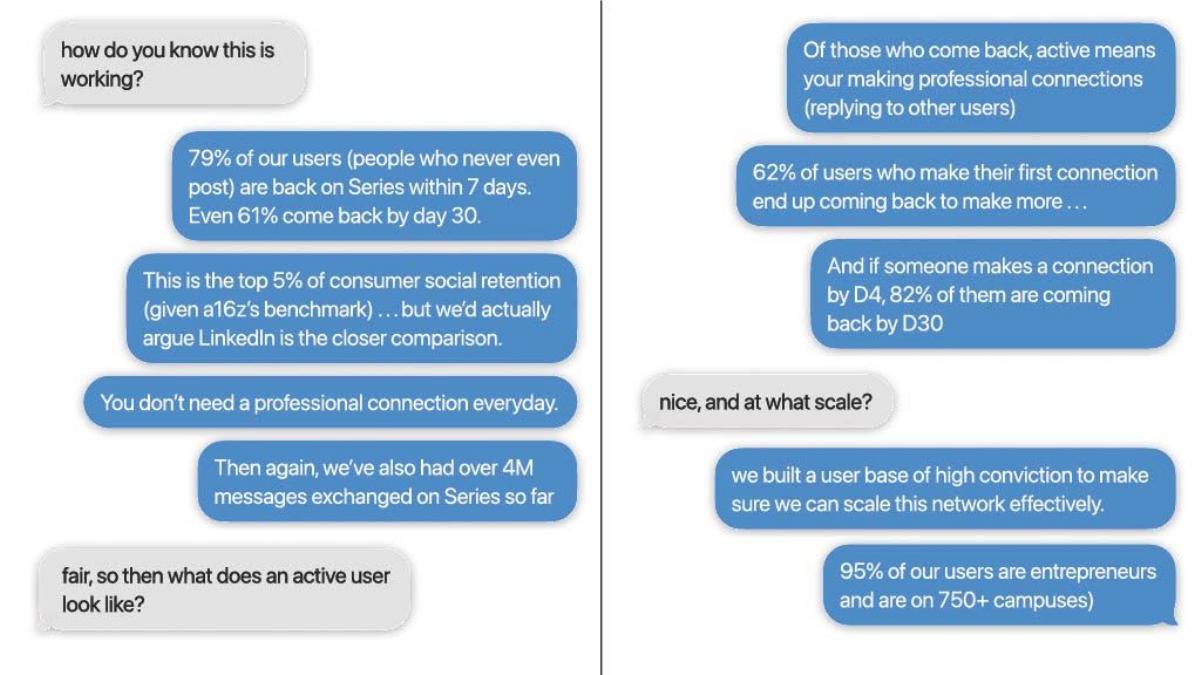
- Series claims a 79% 7-day retention rate, placing it in the top 5% of consumer social benchmarks on slide 7.
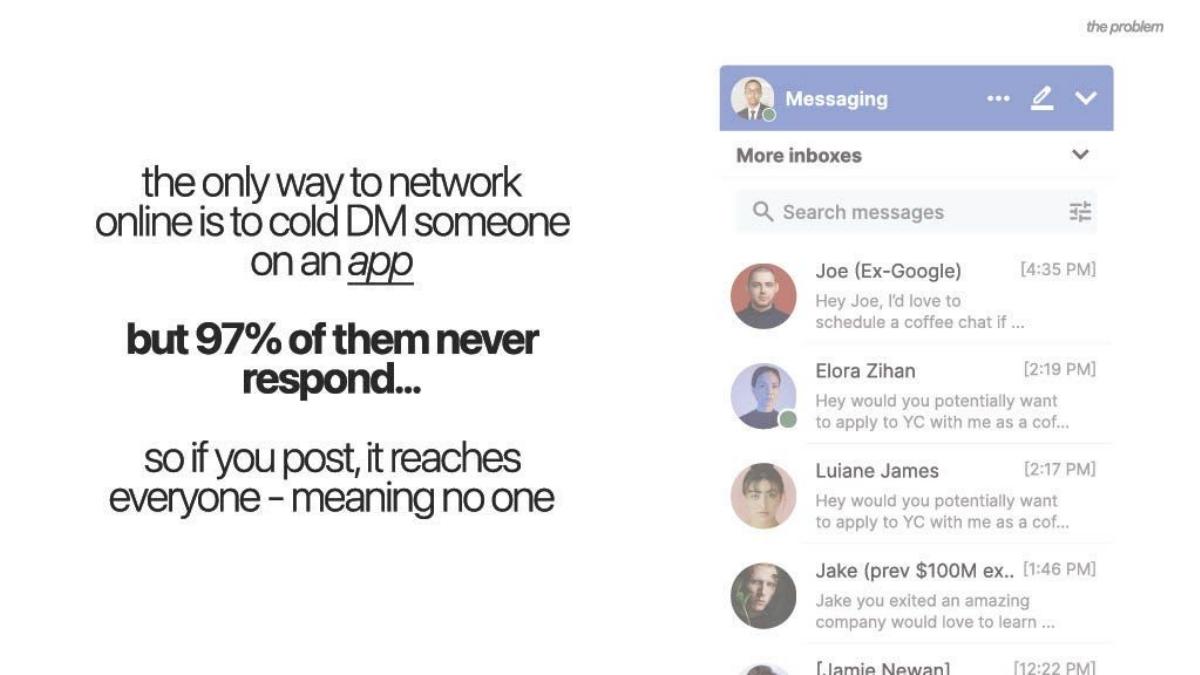
- The startup identifies a 97% non-response rate for cold DMs on traditional apps as a core problem on slide 3.
- The team is composed of 8 members with an average age of 23, positioning themselves as the 'exact demographic' they are building for on slide 6.
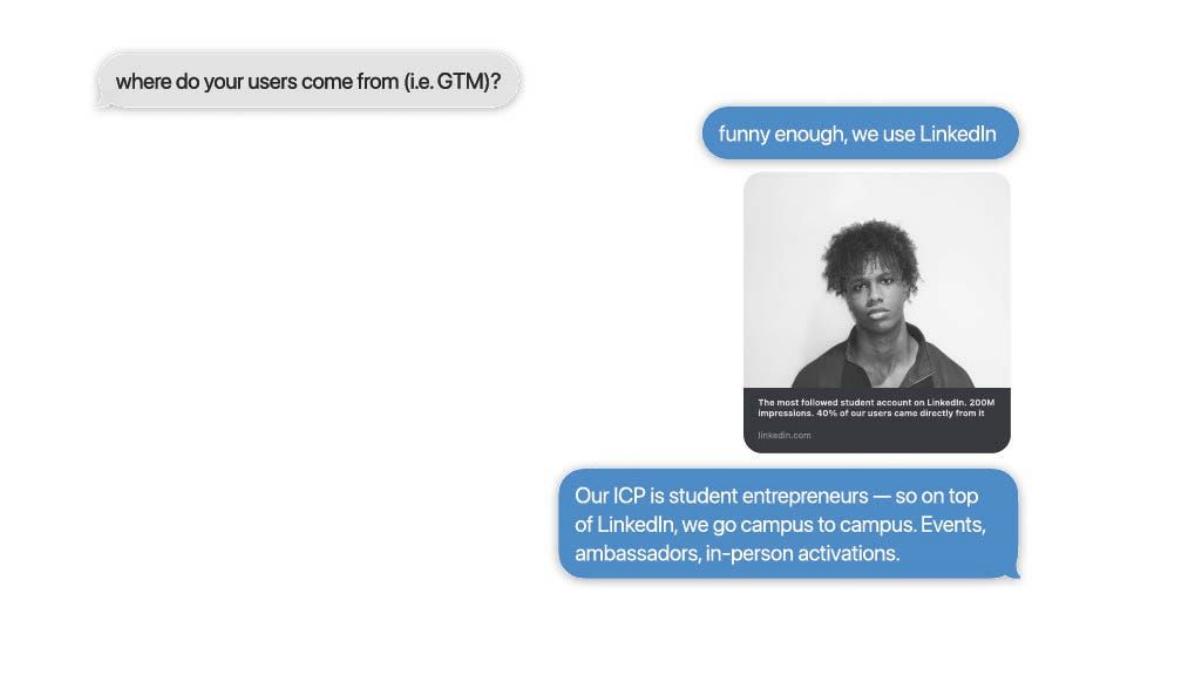
- GTM strategy relies on a student account with 200M impressions on LinkedIn, which drove 40% of their initial users as noted on slide 8.
- Series reports over 4 million messages have been exchanged on the platform to date on slide 7.
- The platform boasts an 80% read rate for messages compared to a 57% read rate for LinkedIn Recruiter on slide 9.
- The company has secured LOIs for recruitment access despite being pre-revenue by choice, according to slide 9.
Series Pitch Deck Teardown
Series represents a new wave of 'invisible' consumer social apps that leverage existing infrastructure—in this case, Apple’s iMessage—to bypass the friction of app discovery and installation. As reported by Business Insider, the company raised a $2M pre-seed round in 2024. The deck is a masterclass in thematic consistency, using a 10-slide conversational format to pitch a conversational product.
Slide 1: Title and Hook
The opening slide is minimalist, featuring the company name 'Series' in a bold, sans-serif font. The sub-headline, 'The Professional Network for GenZ,' immediately identifies the target market. The top-left corner features the primary value proposition: 'Find your people on iMessage.' This slide sets the tone for a deck that values white space and clear, punchy messaging.
Slide 2: The Thesis
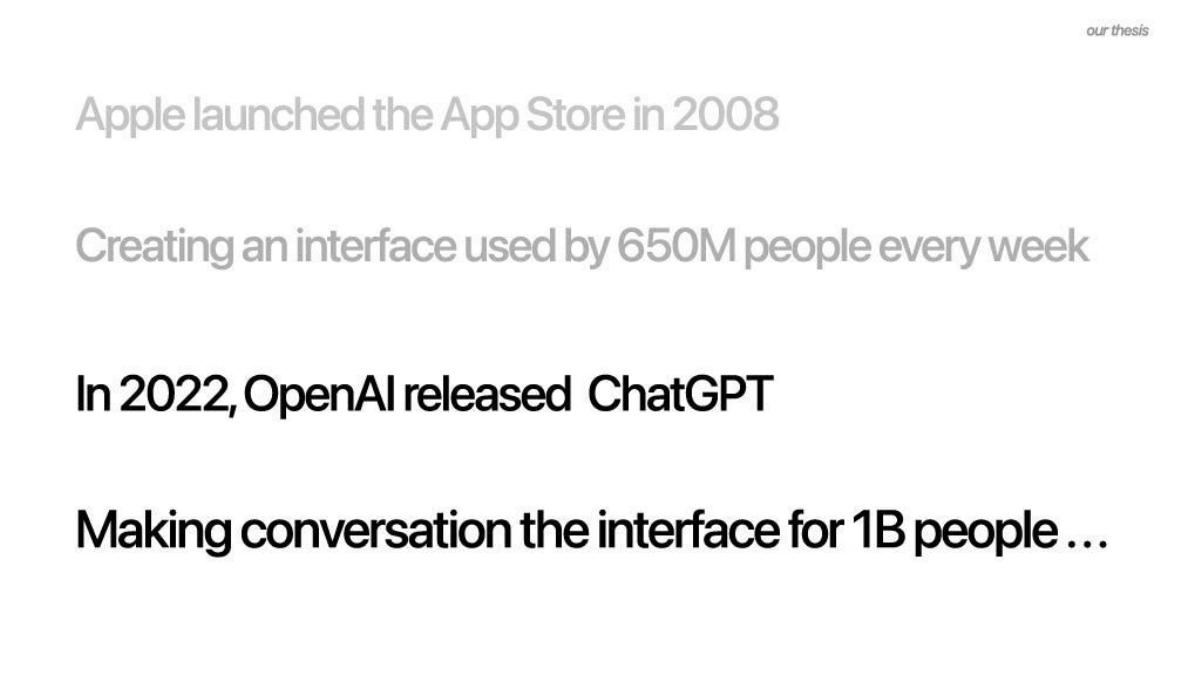
Slide 2 establishes a historical context for the product. It contrasts the 2008 launch of the App Store (650M weekly users) with the 2022 release of ChatGPT (1B users). The core argument is that 'conversation' has become the new interface. This framing is crucial because it justifies why Series isn't a standalone app; it is positioning itself as part of a broader shift in how humans interact with software.
Slide 3: The Problem
The problem slide focuses on the inefficiency of current networking tools. It claims that 'the only way to network online is to cold DM someone on an app but 97% of them never respond.' It also critiques the 'broadcast' nature of social posting, stating that if a post reaches everyone, it effectively reaches no one. A visual mock-up of a cluttered LinkedIn-style inbox reinforces the pain point of digital noise and low engagement.
Slide 4: The Solution
The solution is presented through a chat bubble interface. It defines Series as 'the first professional network built the way GenZ communicates entirely on iMessage.' By placing the solution inside a blue iMessage bubble, the founders reinforce the product's native environment. This is a high-conviction play that assumes the investor understands the dominance of iMessage among North American youth.
Slide 5: Product Mechanics
Slide 5 explains 'how does Series work?' It introduces the concept of a 'share' as a replacement for the cold DM. Users create a share, and Series uses an algorithm to distribute it to the 'right people' in a carousel format. The slide shows a mock-up of a user replying to a share to start a conversation. This slide is vital because it explains the 'magic'—how they prevent the 97% ghosting rate mentioned earlier by using curated distribution rather than open-access DMs.
Slide 6: The Team
The team slide leans heavily into the 'founders as the user' trope. With an average age of 23, the team claims to be the 'exact demographic we're building for.' Despite their youth, they list impressive pedigree, with experience at Meta, Microsoft, Salesforce, and Apple. The slide notes that 65% of the 8-person team writes code, signaling a product-heavy, lean organization. The use of circular avatars within a simulated iMessage contact list is a clever design choice.
Slide 7: Traction and Retention
This is the 'meat' of the deck. Slide 7 provides specific, high-performance metrics. It claims a 79% 7-day retention rate and a 61% 30-day retention rate. The founders explicitly compare these numbers to a16z benchmarks, placing themselves in the 'top 5% of consumer social retention.' They also mention that over 4 million messages have been exchanged. The right side of the slide adds depth: 82% of users who connect by day 4 return by day 30, and the network spans 750+ campuses.
Slide 8: Go-To-Market (GTM)
The GTM slide reveals a somewhat ironic strategy: using LinkedIn to kill LinkedIn. They mention a 'student account on LinkedIn' with 200M impressions that drove 40% of their users. Beyond digital influence, they employ 'campus to campus' tactics including events, ambassadors, and in-person activations. This hybrid approach—viral digital hooks combined with boots-on-the-ground density building—is a classic playbook for campus-focused social networks.
Slide 9: Revenue and Future Monetization
Slide 9 addresses the business model. While 'pre-revenue by choice,' the company has secured LOIs for recruitment access. They benchmark against LinkedIn Recruiter’s $10B/year revenue and 57% read rate, claiming their own messages get read 80% of the time. The focus remains on 'network density' for now, but the path to a B2B recruitment marketplace is clearly signaled to investors.
Slide 10: The Ask
The final slide confirms they are raising a Seed Round. It name-drops previous investors, including Pear VC and the co-founder of Venmo, to provide social proof. The closing line, 'the future is conversation. so we made sure our deck was one too,' brings the narrative full circle. It includes a direct contact email for the founder at a Yale.edu address, further emphasizing the student-led nature of the venture.
What Works in the Series Deck
Thematic Consistency: The deck is a rare example where the medium is the message. By designing the entire presentation as an iMessage thread, the founders prove they understand the aesthetic and functional nuances of their chosen platform. This builds immediate confidence in their ability to design for Gen Z.
Retention-First Metrics: Instead of focusing on vanity metrics like total signups, the deck leads with retention. The 79% 7-day retention figure is the most compelling data point in the deck. In consumer social, where churn is usually fatal, these numbers suggest a high degree of product-market fit within their initial niche.
Clear Competitive Moat: By highlighting the 97% non-response rate on traditional platforms and countering it with their own 80% read rate, Series creates a clear, quantifiable reason for their existence. They aren't just 'another social network'; they are a 'response-rate optimizer.'
What Is Missing from the Series Deck
Technical Infrastructure Detail: Building a complex network 'entirely on iMessage' presents significant technical hurdles, particularly regarding Apple’s API limitations and the risk of being flagged as spam. The deck does not explain how they manage the backend of these 'shares' or how they maintain a persistent user graph outside of a traditional app database.
Platform Risk Disclosure: The business is entirely dependent on Apple’s ecosystem. If Apple changes iMessage policies or launches a competing 'professional' feature, Series could be wiped out. A slide addressing platform risk or the eventual transition to a standalone app (if planned) is absent.
Detailed Use of Funds: While the deck mentions raising a Seed Round, it does not specify the amount being sought or how the capital will be allocated. Investors typically want to see a breakdown of hiring, marketing, and R&D spend for the next 18-24 months.
What Founders Should Copy
The 'Thesis' Slide: Slide 2 is an excellent example of how to frame a startup within a larger technological shift. By linking their conversational interface to the success of the App Store and ChatGPT, they make their specific product feel like an inevitable evolution rather than a random idea.
Benchmarking Against the Best: Series doesn't just list their retention numbers; they put them in context using a16z benchmarks. This makes it easier for an investor to categorize the quality of the traction without doing outside research.
Pedigree and Persona: The team slide effectively balances 'professionalism' (Meta, Apple, Salesforce) with 'authenticity' (we are the demographic). Founders building for a specific age group should always highlight why their personal identity gives them an unfair advantage in understanding that market's behavior.
Frequently asked questions
- How does Series actually function within iMessage?
- According to slide 5, Series functions by replacing cold DMs with 'shares.' Users create a share, which the platform then distributes to a personalized carousel for relevant recipients. Recipients can then reply directly to the share to initiate a conversation, all within the native iMessage interface. This removes the friction of downloading a new app while maintaining the intimacy of a private message.
- What are the primary engagement metrics mentioned in the deck?
- Engagement is a focal point on slide 7. Series reports that 79% of users return within 7 days and 61% return by day 30. Furthermore, 82% of users who make a professional connection by day 4 return by day 30. The deck also notes that over 4 million messages have been exchanged on the platform so far.
- Who is the target audience for Series?
- Slide 8 identifies the Ideal Customer Profile (ICP) as student entrepreneurs. The platform currently has users across more than 750 campuses, and 95% of the user base is identified as entrepreneurs. This narrow focus allows them to build network density before expanding to the broader Gen Z professional market.
- How does the company plan to make money?
- Slide 9 states that Series is currently 'pre-revenue by choice' to focus on network density. However, they have validated demand through Letters of Intent (LOIs) for recruitment access. They compare their potential to LinkedIn Recruiter, which generates $10B+ annually, suggesting a B2B recruitment model where firms pay to get in front of specific talent natively in iMessage.
- What is the background of the founding team?
- The team consists of 8 people with an average age of 23, as stated on slide 6. While many are still in school, the team members have previous experience at major firms including Meta, Microsoft, Salesforce, Raytheon, and Apple. 65% of the team are engineers ('writes code').