The Sequoia Capital pitch deck template is the industry's most influential framework for seed and series A fundraising. Spanning 15 slides (including instructional placeholders), the core narrative is compressed into just 10 functional chapters. It prioritizes a 'Problem-First' approach, forcing founders to articulate customer pain before showcasing technology. The template omits fluff, focusing instead on the 'Why Now'—the historical evolution and recent trends that create a market window. By demanding a single declarative sentence for the company purpose and a rigorous breakdown of TAM, SAM…
Key takeaways
- The deck mandates a single declarative sentence to define the company purpose on Slide 3.
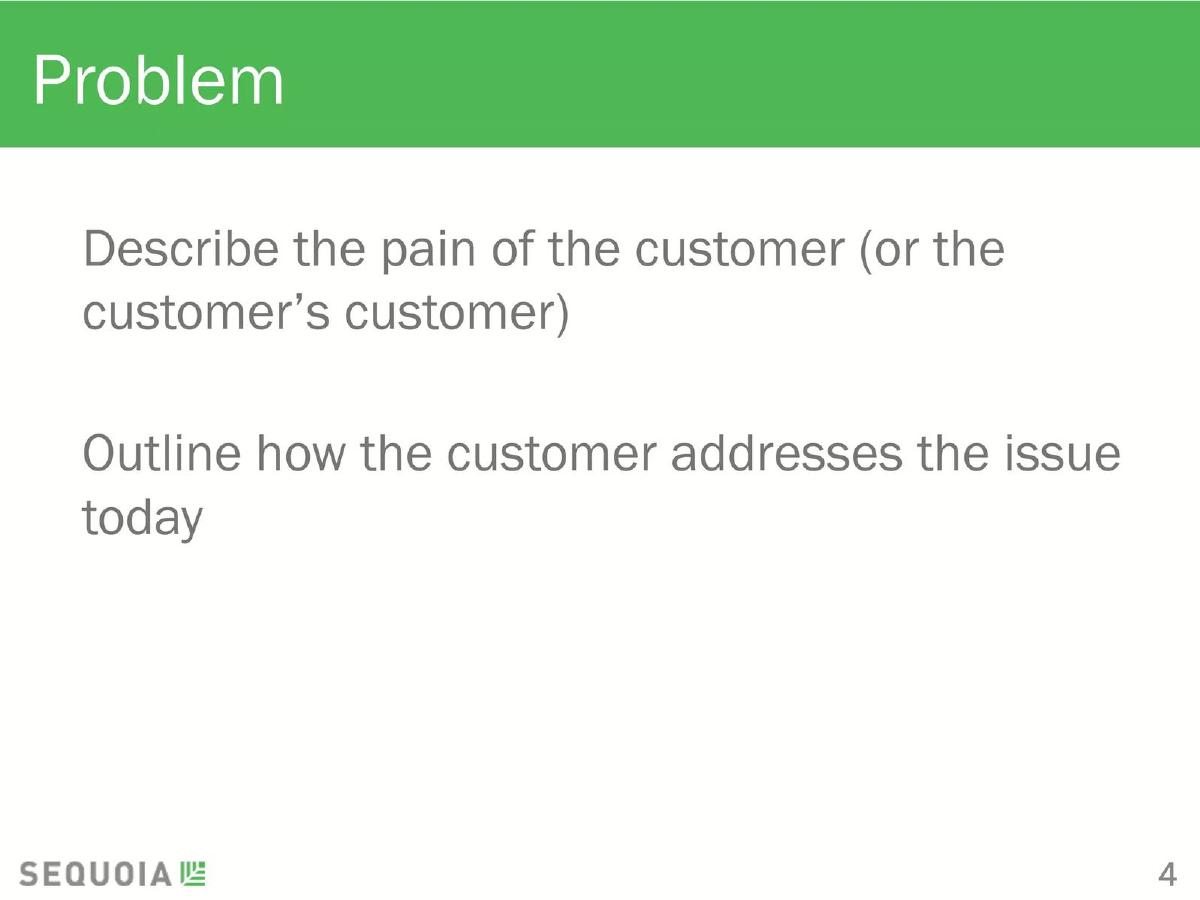
- Founders are required to describe the pain of the customer and how they address it today on Slide 4.
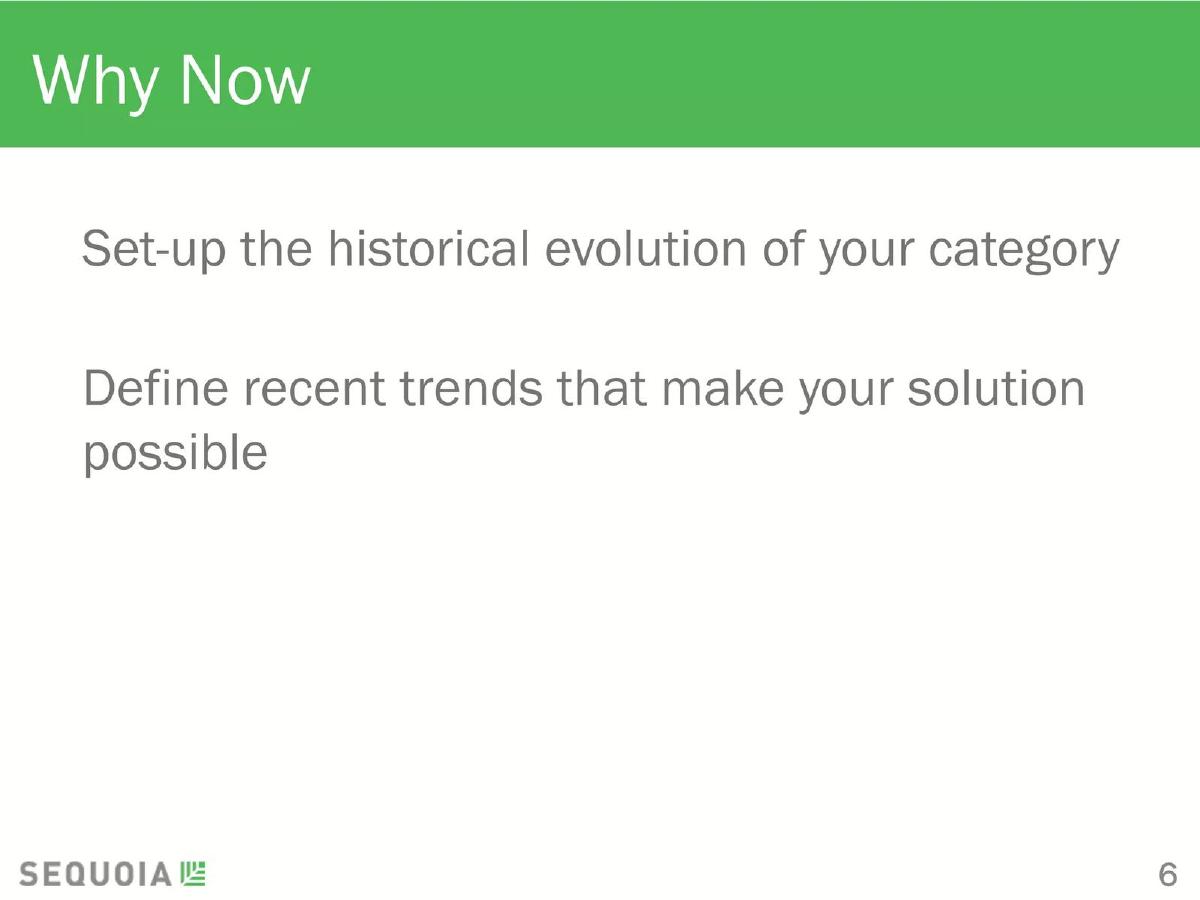
- The 'Why Now' slide (Slide 6) is critical for setting up the historical evolution and recent trends of a category.
- Market sizing must be broken down into TAM (top down), SAM (bottom up), and SOM on Slide 7.
- The business model slide (Slide 10) requires specific details on revenue model, pricing, and average account size/LTV.
- The product slide (Slide 9) focuses on intellectual property and the development roadmap rather than just features.
- Financials are expected to include a P&L, balance sheet, cash flow, and cap table on Slide 12.
- The template explicitly asks for a list of competitive advantages on Slide 8 to differentiate from the market.
Introduction: The Blueprint for Venture Success
The Sequoia Capital pitch deck template is not just a set of slides; it is a masterclass in venture communication. Reproduced by PitchDeckCoach from Sequoia's own public guidance, this 15-slide document serves as the structural foundation for startups seeking to join the ranks of Sequoia's portfolio. The deck is characterized by an extreme economy of words, forcing founders to abandon jargon in favor of clear, declarative logic.
Slides 1-2: The Setup and The Flow
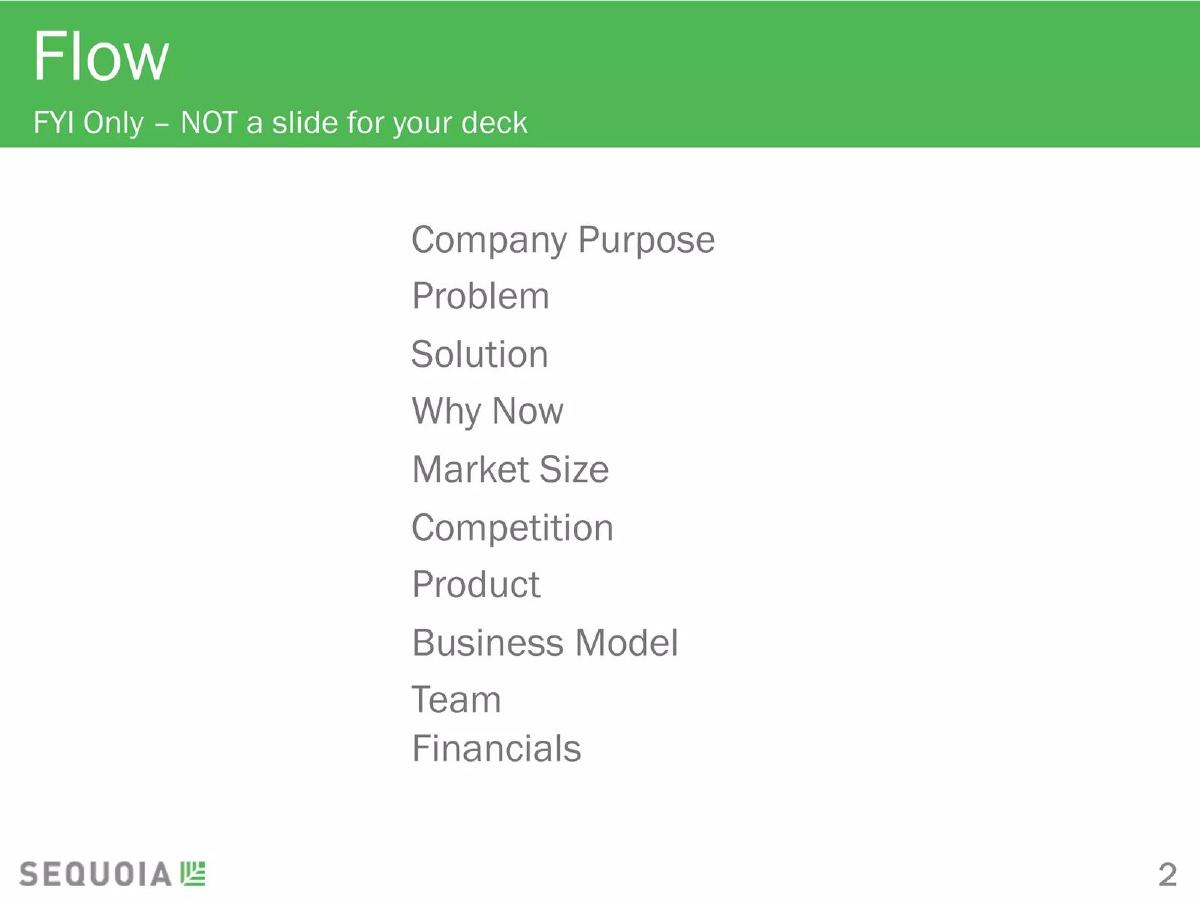
Slide 1 is the title card, identifying the source as Sequoia Capital and providing the original URL for the guidance. It sets a minimalist tone that carries through the entire presentation. Slide 2 , titled 'Flow,' is an instructional slide (not intended for the final deck) that lists the ten essential chapters: Company Purpose, Problem, Solution, Why Now, Market Size, Competition, Product, Business Model, Team, and Financials. This sequence is designed to build a narrative arc that moves from the macro problem to the micro execution details.
Slide 3: Company Purpose
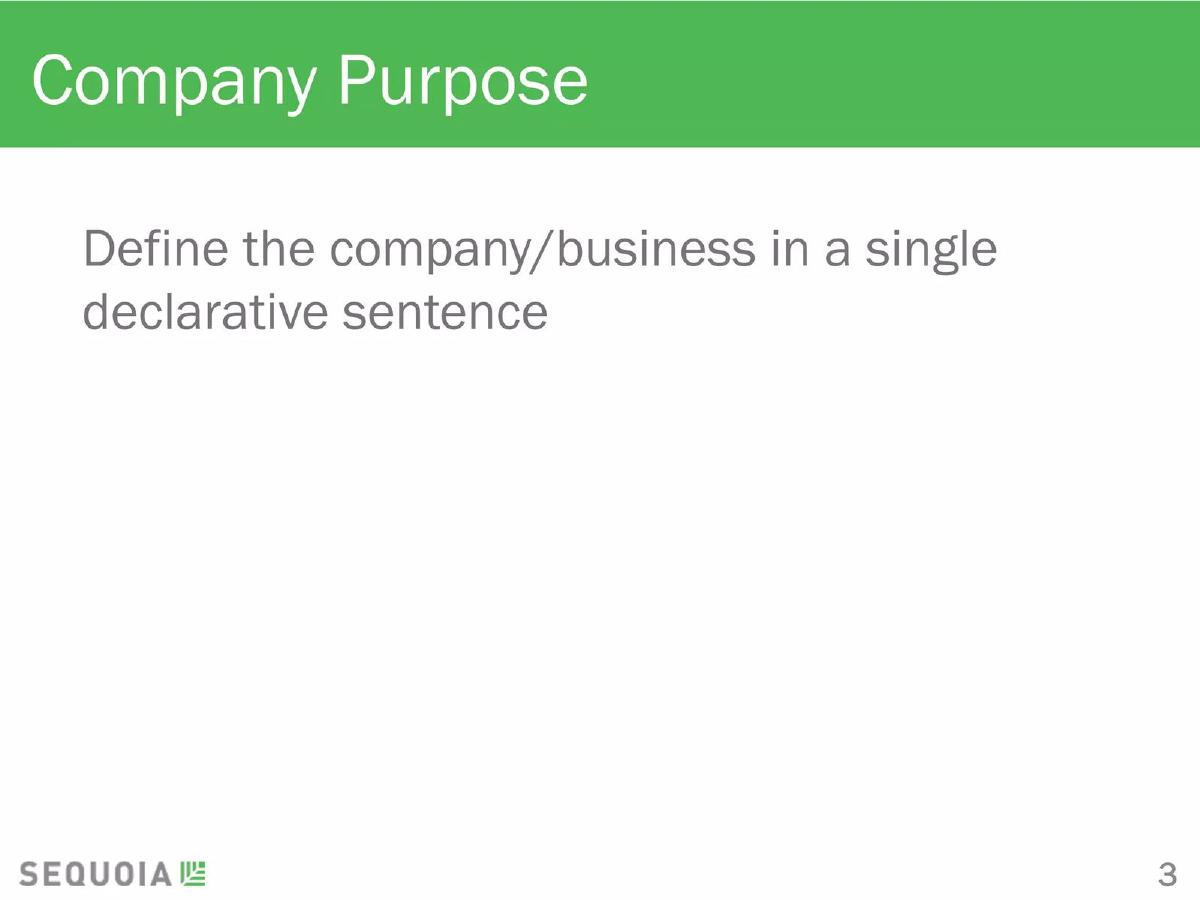
On Slide 3 , Sequoia demands that founders 'Define the company/business in a single declarative sentence.' This is often the hardest slide for founders to complete. It prohibits the use of 'the Uber for X' or 'AI-powered platform for Y' unless those terms truly define the core purpose. The goal here is absolute clarity of vision. If a founder cannot explain what they do in one sentence, Sequoia assumes they do not yet understand their own business deeply enough.
Slide 4: The Problem
Slide 4 focuses on the 'Pain.' It asks the founder to 'Describe the pain of the customer (or the customer’s customer).' Crucially, it also requires an outline of 'how the customer addresses the issue today.' This second point is vital because it identifies the incumbent behavior. If the customer is currently using a manual spreadsheet or a legacy provider, that is the 'competitor' the startup must displace. This slide establishes the 'gravity' of the pitch.
Slide 5: The Solution
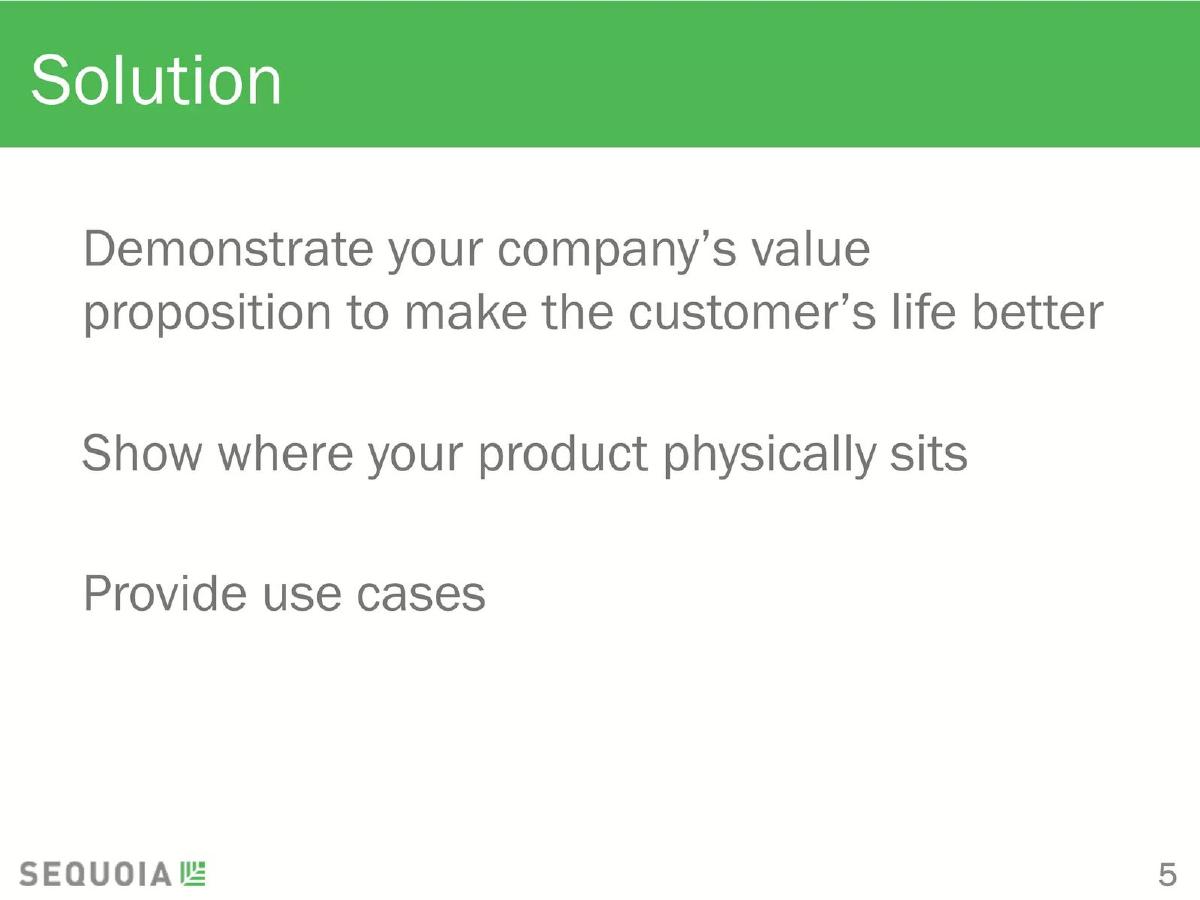
Slide 5 is the counterpoint to the pain. It asks founders to 'Demonstrate your company’s value proposition to make the customer’s life better.' It also includes a specific prompt to 'Show where your product physically sits.' This is a call for architectural clarity—is it a browser extension, a hardware device, or a backend API? Finally, it asks for 'use cases' to ground the solution in reality rather than abstract theory.
Slide 6: Why Now?
Often cited as the most critical slide in a modern pitch, Slide 6 asks for the 'historical evolution of your category' and the 'recent trends that make your solution possible.' This is the 'timing' slide. Sequoia is looking for a confluence of factors—perhaps a drop in sensor costs, a change in privacy laws, or a shift in consumer behavior—that has opened a window of opportunity that did not exist previously.
Slide 7: Market Size
Slide 7 moves into the quantitative. It requires the founder to 'Identify/profile the customer you cater to' and then calculate three specific tiers of market size: TAM (top down), SAM (bottom up), and SOM. By requiring a 'bottom-up' SAM, Sequoia forces founders to prove their market size based on actual pricing and reachable customer counts, rather than just quoting a multi-billion dollar industry report from Gartner or Forrester.
Slide 8: Competition
On Slide 8 , the template asks for a 'List of competitors' and a 'List of competitive advantages.' This is a direct prompt to acknowledge the landscape. Sequoia values honesty here; pretending there is no competition is a red flag. The focus is on the 'unfair advantages'—the IP, network effects, or cost structures that will allow the startup to win in a crowded field.
Slide 9: Product
Slide 9 goes deeper into the 'how.' It asks for the 'Product line-up,' specifically mentioning 'form factor, functionality, features, architecture, [and] intellectual property.' It also requires a 'Development roadmap.' This slide is intended to prove that the product is not just a prototype, but a scalable piece of engineering with a clear path for future iterations.
Slide 10: Business Model
Slide 10 is the 'How we make money' slide. It lists five requirements: Revenue model, Pricing, Average account size and/or lifetime value, Sales & distribution model, and a Customer/pipeline list. This slide bridges the gap between a great product and a great business. Sequoia wants to see that the founder has thought through the unit economics and the mechanics of customer acquisition.
Slide 11: Team
Slide 11 covers the 'Founders & Management' as well as the 'Board of Directors/Board of Advisors.' In early-stage investing, the team is often the primary signal. This slide should highlight why this specific group of people is uniquely qualified to solve the problem identified on Slide 4. The inclusion of the Board suggests that Sequoia looks for startups that have already begun to surround themselves with experienced mentors and governance.
Slide 12: Financials
The final functional slide, Slide 12 , is surprisingly rigorous for a general template. It asks for a P&L, Balance sheet, Cash flow, Cap table, and 'The deal.' This level of detail ensures that the founder is 'investor-ready' and has a clear grasp of their financial health and the specifics of the funding round they are seeking.
Slides 13-15: Closing and Metadata
Slide 13 is a call to action for the SlideShare platform where this template was hosted. Slide 14 is a blank green slide, and Slide 15 is a concluding slide with the PitchDeckCoach branding. These slides do not contain startup data but serve to close the presentation format.
What Works in the Sequoia Template
The primary strength of this deck is its logical progression . It follows a 'Why/What/How' structure that mirrors the way an investor's mind works. By starting with the 'Company Purpose' and 'Problem,' it builds emotional and intellectual buy-in before getting into the weeds of 'Architecture' or 'P&L.' This ensures the investor cares about the solution before they are asked to evaluate it.
Another standout feature is the Why Now slide. Most founders skip this, assuming the need for their product is self-evident. By forcing a historical context, Sequoia helps founders articulate their 'Alpha'—the specific insight they have about a changing market that others have missed. This slide often separates the visionary founders from the incremental ones.
What is Missing
While this is a gold standard template, it is a product of its time (2018) and Sequoia's specific preferences. It lacks a dedicated Traction slide. While traction can be mentioned in the 'Business Model' (Slide 10) under the 'Customer/pipeline list,' most modern decks require a standalone slide showing month-over-month growth, user engagement metrics, or revenue milestones. In today's market, showing 'Product-Market Fit' through data is often more important than the 'Product Architecture' details requested on Slide 9.
Additionally, there is no explicit Vision or Exit slide. While Sequoia likely prefers the vision to be woven through the 'Company Purpose,' some founders benefit from a closing slide that paints a picture of what the world looks like once they have succeeded at scale.
What Founders Should Copy
Founders should absolutely copy the single declarative sentence rule from Slide 3. It is the ultimate test of a pitch. If you cannot explain your business without using three commas and five adjectives, your pitch is too complex. Use this template to trim the fat from your narrative.
The Market Size breakdown on Slide 7 is also a must-copy. Moving from a top-down TAM to a bottom-up SAM shows a level of financial sophistication that immediately builds credibility with VCs. It proves you aren't just dreaming of a big market, but that you have a plan to actually invoice customers within it.
Finally, the Problem/Solution/Why Now triad is the most effective way to open any pitch. Use these three slides to establish the 'Market Pull' for your startup. If you can convince an investor that a massive problem exists and that the world has just changed to make your solution possible, the rest of the deck becomes a conversation about execution rather than permission.
Frequently asked questions
- Why does Sequoia prioritize the 'Problem' slide so early?
- Sequoia's philosophy, as seen on Slide 4, is that a startup's value is directly proportional to the severity of the pain it solves. By placing the problem before the solution, founders are forced to validate the market need. This ensures the investor understands the 'gap' in the market before being distracted by the specific features of the product.
- What is the difference between TAM, SAM, and SOM in this template?
- Slide 7 requires all three. TAM (Total Addressable Market) is the global opportunity. SAM (Serviceable Addressable Market) is the portion of the TAM your product can actually reach. SOM (Serviceable Obtainable Market) is the specific portion of the SAM you can realistically capture in the short term. This prevents founders from using only 'billion-dollar' vanity metrics.
- Why is 'Why Now' considered the most important slide?
- Slide 6 asks for the 'historical evolution' and 'recent trends.' Investors look for a 'market pull.' If a problem has existed for 20 years, why hasn't it been solved? The 'Why Now' slide identifies the specific technological or regulatory shift that makes your solution viable today when it wasn't possible five years ago.
- How detailed should the Financials slide be?
- According to Slide 12, it should be comprehensive. Unlike many seed decks that only show a burn rate, Sequoia asks for a P&L, Balance Sheet, Cash Flow, and Cap Table. This suggests they are looking for founders who have a deep grasp of their accounting and equity structure, even at earlier stages.
- What does 'The Deal' refer to on the final slide?
- On Slide 12, 'The Deal' refers to the specific ask. This includes how much money is being raised, the valuation expectations (if applicable), and the milestones that the funding will enable the company to reach. It is the closing argument of the pitch.