Setpoint’s Series A deck is a lean, 10-slide presentation that successfully raised $43M in 2022. The company addresses the friction in asset-backed lending, specifically for PropTech and Single-Family Rental (SFR) firms. The deck’s strength lies in its ability to quantify value: it claims to reduce funding times from 4-6 days to just 40 minutes and boasts a net dollar retention rate exceeding 200%. By focusing on the 'Funding OS' narrative, Setpoint positions itself as critical infrastructure rather than just a workflow tool. While it lacks a formal 'Ask' slide or detailed unit economics, the…
Key takeaways
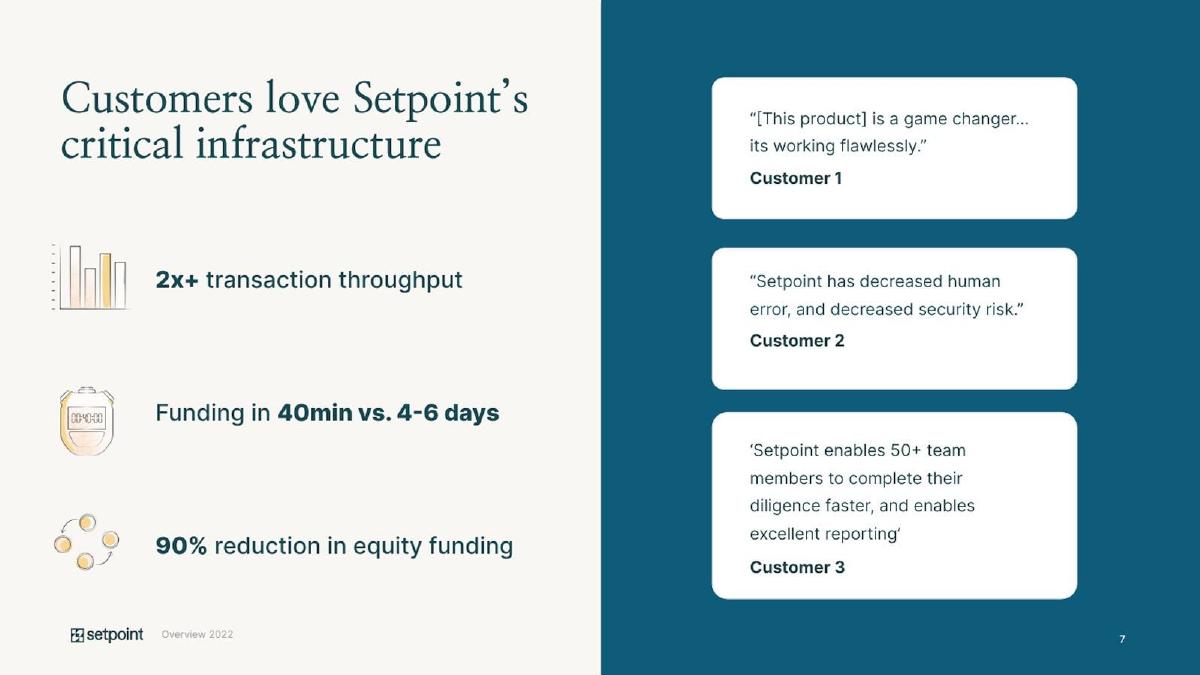
- The deck highlights a massive efficiency gain, reducing funding time from 4-6 days to 40 minutes (Slide 7).
- The founding team features deep domain expertise with previous leadership roles at Realtor.com, Opcity, and Citi (Slide 2).
- Setpoint reports a quarterly net dollar retention (NDR) of over 200% average, indicating significant expansion within existing accounts (Slide 8).
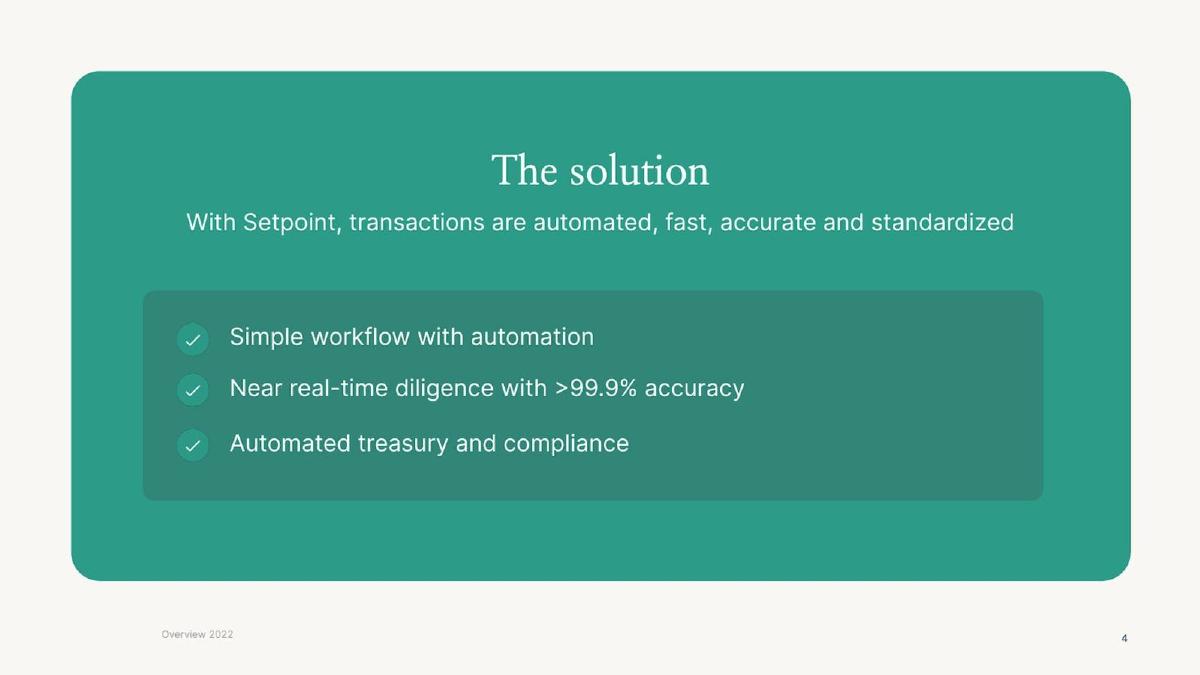
- The platform claims to achieve >99.9% accuracy in near real-time diligence (Slide 4).
- The business model relies on a flywheel effect where originators and lenders pull each other into the platform (Slide 9).
- The total addressable market (TAM) for US asset-backed lending is estimated at $17.5B for 2022 (Slide 10).
- Setpoint positions itself as the 'Funding OS' for originators, moving beyond a simple SaaS tool to a core infrastructure play (Slide 8).
- The deck omits a specific financial 'Ask' slide, though external reports confirm a $43M Series A raise in 2022.
The 10-Slide Efficiency Play
Setpoint’s Series A deck is a study in brevity. At only 10 slides, it avoids the common pitfall of over-explaining the technical nuances of fintech infrastructure and instead focuses on the brutal inefficiency of the status quo. The deck was used to secure a $43M Series A in 2022, a period when investors were shifting their focus from pure growth to operational efficiency and 'critical infrastructure' status. Setpoint positions itself as the 'Funding OS,' a term that suggests they are not just a vendor, but the underlying rails for asset-backed lending.
Slide 1: Title Slide
The deck opens with a simple 'Setpoint Overview' title. The visual branding uses a dark teal palette with an illustration of various modern residential properties. This immediately anchors the company in the real estate sector, specifically targeting the institutional side of property acquisition rather than consumer-facing mortgage tech.
Slide 2: Founding Team
Slide 2 introduces the three co-founders: Stuart Wall (CEO), Ben Rubenstein (President), and Michael Lam (CIO). This is a 'pedigree' slide. The logos for Signpost, Bain & Company, Realtor.com, Opcity, Yodle, and Citi are prominently displayed under the founders' names. For a Series A fintech company, showing that the leadership has both high-level consulting experience (Bain) and deep industry experience in real estate (Realtor.com) and banking (Citi) is a critical trust signal. It suggests the team has the 'earned secret' necessary to disrupt warehouse lending.
Slide 3: The Problem
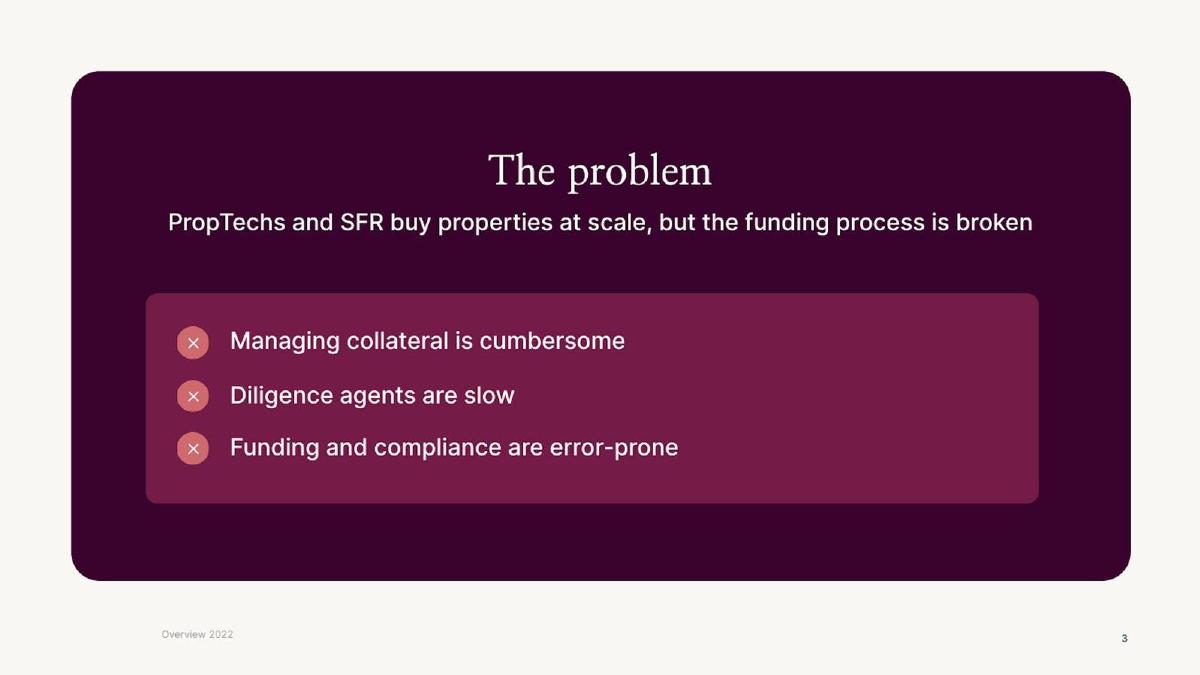
The problem slide is concise, identifying that PropTechs and SFR (Single-Family Rental) companies buy properties at scale, but the funding process is 'broken.' It lists three specific pain points: cumbersome collateral management, slow diligence agents, and error-prone funding/compliance. By focusing on 'diligence agents' and 'compliance,' Setpoint identifies the human-heavy bottlenecks that increase cost and risk for lenders.
Slide 4: The Solution
The solution slide mirrors the problem slide. It promises transactions that are 'automated, fast, accurate and standardized.' The key figure here is the claim of '>99.9% accuracy' in near real-time diligence. In the world of warehouse lending, where a single document error can stall millions of dollars in capital, this level of precision is the primary selling point.
Slide 5: The 'Before' State (Status Quo)
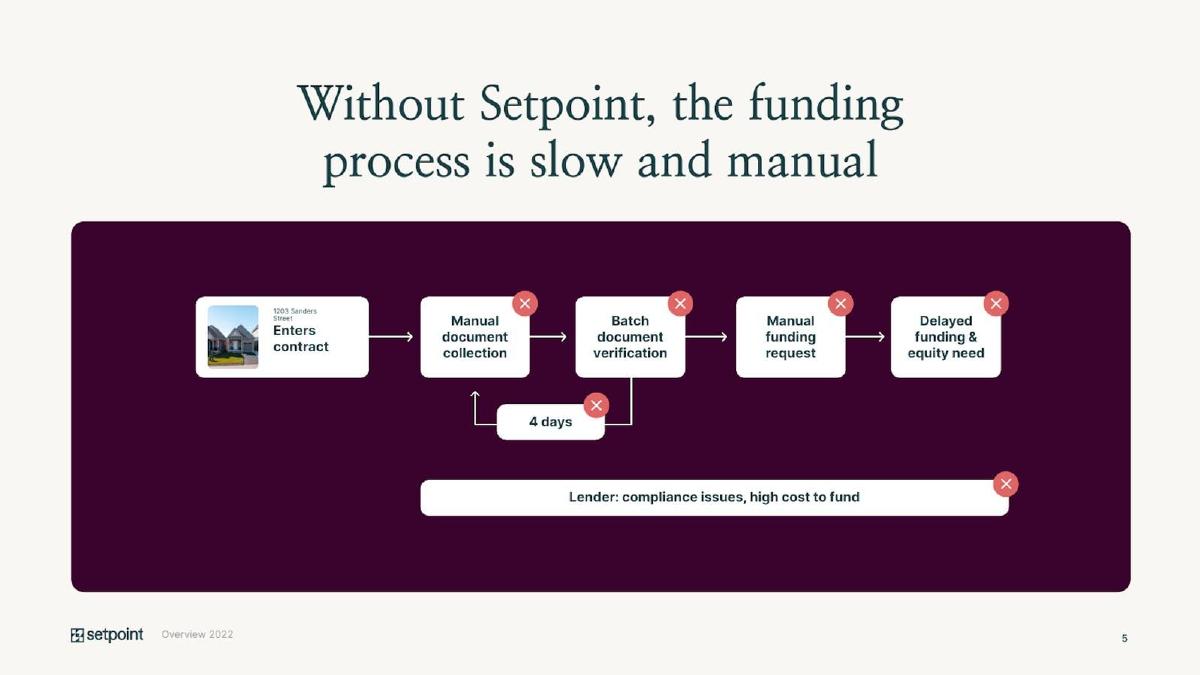
Slide 5 uses a process flow diagram to visualize the current state of the industry. It shows a linear path from 'Enters contract' to 'Delayed funding & equity need.' The most important detail is the '4 days' loop between manual document collection and batch document verification. It also highlights that lenders face compliance issues and high costs to fund. This slide sets the baseline for the 'After' state shown next.
Slide 6: The 'After' State (Setpoint)
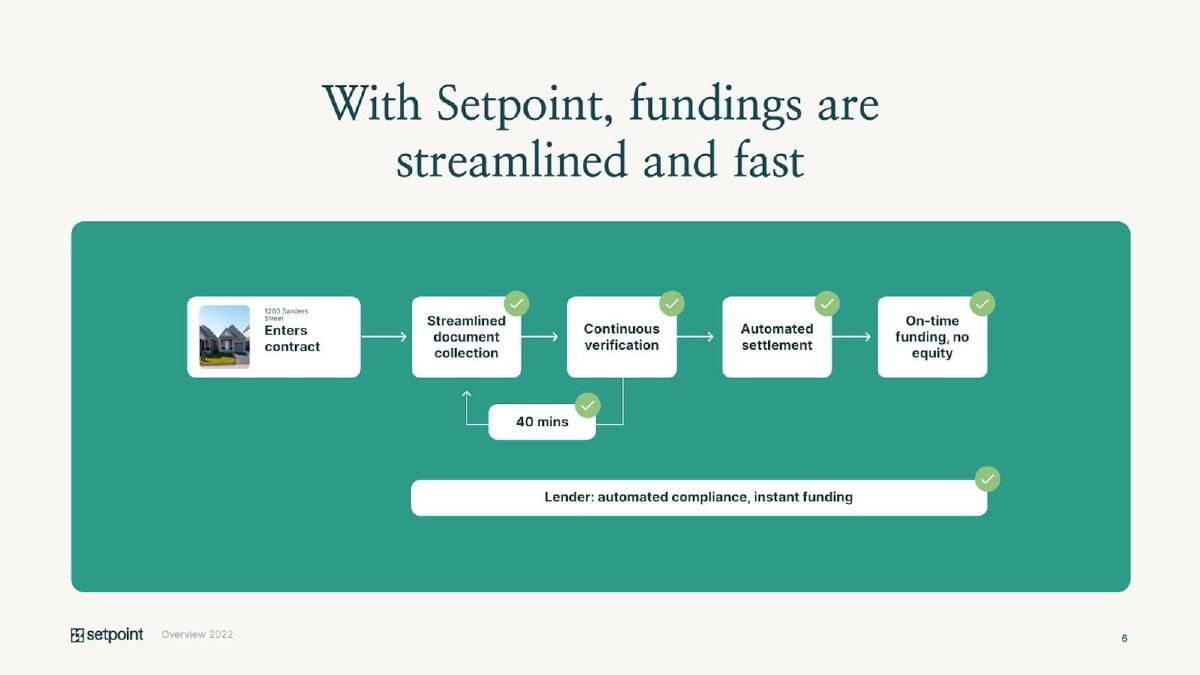
Slide 6 replicates the flow from Slide 5 but replaces the manual steps with Setpoint’s automated modules. The '4 days' bottleneck is replaced by a '40 mins' continuous verification step. The final outcome changes from 'Delayed funding' to 'On-time funding, no equity.' This visual comparison is the strongest part of the deck, as it provides a clear, quantifiable reason for a customer to switch to their platform.
Slide 7: Customer Impact and Testimonials
This slide combines quantitative metrics with qualitative social proof. It claims a '2x+ transaction throughput' and a '90% reduction in equity funding.' The latter is particularly important for PropTechs; if they can get their debt capital faster, they don't need to keep as much expensive equity on their balance sheet to bridge the gap. The slide includes three anonymous testimonials from 'Customer 1, 2, and 3,' focusing on the product being a 'game changer' and decreasing 'security risk.'
Slide 8: Retention and Growth
Slide 8 introduces the 'Funding OS' narrative. It features a cohort revenue chart showing 'Quarterly net dollar retention >200% avg.' For a SaaS company, an NDR of 200% is exceptional, suggesting that once an originator starts using Setpoint for one credit facility, they rapidly move all their other facilities onto the platform. The slide also mentions that originators are adding integrated services like 'valuation and calculation agent' roles, showing a path to increasing Average Revenue Per User (ARPU).
Slide 9: The Sales Flywheel
Slide 9 explains the 'Setpoint SaaS Adoption Cycle.' It’s a circular diagram showing how more originators lead to more lenders, which leads to expansion to all lenders/lines, and finally more originators. This suggests a network effect: as lenders become comfortable with the Setpoint interface through one client, they are likely to encourage their other borrowing clients to use the same platform to standardize their own internal workflows.
Slide 10: Market Expansion (TAM)
The final slide addresses the Total Addressable Market (TAM). It uses a concentric circle diagram to show the expansion path: starting with Power Buyers and PropTech, moving into SFR, then Mortgage, and finally 'Other Asset Backed Lending.' It cites a '$17.5B ’22 US TAM.' This slide tells investors that while Setpoint is starting in a niche (PropTech/SFR), the underlying technology is applicable to the much larger mortgage and general asset-backed lending markets.
What Setpoint Does Exceptionally Well
The Setpoint deck excels at quantifying the pain . Many founders describe their problem in abstract terms like 'inefficiency' or 'friction.' Setpoint uses specific time units: 4 days versus 40 minutes. This makes the value proposition undeniable. If a lender can fund a deal in 40 minutes instead of 4 days, their capital is more productive, and their risk profile improves.
Furthermore, the deck is highly disciplined . There are no 'fluff' slides about company culture or vague mission statements. Every slide serves to prove one of three things: the team is capable, the product works significantly better than the status quo, or the business is growing rapidly within its customer base. The inclusion of the 200% NDR figure (Slide 8) is a powerful 'mic drop' moment that validates the product-market fit better than any long-winded explanation could.
What is Missing from the Deck
Despite raising $43M, the deck has several notable omissions that would typically be expected in a Series A presentation:
No Financials or Unit Economics: While the NDR is mentioned, there is no mention of actual revenue figures, burn rate, or gross margins. Investors are left to guess the scale of the business. · No Competitive Landscape: The deck assumes Setpoint is the only solution. It does not mention legacy incumbents or other fintech startups targeting the warehouse lending space. · No Product Deep Dive: We see the 'flow,' but we don't see the software. There are no screenshots or detailed descriptions of how the 'continuous verification' actually works technically. · No 'The Ask' Slide: The deck ends on the TAM slide. It does not state how much money is being raised, what the milestones for the next 18 months are, or how the new capital will be allocated.
Founder Takeaways: Copy the Clarity, Not the Omissions
Founders should look at Slides 5 and 6 as a template for explaining complex B2B workflows. The 'Before and After' visualization is the most effective way to communicate value to an investor who may not be an expert in warehouse lending. If you can show a 90% reduction in a key negative metric (time, cost, or error rate), you have a compelling pitch.
However, founders should be cautious about omitting 'The Ask' or a competitive analysis unless they have the same level of founder pedigree and 'hot round' momentum that Setpoint likely had. For most startups, providing a clear roadmap and a specific funding goal is necessary to close the loop with investors. Setpoint’s deck works because the traction (200% NDR) and the team (ex-Citi/Realtor.com) are so strong that they overshadow the missing tactical details.
Frequently asked questions
- How much did Setpoint raise with this deck?
- According to publisher-reported facts from Business Insider, Setpoint raised $43 million in a Series A round in 2022. The deck itself does not state the amount being raised or the valuation.
- What is Setpoint's core value proposition?
- Setpoint digitizes and automates the warehouse lending process. As shown on Slide 7, they increase transaction throughput by 2x and reduce the need for equity funding by 90% by accelerating the speed at which capital moves from lenders to originators.
- Who are Setpoint's primary customers?
- The deck identifies PropTech companies and Single-Family Rental (SFR) firms as the primary originators, alongside the financial institutions (lenders) that provide their credit facilities, as detailed on Slides 3 and 9.
- What metrics does Setpoint use to prove traction?
- The deck focuses on two primary traction metrics: a net dollar retention rate of over 200% (Slide 8) and operational speed, moving from a 4-day document verification cycle to a 40-minute continuous verification cycle (Slides 5 and 6).
- Does the deck include a roadmap or future product plans?
- The deck does not include a traditional chronological roadmap. Instead, Slide 10 outlines a market expansion strategy, moving from Power Buyers and PropTech into Mortgage and other asset-backed lending categories.