Sharesomestyle raised $2.5M in 2016 for its personal styling marketplace. The deck is a masterclass in visual storytelling, using high-impact photography to illustrate the 'before and after' emotional journey of its customers. While it lacks a traditional 'Ask' slide or detailed financial projections, it compensates with strong traction data, including a 38% month-over-month revenue growth rate and a $100k run rate. The deck leans heavily on the quality of its supply side, showcasing a diverse roster of stylists to prove the platform's curation capabilities. By focusing on the human element o…
Key takeaways
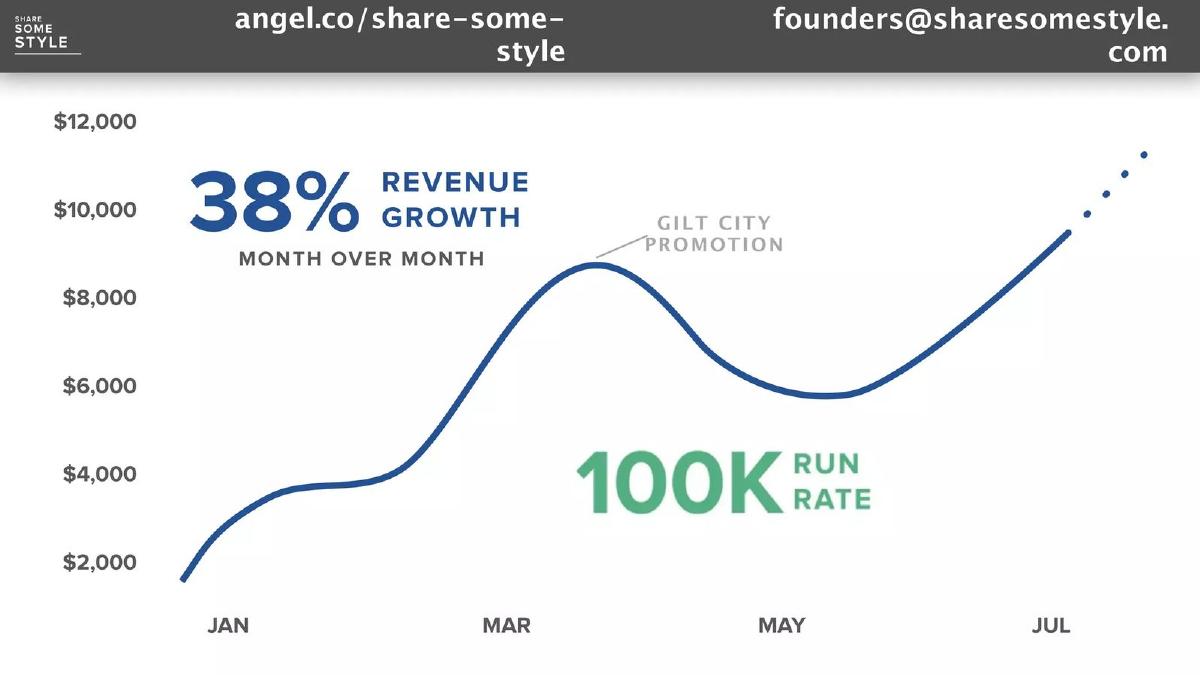
- The company reported a 38% month-over-month revenue growth rate leading up to July (Slide 2).
- A 'Gilt City Promotion' caused a significant revenue spike in March, followed by a dip and subsequent recovery (Slide 2).
- The platform achieved a $100k run rate by the time of the pitch (Slide 2).
- Customer retention is highlighted by a metric of 3x bookings per year and $750 revenue per client per year (Slide 20).
- The problem is framed through five distinct pain points: lack of personalization, pushy sales associates, lack of friend expertise, high cost of traditional stylists, and search friction (Slides 5-9).
- The team includes experience from Mozilla, Cisco, and Rocksbox, with advisors from ModCloth and Gap (Slide 22).
- The deck omits a specific funding ask, valuation, or detailed use of funds slide.
- Visual evidence of the product includes a dashboard for stylists to manage leads and client communications (Slide 21).
Introduction: The Visual Marketplace Narrative
Sharesomestyle’s 2016 seed deck is a quintessential example of the 'less is more' design philosophy. With 24 slides, the deck relies almost entirely on full-bleed imagery and short, punchy headlines. This approach is particularly effective for a fashion and lifestyle startup where the aesthetic quality of the service is the product itself. The deck successfully navigates the transition from identifying a fragmented, expensive traditional market to presenting a scalable, tech-enabled solution.
Slide 1: Title and Mission
The cover slide features a blurred background image of a styling session, immediately establishing the human-centric nature of the business. The mission statement is broad: "We help men and women look great and be more confident." It avoids technical jargon, focusing instead on the emotional outcome of the service.
Slide 2: The Traction Hook
Unusually, Sharesomestyle places a traction slide second. This is a power move designed to immediately validate the business before explaining the mechanics. The slide shows a "38% Revenue Growth Month Over Month" and a "100K Run Rate." The graph is honest, showing a peak during a "Gilt City Promotion" in March, a subsequent dip, and then a steady climb back up through July. This transparency regarding a promotion-driven spike builds credibility with analysts.
Slide 3: Geographic Footprint
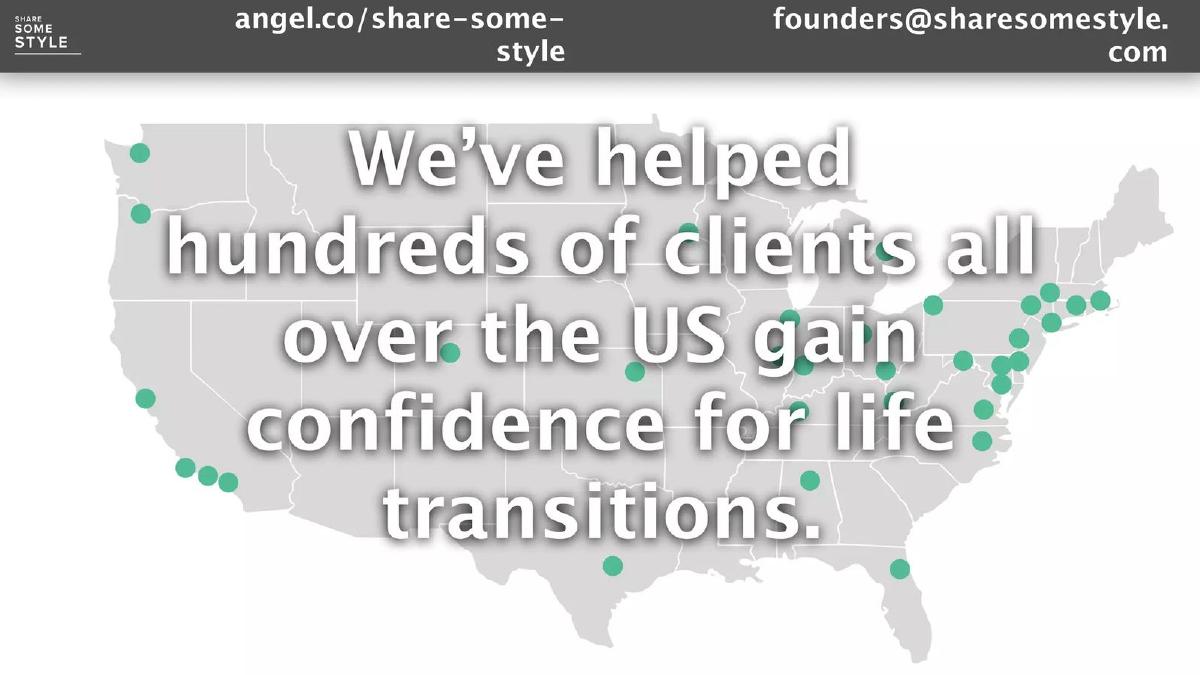
A map of the United States with green dots indicates that the company has "helped hundreds of clients all over the US." The concentration of dots is highest on the coasts, particularly the Northeast and California, which aligns with the target demographic for personal styling services. The text emphasizes "confidence for life transitions," positioning the service as a solution for major life events rather than just daily wear.
Slides 4-9: The Problem Statement
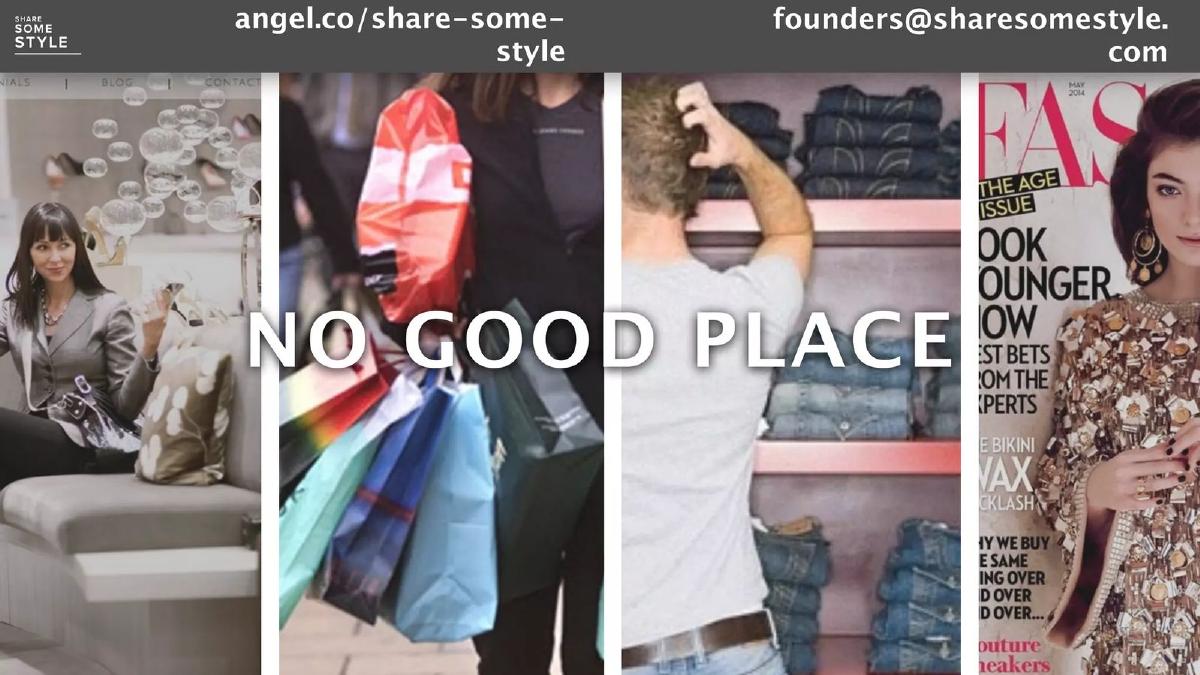
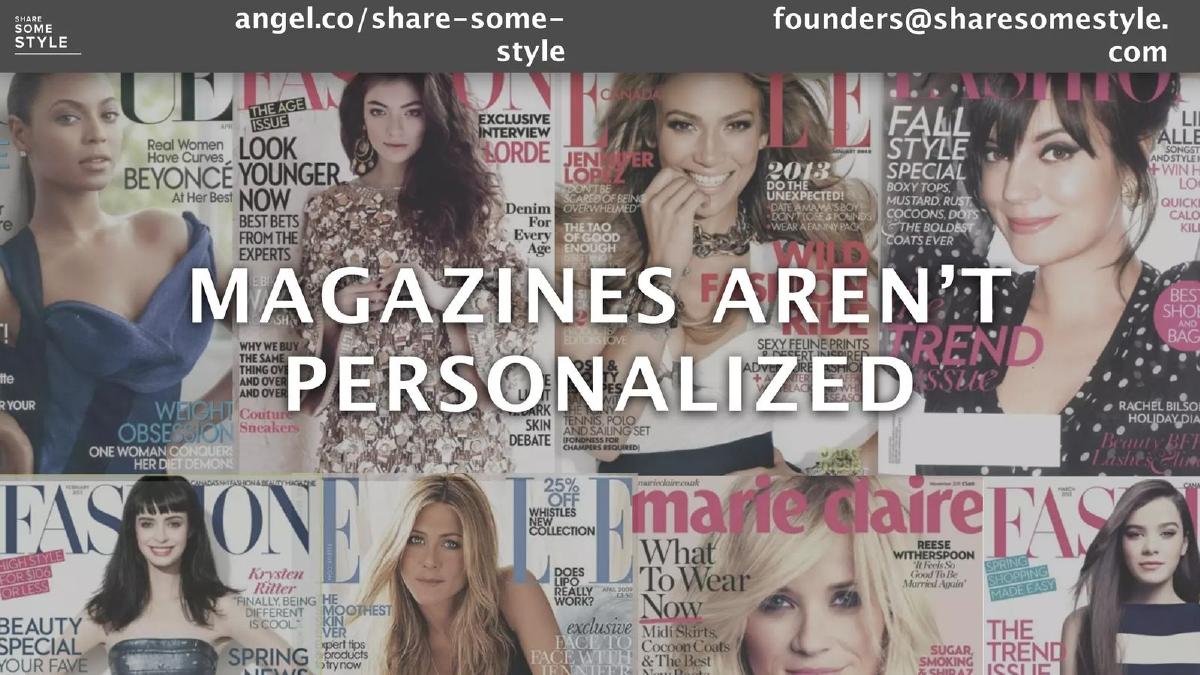
The deck spends five slides detailing the 'Problem,' using a 'No Good Place' theme. Each slide identifies a specific failure of the current fashion ecosystem:
Slide 5: "Magazines aren't personalized." · Slide 6: "Sales associates push clothing" (implying a conflict of interest). · Slide 7: "Friends don't have the expertise." · Slide 8: "Traditional stylists are too expensive." · Slide 9: "Too hard to find the right one" (illustrated with cluttered Google and Yelp search results).
By breaking the problem down into these specific friction points, the founders set up their solution as a multi-faceted fix for cost, trust, and discovery.
Slides 10-14: The Solution and Service Model
Slide 10 reintroduces the brand logo over a clear, brightly lit photo of a stylist and client. Slide 11 uses a hub-and-spoke diagram to show how the platform connects diverse clients to specific stylists like "Christina," "Katina," and "Rashad." This highlights the curation aspect of the marketplace.
Slides 12 and 13 define the service delivery: "One-on-one coaching and advice" that happens "In-home, In-store, Online." This omni-channel approach is a key differentiator, suggesting that the platform isn't just a directory but a full-service logistics layer for styling.
Slides 15-19: Social Proof and Case Studies
Slide 15 is a 'wall of faces' representing the user base. This is followed by two 'Before and After' slides. Slide 16 features "Rohit, Tech CEO," showing a transition from a t-shirt and shorts to a tailored button-down and chinos. Slide 17 features "Olga, Working Mom," showing a similar professional upgrade. These slides are critical because they prove the service works for different body types and lifestyles.
Slide 18 and 19 provide further social proof. Slide 18 shows logos for Kimpton Hotels & Restaurants and Kiva , implying corporate partnerships or high-profile client origins. Slide 19 is a quote cloud with descriptors like "game changer," "empowered," and "best money I've spent in a long time."
Slide 20: Unit Economics
This is the most important slide for a seed-stage investor. It lists two key metrics:
3x Bookings/Year: This proves high retention and utility. · $750 Revenue/Client/Year: This establishes a high Average Revenue Per User (ARPU), which is necessary to offset the cost of high-touch human stylists.
Slides 21-22: Product and Team
Slide 21 provides a glimpse of the actual software. It shows a dashboard on a laptop and a mobile phone. The interface includes a list of clients (e.g., "Jason Shen," "Asavari Devadiga" ) with status tags like "Lead," "Ready," and "Maybe." This confirms that Sharesomestyle is building a CRM for stylists, not just a landing page.
Slide 22 introduces the team. Diane Loviglio (CEO) brings experience from Mozilla and FailCon . Gilman Tolle (CTO) has a deep technical background with Cisco and UC Berkeley . Nicole Chiu-Wang provides the industry expertise from Rocksbox . The inclusion of advisors from ModCloth and Gap rounds out the retail credibility.
What Sharesomestyle Does Well
The deck excels at emotional resonance . By focusing on 'confidence' and 'life transitions,' the founders move the product out of the 'luxury' category and into the 'essential tool for success' category. The use of real client names and faces makes the traction feel tangible rather than theoretical. Furthermore, the transparency on the traction slide (Slide 2) regarding the Gilt City promotion is a sophisticated way to handle a revenue spike that might otherwise look like a red flag to a diligent investor.
What is Missing
The most glaring omission is the Financial Ask . There is no slide stating how much money is being raised, what the valuation is, or how the $2.5M will be spent. Additionally, the deck does not explain the Take-Rate . While we see the revenue per client, we don't know how much of that $750 stays with the platform versus going to the stylist. Finally, there is no Competitive Analysis . In 2016, companies like Stitch Fix were already gaining massive traction; failing to address how Sharesomestyle differs from algorithmic styling models is a missed opportunity to define their moat.
Founder Takeaways
Founders should copy the clean, high-impact visual style of this deck. If you are in a consumer-facing industry, your deck should look as good as your product. The use of 'Before and After' case studies is also a highly effective way to demonstrate value proposition without using a single bullet point. However, founders should ensure they include a clear 'Ask' and a brief explanation of their business model's margins to ensure the deck functions as a complete investment document, not just a marketing presentation.
Frequently asked questions
- What was the primary growth driver mentioned in the deck?
- The deck highlights a 38% month-over-month revenue growth rate. A specific catalyst mentioned on Slide 2 is a 'Gilt City Promotion' in March, which drove a temporary peak. However, the subsequent trend line shows organic recovery and growth towards a $100k run rate by July, suggesting the platform could sustain momentum beyond one-off marketing events.
- How does Sharesomestyle define its value proposition to customers?
- The value proposition is centered on 'confidence for life transitions' (Slide 3). The deck uses 'Before and After' slides (Slides 16-17) to demonstrate that the service isn't just about clothes, but about professional and personal transformation for demographics like 'Tech CEOs' and 'Working Moms.'
- What are the unit economics for a typical Sharesomestyle client?
- According to Slide 20, the marketplace generates $750 in revenue per client per year. This is driven by a high frequency of use, with clients averaging 3x bookings per year. This suggests a move away from the 'one-and-done' nature of traditional personal styling toward a recurring service model.
- Who are the key members of the leadership team?
- The team consists of Diane Loviglio (CEO), formerly of Mozilla and Wattbot; Gilman Tolle (CTO), with a background at Cisco and Arch Rock; and Nicole Chiu-Wang (Director of Style), who came from Rocksbox. They are supported by advisors from major retail brands like Gap and ModCloth (Slide 22).
- What is missing from this pitch deck that investors usually expect?
- The deck is notably missing an 'Ask' slide detailing how much capital is being raised and the specific milestones it will fund. It also lacks a competitive landscape matrix, a detailed breakdown of the take-rate (marketplace margins), and a clear roadmap for future feature development or geographic expansion beyond the US map shown on Slide 3.