Sharpist’s 12-slide Series A deck is a masterclass in presenting a high-growth SaaS business within a traditional service industry. By focusing on the 'digitalization' of coaching, the company successfully positioned itself as a scalable technology platform rather than a consulting firm. The deck relies heavily on engagement data—citing 92% session utilization and 95% upvotes—to prove that their mobile-first approach solves the chronic problem of employee disengagement. While the version analyzed has several key financial figures redacted, the structural flow from problem (80% disengagement)…
Key takeaways
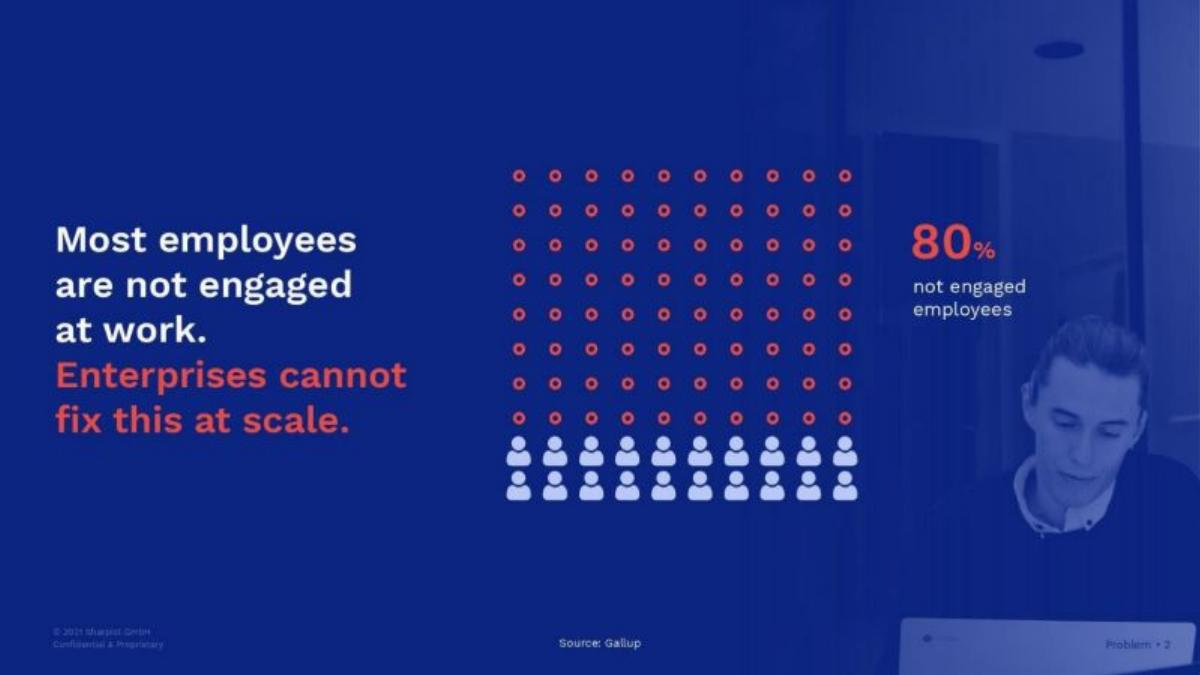
- The deck identifies a massive pain point: 80% of employees are not engaged at work, and enterprises cannot fix this at scale (Slide 2).
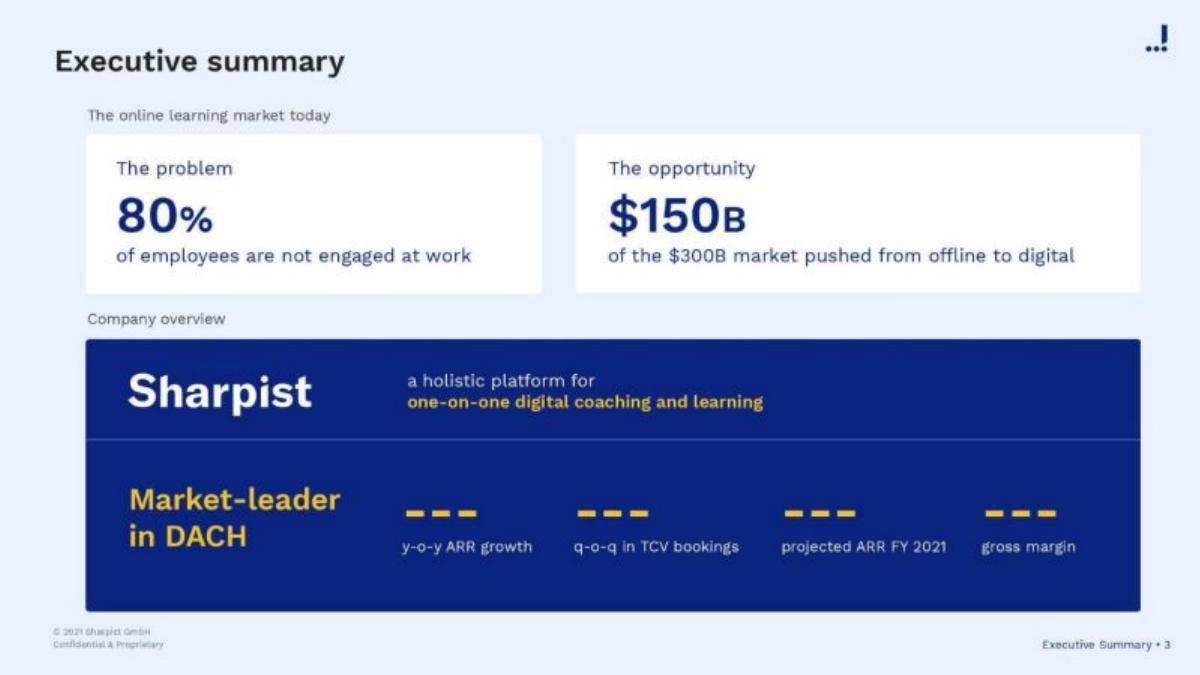
- Sharpist positions itself as the 'Market-leader in DACH,' though specific ARR and growth figures are redacted in this version (Slide 3).
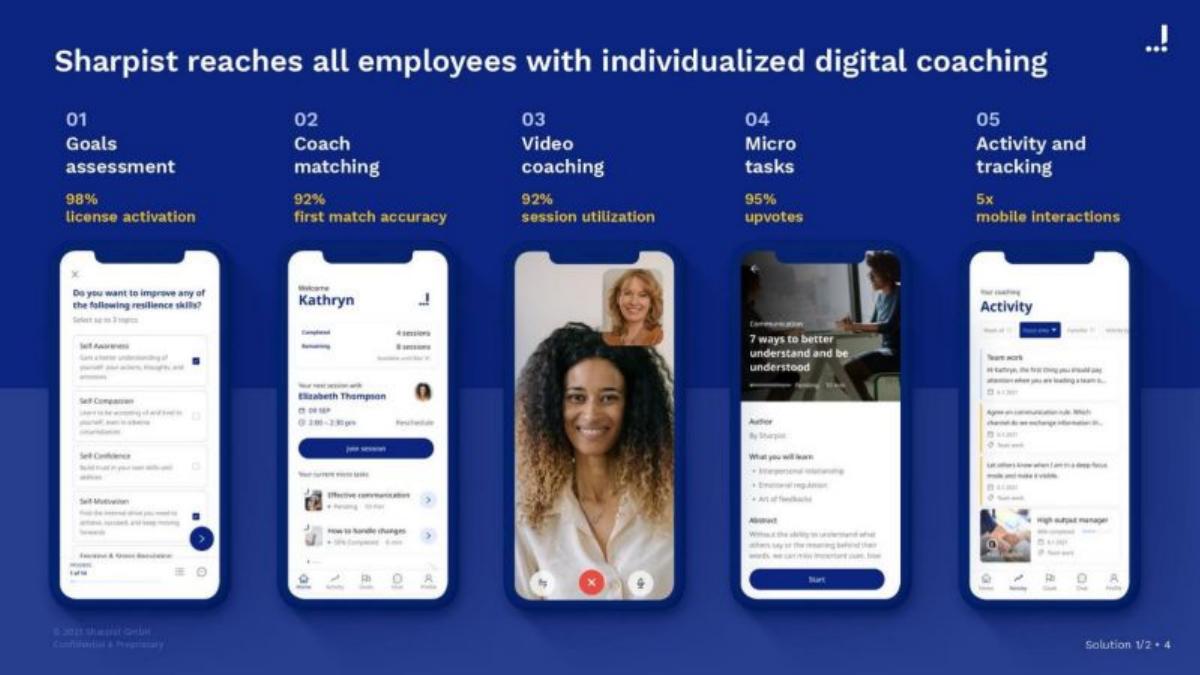
- Product efficacy is supported by high engagement metrics, including a 92% first match accuracy for coaches and 98% license activation (Slide 4).
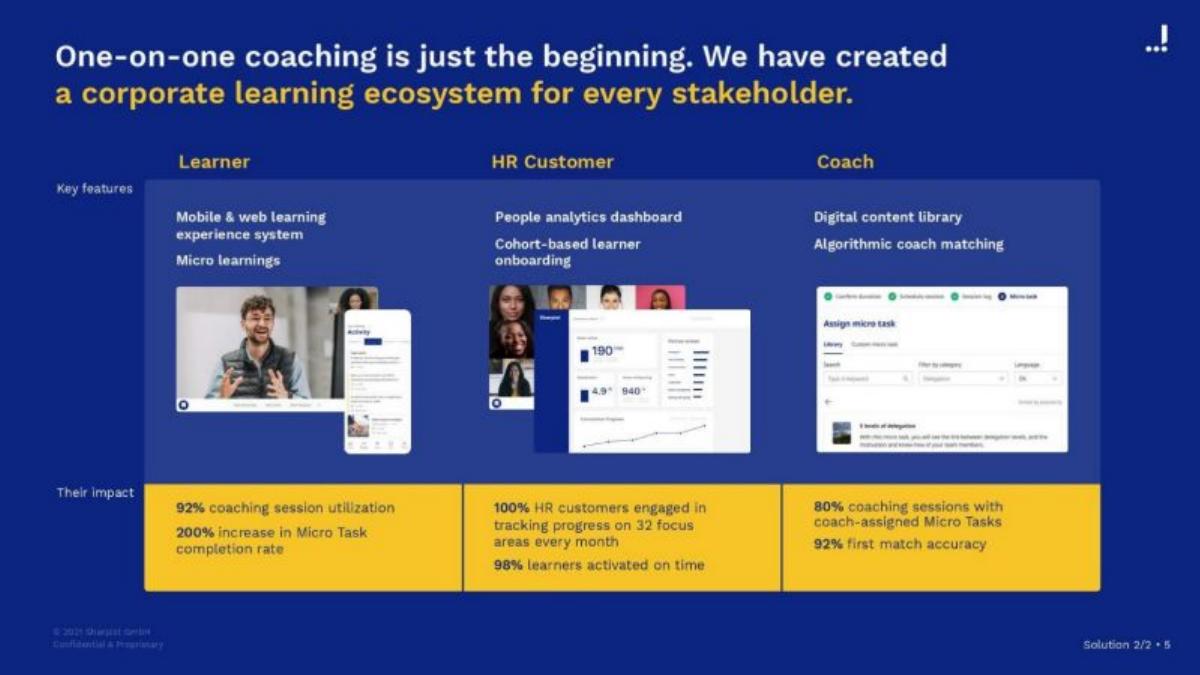
- The business model expands beyond one-on-one coaching to a 'corporate learning ecosystem' involving learners, HR customers, and coaches (Slide 5).
- The roadmap shows a strategic shift from $1.8B one-on-one coaching to a $150B cohort-based learning market (Slide 7).
- Customer traction is visualized through a grid of 36 client logos, although all names are redacted in the public version (Slide 8).
- The revenue projection shows an aggressive hockey-stick growth curve through December 2023 (Slide 9).
- The team is built on 'veterans in SaaS and HR' with experience from Google, McKinsey, and LinkedIn (Slide 10).
The Narrative: From Service to Scalable Ecosystem
Sharpist’s Series A deck is built on the premise that professional development is no longer a luxury for executives but a necessity for the entire workforce. The narrative moves quickly from a universal problem—employee disengagement—to a technology-driven solution that claims to be the market leader in the DACH region (Germany, Austria, Switzerland). By framing coaching as a 'digital learning ecosystem,' they move the conversation away from high-touch, low-margin consulting toward a high-margin SaaS model.
Slides 1-2: The Engagement Crisis
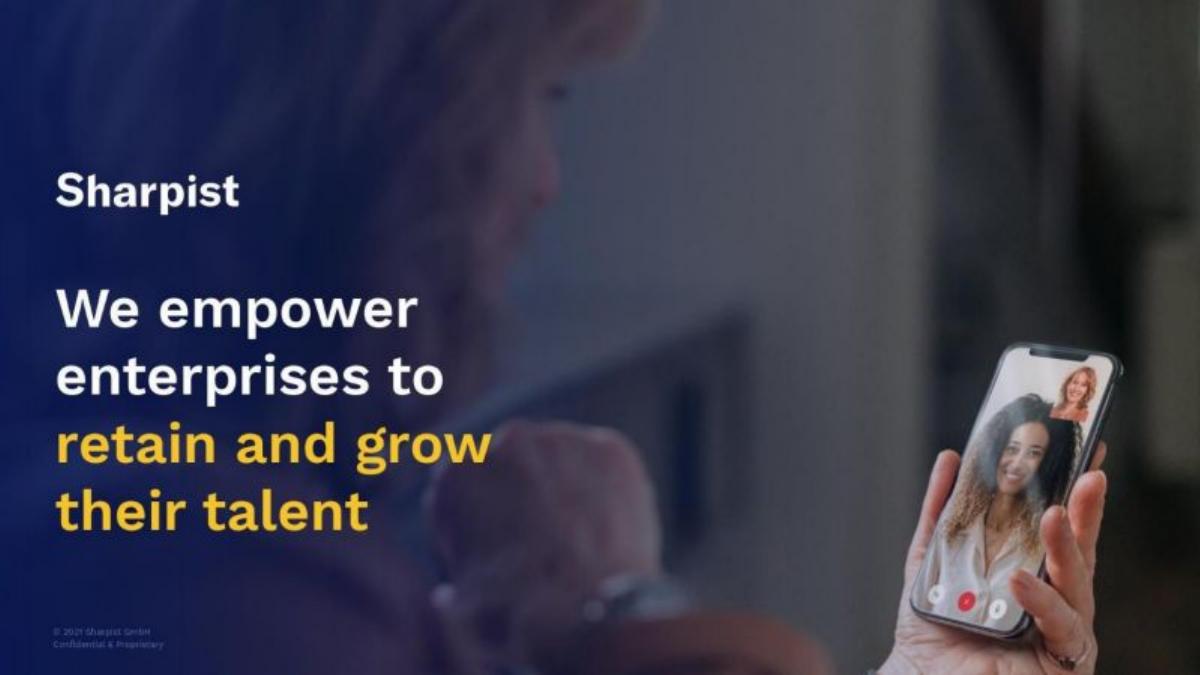
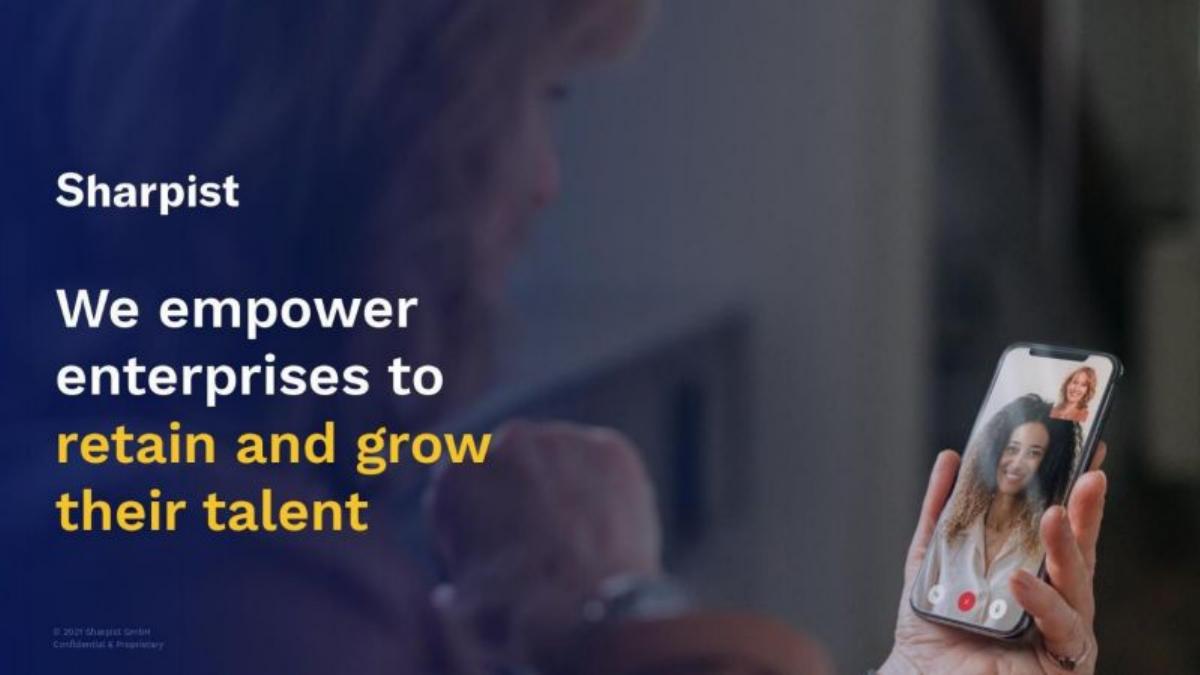
The deck opens with a clear mission statement on Slide 1 : 'We empower enterprises to retain and grow their talent.' This immediately identifies the buyer (Enterprise HR) and the primary value proposition (retention and growth). Slide 2 introduces the 'Problem' with a stark visual: a grid of icons where 80% are highlighted in red. Citing Gallup, the slide states that '80% of employees are not engaged at work' and emphasizes that 'Enterprises cannot fix this at scale.' This sets the stage for a digital solution that can bypass the limitations of human-led HR departments.
Slide 3: The Executive Summary
Slide 3 functions as a teaser. It restates the 80% disengagement problem alongside a '$150B opportunity' representing the portion of the $300B market moving from offline to digital. Crucially, this slide labels Sharpist as the 'Market-leader in DACH.' While the specific figures for y-o-y ARR growth, TCV bookings, and gross margin are redacted in this version, the placeholders indicate that the company is tracking these standard SaaS KPIs closely.
Slides 4-5: The Product and Its Impact
Slide 4 breaks down the user journey into five steps: Goals assessment, Coach matching, Video coaching, Micro tasks, and Activity tracking. The strength of this slide lies in the data points attached to each step. They claim a 98% license activation rate and 92% first match accuracy . These numbers are vital for a Series A pitch because they prove product-market fit and user stickiness. Slide 5 expands the scope to the 'ecosystem,' showing different interfaces for the Learner, the HR Customer, and the Coach. This demonstrates that Sharpist isn't just an app for employees; it’s a management tool for HR departments, featuring a 'People analytics dashboard' and 'Cohort-based learner onboarding.'
Slide 6: Future Releases
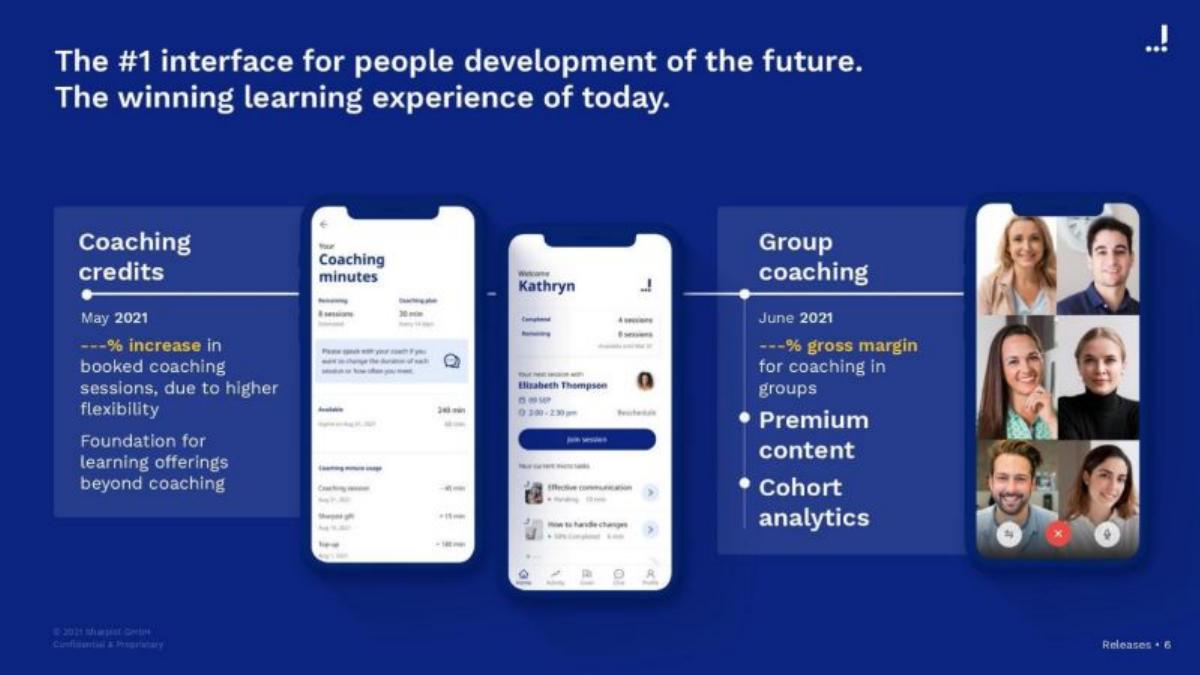
On Slide 6 , Sharpist teases its roadmap with 'Coaching credits' (May 2021) and 'Group coaching' (June 2021). The inclusion of group coaching is a strategic move to show how the company can increase its margins and reach more users simultaneously. The slide mentions a '---% increase in booked coaching sessions' and '---% gross margin for coaching in groups,' suggesting that the transition to group models is a key driver for their financial efficiency.
Slide 7: Market Expansion Roadmap
Slide 7 is perhaps the most important slide for justifying a $23M round. It shows a growth curve from 2020 to 2022. It starts with the $1.8B 'One-on-one digital coaching' niche and moves toward 'Learning experience systems' ($0.6B) and 'People analytics' ($2.2B). The final destination is 'Social learning' and 'Holistic corporate learning,' which they value at $150B . This slide tells investors that while Sharpist is starting with coaching, its ultimate goal is to own the entire corporate learning stack.
Slides 8-9: Traction and Projections
Slide 8 uses a visual 'wall of logos' to show growth in the enterprise client base from 2020 to 2021. Although the logos are redacted, the sheer volume (36 blocks) suggests significant market penetration. Slide 9 provides the revenue projection. It shows a classic hockey-stick curve from January 2021 through December 2023. Even with the actual ARR numbers redacted, the slope of the bars indicates an expectation of roughly 5x to 10x growth over a three-year period.
Slide 10: The Team
The team slide ( Slide 10 ) is heavy on 'pedigree.' CEO Hendrik Schriefer is noted as a 'Business Punk Top 10 thinker' with a background at Rocket Internet. COO Fabian Niedballa comes from GetYourGuide. Other team members bring experience from Google, LinkedIn, McKinsey, and Udacity . This mix of consumer-tech growth experience and enterprise-sales expertise is a strong signal to VCs that the leadership can handle the complexities of scaling a B2B2C platform.
Slide 11: The Closing
The final slide ( Slide 11 ) is a standard contact page. It includes a call to action: 'Join Sharpist in transforming the world of personalized development.' Interestingly, there is a large redacted box labeled 'KPIs redacted,' which likely contained the most sensitive bottom-line data for the actual pitch meetings.
What Sharpist Does Well
Metric-Driven Product Story: Instead of just saying the product is 'good,' they use specific percentages (92% utilization, 95% upvotes) to prove engagement. · Clear Market Evolution: They don't just claim a $300B TAM; they show the path from a small niche (one-on-one coaching) to the broader market (social learning). · Stakeholder Mapping: By showing the product views for the Learner, HR, and Coach, they demonstrate a deep understanding of the enterprise sales cycle.
What is Missing
The Ask: There is no slide detailing how much capital is being raised or how it will be spent (e.g., 40% Sales, 30% Engineering). · Competitive Landscape: The deck does not mention competitors like BetterUp or CoachHub, which were active in the market at the time. · Unit Economics: While they mention gross margins, there is no data on Customer Acquisition Cost (CAC) or Lifetime Value (LTV), which are critical for Series A SaaS companies.
What Founders Should Copy
The 'Solution' Layout: Use Slide 4 as a template for explaining a complex user journey. Breaking it into 5 clear steps with a metric for each is highly effective. · The Market Roadmap: Slide 7 is a great way to show 'Land and Expand.' Start with a small, proven market and show how your product naturally evolves into a much larger one. · Pedigree Highlighting: If your team has worked at recognizable 'unicorns' or top-tier firms, use their logos prominently as Sharpist did on Slide 10.
Frequently asked questions
- What is the core problem Sharpist is solving?
- According to slide 2, Sharpist addresses the fact that 80% of employees are not engaged at work. They argue that large enterprises lack the tools to solve this engagement crisis at scale, creating a need for a digital, individualized coaching solution that can reach every employee.
- How does Sharpist prove their platform actually works?
- Sharpist uses high-intent engagement metrics on slide 4 and slide 5. They report a 98% license activation rate, 92% coach matching accuracy, and 92% session utilization. They also claim a 200% increase in 'Micro Task' completion rates, suggesting that their digital-first approach keeps learners more active than traditional methods.
- What is the total addressable market for Sharpist?
- Slide 7 outlines a $300B+ total market. They break this down by segments: $1.8B for one-on-one digital coaching, $2.2B for people analytics, and a massive $150B opportunity in cohort-based group learning that is rapidly shifting from offline to online.
- Who are the key people behind Sharpist?
- The team (Slide 10) is led by CEO Hendrik Schriefer (ex-Rocket Internet) and COO Fabian Niedballa (ex-GetYourGuide). The leadership includes veterans from McKinsey, Google, LinkedIn, and Udacity, providing a mix of high-growth SaaS experience and deep HR industry knowledge.
- What is missing from this pitch deck?
- This deck omits a clear 'Ask' slide. While we know from catalogue facts that they raised $23M, the deck itself does not state the amount being raised, the intended use of funds, or the milestones they plan to hit with the new capital. It also lacks a detailed competitor analysis.