SheNative presents a mission-driven business model that combines luxury leather goods with social advocacy for Indigenous women in Canada. The deck, likely produced around early 2014, focuses on addressing systemic disadvantages through job creation and design crowdsourcing. The business strategy relies on a five-year roadmap, starting with a direct-to-consumer approach before expanding into wholesale. Financial projections are grounded in specific unit sales targets, ranging from 500 to 5,000 items per year, with a clear commitment to a $10-per-item contribution to community initiatives. Whi…
Key takeaways
- The company positions itself as a social enterprise dedicated to empowering Native women in Canada through fashion (Slide 1).
- The problem slide focuses on systemic issues including poverty, incarceration, and violence, rather than market gaps in the handbag industry (Slide 2).
- The business model transitions from 100% Direct-to-Consumer in years 1-3 to a hybrid Wholesale model in years 4-5 (Slide 4).
- Product differentiation is based on 'Native Design Elements' and crowdsourcing designs from Indigenous artisans (Slide 5).
- Marketing strategy heavily emphasizes local Canadian presence, including the Saskatoon Farmers Market and Indigenize launch events (Slide 6).
- Financial projections are split between 'Conservative' and 'Ambitious' scenarios, with a target profit margin of 15% (Slide 9).
- The deck includes a specific social impact metric: a $10 per item contribution to a Community Initiatives Program (Slide 9).
- At the time of the deck, the company was in the 'Product Development & Crowdsourcing Phase' with a planned Indiegogo launch in April 2014 (Slide 10).
SheNative: A Mission-Driven Fashion Teardown
SheNative is a social enterprise that attempts to bridge the gap between high-end fashion and social advocacy. The deck is structured as a narrative of empowerment, using the handbag as a vehicle for economic change for Indigenous women in Canada. This teardown examines the 10-slide presentation, which serves as an early-stage roadmap for the brand's launch and growth.
Slide 1: Title and Mission
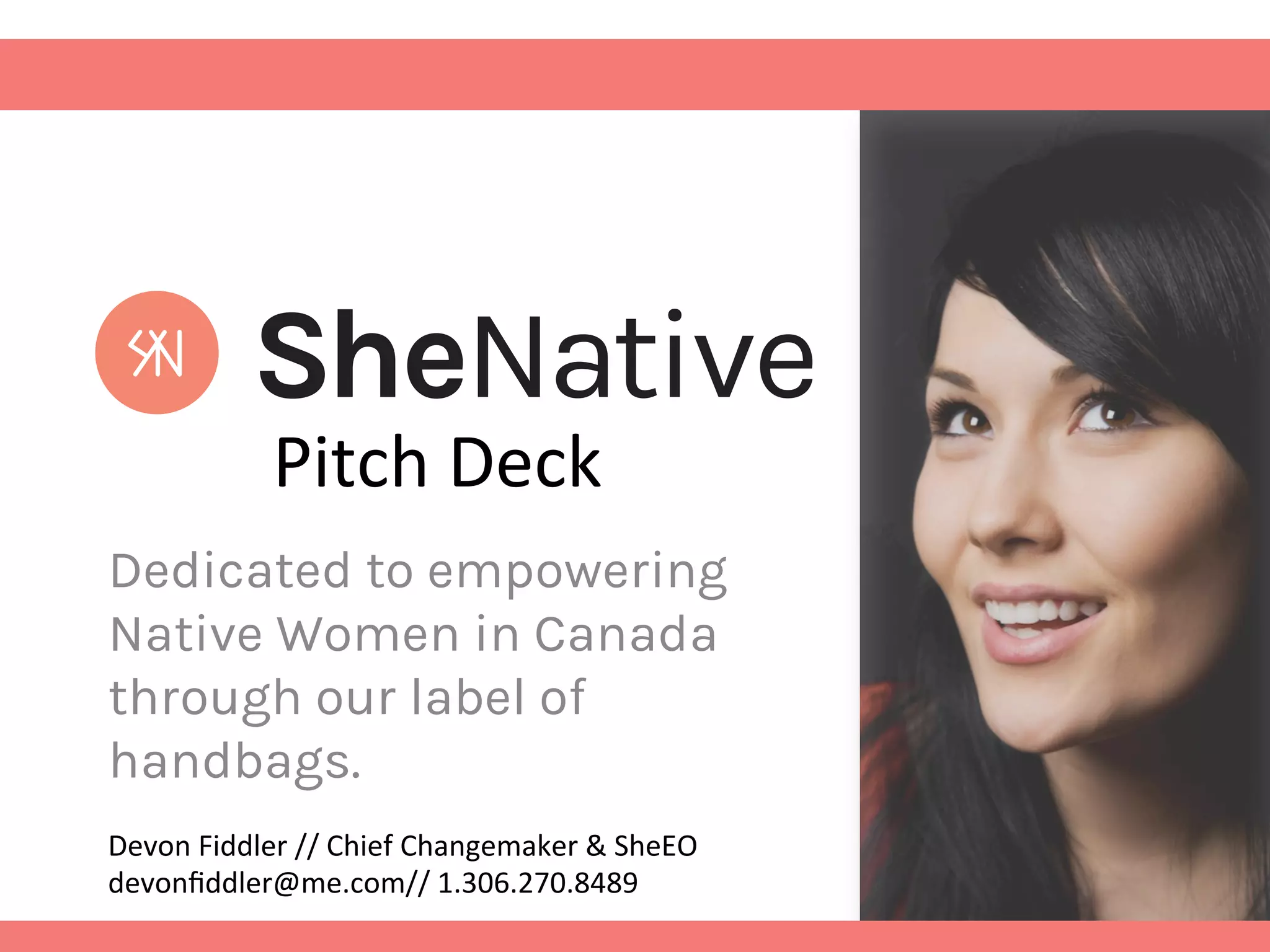
The cover slide introduces Devon Fiddler as the 'Chief Changemaker & SheEO.' It clearly states the company's purpose: 'Dedicated to empowering Native Women in Canada through our label of handbags.' The inclusion of a direct phone number and email address suggests this was used for direct outreach or as a leave-behind for potential partners and investors.
Slide 2: The Problem
Unlike traditional startup decks that highlight a market inefficiency, SheNative highlights a social crisis. The slide lists 'Higher rates of poverty, incarceration & victims of violence' and 'High rates of unsolved missing & murdered cases' as the core problems. It argues that these realities allow negative stereotypes to prevail, overshadowing the successes of Native women. This sets a heavy, serious tone for the pitch, framing the business as a necessary intervention rather than just a retail play.
Slide 3: The Solution
The solution is two-fold: economic empowerment and education. The company aims to create jobs and design collaboration opportunities for Native women. Simultaneously, they seek to 'Educate mainstream' through their platform and goods. The slide features imagery of traditional beadwork alongside a modern white handbag, visually representing the blend of traditional culture and contemporary fashion.
Slide 4: Business Model
The business model is presented as a timeline-based transition. For Years 1 through 5, the focus is 'Direct to Customer,' involving design, making, and online marketing. In Years 4 and 5, the company plans to introduce 'Wholesale,' which includes distributing to retail and manufacturing at a larger scale. The bottom of the slide reinforces the brand pillars: 'Empower. Celebrate. Educate. Inspire.'
Slide 5: Underlying Magic - Our Goods
This slide focuses on the product's unique selling propositions (USPs). It highlights three elements: Leather Goods, Modern/Timeless/Functional design, and Native Design Elements. The strategy involves 'Crowdsourcing Native designers/artisans,' which allows the brand to remain authentic while scaling its design pipeline. It positions the handbags as 'Niche Goods in Handbags Industry.'
Slide 6: Marketing & Sales Strategy
The marketing plan is divided into Pre-Launch and Launch phases. Pre-launch activities include social media building (blogging, Facebook giveaways, Pinterest), celebrity gifting, and a soft launch party. The launch strategy is highly localized to Canada, mentioning 'Pop-up Shops in Major Canadian Cities,' the 'Saskatoon Farmers Market,' and 'Aboriginal & local tradeshows.' This suggests a grassroots, community-first approach to brand building.
Slide 7: Competition
The competition slide is a simple list. It acknowledges other Native handbag brands like Angelia Demontigny and Joanne Anderson, as well as established Canadian leather brands like Roots Canada. By listing Roots, a major national retailer, SheNative signals that it views itself as a high-quality alternative to mainstream Canadian leather goods, not just a craft brand.
Slide 8: Team
The team slide features three key figures. Devon Fiddler (Founder) handles business planning and operations. Heather Abbey (Co-Founder) brings social media marketing and startup experience, specifically through her work with Shopindigenous.ca. Sheena Repath is listed as a Product Development Advisor, providing expertise in manufacturing, wholesale, and online distribution. This team covers the essential bases of mission, marketing, and production.
Slide 9: Financial Projections
This is the most data-dense slide in the deck. It provides 'Conservative' and 'Ambitious' projections for Years 1, 3, and 5. Key figures include:
Average Selling Price: Starts at $339 and is projected to drop to $289 by Year 5, likely due to wholesale volume or manufacturing efficiencies. · Cost of Goods Sold (COGS): Stated as 'no more than 50% of sales.' · Profit Margin Goal: 15% of sales. · Social Impact: A consistent $10 per item is allocated to the Community Initiatives Program.
The ambitious Year 5 goal is $1,445,000 in sales from 5,000 items sold.
Slide 10: Accomplishments and Future Plans
The deck concludes with a status update. The company was in the 'Product Development & Crowdsourcing Phase' and had participated in the Praxis School of Entrepreneurship. The roadmap for 2014 included an Indiegogo campaign (April-May), production (June), and the launch of an online shop and pop-ups (July-August). This provides a clear sense of urgency and immediate next steps.
What Works in This Deck
Clarity of Mission: The deck never loses sight of its social purpose. Every slide, from the problem to the financials, reinforces the goal of empowering Indigenous women. This is a strong 'North Star' for a social enterprise.
Specific Unit Economics: Unlike many early-stage decks that use vague percentages, SheNative provides specific price points ($339) and a specific social give-back amount ($10). This makes the business model feel tangible and calculated.
Phased Growth Strategy: The distinction between the DTC phase and the Wholesale phase shows that the founders understand the complexities of scaling a physical product brand and aren't trying to do everything at once.
What Is Missing
The Ask: The most significant omission is a funding request. The deck does not state how much money is being raised, the terms of the investment, or how the funds will be allocated. Without an 'Ask' slide, it functions more as a brand overview than a fundraising tool.
Manufacturing Details: While the deck mentions 'in-house production' and 'manufacturing,' it lacks detail on the supply chain. For a leather goods brand, investors would want to know where the leather is sourced and the capacity of the production facility.
Market Size (TAM/SAM/SOM): The deck identifies the problem in social terms but fails to quantify the market opportunity in the handbag industry. There is no data on the size of the Canadian leather goods market or the specific niche for Indigenous-designed luxury items.
Founder's Playbook: What to Copy
The 'Conservative vs. Ambitious' Table: Providing two sets of projections is a smart way to manage expectations while showing the upside potential. It demonstrates that the founder has considered multiple scenarios.
Visual Brand Consistency: The use of the coral/pink color palette and the consistent 'SN' logo throughout the deck creates a professional, branded feel that is essential for a fashion startup.
Advisor Integration: Including a 'Product Development Advisor' (Sheena Repath) on the team slide is a great way for first-time founders to borrow credibility in technical areas like manufacturing and wholesale distribution.
Frequently asked questions
- What is the primary product offered by SheNative?
- SheNative produces a label of leather handbags. According to Slide 5, these goods are described as 'Modern, Timeless, Functional' and incorporate 'Native Design Elements.' The company also utilizes a crowdsourcing model to involve Indigenous designers and artisans in the creation of their niche goods.
- How does the company plan to generate revenue?
- The revenue model is two-phased. As shown on Slide 4, the first five years focus on Direct to Customer (DTC) sales through online marketing and sales. Starting in Year 4, the company plans to add a Wholesale layer, distributing products to retail partners to scale sales volume.
- What are the projected sales figures for the brand?
- Slide 9 outlines two paths. The 'Conservative' projection estimates sales growing from $169,500 (500 items) in Year 1 to $867,000 (3,000 items) by Year 5. The 'Ambitious' projection targets $186,450 (550 items) in Year 1, scaling to $1,445,000 (5,000 items) by Year 5.
- How does SheNative measure its social impact?
- Beyond job creation for Indigenous women, Slide 9 explicitly lists a 'Community Initiatives Program' funded by a $10 contribution from every item sold. Based on their ambitious Year 5 projections, this would result in $50,000 annually dedicated to community programs.
- Who are the key competitors identified in the deck?
- Slide 7 categorizes competition into two groups: Native Handbag Brands (Angelia Demontigny, Joanne Anderson) and Canadian Made Leather Handbag Brands (Roots Canada, Chicks & Girlies, Erin Templeton, Rowland Leather, and Jessica Jensen). This indicates the brand competes on both cultural authenticity and regional manufacturing.