Shiva’s 10-slide deck presents a specialized investment vehicle designed for the AI era, where small teams of 1-3 people can build global products. The fund, led by former Méliuz COO Lucas Marques, aims to back 100 programmer-founders using a milestone-based stipend model rather than traditional large upfront rounds. The deck leans heavily on the thesis that AI has collapsed the cost of software development, allowing for a 'fast death of ideas' and a portfolio of 'antifragile' micro-startups. By targeting three distinct founder personas—Underdogs, Blacksmiths, and Camels—Shiva positions itsel…
Key takeaways
- The fund targets 100 programmer-founders with a focus on 'solo builders' to reduce the cost and complexity of software development (Slide 3).
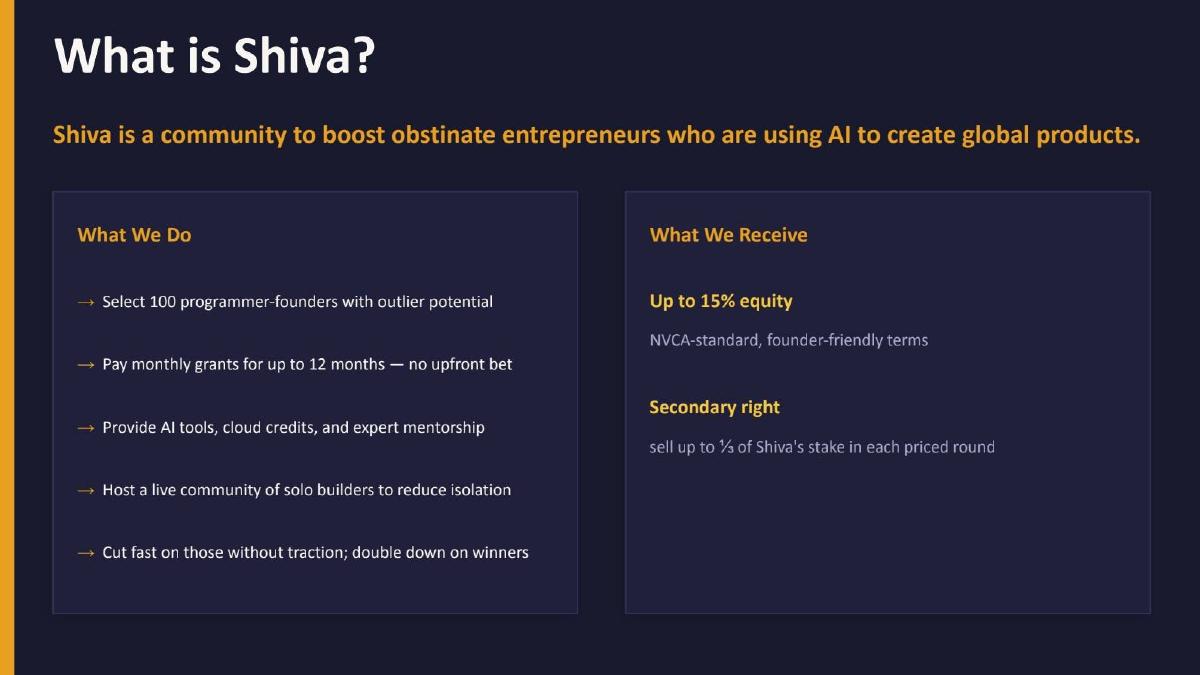
- Shiva takes up to 15% equity using NVCA-standard terms and retains a secondary right to sell up to 1/3 of its stake in each priced round (Slide 3).
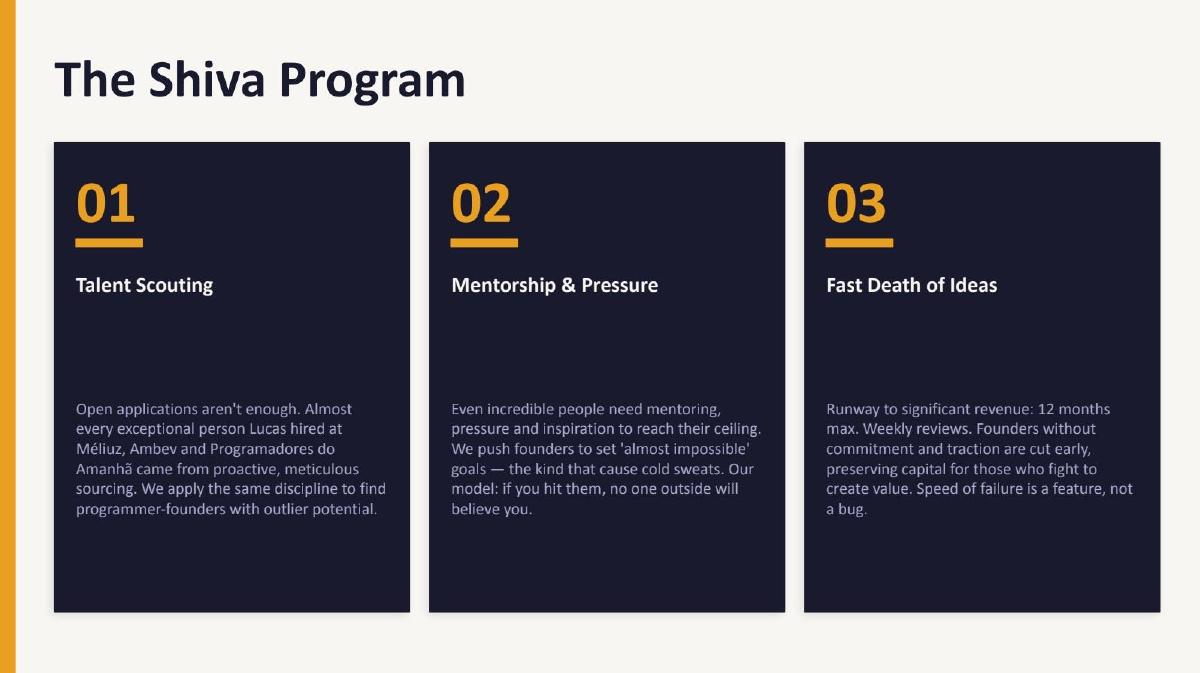
- The 'Fast Death of Ideas' strategy limits runway to 12 months with weekly reviews to cut non-performing projects quickly (Slide 4).
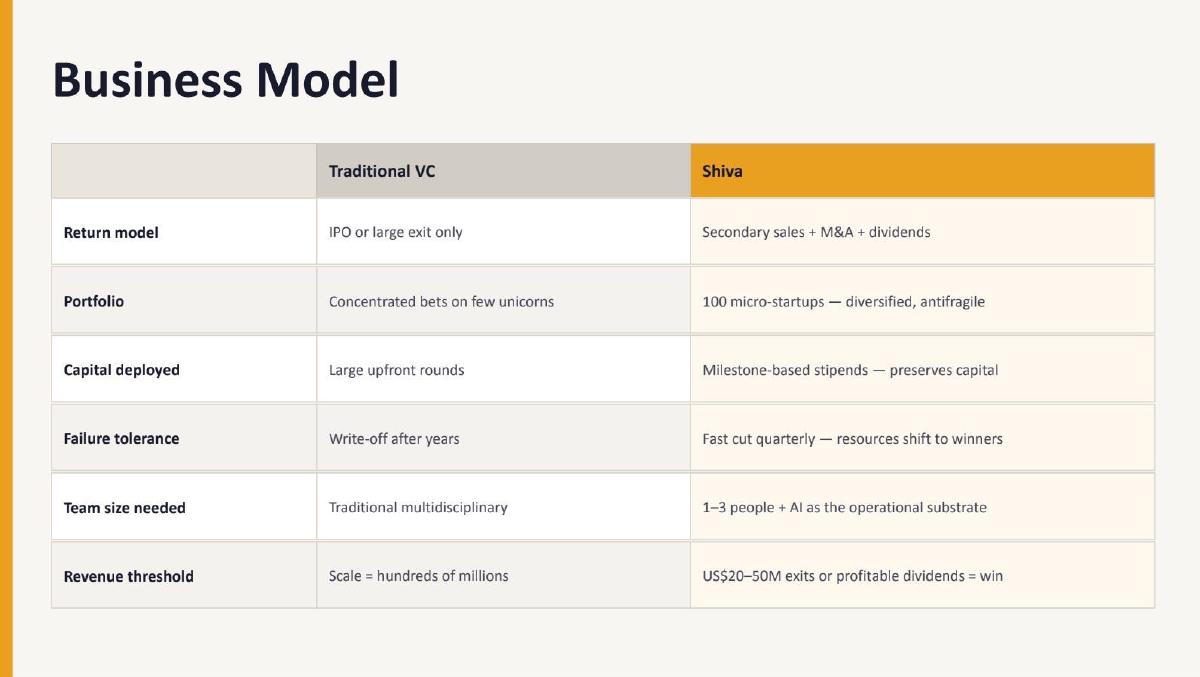
- The business model differentiates from traditional VC by targeting $20M-$50M exits or profitable dividends as 'wins' (Slide 5).
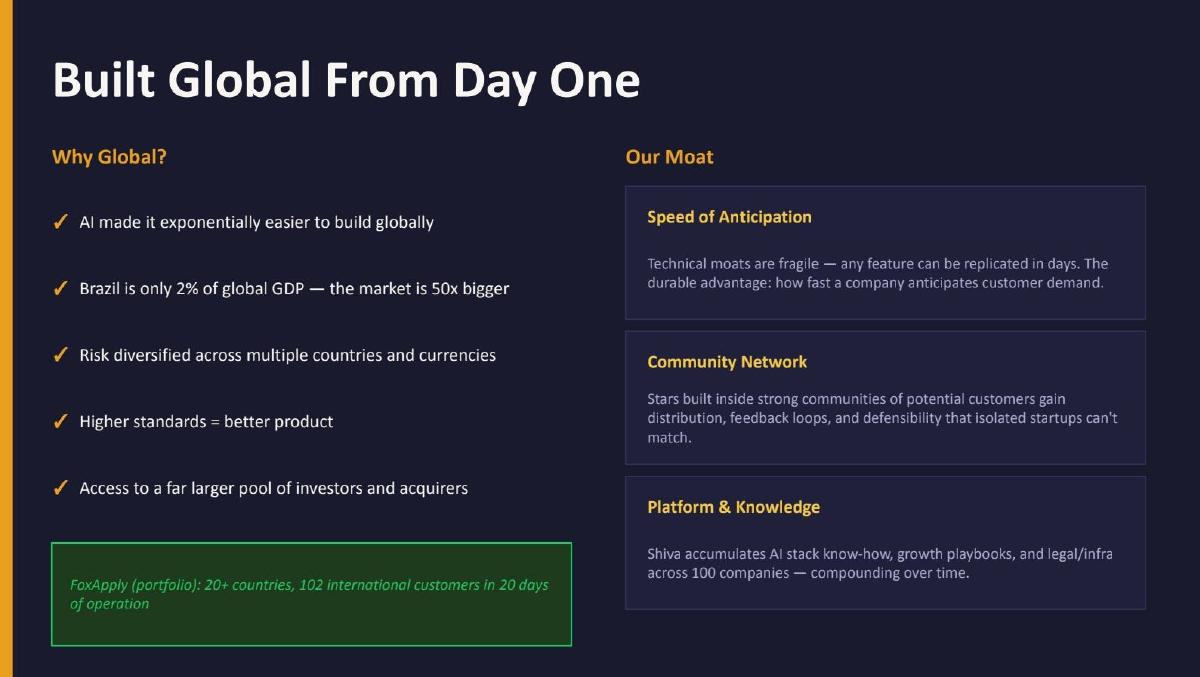
- Portfolio company FoxApply is cited as a success indicator, reaching 20+ countries and 102 international customers in 20 days (Slide 6).
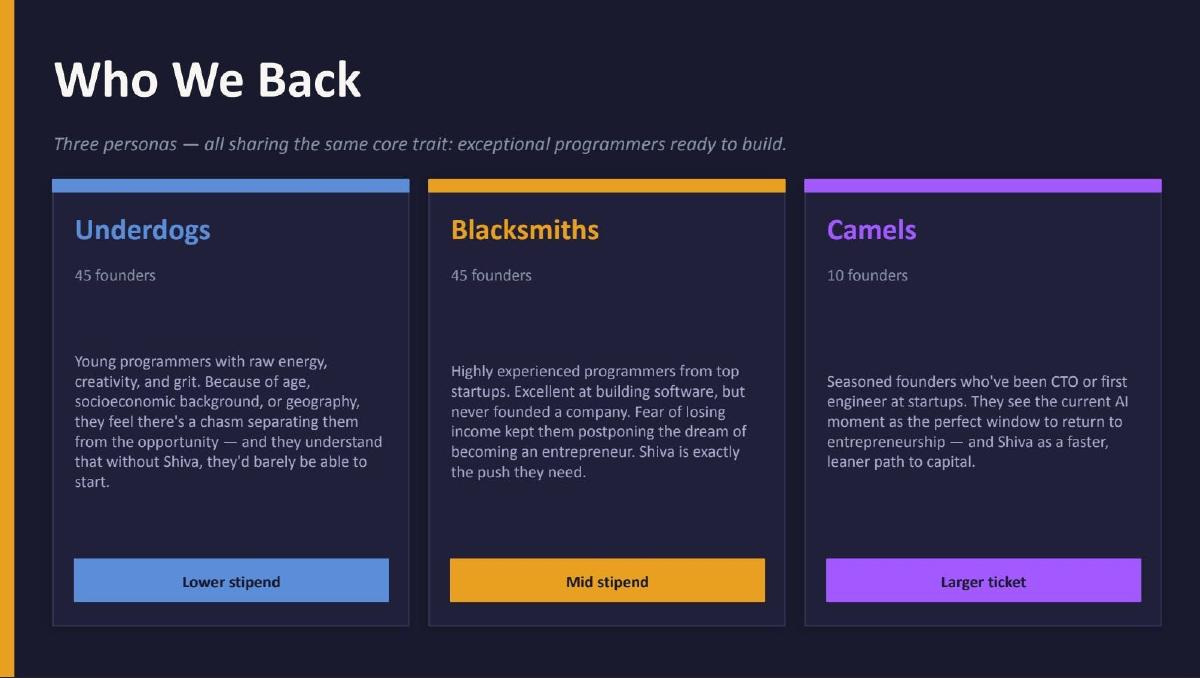
- Founder personas are segmented into 'Underdogs' (45), 'Blacksmiths' (45), and 'Camels' (10), each receiving different stipend levels (Slide 7).
- The $10M use of proceeds is broken down by persona, with $5.5M allocated to 'Blacksmiths' and $1.8M to 'Underdogs' (Slide 8).
- Founder Lucas Marques highlights his experience taking Méliuz from zero to IPO and his work placing 150 low-income students per year in tech roles (Slide 9).
The Shiva Pitch Deck: A High-Volume Bet on AI Efficiency
Shiva represents a new breed of investment vehicle that looks less like a traditional venture capital firm and more like a high-throughput talent incubator. The deck for their $10M pre-seed round, raised in 2024, outlines a thesis built entirely on the transformative power of AI to reduce the human capital required to build software. By focusing on solo founders and small teams, Shiva aims to build a portfolio of 100 micro-startups. This teardown examines how the deck balances the high risk of early-stage talent with a disciplined, milestone-based capital allocation strategy.
Slide 1: Title Slide
The deck opens with a minimalist black slide featuring the Shiva logo in a muted green. There is no tagline or mission statement on this slide, relying entirely on the brand name. In a fundraising context, this requires the subsequent slides to immediately establish the 'what' and 'why' of the business.
Slide 2: The Moment Has Arrived
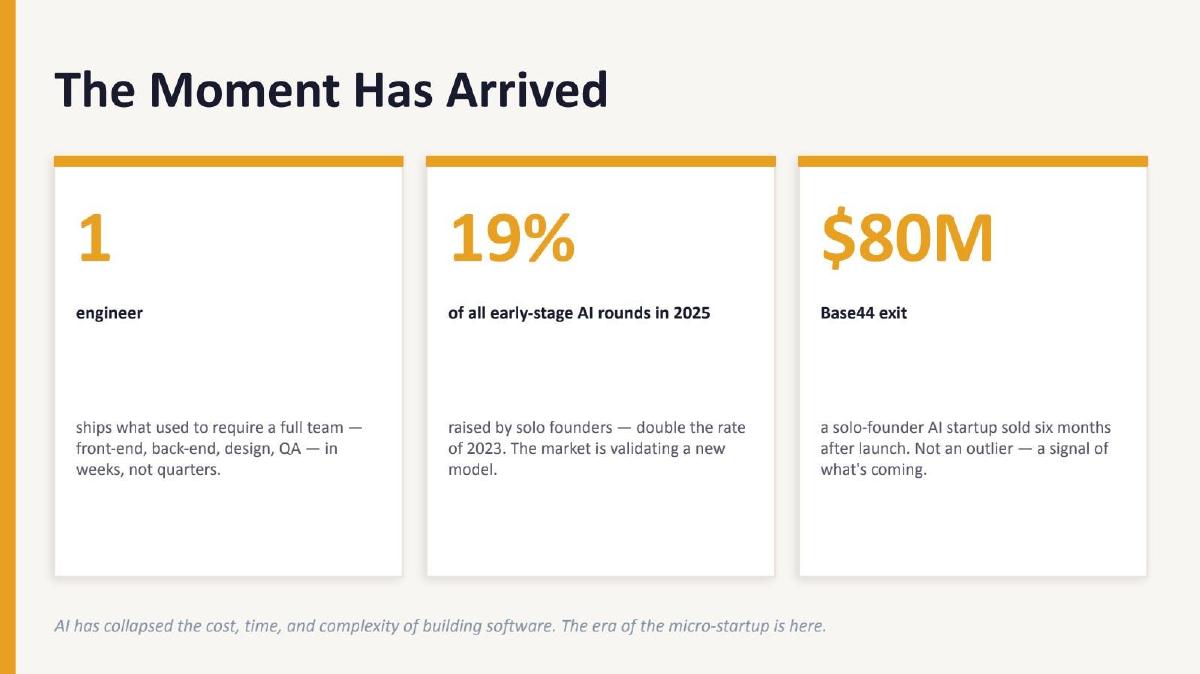
Slide 2 establishes the market thesis. It uses three key data points to argue that the 'era of the micro-startup is here.' First, it claims 1 engineer can now ship what previously required a full multidisciplinary team (front-end, back-end, design, QA) in weeks rather than quarters. Second, it cites that 19% of all early-stage AI rounds in 2025 were raised by solo founders, which it notes is double the rate of 2023. Third, it highlights an $80M exit for Base44, a solo-founder AI startup sold six months after launch. This slide effectively sets the stage: AI has collapsed the cost of building, making solo-founder companies a viable asset class.
Slide 3: What is Shiva?
This slide defines the company as a 'community to boost obstinate entrepreneurs who are using AI to create global products.' It breaks the operations into two columns: 'What We Do' and 'What We Receive.' The fund plans to select 100 programmer-founders , paying monthly grants for up to 12 months with 'no upfront bet.' In exchange, Shiva receives up to 15% equity and a secondary right to sell up to 1/3 of their stake in each priced round. This is a crucial detail for investors, as it suggests a path to liquidity that doesn't rely solely on billion-dollar IPOs.
Slide 4: The Shiva Program
Slide 4 details the operational mechanics of the fund through three pillars. 01 Talent Scouting emphasizes proactive sourcing rather than open applications, citing the founder's experience hiring at companies like Méliuz and Ambev. 02 Mentorship & Pressure describes a high-intensity environment where founders set 'almost impossible' goals. 03 Fast Death of Ideas is the most distinct part of the model, stating a 12-month maximum runway and weekly reviews. The slide explicitly states that 'Speed of failure is a feature, not a bug,' signaling to investors that capital will not be wasted on stagnant projects.
Slide 5: Business Model
This slide uses a comparison table to contrast 'Traditional VC' with 'Shiva.' It highlights that Shiva targets $20M-$50M exits or profitable dividends as a win, whereas traditional VC requires IPOs or massive exits. The portfolio is described as 100 micro-startups that are 'diversified' and 'antifragile.' Team sizes are limited to 1-3 people , using AI as the 'operational substrate.' This comparison is designed to de-risk the investment by showing that Shiva doesn't need every company to be a unicorn to return the fund.
Slide 6: Built Global From Day One
Slide 6 addresses the geographic strategy. It notes that Brazil is only 2% of global GDP , making the global market 50x larger. It lists 'Speed of Anticipation,' 'Community Network,' and 'Platform & Knowledge' as the fund's moats. A small box at the bottom provides a proof point: FoxApply , a portfolio company, reached 20+ countries and 102 international customers in just 20 days of operation. This slide counters the potential concern that a Brazilian fund might be limited to a local, emerging market.
Slide 7: Who We Back
Shiva segments its target founders into three personas. Underdogs (45 founders) are young programmers from diverse backgrounds who receive a 'lower stipend.' Blacksmiths (45 founders) are experienced programmers from top startups who receive a 'mid stipend.' Camels (10 founders) are seasoned former CTOs or first engineers who receive a 'larger ticket.' This segmentation shows a sophisticated approach to talent acquisition, acknowledging that different levels of experience require different capital incentives.
Slide 8: Use of Proceeds -- US $10M Pre-Seed
This slide provides a transparent breakdown of how the $10M will be spent over 36 months. The largest allocation is $5.5M for Blacksmiths , followed by $1.8M for Underdogs and $1.6M for Camels . The core team and mentors (8 people) account for $0.7M , and G&A/Legal takes $0.4M . The bottom of the slide reiterates the 'milestone-based (stage-gate) model,' ensuring investors that the full $10M isn't committed upfront to unproven ideas.
Slide 9: The Founder
The team slide focuses exclusively on Lucas Marques . His credentials include being the Ex-COO at Méliuz , where he took the company from zero to IPO, and the founder of Programadores do Amanhã , an NGO that places 150 low-income students per year in tech jobs. He is also described as an Endeavor Entrepreneur for 5+ years. The slide uses his past success in scaling a company and his experience in talent development to validate his ability to lead this high-volume incubator model.
Slide 10: Join Us in Building What's Next
The final slide is the call to action. It restates the raise of US$10M in pre-seed capital and offers 'asymmetric exposure to the generative-AI boom.' It ends with a quote from Sam Altman : 'The next billion-dollar startup will have just three employees.' This aligns Shiva's specific micro-startup model with the broader industry vision held by leaders in the AI space.
What Works in the Shiva Deck
The deck excels at thesis-driven storytelling . It doesn't just say 'we invest in AI'; it argues for a fundamental shift in how software is built and how capital should be deployed as a result. By defining the 'era of the micro-startup,' Shiva creates a category where they are the primary player. The use of specific founder personas (Underdogs, Blacksmiths, Camels) is also a strong tactical choice. It demonstrates that the fund has a clear plan for sourcing and pricing talent, which is the most critical variable in an incubator model. Furthermore, the Use of Proceeds slide is exceptionally detailed for a pre-seed deck, providing a clear roadmap for how the $10M will be distributed across the cohort.
What is Missing from the Shiva Deck
The most notable omission is a broader team slide . While Lucas Marques has an impressive background, Slide 8 mentions a 'Core Team & Mentors' of 8 people. Investors typically want to see who these individuals are, especially in a model that relies heavily on 'expert mentorship' and 'proactive sourcing.' Additionally, while the deck mentions 'AI tools and cloud credits' as part of the offering, it does not specify any strategic partnerships with major cloud providers or AI labs, which are often a staple of AI-focused funds. Finally, there is no mention of the investment committee or the specific criteria used for the 'weekly reviews' and 'fast cuts,' leaving the actual decision-making process somewhat opaque.
What Founders Should Copy
Founders building investment vehicles or platforms should emulate Shiva's transparency regarding capital allocation . The bar chart on Slide 8 is a masterclass in showing exactly where every dollar goes, which builds significant trust with LPs. Another element to copy is the Business Model comparison table on Slide 5. Instead of just listing features, Shiva frames their model as a direct alternative to the 'flaws' of traditional VC (e.g., needing massive exits vs. $20M-$50M wins). This makes the investment feel like a strategic diversification rather than just another high-risk bet. Lastly, the inclusion of a real-world proof point (FoxApply on Slide 6) within a thesis-heavy deck provides the necessary evidence that the model can actually work in practice.
Frequently asked questions
- How does Shiva's investment model differ from a traditional VC?
- As detailed on Slide 5, Shiva focuses on milestone-based stipends rather than large upfront rounds. While traditional VCs seek 'unicorn' exits of hundreds of millions, Shiva views exits between $20M and $50M, or even profitable dividends, as successful outcomes. They also employ a 'fast cut' strategy, reviewing traction weekly and ending support for projects that don't show immediate promise.
- What kind of equity does Shiva take in its startups?
- According to Slide 3, Shiva receives up to 15% equity in the companies it backs. The terms are described as NVCA-standard and founder-friendly. Additionally, Shiva secures a 'Secondary right,' allowing the fund to sell up to one-third of its stake during each subsequent priced round, providing earlier liquidity than traditional venture models.
- Who are the 'Blacksmiths' and 'Underdogs' mentioned in the deck?
- These are two of the three founder personas Shiva targets (Slide 7). 'Underdogs' are young programmers with high grit from diverse socioeconomic backgrounds who receive a 'lower stipend.' 'Blacksmiths' are highly experienced programmers from top startups who have never founded a company due to fear of losing income; they receive a 'mid stipend.' Together, they represent 90% of the planned cohort.
- What is the 'Fast Death of Ideas' mentioned on Slide 4?
- This is a core operational pillar of the Shiva Program. It limits the runway for any single idea to a maximum of 12 months. Through weekly reviews, founders who lack commitment or traction are cut early. This approach is designed to preserve capital, shifting resources only to the 'winners' who demonstrate the ability to create value quickly.
- What is the primary geographic focus of the fund?
- While the publisher reports the company is based in Brazil (S. America), Slide 6 emphasizes a 'Global From Day One' philosophy. The deck argues that Brazil represents only 2% of global GDP, so startups must target the 50x larger global market immediately. This is supported by the mention of portfolio company FoxApply, which launched in 20+ countries.