ShopMy’s Series A deck is a sophisticated example of how to pitch a multi-sided platform in the advertising sector. By combining a SaaS subscription model for brands (averaging $2,799/month) with a 2.9% take rate on creator GMV, the company demonstrates a diversified and scalable revenue engine. The deck leans heavily into the 'flywheel' effect, showing that 70% of brands bring their own talent to the platform, which in turn attracts more brands. With a team of 50 and a clear competitive matrix that positions them as the only all-in-one solution for discovery, engagement, and tracking, ShopMy…
Key takeaways
- The business model is split between 65% SaaS subscriptions and 35% transaction fees (Slide 5).
- The platform charges brands between $999 and $7,000 per month, with $2,799 being the most common package (Slide 5).
- ShopMy operates an invite-only network of over 50,000 elite content creators (Slide 4).
- Network effects are quantified: 70% of brands onboard their own creators, and 20% of brand leads come from creator referrals (Slide 6).
- The company maintains a 2.9% take rate on Gross Merchandise Value (GMV) (Slide 5).
- The competitive matrix lists 10 competitors, claiming ShopMy is the only one offering a full suite across discovery, engagement, collaboration, and tracking (Slide 7).
- The team has grown by 44% year-over-year, reaching 50 total teammates by early 2024 (Slide 8).
- The leadership team features founders from MIT and Harvard (Slide 8).
Executive Summary: The Creator Economy's SaaS Evolution
ShopMy’s Series A deck, used to secure $18.5M in 2024 as reported by Business Insider, represents a shift in the creator economy from simple 'link-in-bio' tools to comprehensive enterprise marketing platforms. The deck focuses on two core pillars: a highly curated network of 50,000+ creators and a robust SaaS-marketplace hybrid business model. By emphasizing 'elite' talent and automated brand workflows, ShopMy positions itself as a premium solution for the advertising industry.
Slide 1-2: The Vision and The Framework
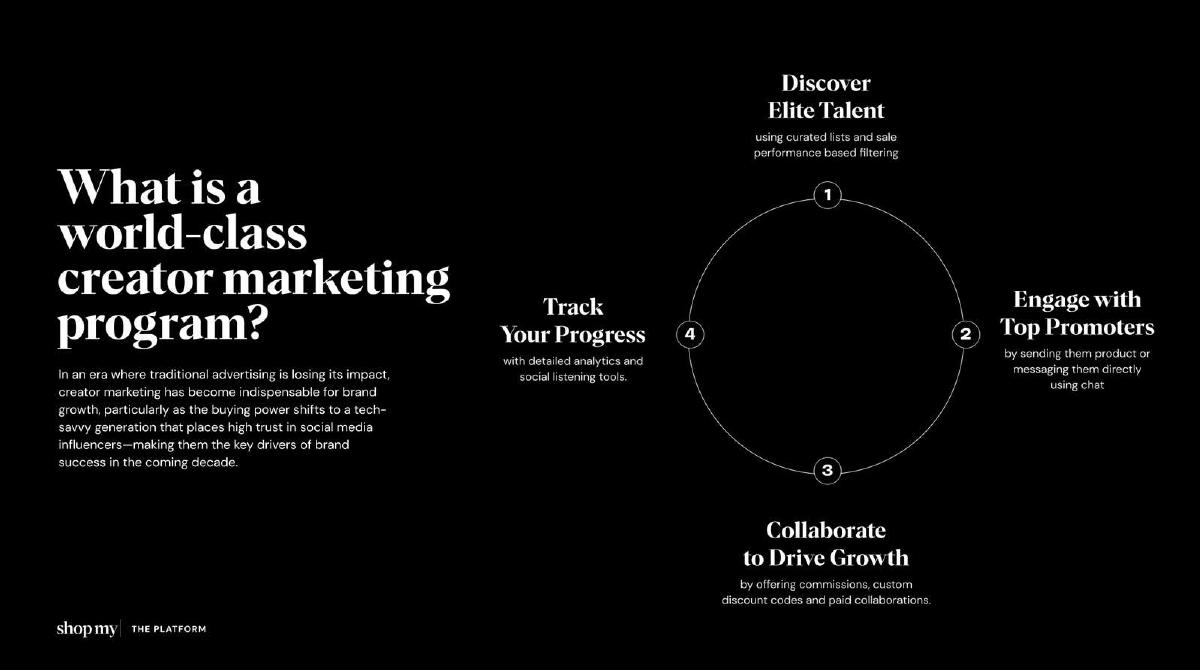
The deck opens with a minimalist aesthetic, using the tagline 'Powering the Creator Economy.' Slide 2 introduces the core operational loop of the platform, defining a 'world-class creator marketing program' through four stages: Discover, Engage, Collaborate, and Track. This slide sets the stage for the product deep-dive, framing the platform not just as a tool, but as a methodology for brand growth in an era where traditional advertising is losing impact.
Slide 3: The 'Engage' Product Suite
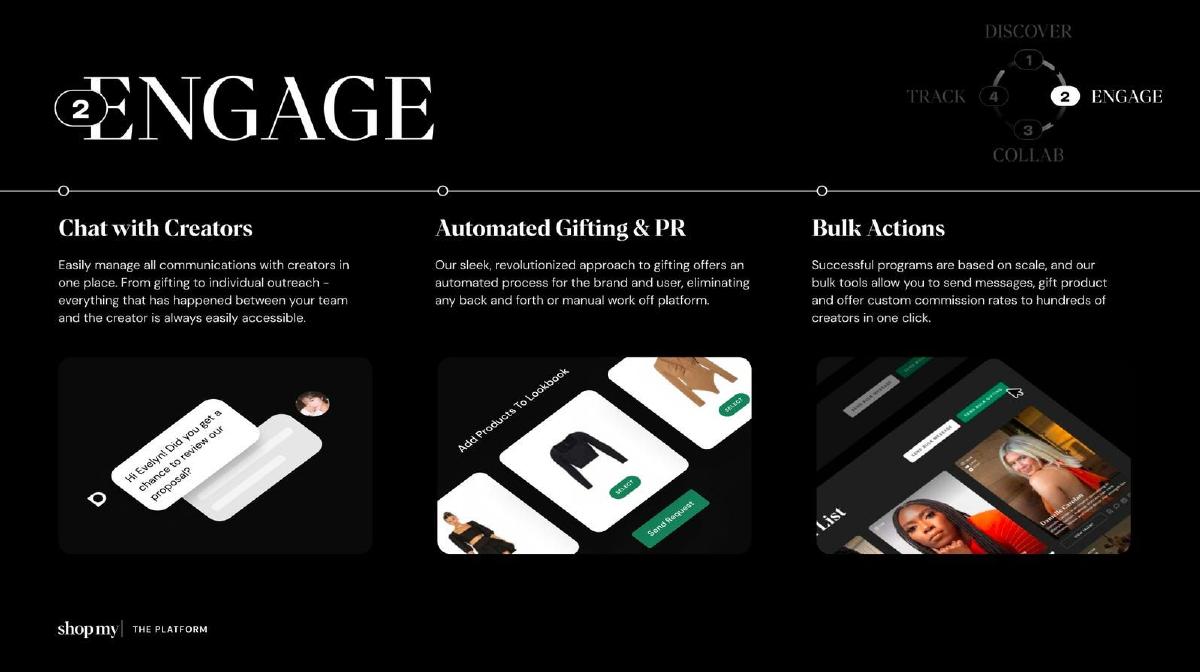
Slide 3 focuses on the second step of their framework: Engagement. It highlights three specific features: Chat with Creators for centralized communication, Automated Gifting & PR to remove manual friction, and Bulk Actions . The emphasis here is on scale; the deck explicitly states that 'successful programs are based on scale,' and their tools allow brands to reach hundreds of creators with a single click. This addresses a major pain point for brands: the labor-intensive nature of managing individual influencer relationships.
Slide 4: The Network Moat
Slide 4 showcases 'The ShopMy Network.' It claims access to an 'invite-only community of over 50k+ elite content creators.' The visual presentation is a dense grid of creator headshots with labels like 'Top Sales Driver,' 'Elite Following,' and 'High-ROI Influencers.' By emphasizing the 'invite-only' nature, ShopMy signals to investors that they are prioritizing quality over quantity, creating a curated marketplace that is harder for competitors to replicate.
Slide 5: The Hybrid Business Model
One of the most critical slides in the deck, Slide 5, breaks down the revenue streams. ShopMy uses a dual-pronged approach:
65% Brand Monthly Subscriptions: Ranging from $999 to $7,000 per month. The deck notes that the most common package is $2,799 per month. · 35% Take Rate on GMV: A 2.9% fee on the sales volume generated through the platform.
This model is highly attractive to investors because it combines the predictable, high-margin revenue of SaaS with the uncapped upside of a transactional marketplace. It ensures the company makes money regardless of whether a brand is actively running a campaign or simply using the software to manage their existing roster.
Slide 6: The Flywheel and Network Effects
Slide 6, titled 'Accelerating Network Effects,' provides the data to back up their growth claims. It outlines a four-step flywheel: brands invite their talent, talent invites their other brands, and the network grows organically. The 'By The Numbers' sidebar provides three key metrics: 70% of brands onboard their own creators, ~600 creators are onboarded per month by brands, and 20% of brand leads come through creator referrals. This proves that the platform has a built-in customer acquisition cost (CAC) advantage.
Slide 7: Competitive Landscape
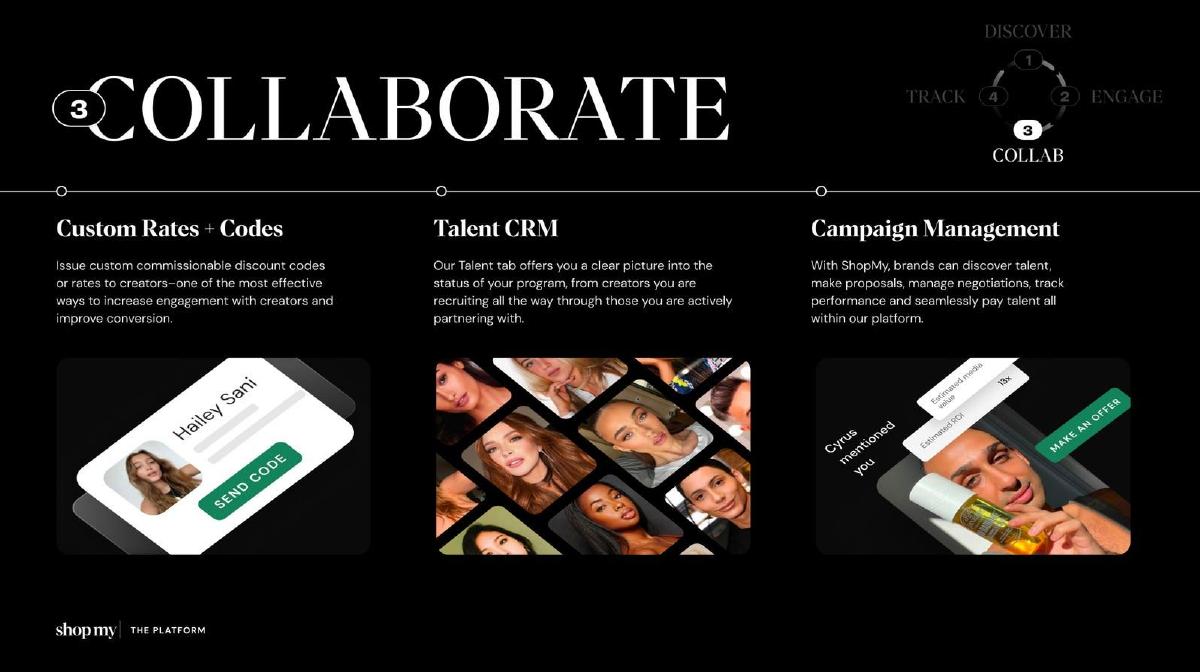
The competitive matrix on Slide 7 is exhaustive, listing 10 competitors including major players like Amazon, Grin, and Aspire. ShopMy claims to be the only platform that offers a complete suite of features across four categories (Discover, Engage, Collaborate, Track) while also providing a full suite of tools 'For Talent' (Commissionable Links, Digital Storefronts, etc.). This slide is designed to show that while other platforms are either brand-focused or creator-focused, ShopMy is the only truly bi-directional solution.
Slide 8: Team and Growth
The final slide in the provided sequence introduces the leadership and team structure. The founders, Harry Rein (CEO), Tiffany Lopinsky (COO), and Christopher Tinsley (President), are highlighted with their MIT and Harvard credentials. The slide also shows a team of 50 people, categorized into Brand Partnerships, Brand Success, Creator Growth, Creator Success, and Product & Engineering. The metric '44% YOY Team Growth' and '+15 joined in 2024' indicates a company in a rapid scaling phase, justifying the need for the $18.5M Series A round.
What Works in This Deck
Quantified Network Effects: Most founders claim to have a flywheel; ShopMy actually proves it with the 70% brand-onboarding metric on Slide 6. This is a powerful signal of product-market fit and organic growth potential.
Revenue Diversification: The split between SaaS and take-rate (Slide 5) is a sophisticated way to capture value. It shows they aren't just a service provider, but a piece of infrastructure that scales with their users' success.
Visual Social Proof: Slide 4 uses a 'wall of faces' effectively. In the creator economy, the quality of the talent pool is the product. Showing recognizable archetypes of 'elite' creators builds immediate credibility.
What Is Missing
Unit Economics: While the deck shows the subscription prices and take rate, it omits LTV (Lifetime Value) and CAC (Customer Acquisition Cost) ratios. For a Series A, investors usually want to see the efficiency of the spend.
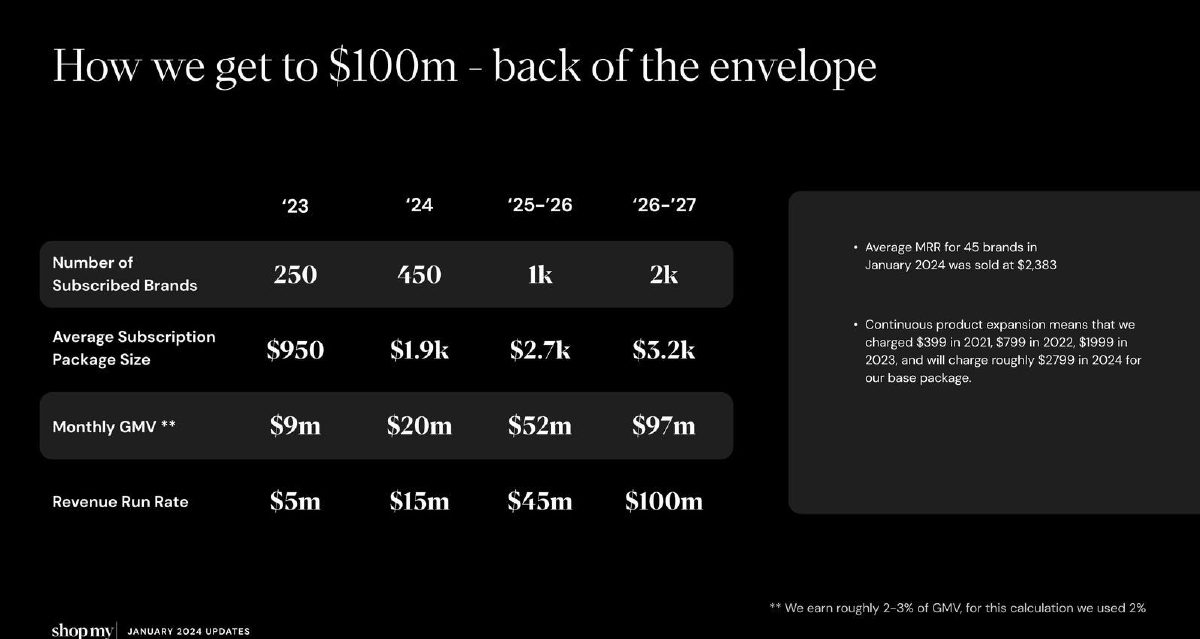
Financial Projections: The provided slides do not include a forward-looking revenue chart or a clear path to the '$100M' mentioned in the slide titles. While Slide 18 is titled 'how it gets to 100M,' the specific data points for that projection are not visible in the provided images.
Churn and Retention: There is no mention of brand or creator retention rates. In a SaaS model, especially with a high price point ($2,799/mo), net revenue retention (NRR) is a key metric that investors look for to ensure the bucket isn't leaking.
Founder Takeaways
Master the Hybrid Model: If you are building a marketplace, look at ShopMy’s Slide 5. Combining a subscription fee for the 'tool' with a transaction fee for the 'value' is a winning strategy for Series A and beyond.
Visualize the Flywheel: Don't just say you have network effects. Map out exactly how User A brings in User B, and provide the percentage of users who actually perform that action. ShopMy’s Slide 6 is a perfect template for this.
Segment Your Team: Slide 8 shows a very intentional team structure. By breaking the team down into 'Success' vs. 'Growth' for both brands and creators, they show they have a plan for maintaining the quality of the network as they scale. This gives investors confidence that the 'elite' nature of the platform won't be diluted by rapid growth.
Frequently asked questions
- How does ShopMy make money?
- ShopMy utilizes a hybrid revenue model. As detailed on Slide 5, 65% of their revenue comes from brand monthly subscriptions, which range from $999 to $7,000. The remaining 35% of revenue is generated through a 2.9% take rate on the Gross Merchandise Value (GMV) produced by creators on the platform.
- What is the scale of ShopMy's creator network?
- According to Slide 4, ShopMy manages an invite-only community of over 50,000 'elite' content creators. The deck uses a collage of high-profile influencers and experts to illustrate the quality of this network, categorizing them into groups like 'Beauty Experts' and 'High-ROI Influencers.'
- How does the platform handle creator outreach?
- Slide 3 outlines an 'Engage' suite that includes direct chat with creators, automated gifting and PR tools to eliminate manual back-and-forth, and bulk actions. These bulk tools allow brands to message, gift products, and set custom commission rates for hundreds of creators simultaneously.
- What proof of network effects does the deck provide?
- Slide 6 highlights a 'flywheel' where brands bring their own talent to the platform (70% of brands do this), and those creators then invite their other brand partners to consolidate relationships. This results in ~600 high-quality creators being onboarded per month via brands.
- Who are ShopMy's main competitors according to the deck?
- Slide 7 compares ShopMy against a wide range of players including Amazon Influencers, Grin, Aspire, Tribe Dynamics, ShareASale, Awin, and Howl. ShopMy positions itself as the only platform that checks every box across discovery, engagement, collaboration, and tracking for both brands and talent.