ShowMobile is a mobile-first media platform that blends social networking with original scripted content, specifically targeting the teen demographic. The 9-slide deck focuses heavily on the product experience and the 'transmedia' nature of its storytelling, where narratives unfold across video, SMS, and various social platforms. While the deck demonstrates strong engagement—citing an 83% video completion rate and 71 million total content interactions—it lacks critical business information. There is no team slide, no clear financial ask, no competitive analysis, and no roadmap. It functions m…
Key takeaways
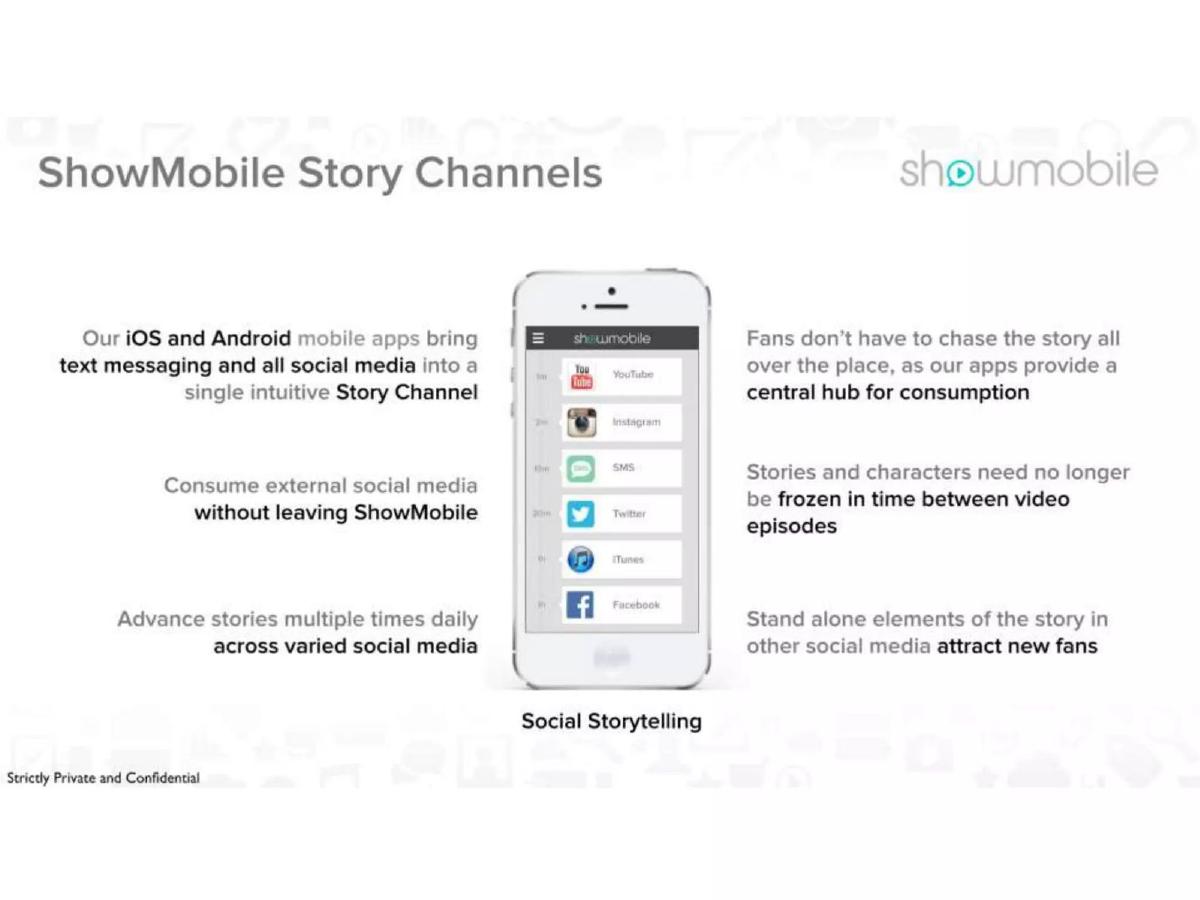
- The platform aggregates YouTube, Instagram, SMS, Twitter, iTunes, and Facebook into a single 'Story Channel' (Slide 1).
- ShowMobile emphasizes COPPA compliance and human moderation to protect its younger user base (Slide 2).
- The company reports an 83% video completion rate for its interactive episodes (Slide 4).
- Storytelling is delivered through various formats including 'Textisodes,' 'Audiosodes,' 'Statusodes,' and 'Instasodes' (Slide 5).
- The primary demographic is 82% female, with 66% of users aged 13-17 (Slide 9).
- Users average 5 app launches and 10 minutes in-app per day (Slide 9).
- The deck claims 71 million total content interactions, though 63 million of these occurred on YouTube rather than the native app (Slide 9).
- There is a total absence of a management team slide, financial projections, or a specific funding request.
Product and Concept Overview
The ShowMobile deck begins by defining its core value proposition: a centralized hub for social storytelling. The platform aims to solve the problem of fragmented content consumption by bringing disparate social media feeds and original content into a single interface.
Slide 1: ShowMobile Story Channels
This slide introduces the 'Story Channel' concept. It features a mockup of an iPhone running the ShowMobile app, displaying a feed that integrates YouTube, Instagram, SMS, Twitter, iTunes, and Facebook. The text highlights that fans no longer have to 'chase the story all over the place.' The emphasis here is on continuity; the deck claims that characters and stories 'need no longer be frozen in time between video episodes' because the narrative advances multiple times daily across varied media types.
Slide 2: ShowMobile Social Network
Slide 2 focuses on the community aspects of the platform. It describes the network as 'Closed, COPPA-compliant,' and 'moderated by sophisticated technology and humans.' This is a critical point for a platform targeting minors. The slide also introduces gamification elements: users earn 'ShowMobile Stars' for interacting, and a leaderboard status is used to encourage participation. It also mentions that posts can be 'scripted on behalf of cast members,' suggesting a blend of reality and fiction within the social feed.
Slide 3: Platform Agnostic
This is a purely visual slide showing the ShowMobile logo at the center of a web connecting various third-party platforms. The icons include Instagram, Vine, Facebook, iBooks, Radio Disney, SMS, Maker Studios, YouTube, and Twitter. The message is clear: ShowMobile acts as a connective tissue between existing major media platforms.
Content Strategy and Execution
The middle section of the deck shifts from the platform's architecture to the specific content being delivered, primarily focusing on their original series, HitStreak.
Slide 4: Interactive Video Episodes
This slide highlights the video experience. It shows a horizontal phone view of a video playing with an overlay notification. The key metric provided here is an 83% video completion rate . In the world of mobile content, particularly for younger audiences with short attention spans, this is a significant figure intended to prove the 'stickiness' of their interactive format.
Slide 5: Transmedia Episodes
Slide 5 breaks down the different formats of content, which they label with custom terminology. These include:
Textisodes: Narrative delivered via simulated text messages. · Audiosodes: Phone calls or audio clips between characters. · Statusodes: Social media-style status updates. · Instasodes: Short-form video or photo content. · Votes: Interactive polls where the audience decides character actions (e.g., 'What would you do if you were Candice?').
Slide 6: HitStreak Original Series
This is a transition slide featuring the logo for 'HitStreak,' which is identified as a 'Made-For-Mobile Original Series.' This appears to be the primary proof-of-concept for the ShowMobile platform.
Slide 7: The Perfect Format
This slide attempts to explain why the HitStreak model works. It uses a formulaic layout: Disruptive Mobile Technology + Authentic Stories/Music + Exceptional Teen Talent + The Perfect Demographic = Powerful Native Ad Units. It mentions that the talent is signed to 'Multi-Year Multi-Rights Deals' and that the demographic (teens) offers 'Obsessive Fan Engagement.' The end goal stated is higher CPMs, new revenue, and real user data.
Slide 8: The HitStreak Story Never Stops
This slide provides a weekly programming schedule, showing how content is distributed throughout the day (Before School, After School, After Dinner) across the various 'transmedia' formats. It illustrates a high-frequency touchpoint strategy, ensuring that the user has a reason to open the app multiple times a day, every day of the week.
Traction and Metrics
The final slide provides the quantitative data intended to validate the preceding product claims.
Slide 9: ShowMobile By The Numbers
Demographics: 82% female, 66% aged 13-17, 86% aged 13-24. · Daily Engagement: 5 app launches per user and 10 minutes spent in-app. · Video Performance: Reiteration of the 83% video completion rate. · Virtual Economy: 436 million Stars earned and 173 million Stars spent. · Total Interactions: 71 million content interactions, broken down into 8 million on the ShowMobile app and 63 million on YouTube. · Content Partners: Mentions of Austin Mahone, Radio Disney, NBT Shawn Mendes, and Rosso Sisters.
What ShowMobile Does Well
The deck is highly effective at communicating a specific vision for 'transmedia' storytelling. By creating new categories like 'Textisodes' and 'Instasodes,' the founders define a new way of thinking about mobile engagement that goes beyond just hosting a video player. The focus on a very specific niche (teen females) and the proof of engagement within that niche (5 app launches a day) is a strong signal of product-market fit for that specific audience.
Furthermore, the inclusion of COPPA compliance and human moderation addresses a major hurdle for any platform dealing with minors, showing that the founders have considered the regulatory and safety requirements of their target market.
What Is Missing From the Deck
While the product story is strong, the business story is almost entirely absent. The following elements are missing: 1. The Team: There is no mention of who is building this. In early-stage fundraising, the team is often more important than the product. Investors need to know if the founders have backgrounds in media, tech, or youth marketing. 2. The Business Model: While 'Native Ad Units' are mentioned on Slide 7, there is no detail on how these are sold, what the current revenue is, or what the projected unit economics look like. 3. The Ask: The deck does not state how much money the company is looking to raise, at what valuation, or what the milestones for the next 18 months will be. 4. Competition: There is no analysis of the competitive landscape. In a space crowded by Instagram, Snapchat, and YouTube, explaining why a user would download a separate app to consume this content is a major requirement. 5. Roadmap: The deck shows what has been done with HitStreak, but it doesn't show what is next. Is the goal to become a studio, a platform for other creators, or a social network?
Founder Takeaways
Founders should look at this deck as a masterclass in defining a product category . The way ShowMobile uses visual aids to explain how different media types weave together to form a single narrative is excellent. It makes a complex content strategy feel intuitive.
However, founders should also view this as a cautionary tale regarding completeness . A deck that only focuses on the product and engagement metrics is a sales deck, not an investor deck. To turn this into a successful fundraising tool, it would need to bridge the gap between 'this is a cool app teens like' and 'this is a scalable, venture-backable business with a world-class team at the helm.'
'83% Video completion rate' (Slide 4 and Slide 9). · '82% female' (Slide 9). · '66% 13-17' (Slide 9). · '5 app launches' and '10 minutes in app' (Slide 9). · '436 MM Stars Earned' and '173 MM Stars Spent' (Slide 9). · '71 Million Content Interactions' (Slide 9). · '63 million on YouTube' (Slide 9).
Frequently asked questions
- What is the core product of ShowMobile?
- ShowMobile is a mobile application for iOS and Android that serves as a central hub for 'Social Storytelling.' It aggregates content from external social media platforms (like Instagram and Twitter) and combines them with original interactive video episodes. The goal is to allow fans to follow a narrative across multiple media formats without leaving the ShowMobile app environment.
- How does ShowMobile engage its target audience?
- The platform uses a 'transmedia' approach, meaning stories are told through a mix of video, text messages, audio clips, and social media status updates. It also incorporates gamification through 'ShowMobile Stars' and leaderboards. According to the deck, this results in high engagement, including 5 daily app launches and a significant virtual economy with 436 million stars earned by users.
- What demographic does ShowMobile target?
- The platform is heavily skewed toward young females. Slide 9 indicates that 82% of the user base is female, and 86% of users fall within the 13-24 age range. Specifically, 66% of the audience is between the ages of 13 and 17, making COPPA compliance a central feature of their social network pitch.
- What are the primary engagement metrics cited?
- ShowMobile claims an 83% video completion rate and an average of 10 minutes spent in the app daily. They also highlight a total of 71 million content interactions. However, it is important to note that the vast majority of these interactions (63 million) took place on YouTube, while 8 million occurred directly on the ShowMobile platform.
- What is missing from this pitch deck?
- This deck is missing almost all standard investor requirements beyond product and traction. There is no slide introducing the founders or management team, no business model explaining how they make money (beyond a mention of 'Native Ad Units'), no competitive landscape, and no 'Ask' detailing how much capital they are raising or how it will be used.