The Floorr’s 12-slide seed deck, which secured $1.6M in 2023, is a masterclass in founder-market fit. Led by Lupe Puerta, former Global Director of Personal Shopping at NET-A-PORTER, the deck focuses on the massive revenue potential of the 'super-luxury' segment. It highlights a specific metric—31 shoppers generating $76M in net revenue—to justify building a dedicated operating system for this workforce. While the deck is light on technical architecture and competitive landscape details, it leans heavily on the founder's 20-year pedigree and a clear commission-based revenue model (2-12% for t…
Key takeaways
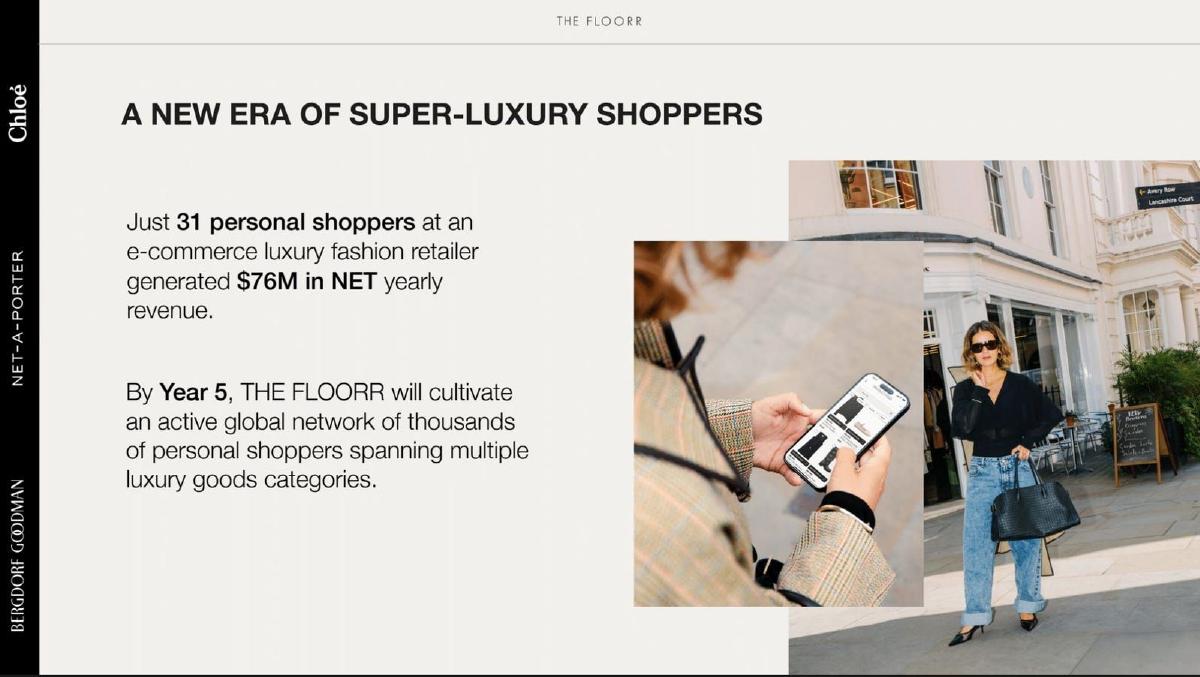
- The deck uses a high-impact anchor metric on Slide 2, noting that just 31 personal shoppers at one retailer generated $76M in net yearly revenue.
- Founder Lupe Puerta’s 20-year background at Harrods, Selfridges, and NET-A-PORTER is the deck's strongest asset, detailed on Slide 6.
- The business model is clearly defined on Slide 4, showing a 2-12% take rate for The Floorr and 6-18% for the personal shopper.
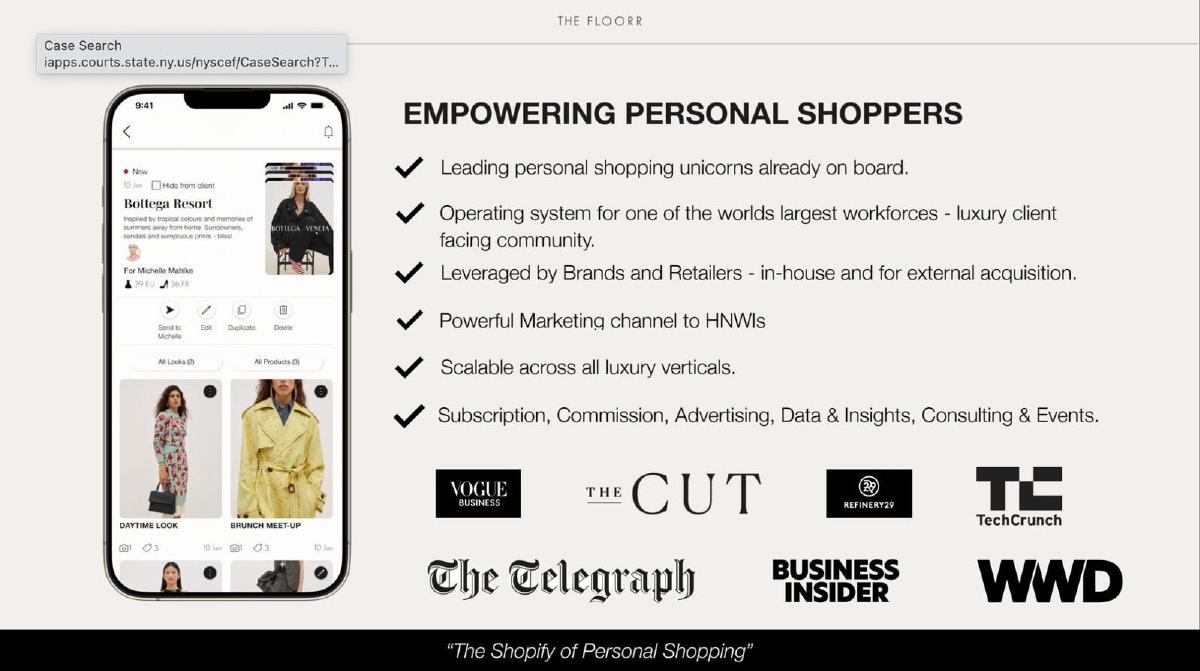
- The platform positions itself as 'The Shopify of Personal Shopping' on Slide 3, signaling a B2B infrastructure focus.
- Revenue streams are diversified beyond commissions to include subscriptions, advertising, data insights, and events (Slide 3).
- The deck lacks a formal 'Ask' slide detailing the specific use of the $1.6M raised, based on the provided materials.
- Geographic expansion targets are specific, with Slide 5 projecting a Year 5 split of 41% America and 29% UK.
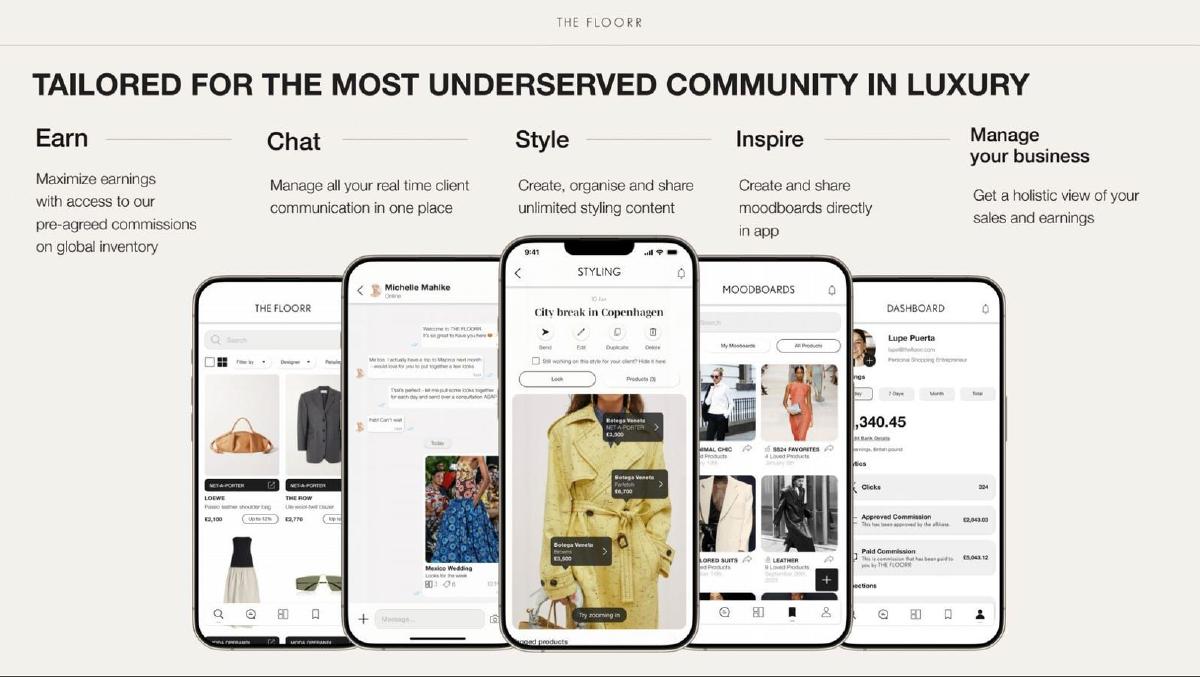
- The product workflow on Slide 4 emphasizes a 'Global Inventory Feed' and 'Look builder' to streamline the shopper's manual tasks.
The Floorr: A Strategic Infrastructure Play for Luxury Retail
The Floorr raised $1.6M in a 2023 Seed round to build what it calls the 'Shopify of Personal Shopping.' In an industry often criticized for being slow to adopt technology, The Floorr targets the highest-leverage point in the value chain: the personal shopper. This teardown examines the 12-slide deck used to secure that funding, focusing on how the company leverages founder pedigree and specific luxury market economics to build a case for a new B2B2C category.
Slide 1: Title and Positioning
The deck opens with a minimalist, high-fashion aesthetic. The subtitle, 'Revolutionising Personal Shopping for the Luxury Market,' immediately identifies the niche. It is labeled as a 'Teaser Deck,' which explains the brevity and the focus on high-level vision over granular technical specs. The imagery is monochromatic and editorial, signaling that the company understands the visual language of its target luxury audience.
Slide 2: The Power of the Personal Shopper
Slide 2 is the 'hook.' It presents a staggering efficiency metric: 'Just 31 personal shoppers at an e-commerce luxury fashion retailer generated $76M in NET yearly revenue.' By leading with this, The Floorr establishes the massive ROI of the human element in luxury sales. It then sets a Year 5 goal to cultivate a 'global network of thousands' of these shoppers. This slide effectively moves the conversation from 'fashion app' to 'high-yield workforce management.'
Slide 3: The 'Shopify' Comparison
This slide introduces the product's value proposition as an 'Operating system for one of the worlds largest workforces.' It lists several key pillars: a marketing channel to HNWIs (High Net Worth Individuals), scalability across luxury verticals, and a multi-pronged revenue model. The bottom of the slide features a 'press wall' with logos from Vogue Business, TechCrunch, and WWD, alongside the tagline 'The Shopify of Personal Shopping.' This comparison is a shorthand for investors to understand that The Floorr is an infrastructure provider, not a retailer itself.
Slide 4: Product Workflow and Unit Economics
Slide 4 provides the most concrete details on how the platform functions and generates revenue. The workflow is described as: Personal Shopper Sign up -> Search Global Inventory Feed -> Access Tools (Look builder, Moodboards, Styling) -> In-platform chat -> Onboard Clients. Crucially, it breaks down the take rate: the personal shopper earns 6-18%, while The Floorr earns 2-12%. This transparency regarding commissions is vital for seed-stage investors to model potential GMV (Gross Merchandise Volume) capture.
Slide 5: Global Market Ambition
The 'Global Ambition' slide uses a map to show the projected distribution of their workforce by Year 5. The heavy weighting toward America (41%) and the UK (29%) reflects the current concentration of luxury wealth. By providing these percentages, the deck shows that the founders have a specific roadmap for international expansion, rather than a vague 'global' goal. It also mentions targeting 'one of the biggest workforces in the world,' framing personal shopping as a massive, fragmented labor market ripe for consolidation.
Slide 6: The Founder's Pedigree
In many seed decks, the team slide is a list of schools and past employers. Slide 6 for The Floorr is a deep dive into Lupe Puerta’s 20-year career. It highlights her roles at Harrods and Selfridges, but focuses most heavily on her 15 years at NET-A-PORTER. The slide notes she managed the 'Extremely Important People' (E.I.P.) segment, where the top 2% of clients generated 40% of revenue. This is a textbook example of founder-market fit; she isn't just entering the luxury market, she helped define its digital personal shopping standards.
Slides 7-12: The Missing Pieces
While the provided text and images cover the core narrative, the full 12-slide deck likely included further details on the technology stack, the current partner list (alluded to as 'leading personal shopping unicorns' on Slide 3), and the specific financial 'Ask.' In the provided materials, there is no explicit slide detailing how the $1.6M will be spent (e.g., engineering vs. marketing) or a competitive landscape analysis. The absence of a competitor slide suggests the founder believes the 'operating system' approach is sufficiently unique compared to existing concierge services or styling apps.
What Works in The Floorr's Pitch Deck
1. The Anchor Metric: Leading with the $76M revenue generated by just 31 people is a brilliant way to demonstrate the 'why now' and the 'why this.' It proves that the workforce is incredibly valuable but currently underserved by technology.
2. Clear Monetization: Many fashion startups struggle to explain their revenue model. The Floorr is explicit about its 2-12% commission and its secondary revenue streams (subscriptions, data, etc.). This makes the business feel grounded and professional.
3. Extreme Founder-Market Fit: Lupe Puerta’s background is the ultimate de-risking factor. Investors are not just betting on an idea; they are betting on the person who ran the most successful version of this service at NET-A-PORTER.
What is Missing from The Floorr's Pitch Deck
1. The Technical 'How': The deck explains what the tools do (look builder, moodboards) but not how they integrate with global inventory. In a B2B2C model, the API integrations and inventory accuracy are the hardest parts to execute. A slide on the technical moat would have strengthened the case.
2. Competitive Landscape: The luxury space is crowded with personal shopping apps (e.g., Threads Styling, PS Dept). The deck relies on the 'Shopify' analogy to differentiate, but a direct comparison showing why an independent shopper would choose The Floorr over an existing agency is missing.
3. The Use of Funds: While we know from publisher reports that $1.6M was raised, the deck (as presented) does not show the roadmap for that capital. Investors typically want to see a 18-24 month plan for hiring and product milestones.
Founder's Playbook: What to Copy
Use 'The [Successful Company] of [Your Niche]' carefully: The Floorr uses 'The Shopify of Personal Shopping' effectively because they actually follow the Shopify model (providing tools for others to sell). If you use this trope, ensure your business model actually mirrors the company you are referencing.
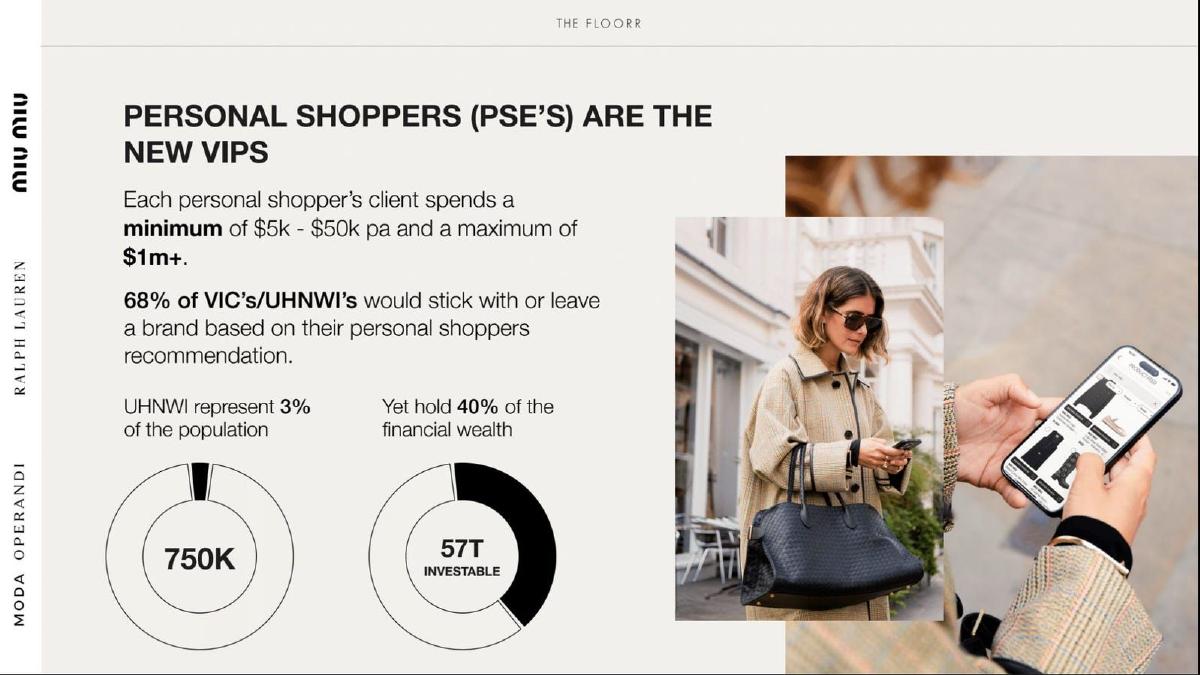
Highlight the 'Whale' Economics: If your industry has a small group of users who generate a disproportionate amount of value (like the E.I.P.s in luxury), make that the center of your pitch. It shows you understand where the money actually is.
Visual Consistency: The deck looks like the industry it serves. If you are pitching a luxury product, your deck cannot look like a generic SaaS template. The Floorr’s use of whitespace and high-quality editorial photography reinforces their brand authority before a single word is read.
Frequently asked questions
- What is the core problem The Floorr is solving?
- The Floorr addresses the inefficiency and lack of dedicated tools for luxury personal shoppers. According to Slide 3, these professionals currently lack a unified 'operating system.' By providing a global inventory feed, look builders, and in-platform chat, The Floorr aims to digitize a high-value but manually intensive workflow, allowing shoppers to scale their client bases and revenue.
- How does The Floorr make money?
- The revenue model is multi-layered. Slide 4 explicitly states the platform earns a 2-12% commission on sales. Additionally, Slide 3 lists five other revenue streams: subscriptions (paid by shoppers for tool access), advertising, data & insights for brands, consulting, and events. This suggests a hybrid SaaS and marketplace commission model.
- What is the 'super-luxury' shopper metric mentioned?
- On Slide 2, the deck highlights that a small group of 31 personal shoppers at a single luxury e-commerce retailer generated $76M in net yearly revenue. This is used to demonstrate the extreme leverage of the personal shopping workforce and the high average order value (AOV) inherent in the luxury fashion sector.
- Who is the founder and why does it matter?
- The founder is Lupe Puerta, whose biography on Slide 6 shows 20 years of experience at top-tier luxury institutions. Most notably, she was the Global Director of Personal Shopping at NET-A-PORTER, where her team managed the 'Extremely Important People' (E.I.P.) segment—the top 2% of clients who generated 40% of the company's revenue.
- What are the geographic targets for the company?
- Slide 5 outlines a 'Global Ambition' with specific Year 5 targets. The company expects its personal shopper network to be distributed primarily in America (41%) and the UK (29%), followed by EMEA (15%), APAC (11%), and Australia (4%). This indicates a focus on established luxury markets with high concentrations of HNWIs.