Canary Technologies' 2022 Series B deck is a study in strategic sequencing. By initially solving a high-friction, niche problem—digital credit card authorizations—the company established a foothold in the notoriously difficult hospitality sector. The deck illustrates a clear transition from this initial 'wedge' to a broad Guest Management System (GMS). With 20,000+ hoteliers and a 75 NPS, the company demonstrates significant traction. The presentation leans heavily on social proof, featuring logos from Four Seasons and Wyndham, and uses a comparison with Veeva to justify the massive potential…
Key takeaways
- The 'wedge' strategy is clearly defined, starting with Digital Authorizations to solve immediate fraud and labor issues (Slide 9).
- Canary reports an exceptionally high Net Promoter Score (NPS) of 75, indicating strong product-market fit in a legacy industry (Slide 13).
- The company has scaled to over 20,000 hoteliers across 70+ countries (Slide 16).
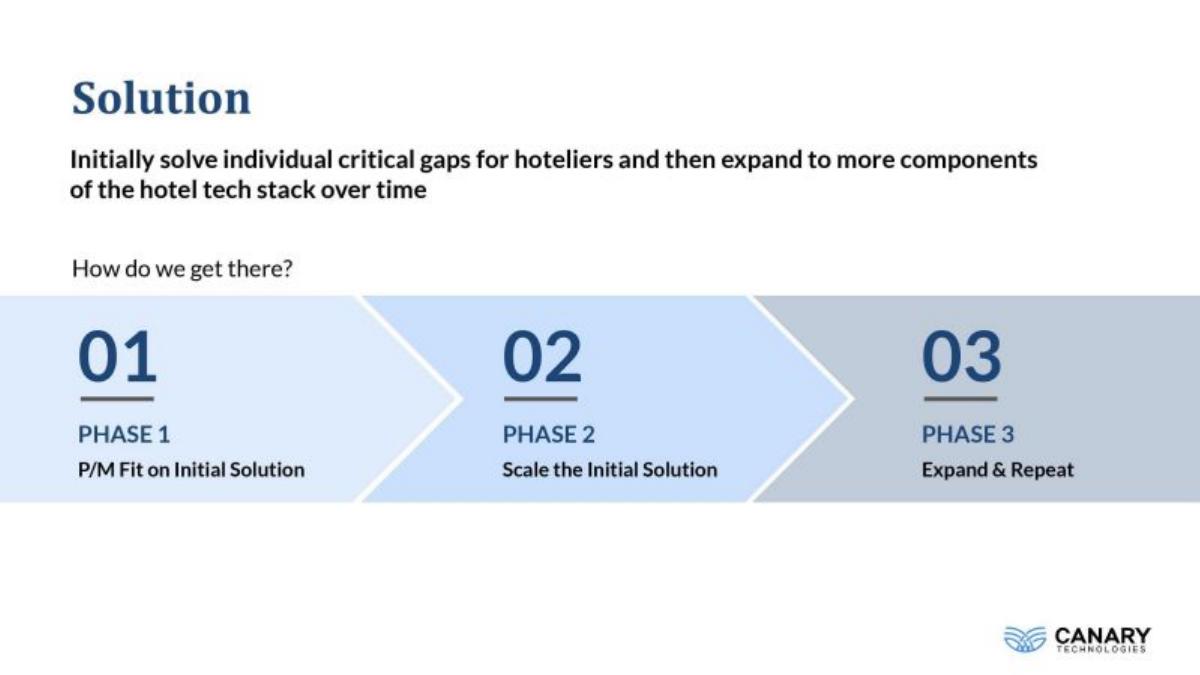
- A three-phase growth strategy outlines the evolution from P/M fit to scaling and finally expanding the tech stack (Slide 6).
- The deck uses a direct comparison to Veeva to illustrate that the $23B hotel software market is ripe for a vertical leader (Slide 20).
- Customer testimonials highlight specific ROI, such as $10k/month in new upsell revenue at Coeur d'Alene Resort (Slide 15).
- The founders emphasize deep domain expertise with backgrounds at Starwood Hotels and Bain & Co. (Slide 3).
- Digital Authorizations are claimed to reduce chargebacks and fraud by over 90% (Slide 12).
Executive Summary and Brand Positioning
Slides 1-2: The Hook and Social Proof
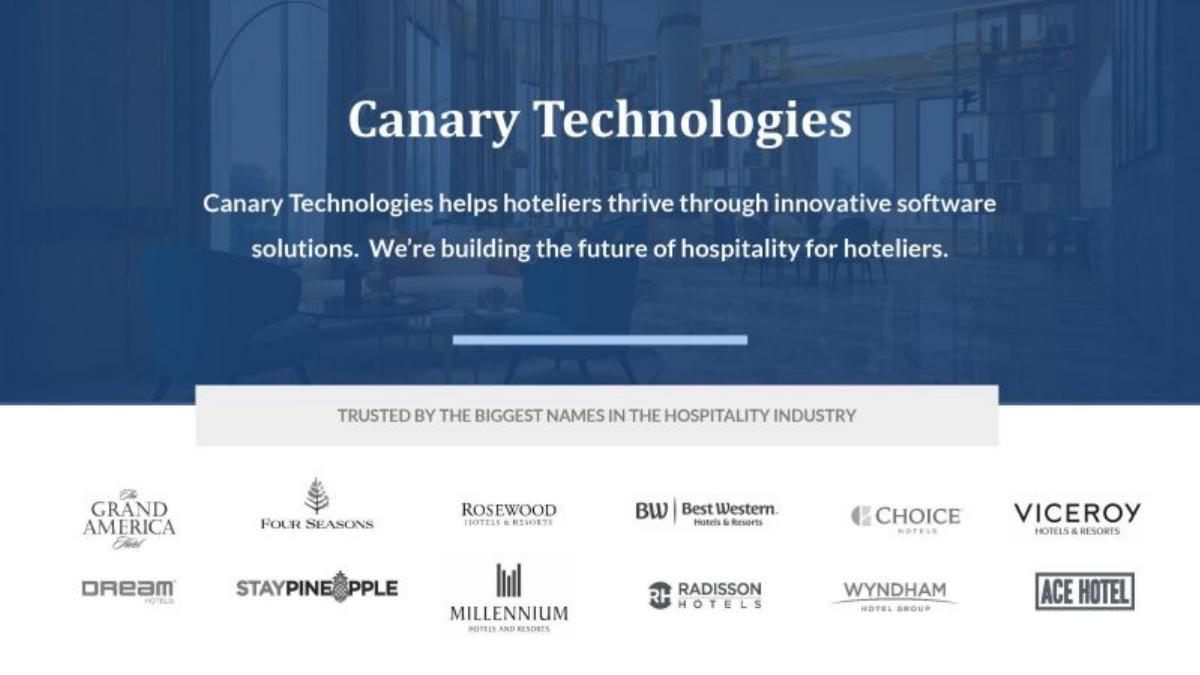
Slide 1 introduces Canary Technologies with a clean, professional logo and a background image of a modern hotel lobby, immediately establishing the industry context. Slide 2 serves as the 'Mission' and 'Social Proof' slide. The company states it helps hoteliers thrive through 'innovative software solutions' and is 'building the future of hospitality.' The most impactful element here is the 'Trusted by' section, featuring heavy-weight logos like Four Seasons, Rosewood, Best Western, Choice Hotels, Wyndham, and Ace Hotel . For a Series B deck, lead-off social proof of this caliber is essential to demonstrate that the company has moved past the pilot phase and is a serious enterprise contender.
Slides 3-4: Team and Global Presence
Slide 3 focuses on Founders with Deep Domain Expertise . Harman Singh Narula's background includes Global Strategy at Starwood Hotels and management consulting at Bain & Co., with degrees from Cornell and Wharton. Satjot "SJ" Sawhney is highlighted as the former VP of Product at Stayful and a Senior Technical PM at Vevo. This combination of industry-specific strategy and technical product leadership is a strong signal to investors. Slide 4 shows the broader team and lists global office locations including San Francisco, New York, Dallas, New Delhi, London, and Kuala Lumpur , emphasizing the scale of the operation.
The Problem and Strategic Solution
Slides 5-6: The Antiquated Industry
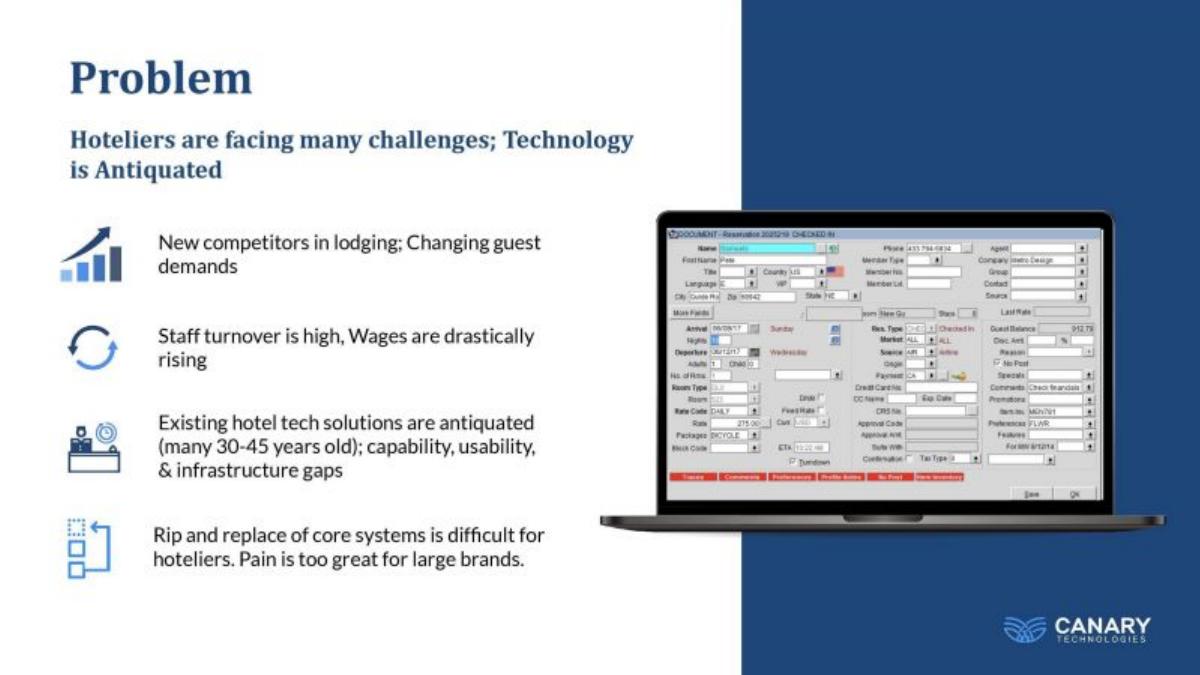
Slide 5 defines the Problem . It notes that hoteliers face high staff turnover, rising wages, and 'antiquated' technology (some 30-45 years old). The slide features a screenshot of a legacy Property Management System (PMS) that looks like a Windows 95 interface, providing a visceral contrast to the modern solution Canary offers. Slide 6 introduces the Solution as a phased approach: Phase 1 (P/M Fit on Initial Solution), Phase 2 (Scale the Initial Solution), and Phase 3 (Expand & Repeat). This tells a story of disciplined growth rather than trying to boil the ocean from day one.
Slides 7-8: Market Tailwinds
Slide 7 addresses the 'Why Now?' question. It cites that 72% of guests prefer self-service and that the pandemic accelerated 10 years of tech adoption into one year. Slide 8 summarizes how Canary 'Meets the Moment' by improving staff efficiency, augmenting guest experience, and increasing revenue to offset rising costs. These are the three primary value drivers for any B2B SaaS product: save time, make money, or improve the end-customer experience.
Product Evolution and Traction
Slides 9-10: The Wedge Strategy
Slide 9 details the success of their first product: Digital Authorizations . It notes that within the first 24 months, they secured notable enterprise brands. While the ARR and ACV figures are redacted, the growth chart shows a steep upward trajectory. Slide 10 explains why this product worked: it eliminates fraud, saves 3 hours per week in front desk time, and provides 24/7/365 support. This was the 'wedge' that allowed them to enter the hotel tech stack without requiring a full 'rip and replace' of the core PMS.
Slides 11-12: The Pivot to Platform
Slide 11 shows the expansion into a Guest Management System (GMS) . The ARR chart shows a clear inflection point labeled 'Launch of GMS.' Slide 12 breaks down the GMS features: Check-In, Checkout, Digital Tipping, Messages, and Upsells. It also mentions that Digital Authorizations reduce chargebacks and fraud by over 90% . By grouping these under 'Guest Management' and 'Go Paperless,' Canary positions itself as a comprehensive operating system for the guest journey.
Slide 13: The Competitive Advantage
Slide 13 lists five reasons why global brands trust Canary: Security & Compliance (PCI Compliant), Easy User Interface (60-second check-in), Simple for Hoteliers (Robust Integrations), High Guest Adoption (Web-based, no app download), and Unparalleled Support. A standout metric on this slide is the 75 NPS , which is exceptionally high for B2B software, particularly in a legacy industry like hospitality.
Case Studies and Global Scale
Slides 14-16: Proof of ROI
Slides 14 and 15 are dedicated case studies. Dream Hollywood reports a 20+% increase in guest satisfaction and a 4.92/5 star rating. Coeur d'Alene Resort highlights $10k/month in average new upsell revenue and a smoother check-in process. These slides move the conversation from 'features' to 'outcomes.' Slide 16 summarizes the global scale: 20k+ Hoteliers , 5M+ Guest Reservations , and presence in 70+ Countries . It also displays 'Best Cyber Security & Fraud Prevention' awards from HotelTechAwards for 2021 and 2022.
Market Opportunity and Future Vision
Slides 17-19: The Growth Narrative
Slide 17 uses an iceberg graphic to suggest they have 'just scratched the tip' of the business, with massive room for GTM expansion. Slides 18 and 19 show historical and projected growth. Slide 18, 'The Story So Far,' maps their journey from 2017 launch to the 2021 Series A (led by F-Prime). Slide 19, 'What comes next...', shows a projected revenue bar chart through 2024, indicating an expectation of exponential growth following the Series B investment.
Slide 20: The Vertical SaaS Comparison
Slide 20 is a strategic comparison between Canary Technologies and Veeva . It compares the Hotel industry ($600B revenue, $23B software spend) to Life Sciences ($500B revenue, $28B software spend). This is a classic 'Market Size by Proxy' argument, suggesting that if Veeva can be a multi-billion dollar company in Life Sciences, Canary has the same potential in Hotels. It frames the hospitality market not as a niche, but as a massive vertical ripe for a platform leader.
Slides 21-22: Values and Closing
Slide 21 outlines the company values: 'Open, honest & direct,' 'Do it today, not tomorrow,' 'Resourceful,' 'True to ourselves,' and 'We care.' This slide aims to humanize the brand and signal a strong internal culture to potential investors. Slide 22 is a standard closing slide with a call to action to browse more pitch decks, which is likely an artifact of the platform hosting the deck rather than the original presentation.
What Makes This Deck Work
The Wedge Strategy: The deck clearly explains how they entered the market with a high-ROI, low-friction product (Digital Authorizations) before expanding. This is the gold standard for vertical SaaS. · Quantified ROI: Including a specific dollar amount ($10k/month in upsells) and a specific fraud reduction percentage (90%) makes the value proposition undeniable. · Social Proof: The density of enterprise logos and the high NPS (75) mitigate the perceived risk of investing in a company targeting a slow-moving industry. · Strategic Benchmarking: Comparing themselves to Veeva is a brilliant way to anchor the valuation and market potential in the minds of Series B investors who are looking for 'fund-returner' scale.
What is Missing
The Ask: This version of the deck does not include a slide detailing how much capital is being raised or how it will be spent. · Unit Economics: While growth is shown, there is no mention of LTV (Lifetime Value), CAC (Customer Acquisition Cost), or churn rates, which are critical for a Series B evaluation. · Competitive Landscape: The deck focuses entirely on legacy systems (the 'antiquated' problem). It does not address other modern competitors in the hospitality tech space, which investors would certainly ask about. · Financial Specifics: The redaction of ARR and ACV makes it difficult to assess the actual efficiency of the growth shown in the charts.
Founder Takeaways
Sequence your story: Don't just show what you do today; show the evolution from your first 'wedge' to your current platform. · Use industry proxies: If your market is misunderstood, compare it to a well-known success story in a different vertical (like the Veeva comparison). · Highlight 'Why Now': Clearly articulate the macro trends (labor shortages, consumer behavior shifts) that make your solution a necessity rather than a luxury. · Focus on Outcomes: A case study that shows a customer making an extra $10,000 a month is worth more than five slides of feature lists.
Frequently asked questions
- What was the primary 'wedge' product for Canary Technologies?
- Canary entered the market with a Digital Authorizations solution. As shown on slide 9, this was their first product to find product-market fit. It addressed a specific pain point: the manual, paper-based process of credit card authorizations which was prone to fraud and high labor costs. By solving this single, critical gap, they were able to build trust with major enterprise brands like Four Seasons and Wyndham before expanding their product suite.
- How does Canary justify the market opportunity for hotel software?
- On slide 20, Canary uses a 'Vertical Software' comparison with Veeva (a leader in life sciences software). They note that while Life Sciences has $500B in topline revenue, Hotels have $600B. They estimate the hotel software spend at $23B, compared to $28B for Life Sciences. This comparison suggests that the hospitality industry is underserved by modern technology relative to its size and spend, presenting a massive opportunity for a dominant vertical SaaS player.
- What specific guest behaviors are driving Canary's growth?
- Slide 7 identifies four key drivers: 72% of guests now prefer self-service options, labor shortages are forcing hoteliers to do more with less, the rise of short-term rentals is increasing competition, and the pandemic accelerated tech adoption (like QR codes) by roughly 10 years within a single 12-month period. These factors created a 'why now' moment for hotels to replace 30-45 year old legacy systems.
- What are the core components of the Canary Guest Management System?
- According to slide 12, the Guest Management System (GMS) includes mobile Check-In and Checkout, Contactless Messaging, Upsells (allowing guests to purchase upgrades), and Digital Tipping. These features are designed to improve staff efficiency while simultaneously increasing hotel revenue and guest satisfaction, which the deck claims increased by over 20% at Dream Hollywood (Slide 14).
- What is missing from this version of the Canary Technologies deck?
- The most notable omissions in this public version of the deck are the specific financial metrics. Slides 9, 11, 18, 19, and 20 have redacted figures for Contracted ARR, ACV (Annual Contract Value), and sales cycle lengths. Additionally, while the deck mentions a Series B round in the catalogue, there is no specific 'Ask' slide in this 22-slide sequence detailing how the $30M will be allocated across hiring, R&D, or marketing.