CampusFeed is a multi-platform media company targeting the high school demographic, specifically Gen Y and Z. The deck emphasizes the significant spending power of this group, citing $300+ billion in total US teen spending on slide 2. The business model relies on a three-pronged revenue approach: YouTube advertising and subscriptions, direct ad sales and licensing on CampusFeed.com, and e-commerce verticals. By highlighting high-profile exits in the MCN space, such as Maker Studios' $500M+ acquisition by Disney, the company attempts to validate its market landscape. The deck concludes with a…
Key takeaways
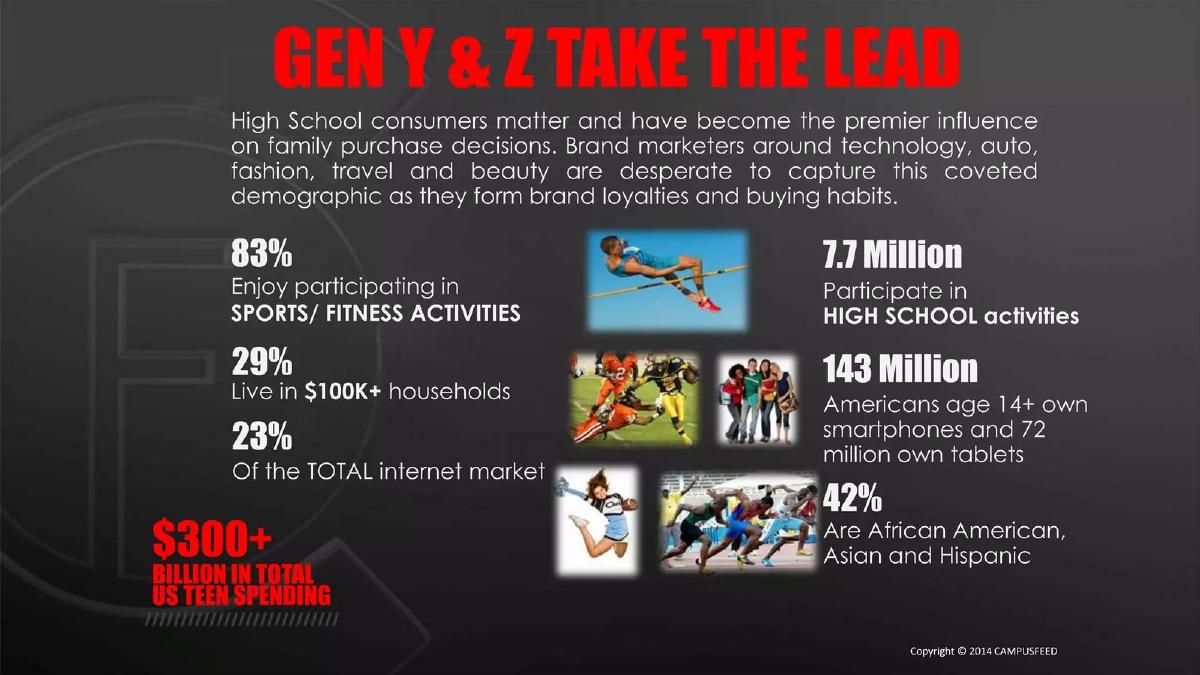
- The company targets Gen Y and Z, noting that 29% of this demographic lives in $100K+ households (Slide 2).
- Total US teen spending is estimated at over $300 billion, serving as the primary macro-economic driver for the platform (Slide 2).
- CampusFeed operates across three main pillars: YouTube/CampusFeedTV, CampusFeed.com, and Commerce Verticals (Slide 4).
- Revenue streams include advertising, sponsorships, branded content, licensing, and m-commerce (Slide 4).
- The deck uses MCN (Multi-Channel Network) comparables like Fullscreen and Machinima to establish market value (Slide 5).
- The company has raised $205K to date prior to this specific investor overview (Slide 6).
- The current ask is $1 million via a convertible note with a 20% discount and a $5 million valuation cap (Slide 6).
- The deck lacks a team slide, specific user growth metrics, or a detailed breakdown of how the $1M will be spent (Slides 1-6).
Executive Summary: The High School Influencer Play
CampusFeed presents a classic digital media play from the mid-2010s, focusing on the burgeoning Multi-Channel Network (MCN) space. The deck, dated 2014 in the footer, targets the high school demographic—a group the founders claim is the 'premier influence on family purchase decisions.' By positioning themselves at the intersection of content creation and brand advocacy, CampusFeed seeks to capture a slice of the $300+ billion teen spending market. The deck is concise, focusing heavily on market opportunity and financing terms, but it leaves significant gaps regarding operational execution and historical performance.
Slide 1: Title and Contact
The cover slide is minimalist, featuring a large red 'CF' logo. It identifies Matthew Papish as the Founder and Chairman. Providing a direct email address (matt@campusfeed.com) on the first slide is a standard practice for accessibility, though the slide lacks a clear one-sentence value proposition or 'tagline' that immediately explains what the company does. The subtitle 'Investor Overview' suggests this is a high-level summary rather than a deep-dive operational deck.
Slide 2: The Gen Y & Z Opportunity
This slide serves as the 'Market Need' and 'TAM' (Total Addressable Market) combined. It uses several key statistics to justify the focus on high schoolers: 83% participate in sports, 29% live in high-income households ($100K+), and the demographic represents 23% of the total internet market. The most significant figure is the $300+ billion in total US teen spending , highlighted in red. The slide also notes that 143 million Americans age 14+ own smartphones. While these numbers are large, they are macro-stats; the deck does not yet explain how CampusFeed specifically captures this value compared to general social media platforms.
Slide 3: Multi-Platform Strategy
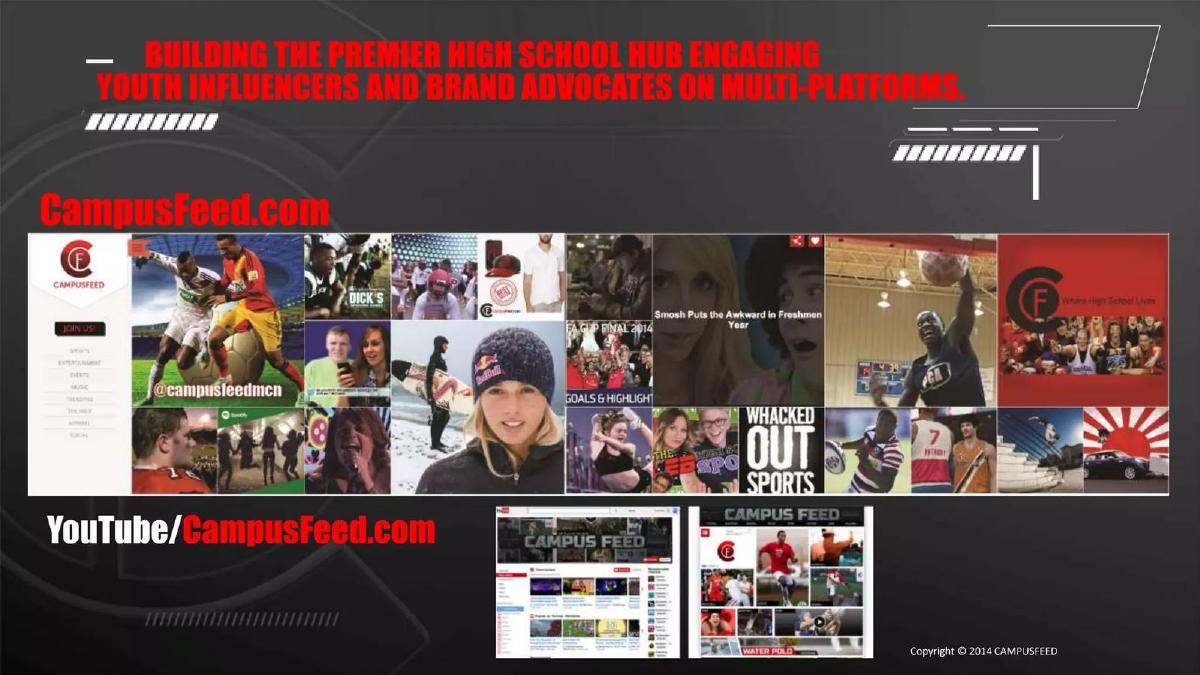
Slide 3 attempts to show the product in action. It describes the company as 'Building the premier high school hub engaging youth influencers and brand advocates on multi-platforms.' The visuals show a collage of content: sports highlights, music, and lifestyle imagery. It explicitly mentions two primary destinations: CampusFeed.com and YouTube/CampusFeed.com . The inclusion of the YouTube logo and a screenshot of a YouTube channel suggests that CampusFeed operates, at least in part, as a Multi-Channel Network (MCN) that aggregates or produces video content for the Google-owned platform.
Slide 4: Revenue Streams
The 'How We Make Money' slide breaks the business model into three silos. YouTube/CampusFeedTV relies on traditional digital media monetization: advertising, sponsorship, and subscriptions. CampusFeed.com focuses on higher-margin direct sales: direct ad sales, branded content, and licensing. The third silo, Commerce Verticals , mentions e-commerce and m-commerce. This indicates a desire to move beyond 'rented' attention (ads) into direct consumer transactions, though the slide does not specify what types of products they intend to sell.
Slide 5: Market Landscape and Comparables
To justify a potential valuation, CampusFeed lists successful peers in the digital video space. They cite Maker Studios (Acquisition: $500M+ by Disney), Fullscreen (Acquisition: $750M - $1B by Relativity Media), and Awesomeness TV (Acquisition: $110M by DreamWorks). By listing these, the company is signaling to investors that they are building a vertical-specific version of these broad MCNs. They also mention Machinima and Zefr to show that the sector is attracting significant venture capital from firms like Google and Redpoint Ventures.
Slide 6: Financing and The Ask
The final slide in this set details the investment opportunity. The company discloses a funding history of $205K to date . They are seeking to raise $1 million in convertible notes . The terms are clearly stated: a 20% discount on the next round and a $5 million conversion valuation cap . This is a very specific 'Ask' slide, which is helpful for investors to understand the entry price, but it lacks a 'Use of Proceeds' breakdown to explain how that $1 million will help the company reach its next milestone.
What Works in This Deck
The deck is visually consistent and uses a high-contrast color scheme (red, white, and black) that feels energetic and youthful, matching the brand. The 'Market Landscape' slide is particularly effective because it uses 'social proof' by association; by listing billion-dollar acquisitions in the same space, the founders make their $5 million valuation cap seem like a bargain if they can achieve even a fraction of their competitors' success. The financing terms are also refreshingly transparent, leaving no ambiguity about what the founders are looking for in a deal.
What Is Missing
The Team: There is no slide detailing the experience of the founders or advisors. In early-stage media companies, the ability to sign talent and negotiate brand deals is entirely dependent on the team's network. · Traction: The deck mentions 'building' the hub but provides zero data on current users, YouTube subscribers, monthly active users (MAU), or existing revenue. Without these, the $300B market stats feel disconnected from the company's actual progress. · Differentiation: The deck does not explain why a high school student would go to CampusFeed instead of Instagram, Snapchat, or Vine (which was prominent in 2014). The 'moat' or unique value proposition is not clearly defined. · Use of Funds: While they ask for $1M, they don't say if that money goes toward content production, hiring a sales team, or user acquisition.
Founder's Playbook: What to Copy
Founders should emulate the clarity of the Ask slide (Slide 6) . Many decks are vague about their financing needs, but CampusFeed explicitly states the instrument (convertible note), the discount, and the cap. This allows an investor to immediately decide if the deal fits their mandate. Additionally, the Market Landscape slide (Slide 5) is a great example of how to use industry exits to validate a business model. If you are building in a sector that has recently seen large acquisitions, highlighting those figures helps frame your startup as a viable MCN or platform play rather than just a 'content project.'
Final Analysis
CampusFeed's deck is a product of the 'MCN Gold Rush' era. It leans heavily on the massive spending power of Gen Z and the high exit multiples of early digital video networks. However, the lack of specific traction data and team bios makes it a difficult sell for institutional investors who require proof of execution. For a seed-stage bridge round, the deck serves its purpose of establishing the 'Why Now' and the 'How Much,' but it would likely require a significant verbal pitch or a supplemental data room to close a sophisticated lead investor.
Frequently asked questions
- What is the core problem CampusFeed is trying to solve?
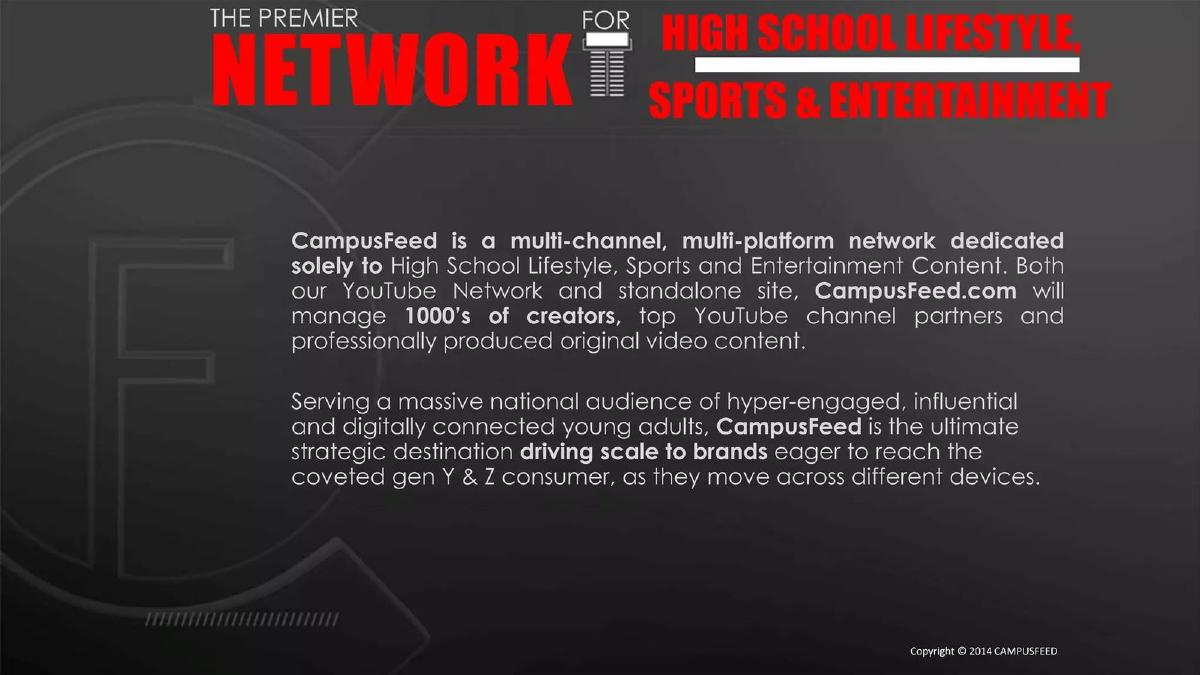
- While the deck does not have a dedicated 'Problem' slide, it implies that brand marketers are 'desperate' to capture the high school demographic as they form buying habits. CampusFeed positions itself as the solution by building a 'premier high school hub' that engages youth influencers and brand advocates across multiple platforms, effectively acting as a bridge between brands and Gen Z.
- How does CampusFeed plan to generate revenue?
- The revenue model is diversified across three channels. On YouTube, they focus on advertising, sponsorships, and subscriptions. Their proprietary site, CampusFeed.com, generates income through direct ad sales, branded content integration, and licensing. Finally, they plan to leverage commerce verticals through e-commerce and mobile commerce (m-commerce) initiatives, though specific product lines are not detailed in the slides.
- What market validation does the deck provide?
- CampusFeed points to the 'Market Landscape' of Multi-Channel Networks (MCNs) and digital media brands. They cite major exits and funding rounds, including Maker Studios ($500M+ acquisition by Disney), Fullscreen ($750M-$1B acquisition by Relativity Media), and Machinima ($68.6M in funding). This suggests the company views itself as a niche MCN focused exclusively on the high school vertical.
- What are the specific terms of the investment being sought?
- The company is seeking $1 million in financing. This is structured as a convertible note, which is a form of short-term debt that converts into equity during a future funding round. The notes carry a 20% discount rate and a $5 million conversion valuation cap, which protects early investors by setting a maximum price at which their debt converts to shares.
- What critical information is missing from this pitch deck?
- The provided slides omit several standard VC requirements. There is no 'Team' slide to verify the founders' expertise, no 'Traction' slide showing actual user numbers or revenue growth, and no 'Use of Funds' slide explaining how the $1 million will be deployed. Additionally, the deck lacks a competitive analysis showing how they differ from existing social platforms like Instagram or Snapchat.