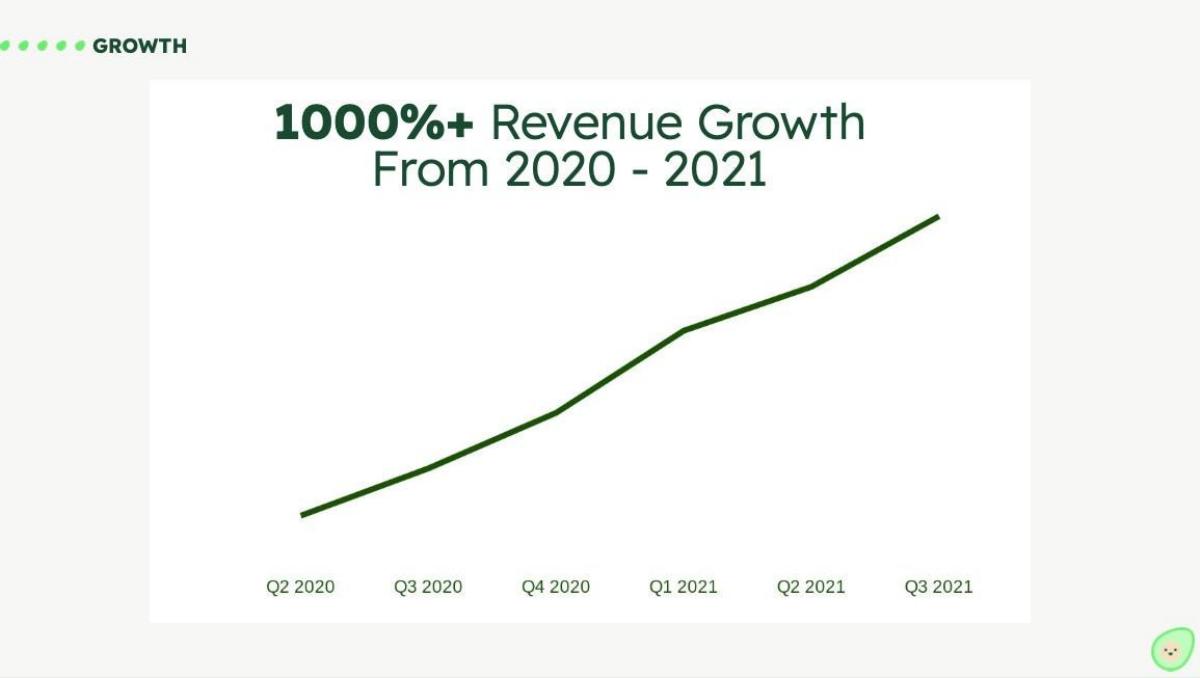
Avo’s Series B deck is a masterclass in B2B2C positioning, moving away from the high-burn consumer acquisition models of traditional delivery apps. By partnering with property managers and employers, Avo creates a captive audience in high-density environments. The deck, which helped secure $45M in 2021 as reported by Business Insider, emphasizes 'delight' and 'tenant experience' over raw logistics metrics. While it lacks explicit financial disclosures or a detailed team slide in the provided materials, the visual evidence of market density in New York and strong testimonials from major real e…
Key takeaways
- The deck positions delivery as a 'tenant experience' amenity rather than a simple logistics service (Slide 3).
- Avo uses a B2B2C model, partnering with employers and property managers to reach residents and employees (Slide 1).
- Visual density is demonstrated through a map of New York City showing thousands of active buildings (Slide 2).
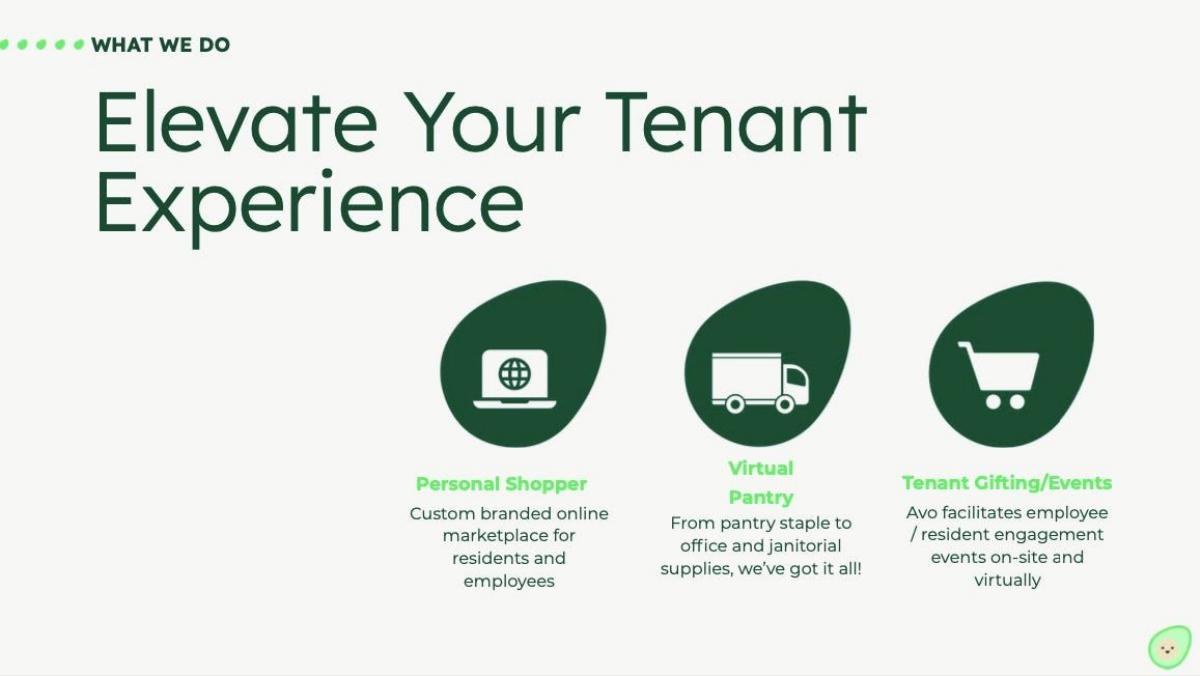
- The product offering is split into three pillars: Personal Shopper, Virtual Pantry, and Tenant Gifting/Events (Slide 3).
- The 'Virtual Pantry' includes everything from staples to office and janitorial supplies (Slide 3).
- Avo provides monthly activity reporting to partners to quantify engagement and impact (Slide 5).
- Social proof is heavily weighted, featuring testimonials from Directors at Extell and FirstService Realty (Slides 6-7).
- The deck emphasizes a 'safe and seamless' experience, specifically cited as a critical need during the pandemic era (Slide 7).
Avo Series B Teardown: Redefining the Last Mile as a Building Amenity
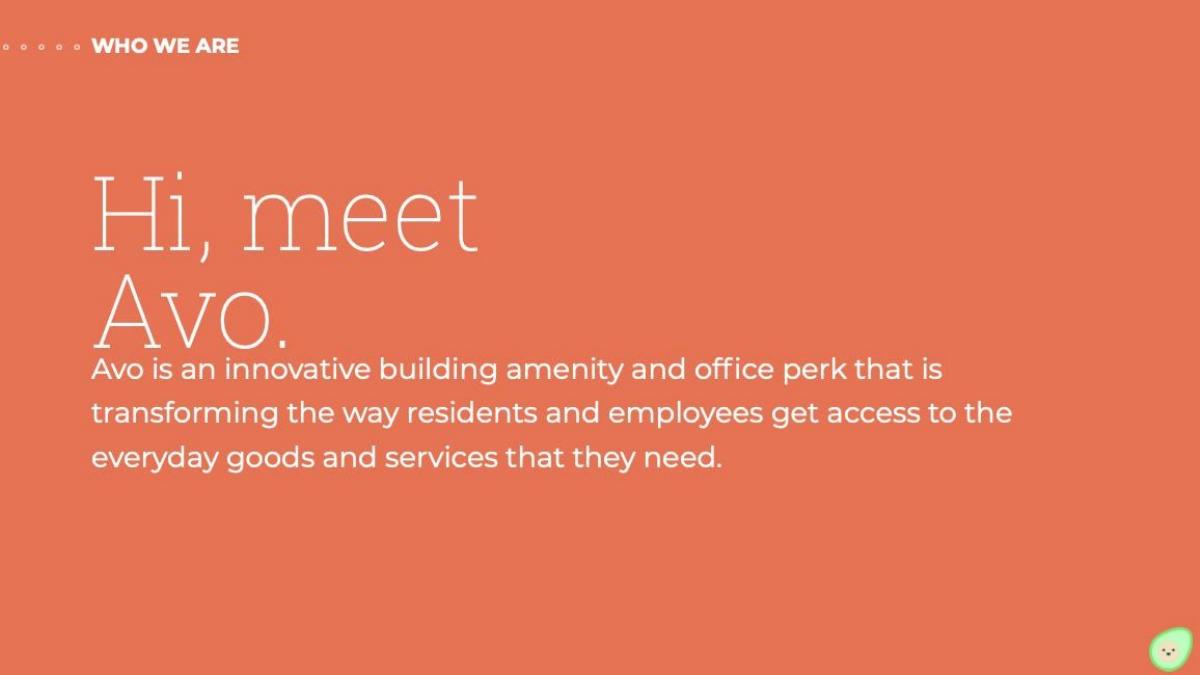
Avo’s 2021 Series B deck, which facilitated a $45M raise, represents a shift in the delivery startup narrative. While the 2010s were defined by the 'uber-for-x' model of hyper-growth at any cost, Avo’s presentation focuses on sustainable density and B2B partnerships. By positioning themselves as a 'tenant experience' platform, they move the conversation from logistics—a low-margin commodity—to real estate value, a high-margin necessity.
Slide 1: The Value Proposition
The cover slide sets a friendly, consumer-centric tone with the tagline 'Delivering Delight to Residents and Employees, Everyday!' The branding is soft, utilizing a green avocado mascot with a smiling face. This immediately signals that Avo is not just a trucking or logistics company; they are a service brand focused on the end-user experience. The inclusion of both 'Residents' and 'Employees' establishes their dual-market approach: residential real estate and corporate offices.
Slide 2: Geographic Density and Traction
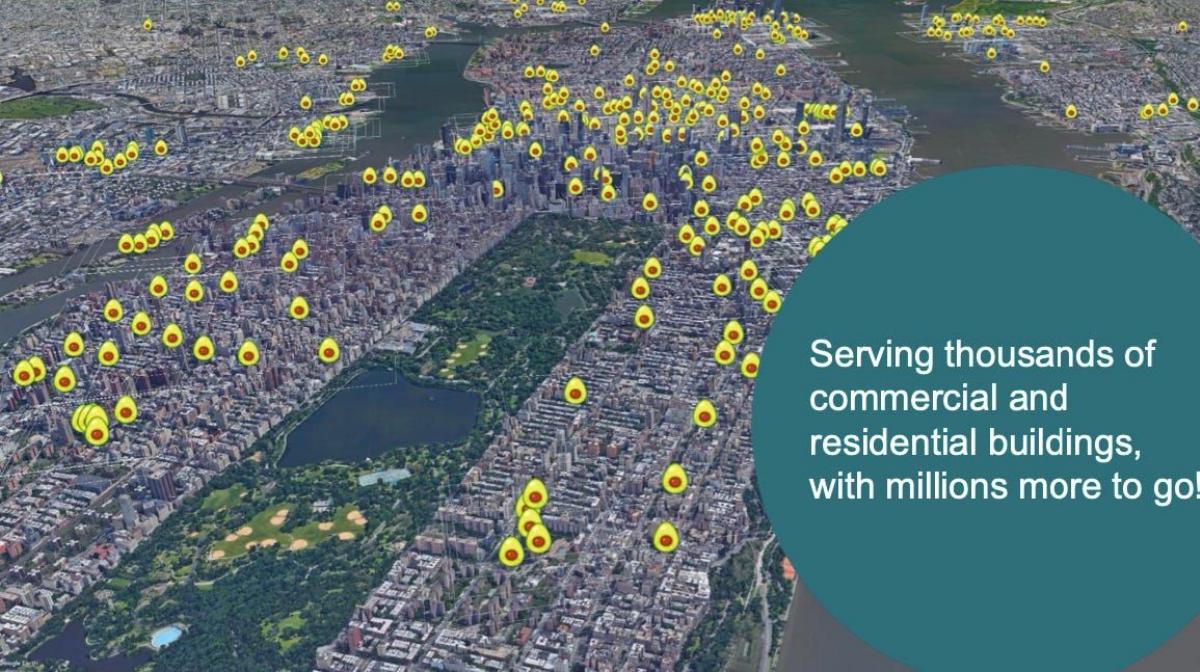
Slide 2 is a powerful visual proof of concept. It features a 3D map of Manhattan and parts of Brooklyn and Queens, peppered with hundreds of avocado icons. The text states they are 'Serving thousands of commercial and residential buildings, with millions more to go!' This slide addresses the 'why now' and 'why us' by showing that they have already solved the hardest part of the delivery business: density. In logistics, density equals profitability. By showing a concentrated presence in the world’s most expensive real estate market, Avo demonstrates they have the operational footprint to scale.
Slide 3: The Three Pillars of Service
Under the header 'What We Do,' Slide 3 breaks the business down into three functional areas: Personal Shopper , Virtual Pantry , and Tenant Gifting/Events . The 'Personal Shopper' is described as a custom-branded online marketplace. The 'Virtual Pantry' covers everything from staples to janitorial supplies, suggesting a B2B revenue stream alongside B2C. Finally, 'Tenant Gifting' positions Avo as an engagement tool for property managers, helping them facilitate resident events. This is a clever move to make the service 'sticky' for the B2B partner who controls access to the building.
Slide 4: Product Interface (The Virtual Pantry)
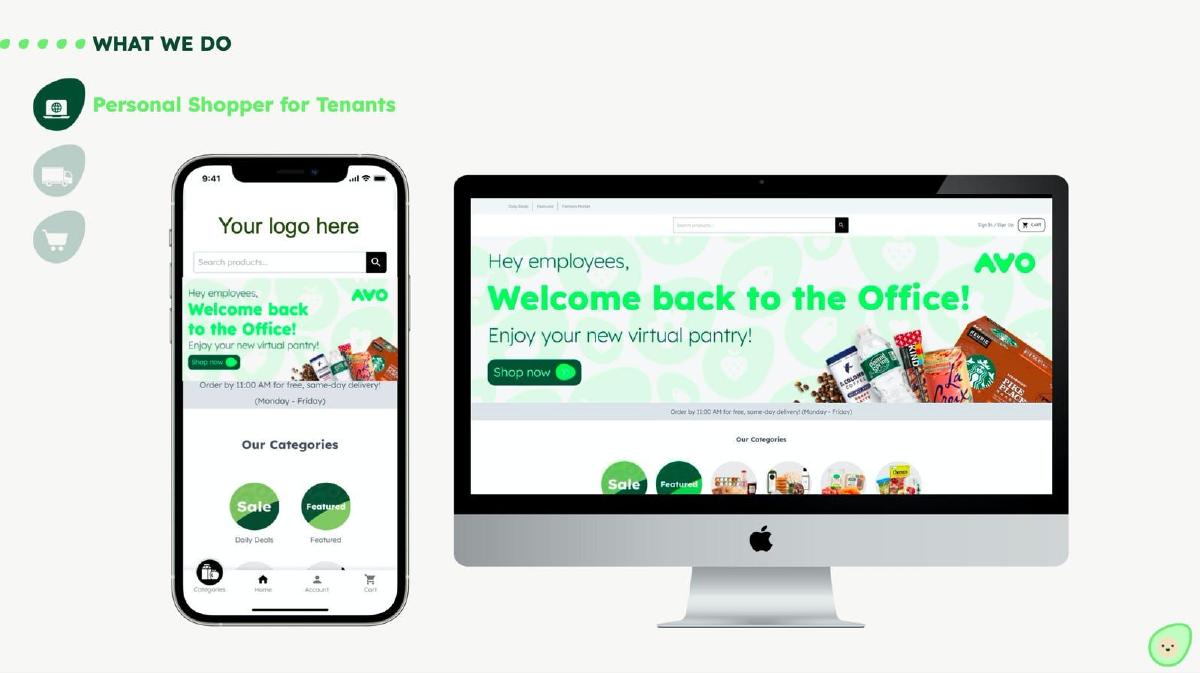
Slide 4 provides a screenshot of the Avo platform on a laptop. The interface is clean and resembles a standard e-commerce site. It lists 'Best Sellers' including a 'Navel Orange' for $0.80, a 'Diet Coke 12 Pack' for $6.99, and 'Boland Spring' water. The categories at the top—Grocery, Perishables, Beverages, Wine, Spirits & Beer, Household, Beauty, and Baby—show the breadth of their SKU count. This slide proves the technology is mature and the inventory is comprehensive enough to replace a trip to a physical grocery store.
Slide 5: The Partner Value Proposition
Slide 5 pivots to the B2B side of the marketplace, titled 'Why Partners Think We’re Awesome.' It uses three illustrated avocados to highlight key benefits: Attract and Retain (giving residents a reason to choose a specific building), Boost Experience (free delivery and virtual events), and Measure Impact . The mention of 'monthly activity reporting' is crucial. It tells property managers that Avo isn't just a vendor; they are a data partner that helps the manager justify their own performance to building owners.
Slide 6: Social Proof - Extell
Slide 6 features a full-bleed image of One Manhattan Square, a luxury skyscraper. The testimonial comes from Rebeca Park, Director of Lifestyle Services at Extell. She describes the partnership with Avo as 'exclusive' and 'seamless.' For an investor, seeing a name like Extell—one of the most prominent developers in New York—provides massive de-risking. It proves that Avo can navigate the complex legal and operational requirements of high-end real estate.
Slide 7: Social Proof - FirstService Realty
Slide 7 follows a similar format, featuring Galaxy Towers and a quote from William Flemm, General Manager at FirstService Realty NYC. Flemm notes that Avo delivered 'well beyond our expectations' during a 'critical time of need.' This is a subtle nod to the COVID-19 pandemic, during which Avo likely became an essential service for buildings looking to minimize outside traffic while ensuring residents had access to goods. This reinforces the 'essential' nature of the service.
Slides 8-14: The Missing Context
While the provided text and images cover the first seven slides, the remaining seven slides (based on the 14-slide count) typically cover the 'Ask,' the 'Team,' and the 'Financials.' In a Series B deck, these would usually include a breakdown of the $45M raise, plans for geographic expansion beyond New York, and a deep dive into the unit economics—specifically how the B2B2C model lowers Customer Acquisition Cost (CAC) compared to traditional delivery apps.
What Avo Does Well
Avo excels at positioning . They are not competing with Amazon; they are competing with the lack of amenities in a residential building. By framing their service as 'Tenant Experience,' they tap into the budgets of property managers who are desperate to differentiate their buildings in a crowded market. The use of high-quality photography of iconic New York buildings (Slides 6 and 7) creates an aura of prestige and established success.
The density map on Slide 2 is the most important slide for a logistics investor. It shows that Avo isn't just 'testing'—they have achieved a level of saturation that allows for efficient routing and high drop-off density, which is the only way to make thin-margin delivery work at scale.
What is Missing from the Deck
The most glaring omission in the provided materials is a Team Slide . At the Series B level, investors are betting heavily on the leadership's ability to scale operations across multiple cities. Without seeing the backgrounds of the founders or the operational leads, it is hard to judge the execution risk.
Furthermore, there is no Competition Slide . The delivery space is notoriously crowded. Avo needs to explicitly state why their B2B2C model is superior to the 'dark store' models of companies like Getir or Gopuff, or the platform models of Instacart. While the 'amenity' angle is strong, a direct comparison of CAC and LTV (Lifetime Value) would make the case even more compelling.
Lessons for Founders
Target the Gatekeeper: If you are in a crowded consumer market, find a B2B partner who controls the audience. Avo’s partnership with property managers gives them a 'moat' that standard delivery apps lack. · Use Social Proof Early: Don't just list logos. Use full-page testimonials from high-ranking executives at recognizable companies. It builds immediate trust. · Visualize Your Traction: A map with pins is far more evocative than a bar chart of 'active users.' It shows the physical reality of your business footprint. · Focus on 'Delight': Even if you are a logistics company, your pitch deck should feel like a consumer brand. Avo’s use of the avocado mascot and soft colors makes a complex operational business feel approachable and friendly. · Quantify the Partner Benefit: Slide 5 shows that Avo understands their B2B partner's pain points (retention and reporting). Always show how you make your partner look good to their own bosses.
Frequently asked questions
- What is Avo's primary business model?
- Avo operates a B2B2C model. Instead of marketing directly to consumers like DoorDash or Instacart, they partner with property managers of residential buildings and employers at commercial sites. This allows them to offer delivery services as an exclusive building amenity, reducing customer acquisition costs and streamlining delivery logistics to single drop-off points.
- What specific products does Avo deliver?
- According to Slide 3 and Slide 4, Avo delivers a wide range of goods through their 'Virtual Pantry.' This includes grocery staples, produce, beverages, household items, and even office or janitorial supplies. The platform also facilitates 'Tenant Gifting' and virtual events to drive engagement within the buildings they serve.
- How does Avo prove its market traction in the deck?
- Avo uses a geographic density map of New York City on Slide 2, claiming to serve 'thousands of commercial and residential buildings.' They further validate this traction with high-profile testimonials from real estate giants like Extell (One Manhattan Square) and FirstService Realty (Galaxy Towers) on Slides 6 and 7.
- What is the 'Virtual Pantry' mentioned in the slides?
- The Virtual Pantry is Avo's custom-branded online marketplace. Slide 4 shows a user interface featuring items like oranges, energy bars, and 12-packs of soda. It is designed to be a one-stop shop for residents and employees to order daily essentials without delivery fees, integrated into their building or workplace experience.
- Does the deck include financial projections or unit economics?
- The provided 14-slide sequence focuses primarily on the value proposition, product interface, and social proof. It does not include specific revenue figures, burn rates, or detailed unit economics. For a Series B round of $45M, these details were likely handled in a separate data room or supplemental financial appendix.