Avantgarde Finance used this 23-slide deck to secure $5.5M in Series A funding in 2021. The company positions itself as the 'cement' for decentralized finance (DeFi), providing the professional services and infrastructure layer on top of the Enzyme protocol (formerly Melon). The deck is notable for its heavy emphasis on the founder's institutional pedigree—Mona El Isa spent nearly a decade at Goldman Sachs—and its clear articulation of the 'virtuous cycle' between protocol development and professional services. While it lacks traditional financial projections or a specific use-of-funds slide,…
Key takeaways
- The company positions itself as a DeFi SaaS provider sitting atop the Enzyme protocol (Slide 2).
- The deck identifies four core problems in DeFi: difficulty knowing where to start, costly infrastructure maintenance, lack of customer support, and non-existent professional tooling (Slide 9).
- Avantgarde claims its solution outpaces Ethereum's growth by 398% and dHedge by 521% (Slide 19).
- The competitive landscape slide highlights a significant cost advantage, claiming a $5 setup cost compared to $1,000 for competitors like Set Protocol (Slide 18).
- Founder Mona El Isa's background is a central pillar of the pitch, citing her decade at Goldman Sachs and experience managing a $30M AUM fund (Slide 22).
- The deck introduces C11Y, described as the first institutional-grade fund of funds in the decentralized asset management space (Slide 13).
- The business model is framed as non-cyclical, scalable SaaS-based revenue (Slide 8).
- The deck completely omits a specific 'Ask' slide detailing the amount being raised or the intended use of funds.
The DeFi Stack: A Professional Layer for Decentralized Assets
Avantgarde Finance's Series A deck is a masterclass in positioning a technical crypto project for institutional venture capital. In 2021, the DeFi space was characterized by high volatility and 'cowboy' builders. Avantgarde took the opposite approach, emphasizing compliance, institutional pedigree, and a structured 'stack' that makes sense to traditional finance professionals. By framing their work as 'DeFi SaaS,' they moved the conversation away from speculative tokenomics and toward sustainable software revenue.
Slide 1-3: Defining the Stack
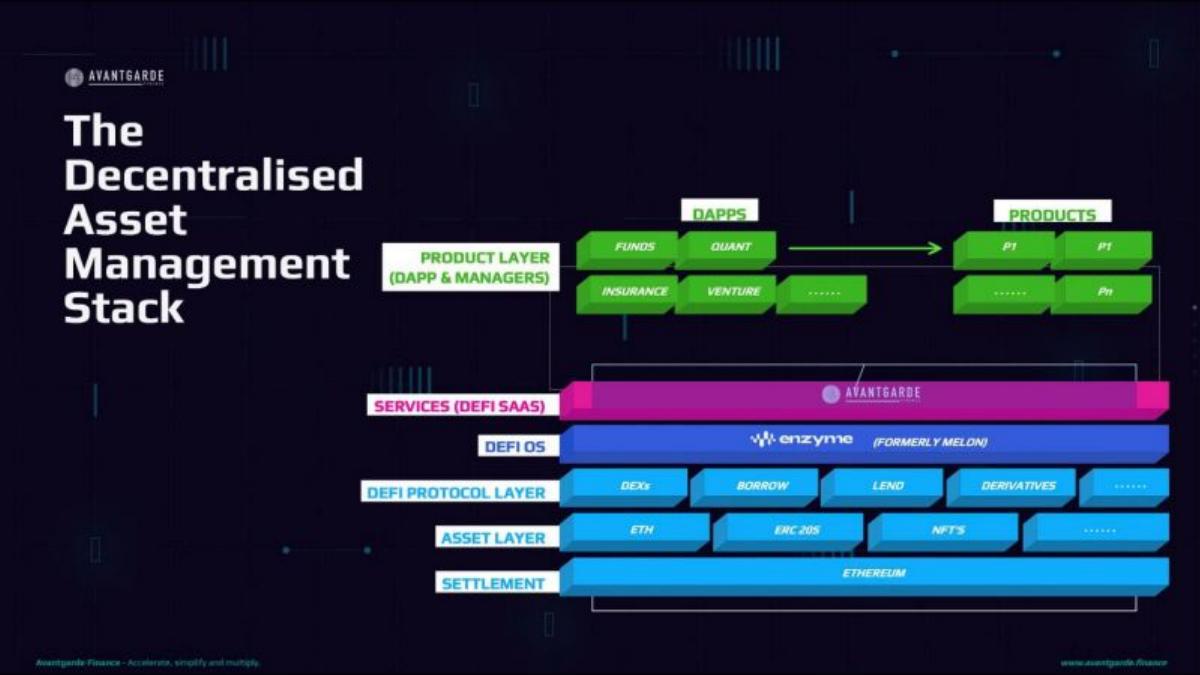
The deck opens with a bold claim: "The World's First Open Source As a Service Proposition for DeFi." This immediately signals that Avantgarde is not just another protocol, but a service layer. Slide 2 is perhaps the most important in the deck, visualizing the "Decentralized Asset Management Stack." It places Ethereum at the bottom (Settlement), followed by Assets (ETH, ERC-20s), Protocols (DEXs, Lending), and the DeFi OS (Enzyme). Avantgarde sits at the very top as the "Services (DeFi SaaS)" layer. This clarifies their role as the bridge between complex protocols and end-user products like funds and venture vehicles.
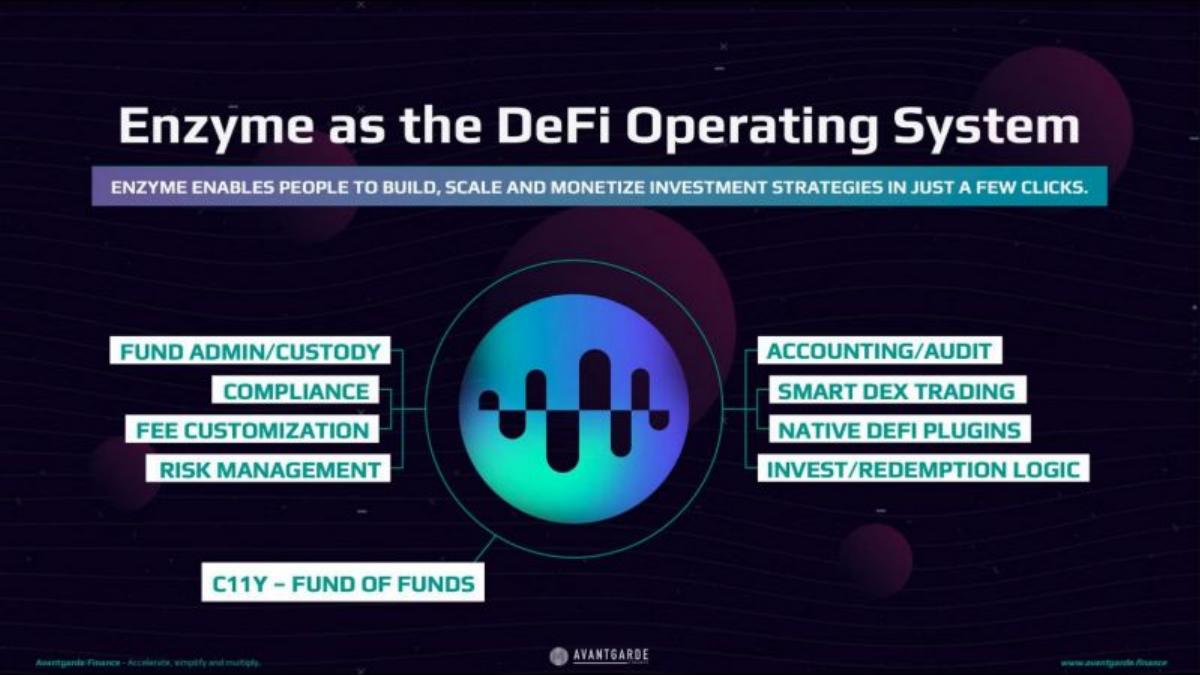
Slide 3 reinforces this by defining Enzyme as the "DeFi Operating System." It lists core functionalities such as Fund Admin/Custody, Compliance, and Risk Management. By using these specific terms, Avantgarde speaks the language of the asset managers they hope to attract as customers.
Slide 4-6: Complexity to Simplicity
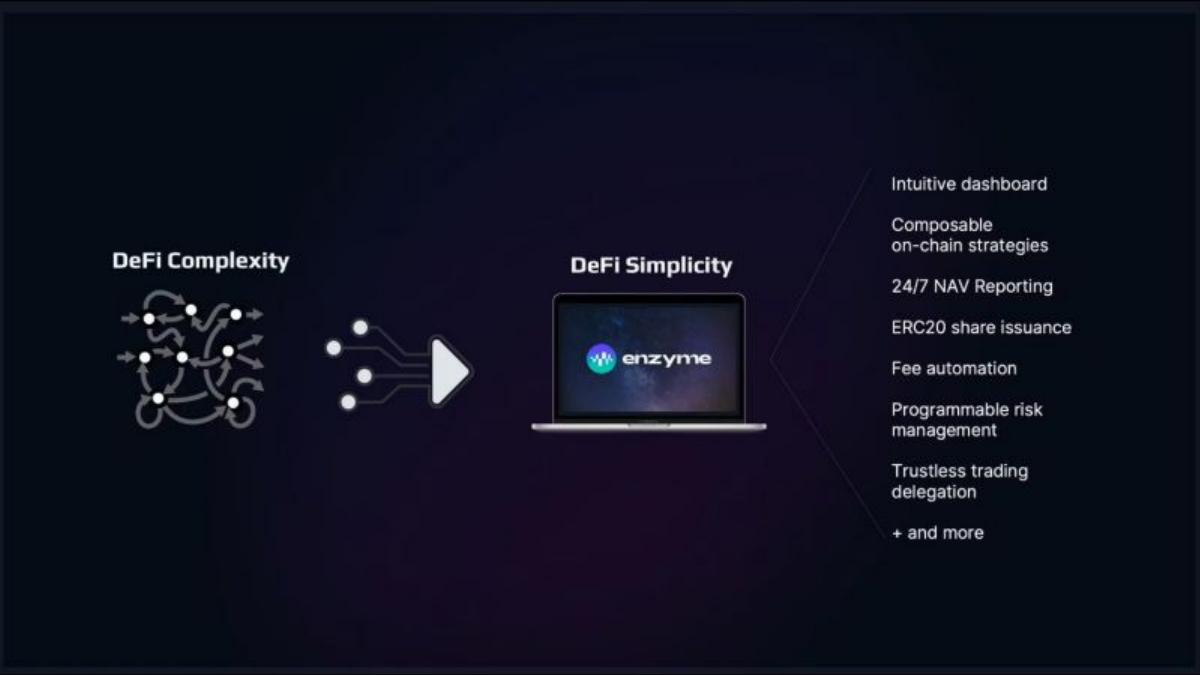
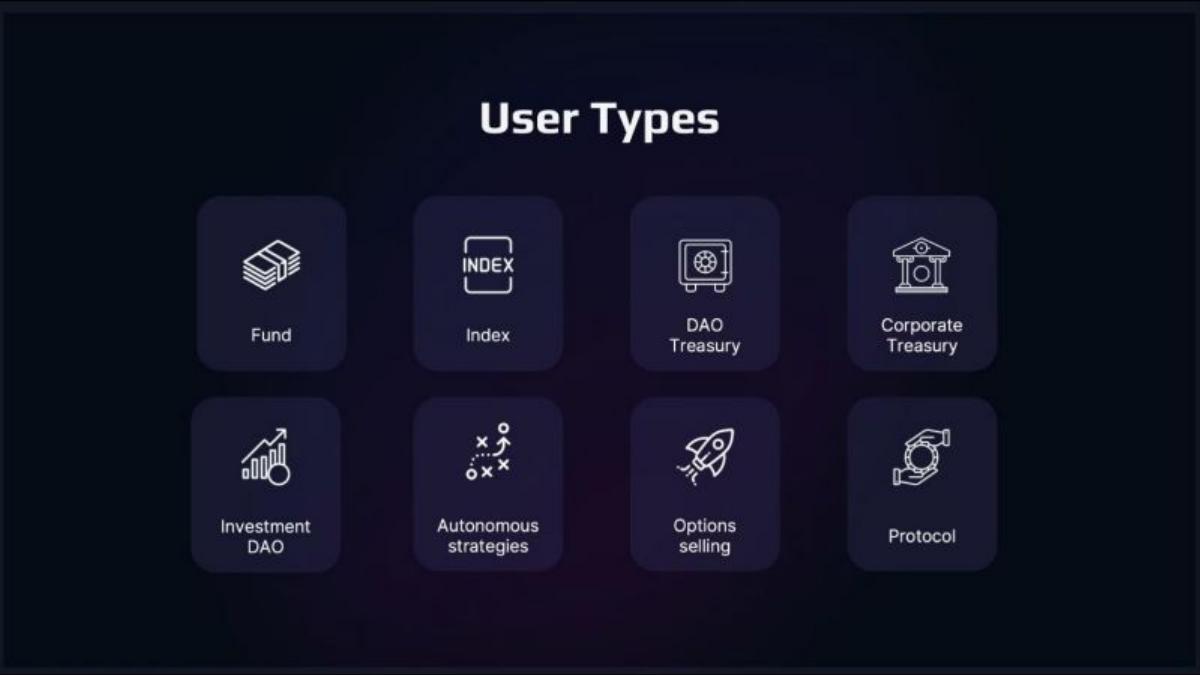
Slide 4 uses a classic 'before and after' visual. On the left, a tangled web represents "DeFi Complexity." On the right, a clean laptop interface represents "DeFi Simplicity." The slide lists features like "24/7 NAV Reporting" and "Trustless trading delegation," which are critical pain points for professional managers. Slide 5 expands the market by listing eight user types, ranging from DAO Treasuries to Corporate Treasuries, showing that their utility isn't limited to crypto-native hedge funds.
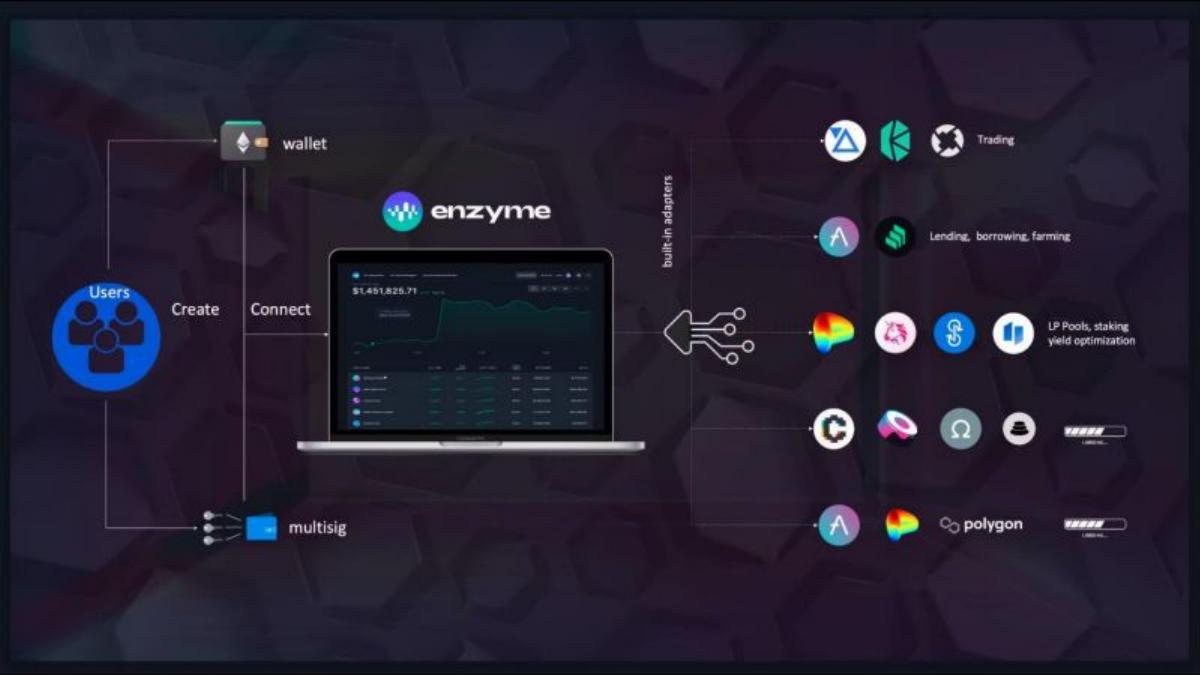
Slide 6 provides a technical architecture overview. It shows how users connect via wallets or multisig to the Enzyme platform, which then connects to a variety of "built-in adapters" for trading (Uniswap, Kyber), lending (Aave, Compound), and yield optimization (Curve, Yearn). This visualizes the 'composability' of DeFi in a way that looks like a standard enterprise software integration map.
Slide 7-10: The Value Proposition and Problem Statement
Slide 7 uses a metaphor: "From DeFi Building Bricks to DeFi Monuments." It positions DeFi as the bricks, Enzyme as the organizer, and Avantgarde as the "cement" that builds professional products. This is a strong branding move that justifies the existence of a separate company (Avantgarde) alongside a decentralized protocol (Enzyme).
Slide 8 introduces the "Path to $1tn" for decentralized asset management. While the graph is purely conceptual and lacks a Y-axis for time, it contains a key piece of messaging: "Avantgarde equity gives you non-cyclical, scalable SaaS based revenue." This is a direct appeal to VCs who might be wary of the boom-and-bust cycles of crypto tokens. Slide 9 explicitly lists the problems they solve, notably the lack of customer support and professional tooling in the current DeFi landscape.
Slide 11-14: Product and Market Strategy
Slide 11 shows a high-fidelity mockup of the "DeFi SaaS" dashboard, including a vault view with AUM ($525,000.25) and monthly returns (12%). Slide 12 bifurcates the treasury management product for DAOs versus traditional companies, highlighting "10X traditional bank yields" for the latter. Slide 13 introduces C11Y, an institutional-grade fund of funds, which serves as a proof-of-concept for the entire ecosystem.
Slide 14 and Slide 15 detail the "Market Strategy" and "Virtuous Cycle." The strategy is to incubate, launch, and scale products (like Exponent and Unslashed) to drive traffic and AUM. The virtuous cycle explains how superior functionality leads to higher-performing strategies, which attracts more users, creating a feedback loop of growth and security.
Slide 16-19: Competition and Traction
The competitive analysis on Slide 18 is aggressive. It compares "Enzyme + Avantgarde" against Set Protocol and dHedge. The most striking figure is the "Cost to set up," where Avantgarde claims a $5 price point compared to $1,000 for both competitors. They also claim a significantly larger "Asset universe" of 200+ tokens. Slide 19 presents the traction data, showing that Enzyme is "out-pacing ETH growth by 398%" and outperforming competitors by similar margins since the release of Enzyme V2. A key note on this slide points out that Enzyme achieved this "without a liquidity mining rewards program," suggesting organic demand rather than subsidized growth.
Slide 20-22: The Team and Social Proof
Slide 20 provides testimonials from industry figures like Raul Pal (Real Vision) and Fran Stranjar (Techemy Capital), lending significant credibility to the project. Slide 21 shows a team of 18 people, but the real weight is on Slide 22 , dedicated entirely to founder Mona El Isa. Her resume—Goldman Sachs, Jabre Capital, and a $30M AUM fund—is designed to reassure institutional investors that the company is led by someone who understands the rigors of traditional finance.
What Avantgarde Finance Does Well
The deck is exceptionally good at abstraction . DeFi is notoriously difficult to explain, but Avantgarde successfully frames it as a standard software stack. By using terms like "SaaS," "Operating System," and "Adapters," they make the technology accessible to generalist investors. Furthermore, the emphasis on the founder's institutional background is a strategic masterstroke; in a sector often criticized for lack of maturity, El Isa's Goldman Sachs pedigree is a powerful signal of 'adults in the room.'
What Is Missing from the Deck
Despite its polish, the deck has several notable omissions. First, there is no 'Ask' slide . We know from catalogue facts that they raised $5.5M, but the deck itself does not state the amount sought or how the funds will be allocated. Second, there are no financial projections . While they mention a SaaS revenue model, they don't provide any data on current MRR (Monthly Recurring Revenue) or projected growth. Finally, the unit economics of the $5 setup cost are not explained—is this a loss leader, or is the platform so efficient that this is profitable?
Founder's Playbook: Lessons to Copy
The Stack Visualization: If you are building in a complex ecosystem (Web3, AI, Biotech), use a slide like Slide 2 to show exactly where you sit in the value chain. It prevents investors from getting lost in the technical weeds. · Problem-Solution Alignment: Slide 9 and 10 are a perfect pair. List the industry's biggest 'unspoken' problems (like lack of support in crypto) and then show exactly how you address each one. · Pedigree as a Moat: If your team has 'blue chip' experience, don't bury it on a group slide. Give your lead founder a dedicated page that highlights their most relevant institutional achievements. · Conceptual Growth Charts: While you should always aim for real data, Slide 8 shows how a conceptual 'Path to $X' chart can be used to communicate a long-term vision and business model (non-cyclical SaaS) even when specific dates are hard to predict.
Frequently asked questions
- What is the relationship between Avantgarde Finance and Enzyme?
- As shown on Slide 2 and Slide 22, Avantgarde Finance is the core development team behind Enzyme (formerly known as Melon). The deck positions Enzyme as the 'DeFi Operating System' (the infrastructure layer) and Avantgarde as the 'Services' layer that provides the professional SaaS tools, compliance, and support necessary for institutional adoption.
- How does Avantgarde Finance plan to make money?
- According to Slide 8 and Slide 11, the company utilizes a SaaS-based revenue model. They provide a 'full compliance suite,' 'tax and investor reporting tools,' and 'data & analytics' to asset managers. Slide 14 further explains a strategy to 'earn free call options' on the success of initial adopters by driving traffic and AUM through their ecosystem.
- Who are the primary target users for this platform?
- Slide 5 identifies eight specific user types: traditional Funds, Index providers, DAO Treasuries, Corporate Treasuries, Investment DAOs, Autonomous strategies, Options selling, and other Protocols. Slide 12 specifically breaks down the value proposition for DAOs (active growth engines) versus Companies (10x traditional bank yields with compliance).
- What competitive advantages does the deck highlight?
- Slide 18 lists several key differentiators, including a massive 'Asset universe' of 200+ tokens, Layer 2 integration, and a setup cost of just $5. They contrast this against competitors like Set Protocol and dHedge, which the deck claims have higher setup costs ($1,000) and more limited asset universes or management capabilities.
- Is there a clear exit strategy or financial forecast in the deck?
- No. The deck focuses on the 'Path to $1tn' in total decentralized AUM (Slide 8) and current growth metrics (Slide 19), but it does not include specific revenue projections, a balance sheet, or an explicit exit strategy. It relies on the macro growth of the DeFi sector to imply the scale of the opportunity.