Pecan AI’s pitch deck is a masterclass in functional simplicity, focusing heavily on the 'how' and 'who' of their low-code predictive analytics platform. By positioning their product as an 'AI bridge' between business owners and analysts, they address the talent scarcity in data science. The deck, dated February 2021, successfully raised significant capital by demonstrating clear use cases—such as a 37% revenue uplift for a mobile app company—and a robust technical moat including automated feature engineering. While the deck lacks a formal 'Ask' slide or detailed market sizing, its technical…
Key takeaways
- The core value proposition is 'Predictive analytics without data scientists,' directly addressing the scarcity of domain-expert data scientists (Slide 1, 2).
- Pecan positions itself as a low-code 'AI bridge' that allows BI analysts to build and deploy models (Slide 3).
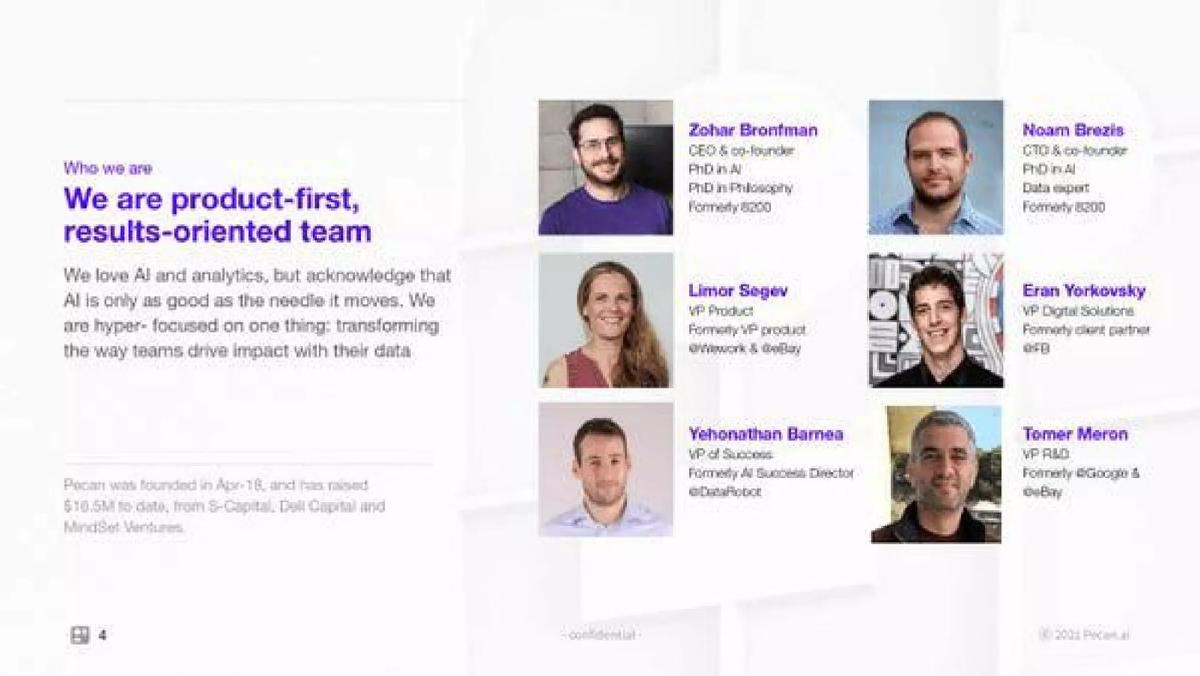
- The team is anchored by two PhDs in AI and former members of the 8200 unit, signaling deep technical credibility (Slide 4).
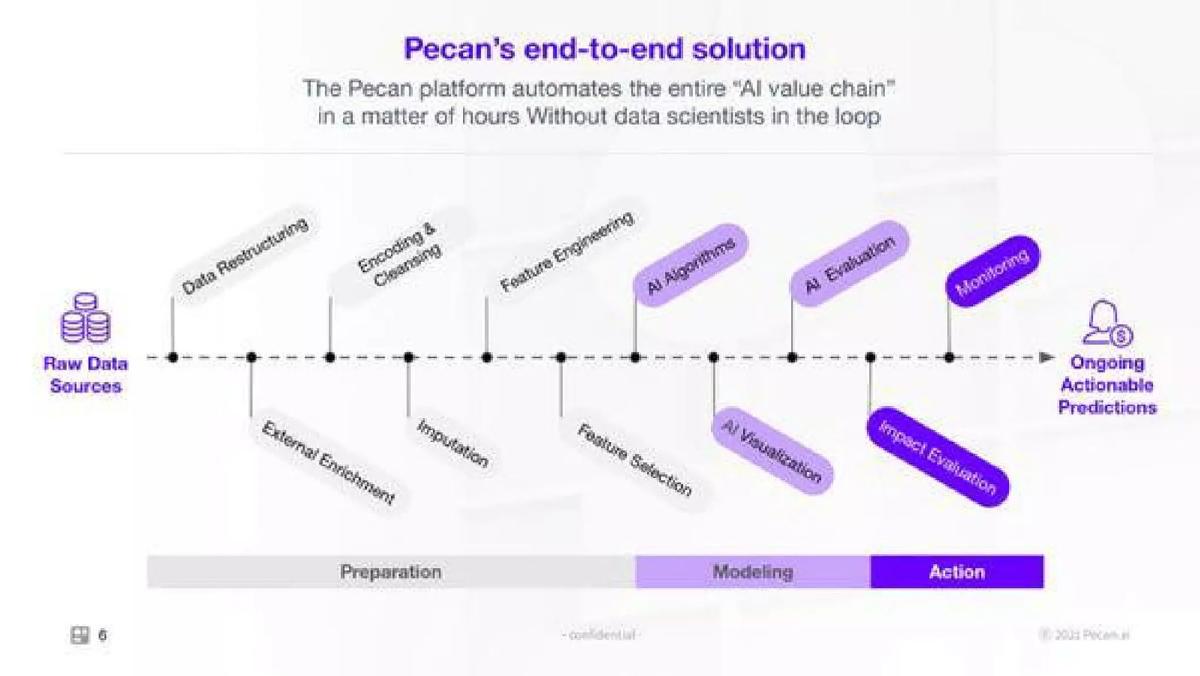
- The platform automates the entire 'AI value chain,' including data restructuring, encoding, and feature engineering (Slide 6).
- Technical moats are defined by three pillars: Drag & Drop-to-AI, automated data prep, and continuous model retraining (Slide 7).
- The business model relies on a subscription per use case and per entity, with expansion through increased usage (Slide 8).
- Case studies demonstrate specific ROI, such as a 91% increase in purchases for a mobile app company (Slide 9).
- Retailer impact is quantified as a 35% boost in sales conversion and a 20% increase in rep productivity (Slide 10).
Pecan AI: The Low-Code Predictive Analytics Playbook
Pecan AI’s pitch deck, dated February 2021, represents a specific moment in the evolution of enterprise AI. At only 11 slides, it is remarkably lean for a company that has raised a total of $116,000,000 according to catalogue data. The deck focuses almost exclusively on the product's ability to bridge the gap between business needs and technical execution. By targeting the 'BI Analyst' rather than the 'Data Scientist,' Pecan carves out a unique space in the crowded analytics market.
The Problem and the 'AI Bridge'
Slide 1: Title The deck opens with a clear, punchy subtitle: "Predictive analytics without data scientists." This immediately identifies the target audience and the primary pain point.
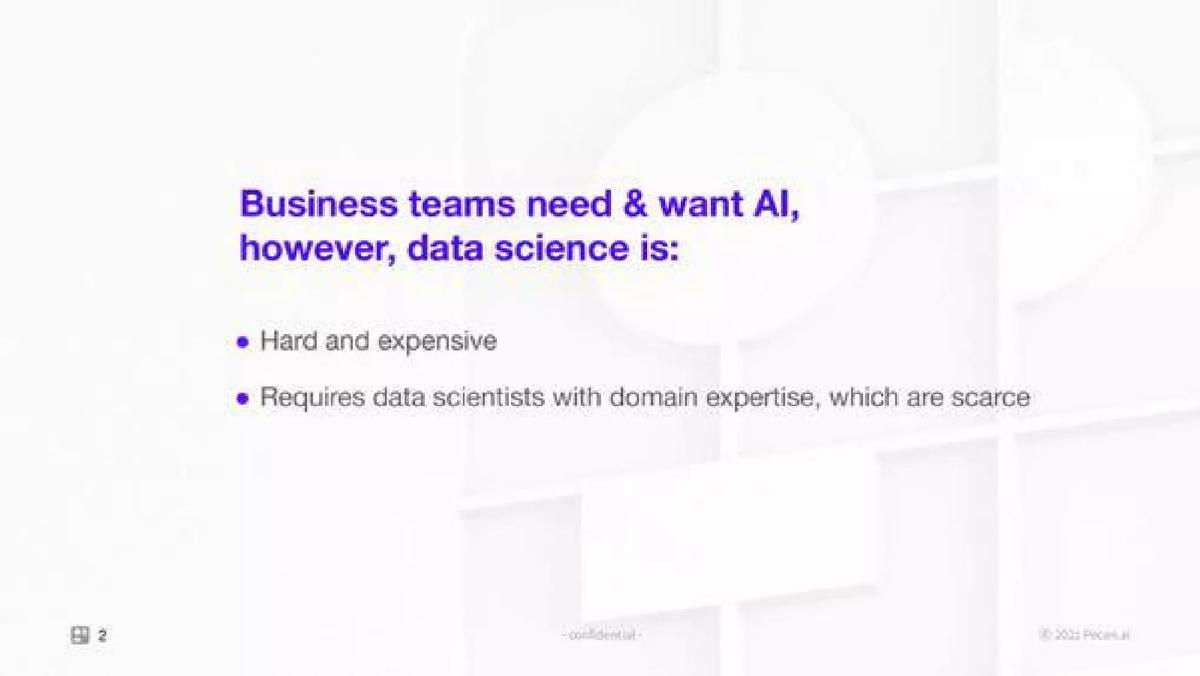
Slide 2: The Problem The problem is framed simply. Business teams want AI, but data science is "Hard and expensive" and requires "scarce" experts with domain knowledge. This slide sets the stage for a tool that democratizes access to complex modeling.
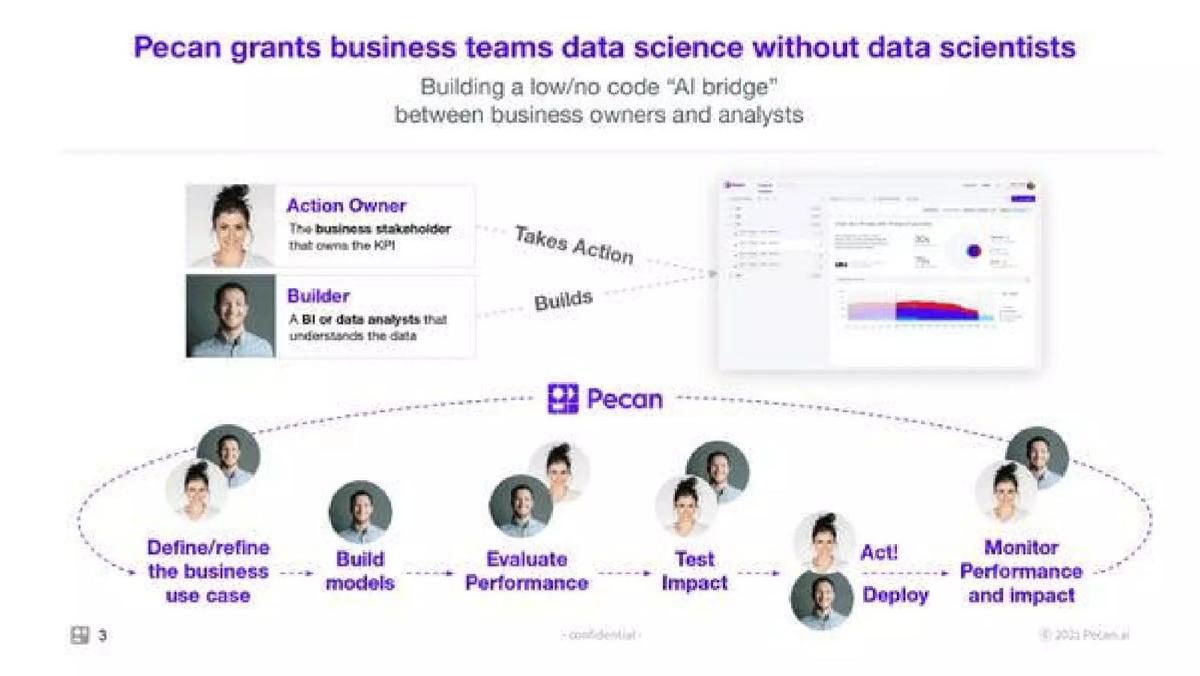
Slide 3: The Solution Pecan introduces the concept of an "AI bridge." It visualizes two personas: the Action Owner (business stakeholder) and the Builder (BI analyst). The slide maps out a six-step workflow from defining the use case to monitoring impact, all happening within the Pecan environment. This is a crucial slide because it explains the operational reality of using the software.
Team and Technical Foundation
Slide 4: The Team Pecan highlights a "product-first, results-oriented team." The founders, Zohar Bronfman (CEO) and Noam Brezis (CTO), both hold PhDs in AI and are alumni of the elite 8200 unit. The slide also notes that the company was founded in April 2018 and had raised $16.5M to date from investors including S-Capital, Dell Capital, and Mindset Ventures at the time this deck was produced.
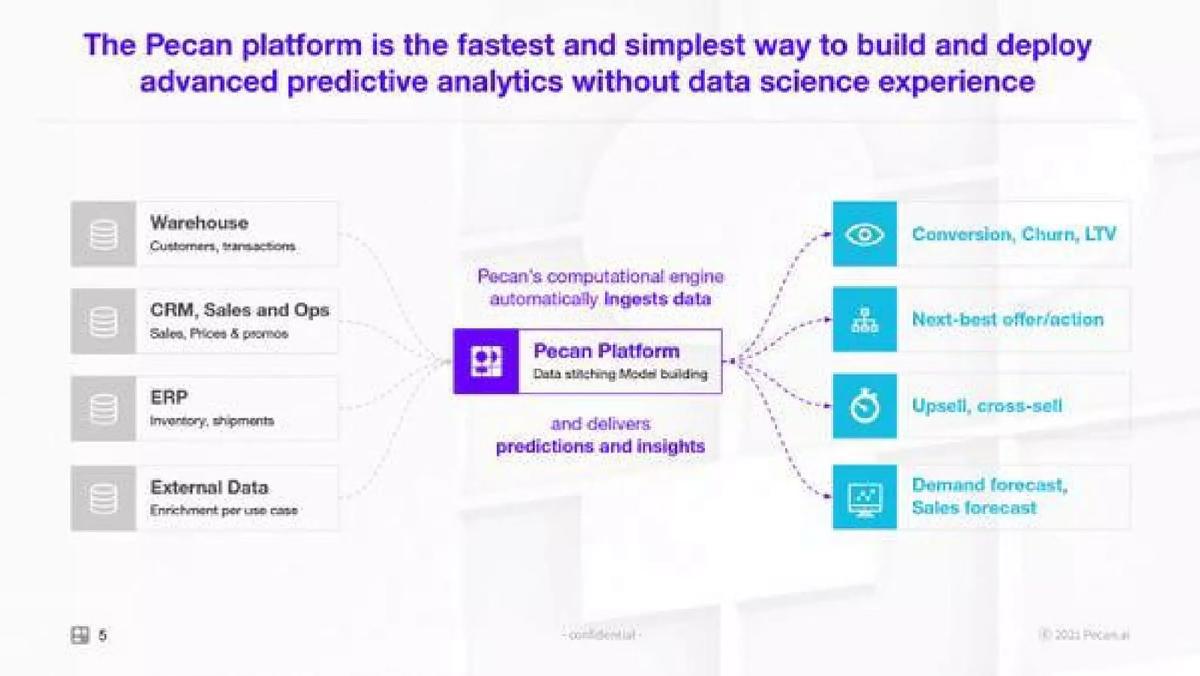
Slide 5: Platform Overview This slide serves as a high-level architecture diagram. It shows data flowing from Warehouses, CRM, ERP, and External sources into the Pecan Platform for "Data stitching" and "Model building." The output is categorized into four buckets: Conversion/Churn/LTV, Next-best offer, Upsell/Cross-sell, and Demand/Sales forecasting.
Slide 6: The AI Value Chain This is the most technical slide in the deck. It breaks down the "AI value chain" into three phases: Preparation, Modeling, and Action. It lists specific automated tasks like Data Restructuring, Imputation, Feature Engineering, and Impact Evaluation. The claim is that this entire chain is automated "in a matter of hours."
Moats and Monetization
Slide 7: 3 Key Tech Moats Pecan explicitly labels its competitive advantages. These include Drag & Drop-to-AI (allowing SQL-only builds), automated feature engineering, and continuous model retraining. A "Patent Pending" seal is prominently displayed at the bottom, reinforcing the idea of proprietary intellectual property.
Slide 8: Business Model The pricing strategy is straightforward: a subscription based on the number of use cases and entities. Growth is driven by "Upsell from customer growth" and the addition of new use cases. This suggests a land-and-expand strategy common in enterprise SaaS.
Proof of Concept: Case Studies
Slide 9: Case Study - Mobile App Pecan uses a "Challenge, Solution, Impact" framework. For a mobile app company, they moved from "BI-based segmentation" to "Scalable AI capabilities." The results are quantified: a 37% uplift in revenue per user and a 91% increase in purchases. The timeline for this transformation is noted as "10 Days."
Slide 10: Case Study - Retailer The second case study focuses on a retailer moving from "Manually prepared spreadsheets" to "Fully integrated recommendations." The impact listed is a 35% increase in conversion and a 20% increase in sales rep productivity. These specific, high-digit percentages are designed to prove the platform's efficacy in diverse sectors.
Slide 11: Contact A simple thank you slide with the company website and a general info email address.
What Works in the Pecan AI Deck
The deck is exceptionally disciplined. It does not waste time on the history of AI or broad market trends that investors already understand. Instead, it focuses on the specific friction point of AI adoption: the human talent bottleneck. By explicitly naming the "BI Analyst" as the user, Pecan makes its market entry strategy very clear.
The use of specific ROI metrics in the case studies (Slides 9 and 10) is a major strength. Claiming a "37% uplift" or a "91% increase" provides concrete numbers for an investor's model. Furthermore, the technical breakdown on Slide 6 provides enough detail to satisfy a technical due diligence lead without overwhelming a generalist partner.
What is Missing from the Pecan AI Deck
Despite its success in raising capital, this deck leaves several standard questions unanswered. There is no Market Size (TAM) slide. While the problem is universal, the deck doesn't quantify how many companies have the specific data infrastructure required to plug into Pecan.
There is also a total absence of a Competitive Landscape . In 2021, the AutoML and predictive analytics space was already crowded with players like DataRobot, H2O.ai, and cloud-native tools from AWS and Google. Pecan relies on its "low-code" positioning to differentiate, but a direct comparison would have strengthened the case.
Finally, there is no Ask . We know from catalogue data that the company eventually raised $116M, but this specific deck does not state how much they were seeking in February 2021 or how they intended to allocate that capital (e.g., sales expansion vs. R&D).
What a Founder Should Copy
Founders should emulate the Persona-Based Solution on Slide 3. Many technical decks fail because they don't explain who actually sits in the chair and uses the software. Pecan’s "Action Owner" vs. "Builder" distinction is a perfect way to explain how a product fits into an existing corporate hierarchy.
The "From/To" visualization in the case studies is another excellent tactic. By showing the transition from "Rule-based offers" to "High resolution user-level personalization," Pecan makes the value of their technology tangible. It moves the conversation from "We have an algorithm" to "We change how you work."
Frequently asked questions
- What is the primary problem Pecan AI solves?
- Pecan AI addresses the bottleneck in enterprise AI adoption: the high cost and scarcity of data scientists with domain expertise. According to Slide 2, business teams want AI, but the traditional path is too expensive and difficult. Pecan solves this by providing a low-code platform that allows existing BI analysts to perform data science tasks.
- How does Pecan AI differentiate its technology?
- The deck identifies three 'key tech moats' on Slide 7. First is 'Drag & Drop-to-AI' technology using SQL. Second is automated data preparation and feature engineering, including cleansing and embedding. Third is automated deployment and monitoring with continuous database resampling and retraining, all performed without manual engineering.
- What kind of ROI can customers expect based on this deck?
- Pecan provides two detailed case studies. Slide 9 shows a mobile app company achieving a 37% uplift in revenue per user and a 91% increase in purchases. Slide 10 highlights a retailer that saw a 35% increase in sales conversion and a 20% improvement in sales representative productivity.
- Who is the target user for the Pecan platform?
- The platform is designed for two primary personas within a company, as shown on Slide 3. The 'Action Owner' is the business stakeholder who owns the KPI and takes action on insights. The 'Builder' is a BI or data analyst who understands the data and uses Pecan to build the models.
- What is missing from this pitch deck?
- This is a product and results-focused deck that omits several standard fundraising elements. There is no market sizing (TAM/SAM/SOM), no competitive matrix, no financial roadmap or projections, and no slide detailing the specific 'Ask' or use of funds for the current round.