Feel Therapeutics presents a compelling case for 'Digital Precision Medicine for Mental Health' by addressing the lack of objective monitoring tools in psychiatry. The deck highlights a closed-loop system involving a remote monitoring wearable, proprietary algorithms, and a clinician dashboard. A standout feature of this presentation is the heavy emphasis on clinical validation, citing seven distinct publications or research areas, including an 87% precision rate in detecting mood state changes. The team slide is particularly strong, showcasing a mix of former industry CEOs, FDA directors, an…
Key takeaways
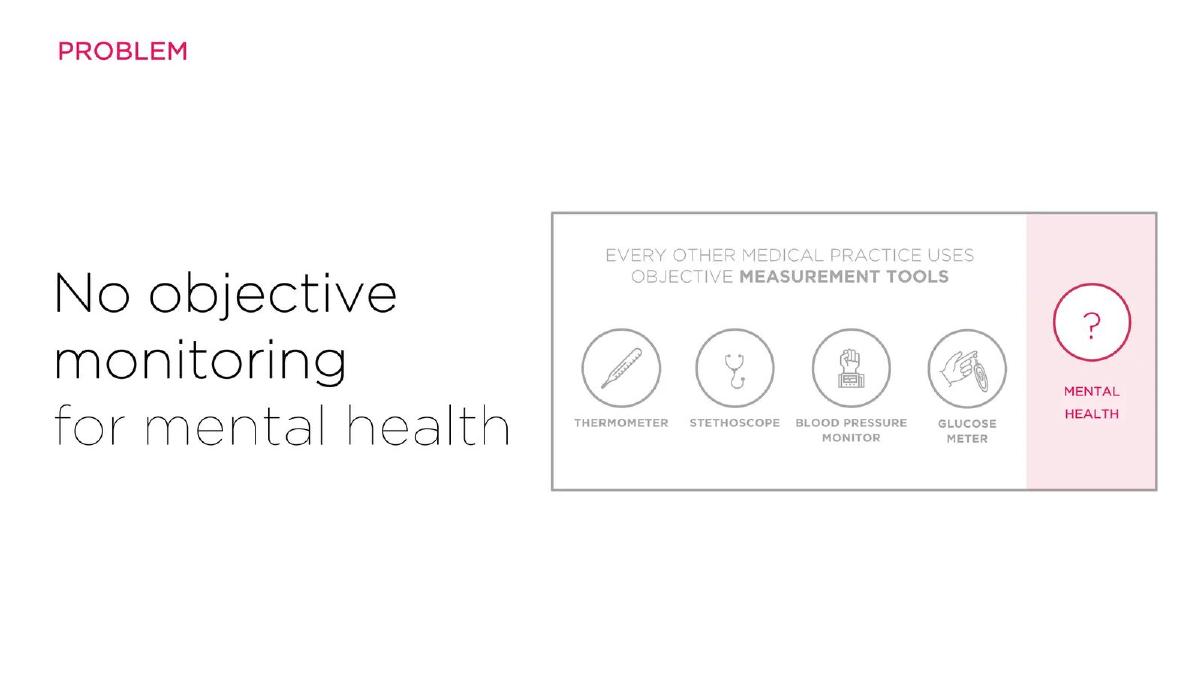
- The company positions itself as the provider of objective measurement tools for mental health, comparable to thermometers or glucose meters (Slide 2).
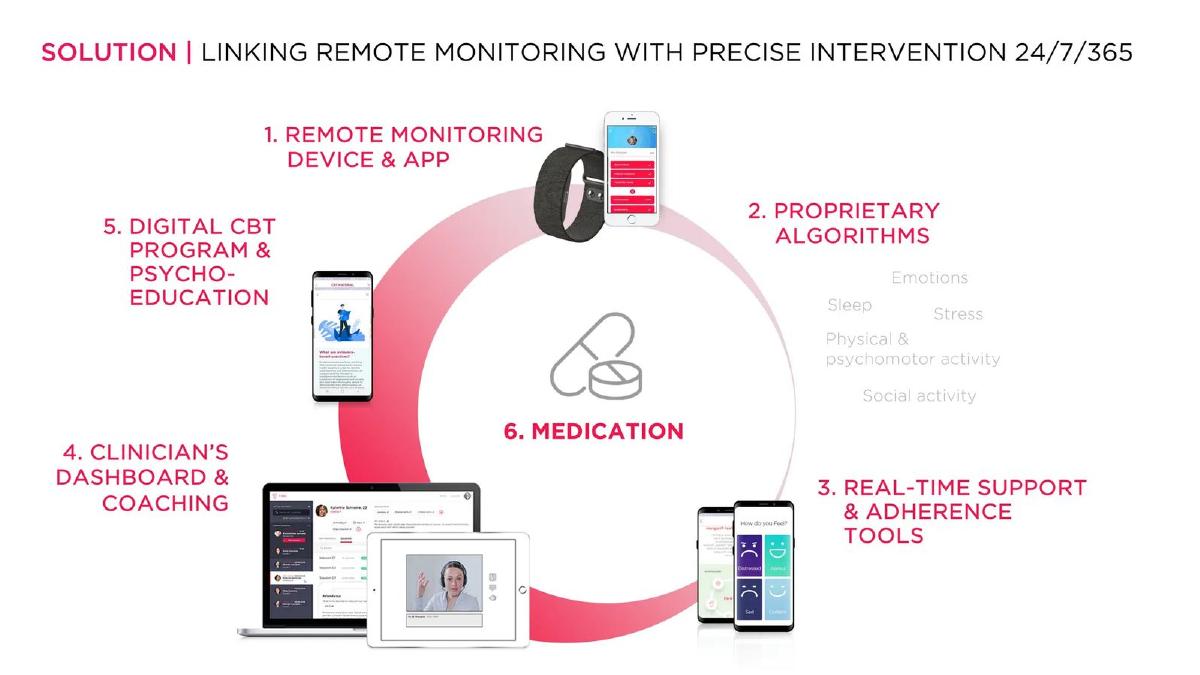
- The solution is a six-part ecosystem: wearable device, algorithms, real-time support, clinician dashboard, digital CBT, and medication (Slide 3).
- Feel Therapeutics claims 87% precision in detecting changes in the mood state of patients in psychiatry (Slide 4).
- Clinical validation is a core pillar, with 800+ team member publications and 16,000+ citations mentioned (Slide 5).
- The leadership team includes a former McKinsey consultant and a PhD in Biomedical Engineering (Slide 5).
- The company discloses a core gross monthly burn rate of $180k (Slide 5).
- Existing investors include Felicis, Satori Capital, SOSV, and Anthemis, with participation in JLABS (Slide 5).
- The deck lacks a traditional market size (TAM/SAM/SOM) slide and a specific 'Ask' slide detailing the use of funds (Omitted).
Introduction: The Quest for Objective Mental Health Data
Feel Therapeutics positions itself at the intersection of wearable technology and psychiatry. The core thesis of the deck, as established on the cover slide, is 'Digital Precision Medicine for Mental Health.' In a field historically reliant on subjective self-reporting, Feel Therapeutics attempts to build a narrative around hard data and clinical validation.
Slide 1: Title Slide
The title slide is minimalist, featuring the company logo and the tagline 'DECODING MENTAL HEALTH.' It explicitly defines the category as 'Digital Precision Medicine for Mental Health.' The visual branding uses a red and pink geometric pattern, establishing a professional yet modern aesthetic. The focus here is clearly on the 'precision' aspect of their medical approach.
Slide 2: The Problem - The Measurement Gap
Slide 2 identifies a specific gap in the healthcare market: 'No objective monitoring for mental health.' The slide uses a comparative visual to drive the point home. It shows icons for a thermometer, stethoscope, blood pressure monitor, and glucose meter, noting that 'Every other medical practice uses objective measurement tools.' A pink box with a question mark represents the current state of mental health, highlighting the absence of a comparable tool. This is a classic 'gap in the market' slide that justifies the existence of a new hardware/software category.
Slide 3: The Solution - A Closed-Loop Ecosystem
The solution slide, titled 'Linking Remote Monitoring with Precise Intervention 24/7/365,' outlines a six-step circular process. The components are: 1. Remote Monitoring Device & App (a wrist-worn wearable), 2. Proprietary Algorithms (tracking emotions, sleep, stress, activity), 3. Real-time Support & Adherence Tools , 4. Clinician's Dashboard & Coaching , 5. Digital CBT Program & Psycho-education , and 6. Medication . By including medication at the center of the loop, the company signals that it is not trying to replace traditional psychiatry but rather to augment it with better data and digital interventions.
Slide 4: Clinical Validation and Publications
This slide is the most data-dense part of the deck. It lists seven distinct areas of research and publication. Notable claims include:
'87% precision in detecting changes in the mood state of patients in psychiatry.' · 'Psychophysiological index for Stress strongly correlates with changes in Cortisol levels.' · 'Precision DTx delivers superior improvement in outcomes in depression and/or anxiety.' · Pending publications regarding 'Digital Biomarker for Detection of ADHD.'
The inclusion of 'Read Publication' links (though not clickable in a static image) suggests a high level of transparency and a commitment to the scientific method, which is critical for a company operating in the regulated medical space.
Slide 5: The Team and Institutional Backing
The team slide is structured to project authority. It is divided into 'Leadership Team,' 'Industry Experts,' and 'Psychiatry Experts.' The leadership includes George Eleftheriou (CEO, ex-McKinsey) and Haris Tsirbas (CTO, PhD). The 'Industry Experts' section is particularly strong, featuring Michel Vounatsos (Former CEO of Biogen) and Stayce Beck (Former Director at the FDA). The 'Psychiatry Experts' include professors from Harvard, UC Davis, and UCSF. On the right side, the slide lists impressive operational stats: 31 team members, 9 post-docs, and a monthly burn of $180k. It also lists their investors, including Felicis, Satori Capital, SOSV, and Anthemis, and notes their status as a JLABS company.
Slide 6: Contact Information
The final slide provides the contact details for CEO George Eleftheriou, including a San Francisco address, phone number, and email. The background continues the geometric pattern from the cover, maintaining brand consistency.
What Works in the Feel Therapeutics Deck
Clinical Credibility: In the 'Digital Health' space, many companies struggle to prove their tech actually works. Feel Therapeutics addresses this head-on with Slide 4. By citing specific precision percentages (87%) and correlations with biological markers like cortisol, they move beyond marketing fluff into scientific claims. High-Pedigree Team: The team slide is a masterclass in building trust. Having a former Biogen CEO and a former FDA director as 'Industry Experts' provides massive regulatory and commercial validation. The inclusion of 9 post-docs and 4 psychiatry professors suggests the company is built on a foundation of deep research rather than just software engineering. Clear Problem/Solution Fit: The comparison to thermometers and glucose meters on Slide 2 is an effective way to explain a complex medical need to a generalist investor. It makes the 'why now' and 'why this' immediately obvious.
What is Missing from the Feel Therapeutics Deck
Market Sizing: There is no mention of the Total Addressable Market (TAM). While the mental health crisis is well-documented, investors typically want to see how the company translates that crisis into a specific dollar-value opportunity. Business Model and Unit Economics: The deck does not explain how the company makes money. Is it a B2B play selling to insurers (payers), a B2B2C play through employers, or a direct-to-consumer subscription? Without a business model slide, the path to revenue is unclear. Competitive Landscape: The deck does not mention competitors. Given the crowded nature of the mental health tech space (e.g., Calm, Headspace, Ginger, or other wearable companies like Oura or Whoop), failing to differentiate from these players is a significant omission. The Ask: While the source listing mentions a $3.5M Seed round, the slides themselves do not contain a formal 'Ask' or a breakdown of how the funds will be used. A slide detailing milestones to be achieved with the new capital is standard for a seed deck.
Founder Takeaways: What to Copy
Use Analogies for Complex Problems: If you are building in a niche or highly technical field, use the 'Slide 2 approach.' Compare your product to a universally understood tool (like a thermometer) to instantly communicate your value proposition. Quantify Your Team's Expertise: Don't just list names and titles. Feel Therapeutics quantified their team's impact by listing '800+ Team Member Publications' and '16,000+ Citations.' This provides a scale of expertise that a simple bio cannot convey. Lead with Validation: If you have clinical data or pilot results, make them a centerpiece of the deck. The 'Publications' slide acts as a 'Traction' slide for a pre-revenue or early-stage medical company, proving that the underlying technology is sound before asking for money to scale it.
Frequently asked questions
- What is the primary problem Feel Therapeutics is solving?
- According to Slide 2, the primary problem is the lack of objective monitoring for mental health. The deck argues that while every other medical practice uses objective measurement tools—such as thermometers for fever or glucose meters for diabetes—mental health lacks a similar standard for real-time, data-driven tracking.
- How does the Feel Therapeutics technology actually work?
- Slide 3 illustrates a closed-loop system. It begins with a remote monitoring wearable and app that feed data into proprietary algorithms. These algorithms track emotions, sleep, stress, physical activity, and social activity. The output is then used for real-time support, clinician dashboards, and digital CBT programs to inform treatment and medication adjustments.
- What clinical evidence does the company provide?
- Slide 4 lists seven specific research areas and publications. Key claims include superior improvement in outcomes for depression and anxiety, 87% precision in mood detection, and strong correlations between their psychophysiological index and cortisol levels. They also mention pending publications regarding ADHD detection using physiological signals from wearables.
- Who is behind Feel Therapeutics?
- The team is highly academic and industry-heavy. As shown on Slide 5, it is led by CEO George Eleftheriou (ex-McKinsey) and CTO Haris Tsirbas (PhD in Biomedical Engineering). The advisory and expert board includes the former CEO of Biogen, a former FDA director, and psychiatry professors from Harvard, UC Davis, and UCSF.
- What are the financial and operational metrics disclosed in the deck?
- Slide 5 provides a snapshot of the company's operations: they have 31 team members across the USA and Europe, a monthly burn rate of $180k, and a team that includes 9 post-docs and 4 professors of psychiatry. The slide also lists their venture capital backers, including Felicis and Anthemis.