Pearpop's Series A deck is a masterclass in using social proof and market timing to justify a $18M round. By framing the creator economy as an inefficient, manual market where 88% of creators earn less than $50,000 annually, Pearpop positions its 'Challenges' and 'Ovation' products as the necessary infrastructure for scalable, performance-based marketing. The deck relies heavily on high-tier brand logos—including Apple, Amazon, and Netflix—and a leadership team with deep roots in entertainment and big tech. While it lacks traditional financial projections and detailed unit economics, it compe…
Key takeaways
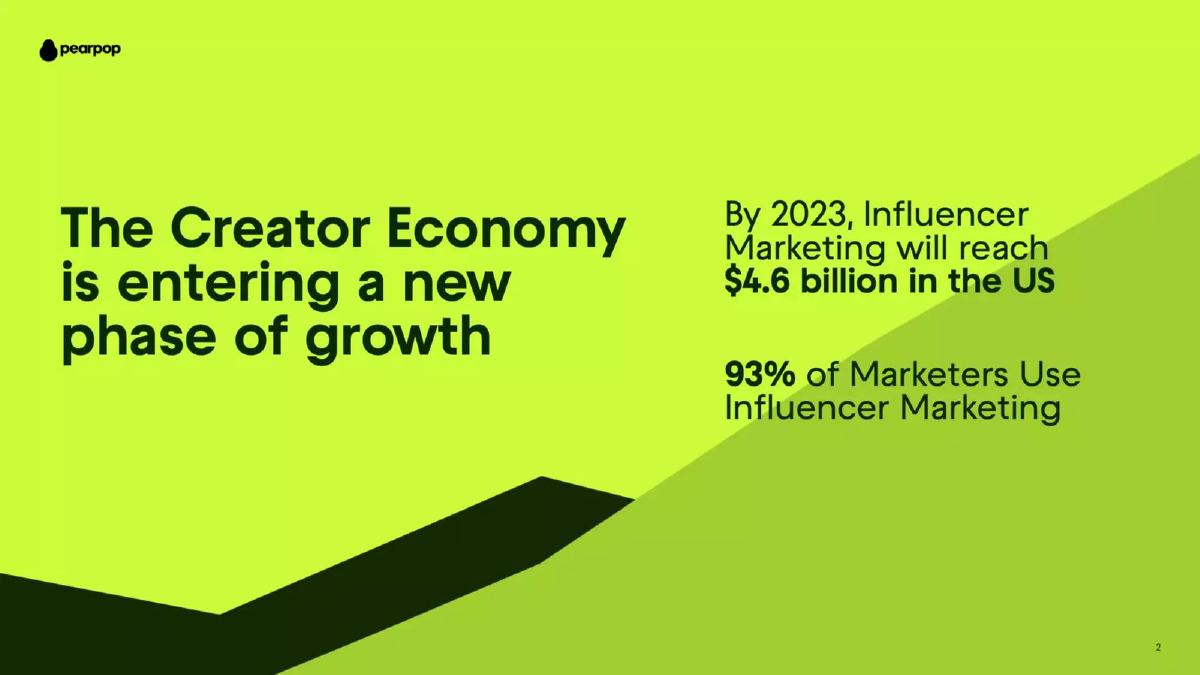
- Influencer marketing is projected to reach $4.6 billion in the US by 2023, with 93% of marketers already using the channel (Slide 2).
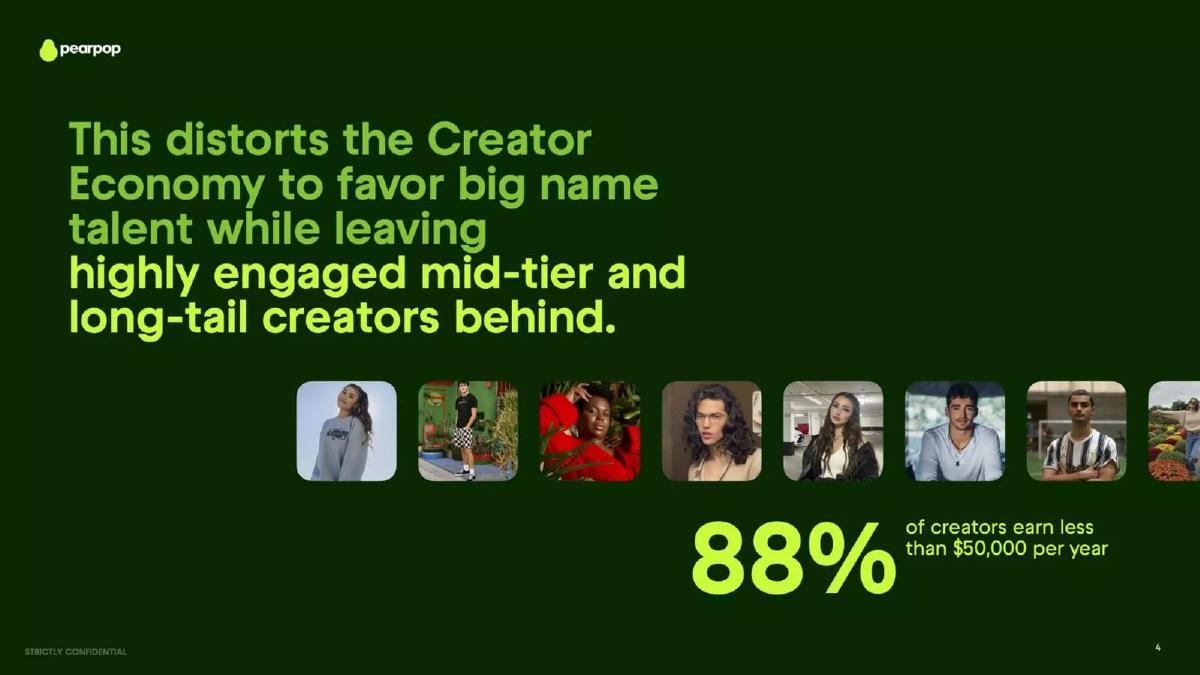
- The current market is inefficient, with 88% of creators earning less than $50,000 per year due to a bias toward big-name talent (Slide 4).
- Pearpop has achieved significant scale, paying out over $10M to creators, with 71% of that going to those with fewer than 1M followers (Slide 9).
- The platform has secured a high-tier client list including Apple, Amazon, Netflix, and American Express (Slide 8).
- Product evolution is moving toward 'Ovation,' a tool for activating a brand's own community as advocates (Slide 12).
- The leadership team features executives from Grey, Tinder, TikTok, and Netflix, providing deep industry credibility (Slide 18).
- Pearpop is investing in 'Passport Protocol,' a Web3-powered data layer to track value across platforms and chains (Slide 15).
- The deck completely omits a specific 'Ask' slide, financial forecasts, and a detailed breakdown of the business model's take rate.
Pearpop Series A Teardown: The Shift to Performance Creator Marketing
Pearpop’s 2022 pitch deck represents a strategic pivot in how the creator economy is presented to investors. Rather than focusing on the 'glamour' of influencers, the deck frames the industry as a broken supply chain that requires technological intervention. By the time this deck was circulated, Pearpop had already established significant traction, which they use to justify their $18M Series A round led by prominent VCs.
Slides 1-4: The Macro Opportunity and the 'Broken' Market
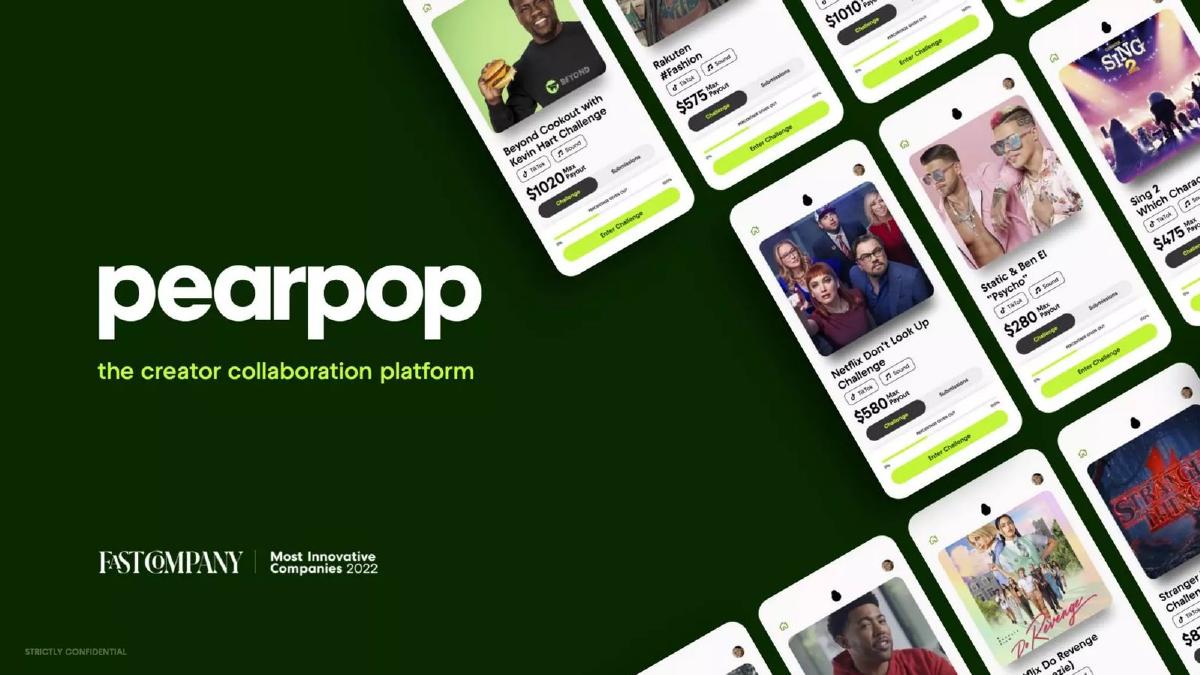
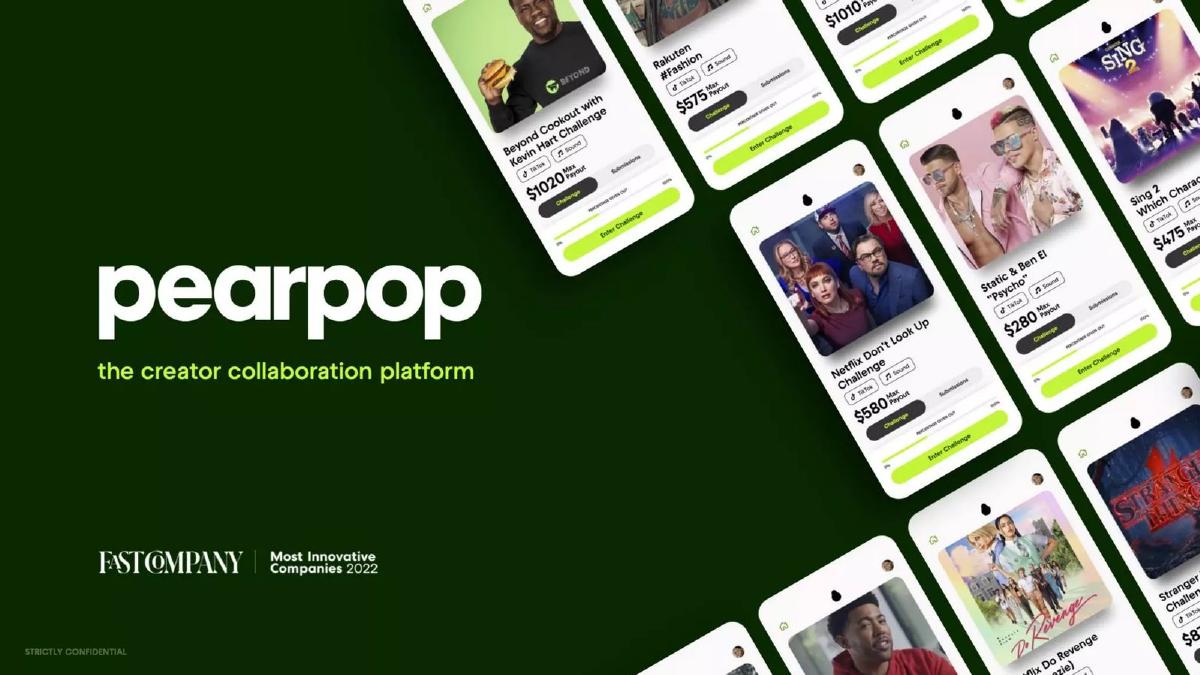
The deck opens with a strong visual identity, immediately showcasing the 'Pearpop Challenges' interface on Slide 1. This slide features recognizable faces like Kevin Hart and brands like Netflix and Beyond Meat, setting a high bar for social proof from the first second. Slide 2 provides the market validation: the US influencer marketing spend is hitting $4.6 billion, and 93% of marketers are already participating. This establishes that Pearpop isn't creating a new behavior; they are optimizing an existing, massive one.
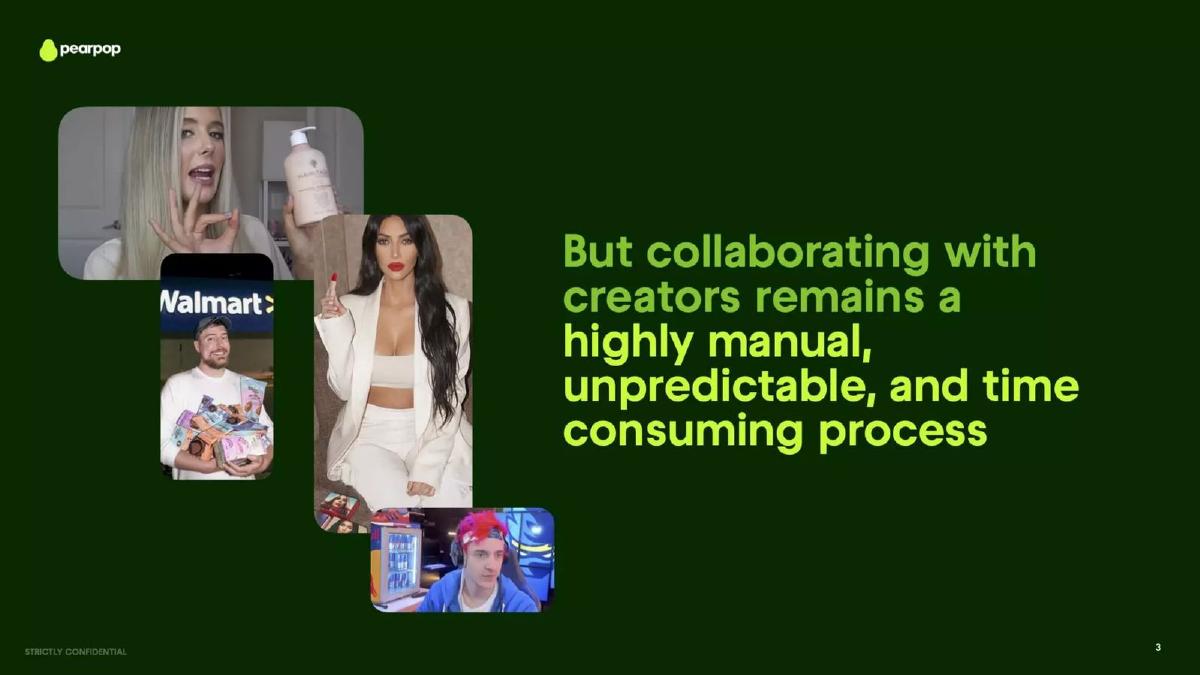
Slides 3 and 4 define the problem. The process is described as 'highly manual, unpredictable, and time-consuming.' The most compelling data point here is on Slide 4: 88% of creators earn less than $50,000 per year . This highlights a market distortion where value is trapped at the top, creating a massive opportunity to unlock the 'mid-tier and long-tail' creators who are currently underserved by traditional agencies.
Slides 5-7: The Solution and Performance Metrics
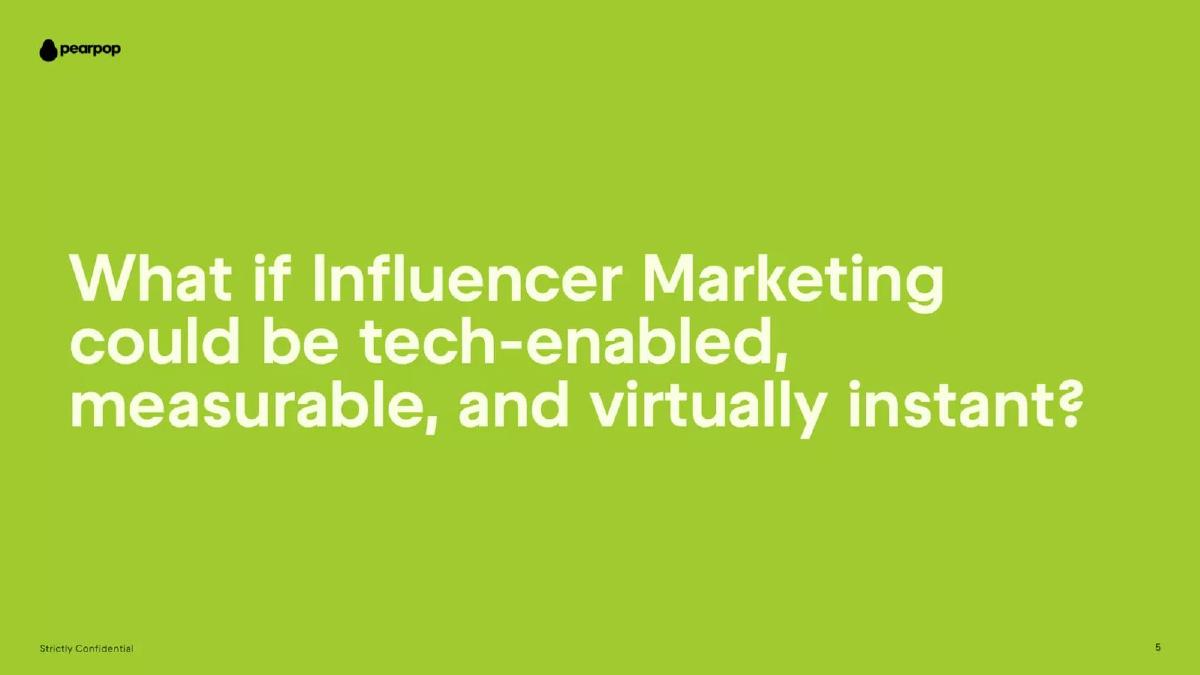
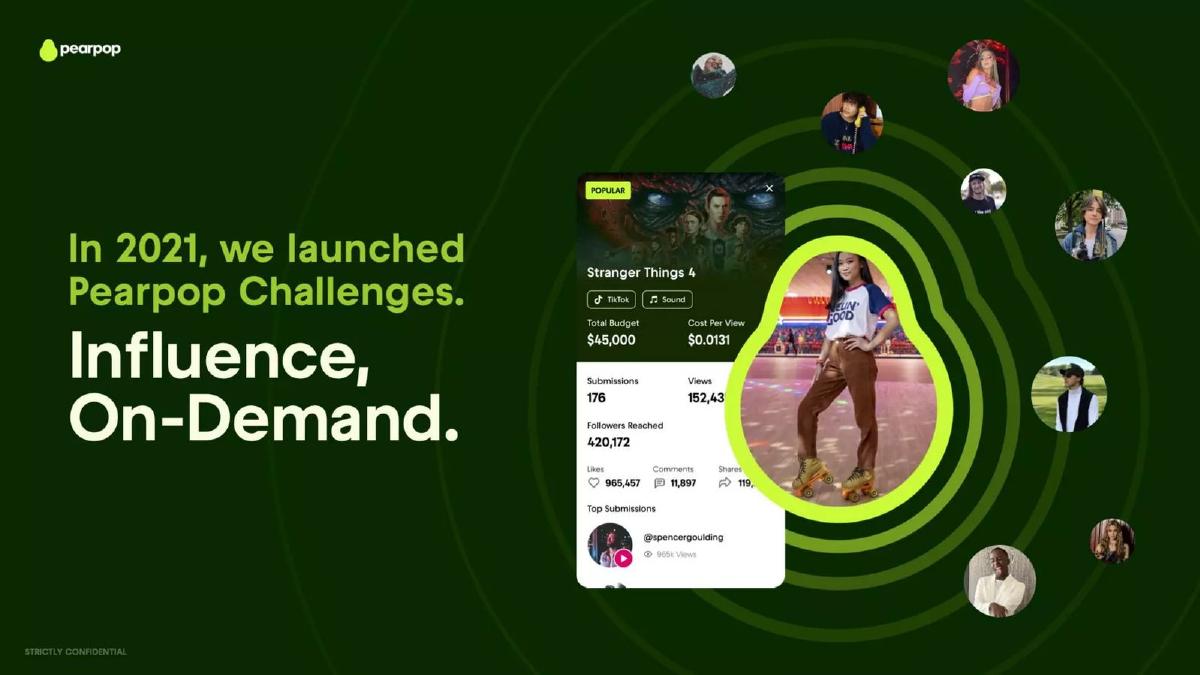
Slide 5 poses the central question: 'What if Influencer Marketing could be tech-enabled, measurable, and virtually instant?' This leads into the introduction of 'Pearpop Challenges' on Slide 6. The deck uses a specific case study for 'Stranger Things 4' to show the platform in action. The metrics are granular: a $45,000 budget resulting in a $0.0131 Cost Per View (CPV), 176 submissions, and over 420,000 followers reached.
Slide 7 is the 'New Standard' slide. It explicitly lists the shift in the business model. Pearpop moves the industry away from 'paying based on follower count' to paying for 'verified views and engagements on a CPM, CPV, or CPA basis.' This is a critical distinction for Series A investors, as it moves the company from a 'talent agency' category into a 'marketing tech' category with more scalable SaaS-like characteristics.
Slides 8-10: Massive Social Proof and Payout Data
Slide 8 is a 'logo soup' slide, but it carries more weight than most. It includes Apple, Amazon, Netflix, American Express, and Mastercard. For a startup at the Series A stage, having this level of enterprise adoption is rare and serves as a powerful de-risking mechanism. Slide 9 backs this up with hard numbers: $10M+ paid out to creators . The most important metric on this slide, however, is that 71% of those payouts went to creators with less than 1M followers. This proves that their mission to support the 'long tail' (stated on Slide 4) is actually happening in practice.
Slides 11-13: Product Evolution - Ovation
The deck then introduces 'Ovation' as the next step in the company's evolution. Slides 12 and 13 show how the platform is expanding from professional creators to brand advocates (regular customers). Using mockups for Starbucks, Nike, and Proactiv, Pearpop shows a system where customers earn 'Achievements' and rewards (like '10% off Nike products' or '3 Months free streaming') based on the performance of their content. This expands Pearpop's Total Addressable Market (TAM) from the 200,000 creators on their platform to the entire customer base of their brand partners.
Slides 14-15: The Data Play and Web3 Integration
Slides 14 and 15 touch on the future roadmap, specifically 'Passport Protocol.' The deck claims this is 'powered by Web3' to provide 'predictable and measurable value - on and off platforms, on and off chain.' While the Web3 mentions are somewhat buzzword-heavy and lack technical detail, the underlying message is clear: Pearpop intends to own the identity and performance data layer for the creator economy, making their platform the 'source of truth' for creator ROI.
Slides 16-19: Leadership and Team
The deck concludes with a focus on the team. Slide 17 highlights the founders, Cole Mason and Guy Oseary. Oseary’s background in entertainment (Maverick, Untitled) provides the 'unfair advantage' in terms of access to talent and brands. Slide 18 showcases a leadership team with deep experience at Grey, R/GA, Tinder, TikTok, and Netflix. This is a 'heavyweight' team for a Series A, suggesting that the $18M raise is intended to fuel a high-burn, high-growth strategy led by industry veterans.
What Pearpop Does Exceptionally Well
1. Framing the Problem Financially: Instead of saying influencer marketing is 'hard,' they say it is 'unpredictable' and 'manual.' By focusing on the 88% of creators who aren't making a living, they identify a massive, untapped supply of labor that their technology can organize.
2. Performance-Based Language: The constant use of marketing acronyms like CPM, CPV, and CPA (Slide 7) speaks directly to the language of CMOs and growth investors. It positions Pearpop as a performance marketing tool rather than a social media experiment.
3. Proof of Scale: The $10M+ payout figure (Slide 9) is the most important number in the deck. It proves the marketplace has liquidity and that the business model is functioning at scale.
What is Missing from the Pearpop Deck
1. The Business Model / Take Rate: While the deck mentions CPM and CPA, it never explicitly states how Pearpop makes money. Is it a SaaS fee for brands? A percentage of the creator payout? A hybrid? This is a significant omission for a Series A deck.
2. Financial Projections: There are no charts showing revenue growth over time, churn rates, or future projections. The deck relies entirely on 'cumulative' metrics (like total payouts) rather than 'periodic' growth metrics (like MoM revenue).
3. Competitive Landscape: The creator economy is one of the most crowded sectors in tech. The deck does not mention competitors or explain why Pearpop’s 'Challenges' model is defensible against platforms like TikTok (which has its own Creator Marketplace) or Instagram.
4. The Ask: There is no slide detailing how much they are raising or how the funds will be used. While we know from external sources it was an $18M round, the deck itself is silent on the terms of the deal.
Founder's Tip: Copy the 'Social Proof' Strategy
If your startup has high-profile customers, do exactly what Pearpop did on Slides 1 and 8. Don't just list the logos; show the product being used by those brands. The 'Stranger Things 4' case study on Slide 6 is far more effective than a simple Netflix logo because it shows the specific ROI ($0.0131 CPV). If you are building a marketplace, focus on the 'Liquidity Proof'—show exactly how much money has moved through your system, as seen on Slide 9. This proves that your platform isn't just a cool idea, but a functioning economy.
Frequently asked questions
- What is Pearpop's core value proposition for brands?
- Pearpop moves brands away from paying for follower counts and toward paying for verified performance. According to Slide 7, the platform enables collaborations on a CPM (Cost Per Mille), CPV (Cost Per View), or CPA (Cost Per Action) basis. This provides predictable and measurable 'Return on Influence' while ensuring brand safety through the 'Pearpop Verified' creator program.
- How does Pearpop address the 'Long Tail' of the creator economy?
- Slide 4 identifies that the current economy favors big-name talent, leaving mid-tier creators behind. Pearpop addresses this by democratizing access to brand deals. Slide 9 highlights that 71% of their $10M+ total payouts have gone to creators with fewer than 1 million followers, proving the platform's ability to monetize the long tail effectively.
- What is the 'Ovation' product mentioned in the deck?
- Ovation is Pearpop's community advocacy tool, detailed on Slides 11 through 13. It allows brands like Starbucks, Nike, and Proactiv to activate their existing user base. Customers who have purchased products can participate in 'Challenges' to earn rewards or achievements based on the performance of their social content, turning customers into a brand's most authentic influencers.
- Who are the founders and what is their background?
- The company was co-founded by Cole Mason (CEO) and Guy Oseary. Cole Mason is noted as a Forbes 30 Under 30 honoree. Guy Oseary is a prominent figure in the entertainment industry, associated with Maverick and Untitled Entertainment, which likely explains the platform's early success in attracting top-tier celebrity and brand partnerships.
- What is missing from this Series A pitch deck?
- The deck is notably light on hard financials. There are no slides detailing revenue growth, gross margins, or customer acquisition costs (CAC). It also lacks a clear 'Ask' slide specifying how the $18M will be allocated. Furthermore, there is no competitive landscape analysis, which is unusual for a crowded space like influencer marketing.