Pega Plantão is a Brazilian startup targeting the healthcare logistics sector, specifically the management and exchange of medical shifts (plantões). The deck, presented at StartupDojo, focuses heavily on the product interface and the technical background of the founding team. While the deck successfully identifies a clear pain point—high costs and communication friction in finding substitute doctors—it lacks critical financial data, market sizing, and a specific investment ask. The presentation is primarily a product showcase, demonstrating a functional web interface with a calendar-based ma…
Key takeaways
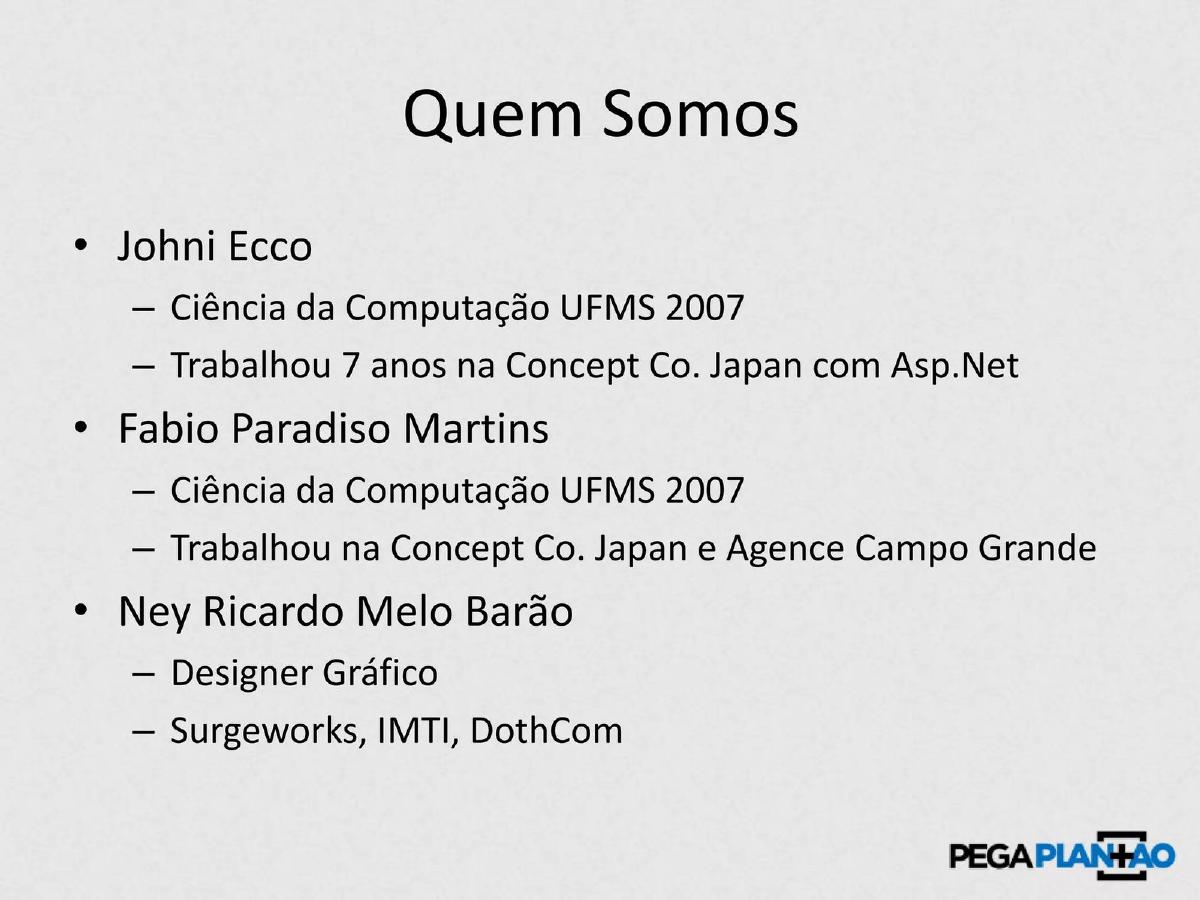
- The founding team consists of two computer scientists from UFMS (2007) and a graphic designer, highlighting a strong technical and design foundation (Slide 2).
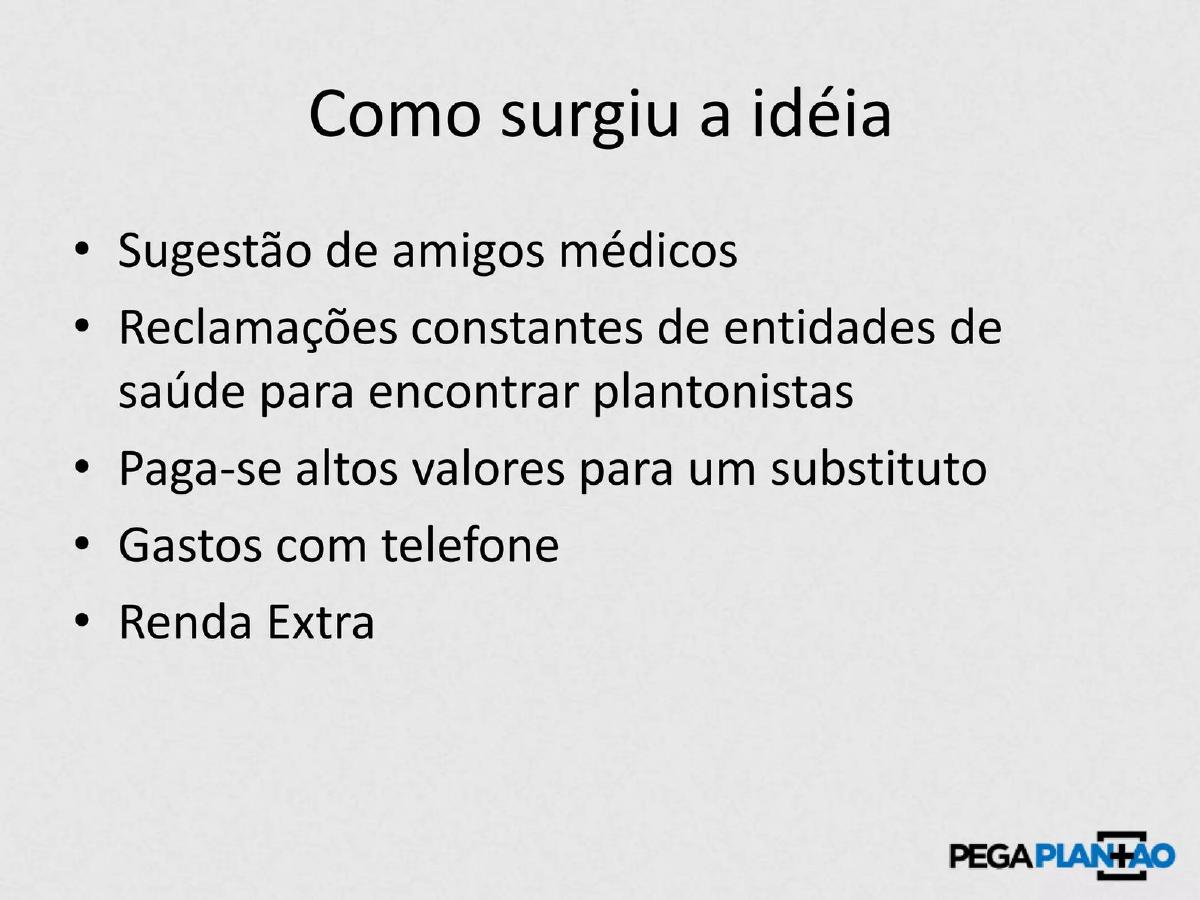
- The problem is defined by high costs for substitutes, excessive phone expenses, and the difficulty health entities face in finding available doctors (Slide 3).
- A pre-registration phase was launched on August 8th, indicating early attempts at user acquisition and validation (Slide 4).
- The product features a centralized 'Agenda' (calendar) view for doctors to manage their shifts and view job offers (Slide 5).
- The platform includes a structured 'Criar Anúncio' (Create Ad) workflow, allowing users to specify date, time, duration, specialty, and location (Slide 6).
- Future development plans prioritize a mobile version, group creation features, and financial control tools (Slide 7).
- The deck completely omits market size (TAM/SAM/SOM), competitor analysis, and revenue models.
- There is no specific financial 'Ask' or explanation of how funds would be utilized to scale the platform.
Pega Plantão: A Product-Centric Approach to Healthcare Logistics
Pega Plantão entered the Brazilian startup scene with a clear, narrow focus: fixing the broken process of medical shift management. In the Brazilian healthcare system, 'plantões' (shifts) are often traded or filled through informal networks, leading to inefficiency and high costs for hospitals. This deck, presented at StartupDojo, is a functional walkthrough of a solution designed to digitize this friction.
Slide 1: Title Slide
The deck opens with the Pega Plantão logo on a solid blue background. The branding is clean, utilizing a medical cross integrated into the word 'Plantão'. There is no tagline or mission statement on this slide, which is a missed opportunity to immediately define the value proposition for an unfamiliar audience.
Slide 2: Quem Somos (Team)
The 'Who We Are' slide introduces three founders. Johni Ecco and Fabio Paradiso Martins are both 2007 Computer Science graduates from UFMS (Universidade Federal de Mato Grosso do Sul) with international experience at Concept Co. Japan. Ney Ricardo Melo Barão is credited as the Graphic Designer. This slide establishes technical credibility; the founders are builders, not just idea-people. However, it lacks any mention of healthcare industry experience, which might be a concern for investors looking for 'founder-market fit' in a highly regulated sector.
Slide 3: Como surgiu a idéia (The Problem)
This slide outlines the genesis of the startup. It cites suggestions from medical friends and constant complaints from health entities regarding the difficulty of finding shift workers. The slide lists four key pain points: high values paid to substitutes , telephone expenses , the need for extra income for doctors, and the general difficulty of coordination. While the pain points are clear, the slide lacks data. It doesn't quantify how much is spent on these inefficiencies, which would help build a stronger case for the market opportunity.
Slide 4: Pré-cadastro (Early Validation)
Slide 4 shows a screenshot of a landing page for pre-registration, active since August 8th. The page describes Pega Plantão as an 'online tool for Doctors and Nurses that facilitates the boring and complicated task of exchanging shifts.' The three-step process is visualized: 1. Advertise the shift, 2. Choose a candidate, 3. Confirm the substitution. This slide serves as proof of concept and early market testing, though it fails to list the actual number of registrations achieved since the launch date.
Slide 5: Agenda (The Core Product)
The 'Agenda' slide provides a full-screen UI mockup of the platform's calendar view. It shows a November 2011 calendar with specific shifts marked (e.g., '9:00 SANTA CASA'). The sidebar includes navigation for 'My Ads,' 'My Proposals,' 'Job Offers,' and 'Evaluations.' This slide is effective because it shows a high level of product maturity. The inclusion of a 'Suggest' box and 'Coupons' (mentioning an iPad giveaway) indicates an early focus on user engagement and growth hacking.
Slide 6: Criar Anúncio (Workflow)
This slide focuses on the 'Create Ad' functionality. A modal window asks for 'Dados Básicos' (Basic Data) like date, time, duration, and specialty, alongside 'Informações do Local' (Location Info) including State and City. This demonstrates that the platform is built to handle the specific metadata required for medical staffing, moving beyond a simple chat group or generic calendar.
Slide 7: Próximos passos (Roadmap)
The roadmap is concise, listing three items: Versão Mobile (Mobile Version), Criação de Grupos (Group Creation), and Controle financeiro (Financial Control). The slide includes a mockup of a mobile app on an iPhone, signaling that the team understands the necessity of a mobile-first approach for doctors who are rarely sitting at a desk. The 'Financial Control' aspect hints at a future revenue model or a stickier value proposition for the users.
Slide 8: Mais informações (Contact)
The final slide provides the website URL, contact email, and social media handles (Facebook and Twitter). It is a standard closing slide but lacks a 'Call to Action' or a summary of why an investor should reach out.
What Works in This Deck
Strong Technical Foundation: The team slide (Slide 2) clearly shows that the founders have the skills to build the product themselves. The 7-year tenure in Japan for two of the founders suggests professional maturity and technical depth.
Product Clarity: By the end of slide 6, there is no ambiguity about what the product does. The UI mockups are clean, professional, and address the specific workflow of the target user. The inclusion of a 'Specialty' filter shows they understand the nuances of medical staffing.
Problem Identification: The 'How the idea arose' slide (Slide 3) successfully bridges the gap between a personal anecdote (friends' suggestions) and a business problem (high costs for health entities).
What Is Missing
Market Size (TAM/SAM/SOM): There is no mention of how many doctors or hospitals exist in Brazil, or the total volume of shifts traded annually. Without this, investors cannot judge if this is a lifestyle business or a venture-scale opportunity.
Business Model: The deck never explains how Pega Plantão intends to make money. Will they charge a subscription to hospitals? A transaction fee on shift trades? A premium model for doctors? This is a critical omission for a pitch deck.
Competition: The deck assumes Pega Plantão is operating in a vacuum. In reality, they are competing against WhatsApp groups, specialized staffing agencies, and potentially hospital HR software. Acknowledging and differentiating from these is vital.
The Ask: There is no slide stating how much money the company is looking for or what milestones that money will help them achieve. This makes the deck feel more like a project showcase than a fundraising tool.
What a Founder Should Copy
The 'Step-by-Step' Visual: Slide 4 uses simple icons to explain a three-step process. This is an excellent way to reduce cognitive load for an investor and explain a marketplace dynamic quickly.
UI Transparency: Instead of using vague stock photos, the founders used actual screenshots of their 'Agenda' and 'Create Ad' screens. This builds trust that the product actually exists and is functional.
Focus on Logistics: The deck stays focused on the logistics of the shift rather than trying to solve all of healthcare at once. Founders should emulate this 'wedge' strategy—identifying one specific, painful friction point and solving it deeply before expanding.
Frequently asked questions
- What specific problem does Pega Plantão solve?
- According to slide 3, the company solves the logistical nightmare of finding medical shift substitutes. The founders noted that health entities struggle to find doctors, resulting in high payments for last-minute substitutes and significant time/money spent on phone calls. It also positions itself as a way for doctors to earn extra income by finding available shifts easily.
- What is the background of the founding team?
- The team is technically oriented. Slide 2 lists Johni Ecco and Fabio Paradiso Martins, both 2007 Computer Science graduates from UFMS with experience at Concept Co. Japan. They are joined by Ney Ricardo Melo Barão, a graphic designer with experience at companies like Surgeworks and DothCom, ensuring the product has both backend stability and frontend usability.
- How does the platform actually work for a doctor?
- Slides 5 and 6 show a web-based dashboard where doctors can view a monthly calendar of their shifts. They can create ads to trade or give away shifts by inputting basic data (date, time, specialty) and location details (State, City, Hospital). The interface is designed to be a 'fast and easy' management tool for both doctors and nurses.
- What are the company's immediate next steps?
- As outlined on slide 7, the priority is moving beyond the web. The 'Próximos passos' (Next steps) include developing a mobile version (essential for doctors on the move), creating private groups for specific hospitals or teams, and implementing financial control features to help users track their earnings from shifts.
- Is there any evidence of market traction in the deck?
- Traction data is very limited. Slide 4 mentions a 'Pré-cadastro' (Pre-registration) period starting from August 8th, but the deck does not provide the number of sign-ups, active users, or hospitals currently using the platform. This is a significant omission for a pitch intended to secure funding.