Uplane’s 14-slide pitch deck is a masterclass in aggressive positioning, explicitly stating a goal to replace marketing agencies and in-house teams with AI. The deck relies heavily on visual proof of concept, using a case study for 'Wagetap' to demonstrate how testing beats human guessing. It quantifies the efficiency gains of an AI-augmented marketing manager, claiming a jump from 5 ads per day to 100. While the deck is light on traditional financial metrics and competitive analysis, its clear value proposition and focus on the data flywheel—where the system improves as it collects brand-spe…
Key takeaways
- The deck explicitly targets an $800 billion market opportunity by aiming to replace agencies and in-house teams (Slide 5).
- Uplane claims to increase a marketing manager's output from 5 ads per day to 100 ads per day (Slide 6).
- The platform automates budget steering, increasing adjustments from 1 per day to 48 per day (Slide 6).
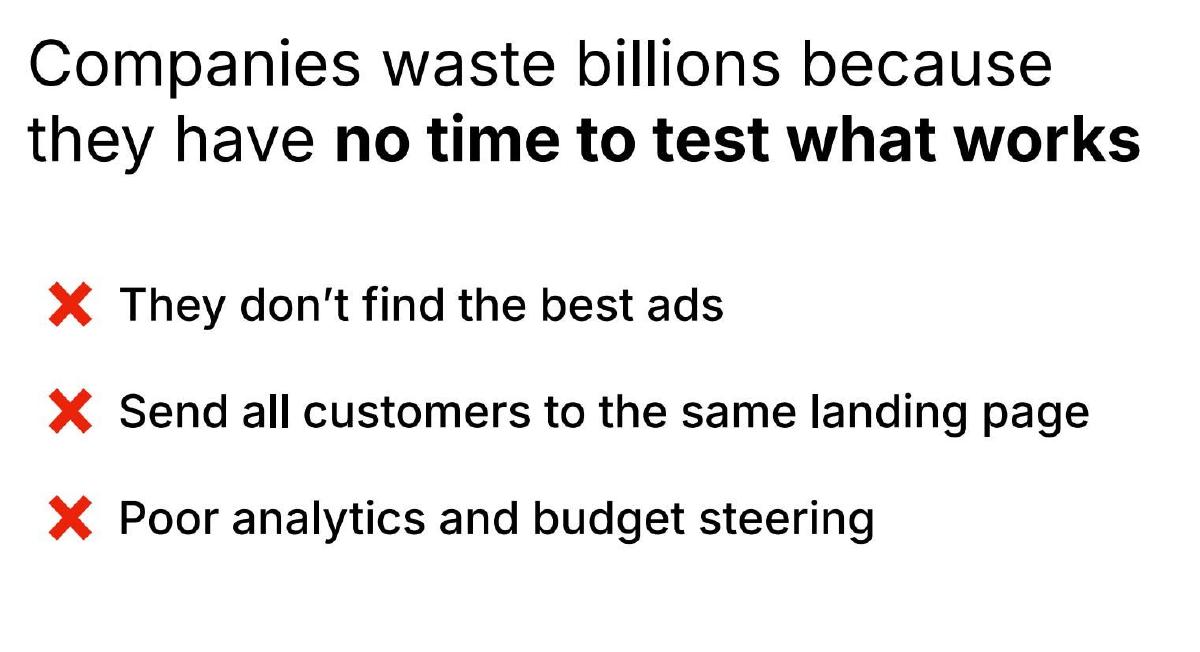
- A core value proposition is the 'full-stack' nature of the tool, covering ad generation, landing page creation, and analytics (Slide 4).
- The deck uses a visual 'Testing > Guessing' framework to show how AI identifies winning creative variations that humans might miss (Slides 2-3).
- Uplane emphasizes a data flywheel effect, stating that performance improves the longer a brand uses the platform (Slide 7).
- The product provides granular element-level analytics, such as the impact of a 'Blue Button' (-3%) versus an 'Image of cold Drink' (+21%) (Slide 7).
- The deck omits a traditional team slide, financial projections, and a specific use-of-funds breakdown in the provided materials.
The Aggressive Automation Narrative
Uplane’s pitch deck is a focused, high-conviction argument for the total automation of the digital marketing workflow. Rather than positioning itself as a 'co-pilot' or a tool to help agencies, Uplane takes a confrontational stance: it exists to replace them. This teardown examines how the company used a 14-slide deck to secure $4.5M in Seed funding by emphasizing volume, testing, and data-driven optimization over traditional creative processes.
Slide 1: The Mission Statement
The cover slide is minimalist, featuring the Uplane logo and a bold sub-headline: "Replace marketing agencies with AI." This sets the tone for the entire presentation. There is no ambiguity about the target customer or the intended impact on the industry. The inclusion of the URL 'uplane.com' at the bottom right provides an immediate call to action for investors to verify the product's existence.
Slide 2 & 3: Testing > Guessing
Slides 2 and 3 function as a two-part visual proof of concept. Slide 2 displays eight different ad variations for a brand called 'Wagetap.' The creative styles range from high-production photography to simple memes and text-heavy graphics. The headline "Testing > Guessing" challenges the traditional agency model where a creative director might pick a single 'best' direction based on intuition.
Slide 3 provides the 'reveal.' Red 'X' marks are placed over seven of the variations, while a green dollar sign is placed over one specific dark-themed ad with the text 'Some weeks bite.' This visual shorthand effectively communicates that human intuition is often wrong, and only large-scale testing can identify the true high-performer that generates revenue. It validates the need for a tool that can generate '100s of ads' because the winner is rarely obvious.
Slide 4: The Full-Stack Solution
Slide 4 introduces the product interface. A laptop mockup shows the Uplane dashboard, which appears to organize ad concepts, landing pages, and brand assets in a centralized sidebar. The slide lists three core capabilities: "Generate and test 100s ads," "Generate matching landing pages," and "Automatic analytics & budget steering." By labeling itself a 'full-stack solution,' Uplane argues that it isn't just a creative tool (like Canva) or an analytics tool (like Triple Whale), but an end-to-end replacement for the marketing function.
Slide 5: The $800B Opportunity
This is the 'Market' slide, though it lacks the traditional TAM/SAM/SOM circles. Against a solid blue background, the text reads: "We aim to replace all marketing agencies and in-house teams with AI." Below this, in parentheses, is the figure "(~$800b dollar opportunity)." This slide is designed to show the scale of the ambition. By framing the market as the total spend on human marketing labor and agency fees, Uplane justifies a venture-scale valuation.
Slide 6: Quantifying Output
Slide 6 is the most data-dense slide in the deck, comparing the "Output of an average marketing manager" with and without Uplane. The metrics are stark:
Ads per day: Increases from 5 to 100. · Landing pages per day: Increases from 0 to 5. · Budget adjustments per day: Increases from 1 to 48.
The slide uses simple blue icons to visualize the volume difference. Notably, the budget adjustment section includes a 'soon' arrow, indicating that high-frequency automated bidding is a roadmap item or a newly released feature. This slide appeals to the investor's desire for 'efficiency gains'—a core tenet of the current AI investment thesis.
Slide 7: The Data Flywheel
Slide 7 addresses the long-term defensibility of the product. The text states: "The longer you use Uplane, the more data it will have to build ads that work for your brand." This describes a classic data network effect. The right side of the slide shows granular performance data for a specific ad: "Contains Brand Logo: -11%," "Blue Button: -3%," "Image of cold Drink: +21%," and "Thirsty Theme: +13%." This demonstrates that the AI isn't just guessing; it is decomposing creative elements into variables and measuring their specific impact on conversion. This level of granularity is something traditional agencies struggle to provide at scale.
Slides 8-14: Omissions and Structure
The remaining slides in the 14-slide deck (based on the provided text) continue to build on these themes. However, several standard pitch deck components are notably absent from the provided materials:
No Team Slide: There is no mention of the founders' backgrounds, previous exits, or technical expertise in AI or AdTech. · No Financials: The deck does not list current Revenue, Burn Rate, or Customer Acquisition Cost (CAC). · No Competition: There is no slide comparing Uplane to competitors like Omneky, Pencil, or Adcreative.ai. · No Ask: The specific amount being raised and the milestones it will fund are not explicitly stated on the slides.
What Works in the Uplane Deck
1. Extreme Clarity of Purpose: Many startups hide their true intentions behind jargon. Uplane is refreshingly direct. They want to kill agencies. This clarity makes it very easy for an investor to decide if they believe in the thesis or not.
2. Visual Proof: The 'Testing > Guessing' slides (2 and 3) are highly effective. They turn an abstract concept (AI creative optimization) into a tangible business outcome (finding the one ad that makes money). It creates a 'lightbulb moment' for the reader.
3. The Efficiency Argument: By quantifying the output of a marketing manager (Slide 6), Uplane moves the conversation from 'cool technology' to 'business ROI.' A 20x increase in ad production is a compelling reason for a CMO to buy the software.
What is Missing
1. The 'How': While the deck shows the 'What' (100 ads a day), it is light on the 'How.' In a crowded AI market, investors often look for 'proprietary data' or 'unique model architecture.' Uplane relies on the 'data flywheel' argument, but more technical detail on how they ensure brand consistency across 100 ads would be beneficial.
2. Unit Economics: For a Seed round, investors want to see that the product works for more than one customer. The deck leans heavily on the 'Wagetap' case study. Evidence of similar results across different industries (e.g., B2B SaaS vs. E-commerce) would strengthen the case for scalability.
3. Founder Market Fit: Replacing an entire industry requires deep domain expertise. The absence of a team slide in the primary narrative flow is a missed opportunity to build trust in the founders' ability to navigate the complex AdTech ecosystem.
Founder's Guide: What to Copy
Use the 'Before vs. After' Framework: Slide 6 is a perfect template for any productivity tool. Don't just say you are 'faster'; show exactly how many more units of work a human can complete in a day using your software.
Deconstruct the Value: Slide 7’s breakdown of ad elements (Logo, Button Color, Theme) is a great way to show that your AI is 'intelligent' and not just a random content generator. If your tool provides insights, show the most granular version of those insights.
Bold Positioning: If you are building a 'disruptor,' don't be afraid to name the incumbent you are disrupting. Uplane’s focus on 'Replacing Agencies' is a polarizing but effective way to stand out in a sea of 'Agency Tools.'
Frequently asked questions
- What is Uplane's primary value proposition?
- Uplane positions itself as a 'full-stack' AI solution that replaces the need for marketing agencies and in-house creative teams. It achieves this by automating the generation of hundreds of ads, creating matching landing pages, and performing automatic budget steering and analytics to optimize campaign performance based on real-time data.
- How does Uplane quantify the efficiency of its AI?
- On Slide 6, Uplane compares a marketing manager's output with and without their tool. They claim the AI enables a single manager to produce 100 ads per day (up from 5), 5 landing pages (up from 0), and perform 48 budget adjustments (up from 1).
- What market size does Uplane target?
- Slide 5 identifies an $800 billion dollar opportunity. This figure represents the total addressable market of marketing agencies and in-house marketing teams that Uplane intends to disrupt or replace with its automated AI platform.
- Does the deck show actual product features?
- Yes, Slide 4 provides a screenshot of the Uplane interface, showcasing a dashboard where users can view generated ad concepts, landing pages, and brand assets. Slide 7 also shows granular analytics on specific ad elements like logos, button colors, and themes.
- What is missing from the Uplane pitch deck?
- The 14-slide deck is missing several standard venture components, including a detailed team slide (founder backgrounds), a competitive landscape analysis, specific financial projections (ARR/MRR), and a clear 'Ask' slide detailing how the $4.5M will be spent.