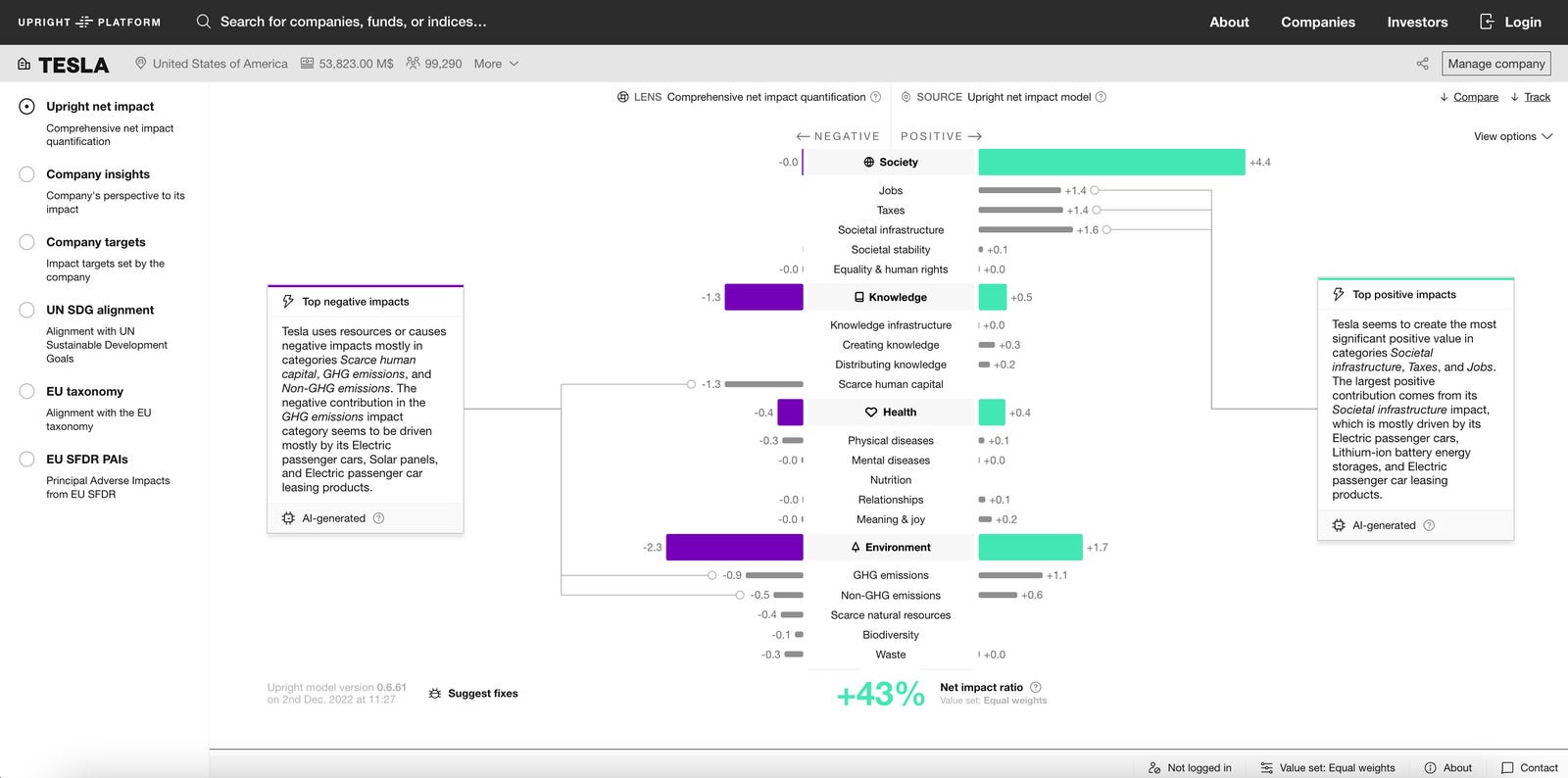
Upright’s 19-slide Seed deck, which secured $5.2M in 2022, is a masterclass in positioning a data product against regulatory tailwinds. The company addresses the 'fragmented landscape' of ESG reporting by offering a science-based net impact model. The deck excels by showcasing high-fidelity product screenshots (Slide 1, 10) and significant market coverage, claiming to cover 99% of global stock market cap (Slide 12). By highlighting a strategic partnership with Nasdaq (Slide 16) and a roster of 24 major institutional logos (Slide 14), Upright shifts the narrative from a social impact project t…
Key takeaways
- The deck uses a specific Tesla impact report as the opening slide to immediately demonstrate product output and data visualization (Slide 1).
- Upright identifies three core market challenges: fragmented metrics, lack of common definitions, and the 'illusion' of company-disclosed data (Slide 6).
- The platform targets four distinct user groups: investors, customers, employees, and leadership, though the deck focuses primarily on institutional investors (Slide 4).
- The company claims massive data scale, offering off-the-shelf coverage for 11,000 companies and 99% of global stock market capitalization (Slide 12).
- A 3-week lead time for on-demand modeling of unlisted companies is cited as a key competitive advantage for due diligence (Slide 12).
- The deck lists 24 institutional customers, including major names like Invesco, Nordea, and EQT, providing significant social proof (Slide 14).
- A global partnership with Nasdaq, active since June 2021, serves as a primary distribution channel via API (Slide 16).
- The deck is missing standard fundraising components such as a team slide, financial roadmap, and a specific dollar amount for the ask.
The Upright Project: A Data-First Approach to Impact
Upright’s Seed deck is a focused, professional presentation that prioritizes product utility and market validation over typical startup storytelling. Raised in 2022, the $5.2M round was led by the strength of their data model and institutional adoption. The deck avoids the 'visionary' fluff often found in social impact startups, instead positioning itself as a necessary tool for regulatory compliance and sophisticated asset management.
Slide 1-2: The Hook and the Identity
Slide 1 functions as a live product demonstration rather than a traditional cover. It shows a 'Tesla report' generated by the Upright platform. The visualization breaks down impact into four categories: Society, Knowledge, Health, and Environment. By showing Tesla’s 'Net impact ratio' of +43% and detailing specific negative impacts (like 'Scarce human capital') alongside positives (like 'Societal infrastructure'), Upright immediately proves they can handle complex, nuanced data. Slide 2 provides the mission statement: Upright builds the world’s 1st open impact data platform, bridging the gap between company narratives and science-based data.
Slide 3-4: Mission and Stakeholders
Slide 3 and 4 expand on the company’s purpose. The mission is defined as creating incentives for companies to optimize their 'net impact.' Slide 4 is particularly effective at showing the platform's versatility. It identifies four key personas: Investors (equity dedication), Customers (purchasing decisions), Employees (time dedication), and Leadership (strategic decisions). While the deck later leans into the investor use case, this slide establishes a much larger Total Addressable Market (TAM) beyond just finance.
Slide 6: The Regulatory Catalyst
Every successful B2B deck needs a 'Why Now?' slide. Slide 6 delivers this by citing 'increasing pressure' on institutional investors. It lists four main drivers: Regulatory reporting mandates (EU taxonomy, SFDR), reporting requirements from asset owners, market demand for sustainable products, and marketing trends. Crucially, it lists the challenges: a fragmented landscape, no common definitions, and the 'illusion of real data.' This slide frames Upright not as a 'nice-to-have' but as a solution to a growing compliance headache.
Slide 8-10: Product and Use Cases
Slide 8 is a high-impact visual of the New York Stock Exchange with Upright’s impact bars overlaid on the monitors, signaling their ambition to be the new standard for market data. Slide 10 brings it back to the software, showing a dashboard for the 'Parvest Climate Impact' fund. It lists six main use cases for institutional investors: Screening, Due diligence, Active ownership, Reporting, Compliance, and Product development. This list is vital because it shows the product is integrated into the entire investment lifecycle, not just a once-a-year reporting tool.
Slide 12: Data Scale and Coverage
For a data company, the 'moat' is the database. Slide 12 makes a bold claim: Upright covers 99% of the global stock market cap. They break this down into 9,000 listed companies and 2,000 unlisted growth companies. The geographical map shows a heavy emphasis on Europe (3,500 companies), North America (3,000), and Asia (4,000). The mention of a '3-week lead time' for on-demand modeling is a specific service-level agreement (SLA) that would appeal directly to Private Equity firms needing quick turnarounds during a deal process.
Slide 14-16: Validation and Distribution
Slide 14 is a 'logo wall' featuring 24 customers. The presence of major financial institutions like Nordea and Invesco, alongside PE giants like EQT, provides massive credibility for a Seed-stage company. Slide 16 reinforces this with the Nasdaq partnership. By quoting James McKeone, VP at Nasdaq, and showing the Upright logo on the Nasdaq tower in Times Square, the company demonstrates that they have already secured a top-tier distribution channel. This significantly de-risks the 'Go-to-Market' strategy for potential investors.
Slide 18-19: The Conclusion
The deck ends abruptly. Slide 18 is a contact slide with a minimalist graphic, and Slide 19 is a simple closing. There is no 'Ask' slide, no 'Team' slide, and no 'Financials' slide in the provided sequence. While these may have been in a separate appendix or omitted for public distribution, their absence in the main narrative is a notable departure from standard pitch deck structure.
What Upright Does Well
Product-First Narrative: By starting with a Tesla report, they show rather than tell. The investor immediately understands what the output of the software looks like. · Regulatory Alignment: They explicitly name-drop EU Taxonomy and SFDR. This tells investors that the company is riding a wave of mandatory spending rather than discretionary spending. · Quantified Scale: Claiming 99% market cap coverage is a powerful metric that sets a high bar for any potential competitors. · Institutional Social Proof: The combination of the Nasdaq partnership and the 24-logo customer slide makes the company look much further along than a typical Seed-stage startup.
What is Missing from the Deck
The Team: There is no mention of the founders, their backgrounds in data science, or their experience in the financial sector. In a Seed round, the team is usually 50% of the investment decision. · Business Model: The deck doesn't explain how they make money. Is it a SaaS subscription per seat? A license for the API? A per-report fee? This is a significant omission for a business teardown. · Financial Projections: There is no roadmap showing how the $5.2M will be used to reach specific revenue or growth milestones. · Competition: The deck mentions a 'fragmented landscape' but doesn't name or position against other ESG data providers like MSCI, Sustainalytics, or newer startups.
Founder's Playbook: What to Copy
Use a 'Hero' Example: If your product generates a report or a specific output, use a well-known entity (like Tesla) to show how your product handles a real-world case. It grounds the abstract technology in reality. · Map the Stakeholders: Slide 4 is a great template for showing how a single data source can serve multiple departments within a large organization. This helps justify a higher contract value. · Leverage Partnerships for Credibility: If you have a pilot or a distribution deal with a major player (like Nasdaq), give it its own slide. It proves that industry incumbents view you as a partner rather than a threat. · Focus on 'Pain' rather than 'Gain': Upright focuses on the 'pressure' and 'challenges' of regulation. Selling a solution to a painful regulatory requirement is often easier than selling a 'feel-good' impact tool.
Frequently asked questions
- What is the core problem Upright is solving?
- Upright addresses the lack of comparability and transparency in corporate impact reporting. As noted on Slide 6, institutional investors face pressure from regulatory mandates like EU Taxonomy and SFDR, but they struggle with a fragmented landscape where companies disclose only what they wish to show. Upright provides a science-based, comparable data model to replace these subjective narratives.
- How does Upright distribute its data?
- Beyond its direct platform, Upright uses a strategic partnership model for global distribution. Slide 16 highlights a partnership with Nasdaq, where Upright’s net impact data is made available through Nasdaq’s API to investors and companies worldwide. This allows them to scale without relying solely on direct sales.
- What is the scope of Upright's data coverage?
- According to Slide 12, Upright covers 99% of the global stock market capitalization. This includes off-the-shelf data for 9,000 listed companies and 2,000 unlisted growth companies. They also offer on-demand modeling for any company with a maximum three-week lead time, ensuring they can support private equity due diligence.
- Who are Upright's primary customers?
- The deck focuses heavily on institutional investors, including private equity (PE) and venture capital (VC) firms. Slide 14 showcases a logo wall featuring 24 customers, including EQT, Invesco, Nordea, and Summa Equity. These firms use the platform for screening, due diligence, active ownership, and regulatory reporting.
- What is missing from the Upright Seed deck?
- The deck is missing several 'standard' slides. There is no team slide introducing the founders or their expertise. It also lacks a business model slide explaining pricing, financial projections showing growth targets, and a final 'Ask' slide detailing how much capital is being raised and how it will be spent.