Upollo’s 19-slide pitch deck (of which 10 key slides are analyzed here) secured a $2.8M Seed round in 2023. The company addresses the revenue leakage caused by account sharing and repeat free trials, a problem they value at over $50 billion annually. The deck stands out by leading with a high-pedigree engineering team from Google, Uber, and Atlassian before diving into the mechanics of their behavioral analytics solution. By positioning their tool as a growth lever rather than a security blocker, and utilizing a pricing model that takes a 10% cut of recovered revenue, Upollo presents a compel…
Key takeaways
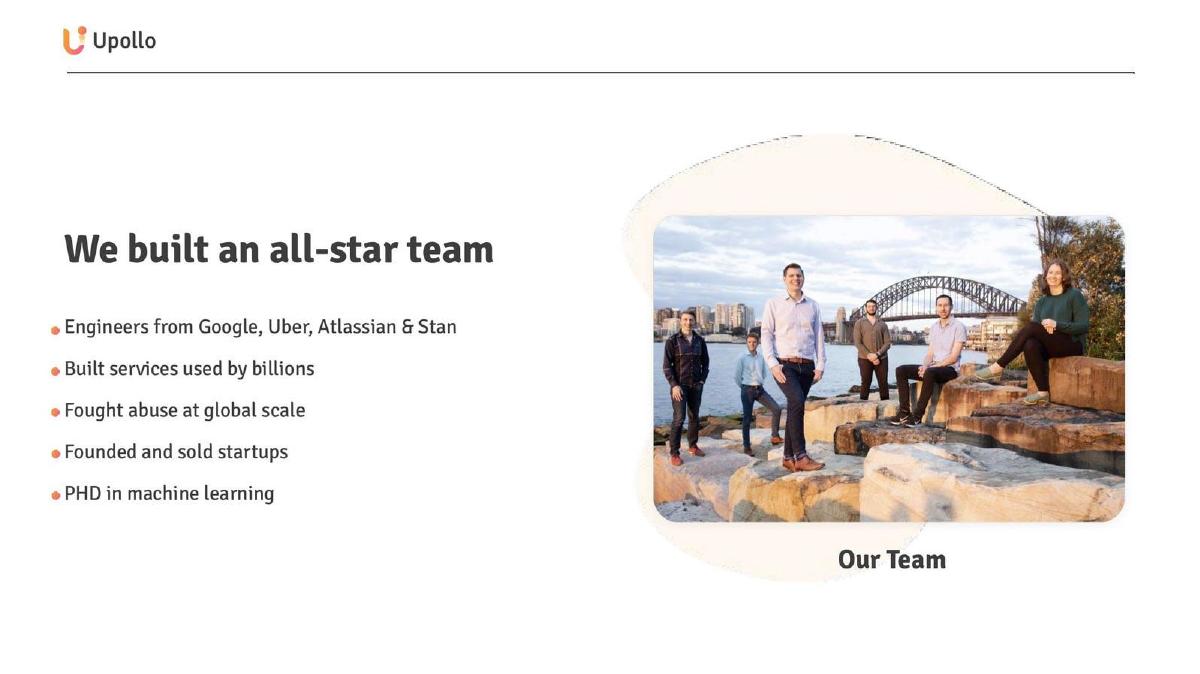
- The team slide (Slide 2) emphasizes high-pedigree engineering backgrounds from Google, Uber, and Atlassian to build immediate technical trust.
- Upollo quantifies the problem by stating that over 10% of trials are repeat attempts and up to 45% of users share accounts (Slide 4).
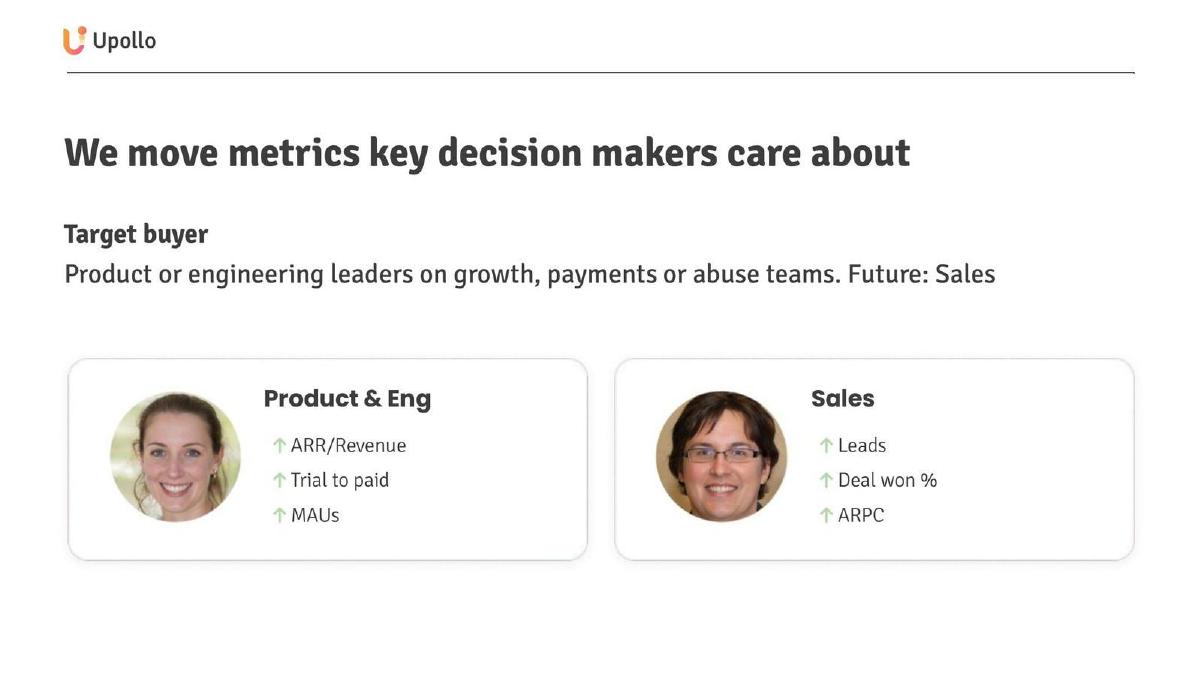
- The deck identifies two distinct buyer personas: Product/Engineering leaders focused on ARR and MAUs, and Sales leaders focused on lead generation (Slide 5).
- Slide 6 addresses the 'build vs buy' objection by noting that an internal solution costs $1M+ to build and requires a 3-4 person team.
- The product is positioned as non-blocking, focusing on 'Insights that turn to action' like expansion in context rather than just locking accounts (Slide 7).
- A customer testimonial from Oddsjam claims Upollo unlocked a 10%+ growth opportunity with minimal effort (Slide 8).
- The pricing strategy is highly aggressive and aligned with customer success, charging 10% of converted first-year revenue (Slide 9).
- The closing slide (Slide 10) frames the market opportunity as a $50B+/year problem that can be solved with just '3 lines' of code.
Upollo: The $2.8M Seed Deck Teardown
Upollo, an Australia-based startup, raised $2.8M in 2023 to tackle a problem that plagues almost every SaaS and consumer software company: account sharing and trial abuse. Their pitch deck is a masterclass in positioning a 'policing' tool as a 'growth' tool. By shifting the narrative from 'stopping bad actors' to 'converting happy paying customers,' Upollo aligns itself with the primary goals of any growth-stage company.
Slide 1: Title Slide
The deck opens with a clean, minimalist design. The logo is prominent, and the tagline 'More happy paying customers' immediately sets the tone. It doesn't mention security, fraud, or abuse—terms that often carry negative connotations. Instead, it focuses on the positive outcome of their service: revenue growth and customer satisfaction.
Slide 2: The All-Star Team
Upollo makes a strategic choice to place the team slide second. For a seed-stage company, the 'who' is often more important than the 'what.' They highlight engineers from Google, Uber, Atlassian, and Stan. The bullet points emphasize that they have 'built services used by billions' and 'fought abuse at global scale.' This establishes immediate technical credibility, suggesting that they have already solved these problems at the world's largest tech companies and are now productizing that expertise.
Slide 3: The Value Proposition
This slide serves as a bridge, stating that they 'drive growth by converting, expanding and understanding users in real time.' The use of a simple illustration keeps the focus on the message. It reinforces the idea that Upollo is a real-time analytics engine designed for growth teams.
Slide 4: Quantifying the Problem
Slide 4 provides the 'shock' statistics necessary to create urgency. It claims that '>10% of trials aren’t first time trials' and 'up to 45% of users share their account.' By stating 'you have probably done it yourself,' they make the problem relatable to the investor. These figures suggest a massive, untapped revenue pool that companies are currently ignoring or unable to capture.
Slide 5: Target Buyers and Metrics
Upollo clearly defines its Ideal Customer Profile (ICP). They target Product and Engineering leaders today, focusing on metrics like ARR, Trial-to-paid conversion, and MAUs. They also signal a future move toward Sales teams, where the tool could help identify leads and increase Average Revenue Per Customer (ARPC). This shows a clear path for horizontal expansion within a customer's organization.
Slide 6: The Build vs. Buy Argument
This is one of the most important slides for an enterprise SaaS pitch. It addresses why companies haven't solved this themselves. Upollo lists three reasons: they don't know where to start, they fear blocking paying customers, and it costs $1M+ to build and maintain. By quantifying the internal cost (3-4 person team + expensive infrastructure), Upollo makes their service look like a bargain.
Slide 7: Product in Action
Slide 7 shows how the insights 'turn to action.' It highlights three use cases: converting on signup, expanding in context (showing a mobile UI with a 'Tired of Sharing?' prompt), and guiding via outreach (email/coupons). This proves the product isn't just a dashboard; it's an active participant in the user journey that nudges users toward payment without being overly aggressive.
Slide 8: Social Proof and Results
The deck includes a screenshot of 'Converted Users' showing payments of $199, $299, and $49, labeled with 'Multiple account' flags. This is followed by a powerful testimonial from the founder of Oddsjam, who claims Upollo helped unlock a '10%+ growth opportunity with just a few minutes of work.' This slide validates the entire pitch by showing real money being captured.
Slide 9: Pricing Aligned to Success
Upollo’s pricing is a standout feature. They offer an 'Unlimited free tier' to let companies see the opportunity size, and then charge '10% of converted ARR.' This 'success-based' model is highly attractive to customers because it eliminates the risk of a high upfront cost for an unproven tool. For investors, it suggests a highly scalable revenue model that grows directly with the value delivered to the client.
Slide 10: The Market Opportunity
The final slide in this set summarizes the scale: 'A $50B+/yr problem... solved in 3 lines.' This frames Upollo as a high-leverage solution. The '3 lines' refers to the ease of integration, which is a key selling point for busy engineering teams. It leaves the investor with the impression of a massive market and a product that is incredibly easy to adopt.
What Works in Upollo's Deck
1. Pedigree-First Approach: By leading with a team that has managed abuse at Google and Uber, Upollo preempts any questions about their ability to handle complex behavioral data. Investors are buying the team's expertise as much as the product.
2. Reframing the Problem: Most 'anti-abuse' tools are sold as cost-saving or risk-mitigation measures. Upollo sells itself as a growth engine. This allows them to tap into growth budgets, which are typically larger and easier to access than security budgets.
3. Low-Friction Entry: The combination of a '3 lines of code' integration and a success-based pricing model removes almost all barriers to entry for a potential customer. This is a classic 'land and expand' strategy.
What is Missing from Upollo's Deck
1. The Ask: The provided slides do not include a specific funding request. While we know from publisher reports that they raised $2.8M, a standard pitch deck should clearly state how much they are raising and what the milestones for that capital are.
2. Competitive Landscape: There is no mention of competitors. While Upollo argues that most companies try to build this internally, there are other third-party tools in the fraud and analytics space. A slide addressing their unique moat against other behavioral analytics platforms would be beneficial.
3. Long-term Financials: While the pricing model is explained, there are no projections on how this scales to $10M or $100M in ARR. Investors at the Seed stage want to see the math on how a 10% success fee translates into a venture-scale business.
What Founders Should Copy
1. Use Relatable Statistics: Upollo’s use of the '45% of users share accounts' stat is powerful because it’s a behavior most people recognize. Founders should find the one 'ugly' truth in their industry and quantify it clearly.
2. Address 'Build vs. Buy' Head-on: Don't wait for the investor to ask why a company wouldn't just build your tool themselves. Show them the math on why building it is a bad business decision (Slide 6).
3. Success-Based Pricing: If your product directly generates revenue for your customers, consider a pricing model that takes a percentage of that gain. It is the ultimate way to prove value and align interests.
Frequently asked questions
- What specific problem does Upollo solve?
- Upollo targets revenue leakage in software companies. According to Slide 4, they address the fact that over 10% of free trials are not first-time trials and up to 45% of users share their accounts. They use behavioral analytics to identify these users and convert them into individual paying subscribers.
- How does Upollo's pricing model work?
- As shown on Slide 9, Upollo uses a 'success-based' pricing model for its 'Grow' tier. They charge a base fee of $250/month plus 10% of the converted first-year revenue. This aligns their incentives with the customer, as they only profit significantly when they successfully convert a sharer or trial abuser into a paying customer.
- Who is the target customer for this software?
- Slide 5 identifies the target buyers as Product or Engineering leaders on growth, payments, or abuse teams. They also highlight a future expansion into Sales teams, where the tool can be used to identify high-intent leads and increase the Average Revenue Per Customer (ARPC).
- What is the technical barrier to entry for Upollo?
- Upollo positions itself as a low-friction integration. Slide 10 claims the problem is 'solved in 3 lines' of code. Conversely, Slide 6 argues that building a similar internal tool would cost a company over $1M and require a dedicated team of 3-4 people to maintain the complex infrastructure.
- Does the deck include financial projections?
- In the 10 slides provided for this teardown, there are no financial projections, burn rate details, or specific revenue targets. The deck focuses primarily on the team, the problem, the product mechanics, and the pricing model to establish market fit and technical capability.