Uplift Labs secured a $5.5M Seed round in 2022 by pitching a mobile-first solution for 3D motion capture. The deck successfully identifies a gap in the market: while elite athletes like Steph Curry and Phil Mickelson benefit from advanced biomechanics, the technology has historically been too cumbersome and expensive for the masses. Uplift's solution uses everyday device cameras to provide AI-powered analytics. The deck is notably strong on team pedigree, featuring leaders from Tesla and Apple, and clear market segmentation across three phases. However, it lacks specific unit economics, a det…
Key takeaways
- The company frames its mission as improving human movement performance across all parts of life on Slide 1.
- Market validation is established on Slide 3 by citing the success of Phil Mickelson and Steph Curry with biomechanical training.
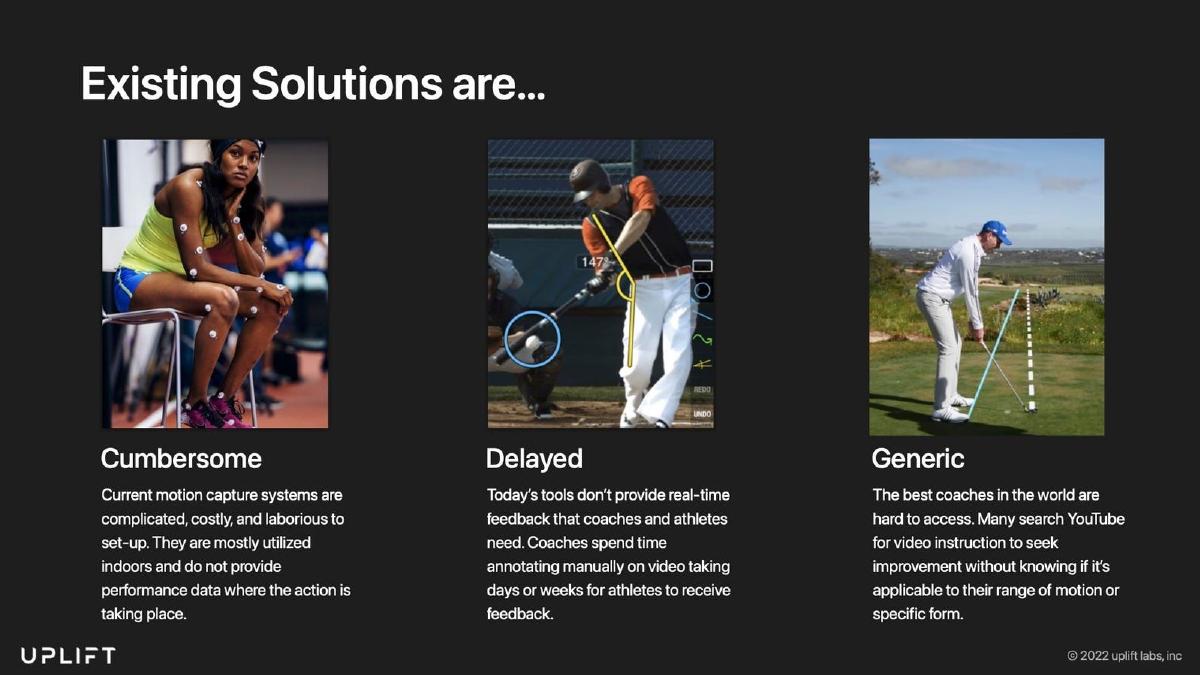
- Slide 4 critiques current solutions as being cumbersome, delayed, and generic, setting up the need for Uplift's mobile-first approach.
- The product is positioned as an AI-powered technology that minimizes injuries while improving performance on Slide 5.
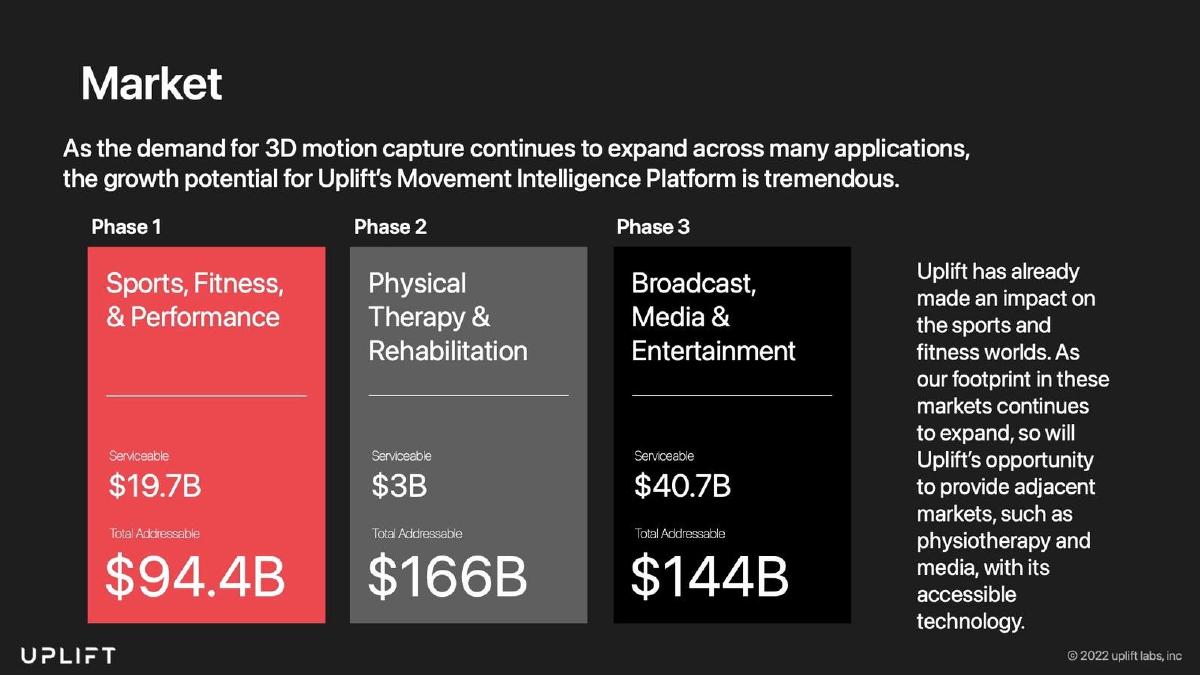
- Slide 11 outlines a three-phase market expansion strategy, starting with a $94.4B Total Addressable Market in Sports and Fitness.
- The deck identifies Physical Therapy as a 'Phase 2' market with a $166B TAM on Slide 11.
- The team slide (Slide 13) highlights significant corporate pedigree, including a CEO who led Tesla Japan and a CTO who is a two-time Academy Award nominee.
- The deck omits a specific financial 'Ask' slide and does not provide current revenue or user growth metrics.
Executive Summary: The Democratization of Biomechanics
Uplift Labs entered the market in 2022 with a clear value proposition: taking the high-end biomechanical analysis used by professional athletes and making it accessible via a smartphone. The deck used to raise their $5.5M Seed round is a masterclass in 'Team and TAM' (Total Addressable Market) pitching. By focusing on the pedigree of the founders and the massive scale of the health and fitness markets, Uplift successfully navigated the Seed stage without relying on heavy revenue metrics.
Slide 1: The Vision Statement
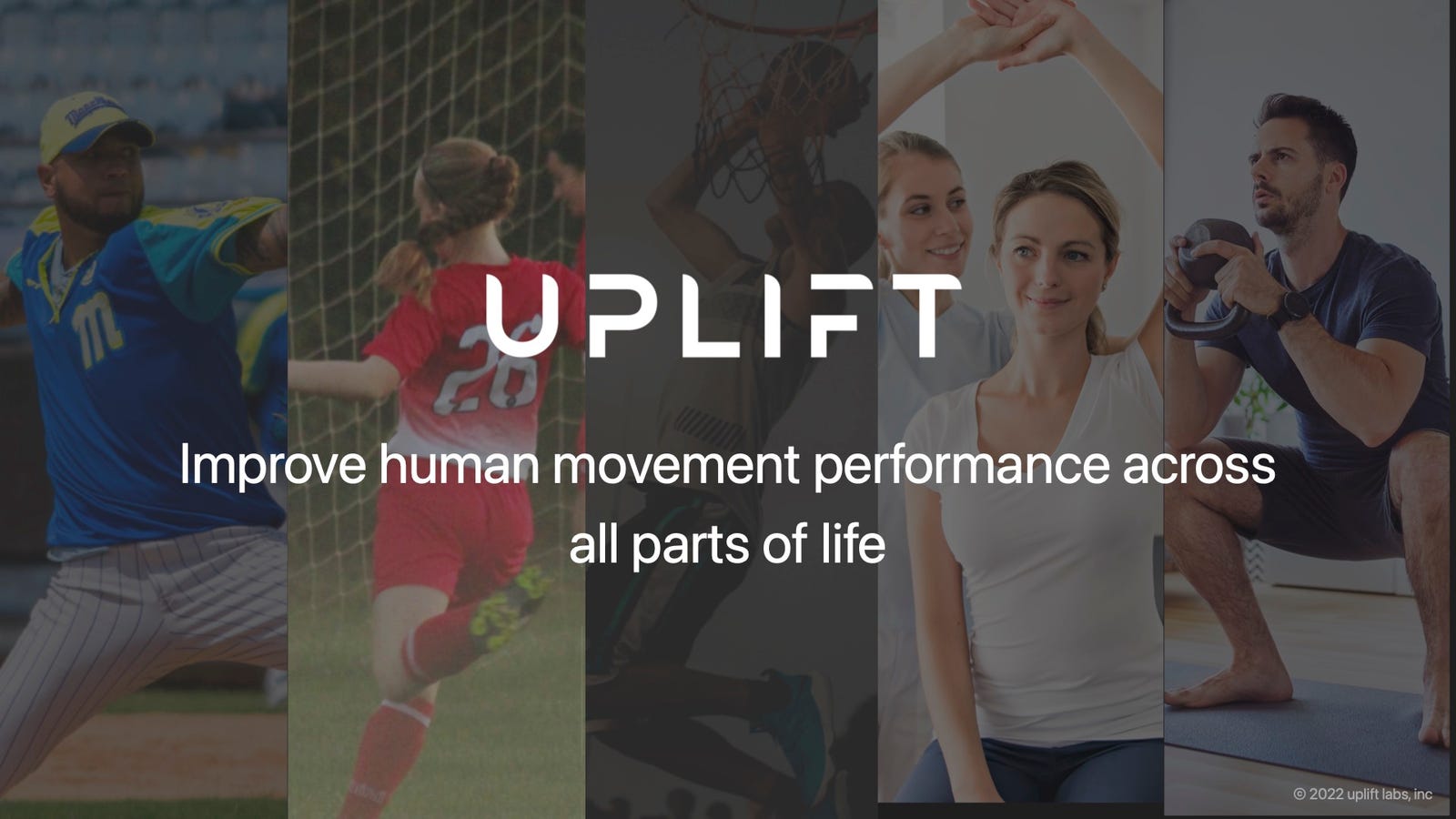
The deck opens with a high-energy montage of athletes and individuals in various states of movement. The core mission is stated plainly: "Improve human movement performance across all parts of life." This slide sets a broad horizontal ambition, signaling to investors that while they may start in sports, the technology is intended for a much wider application, including general wellness and aging.
Slide 2 & 3: Problem and Market Validation
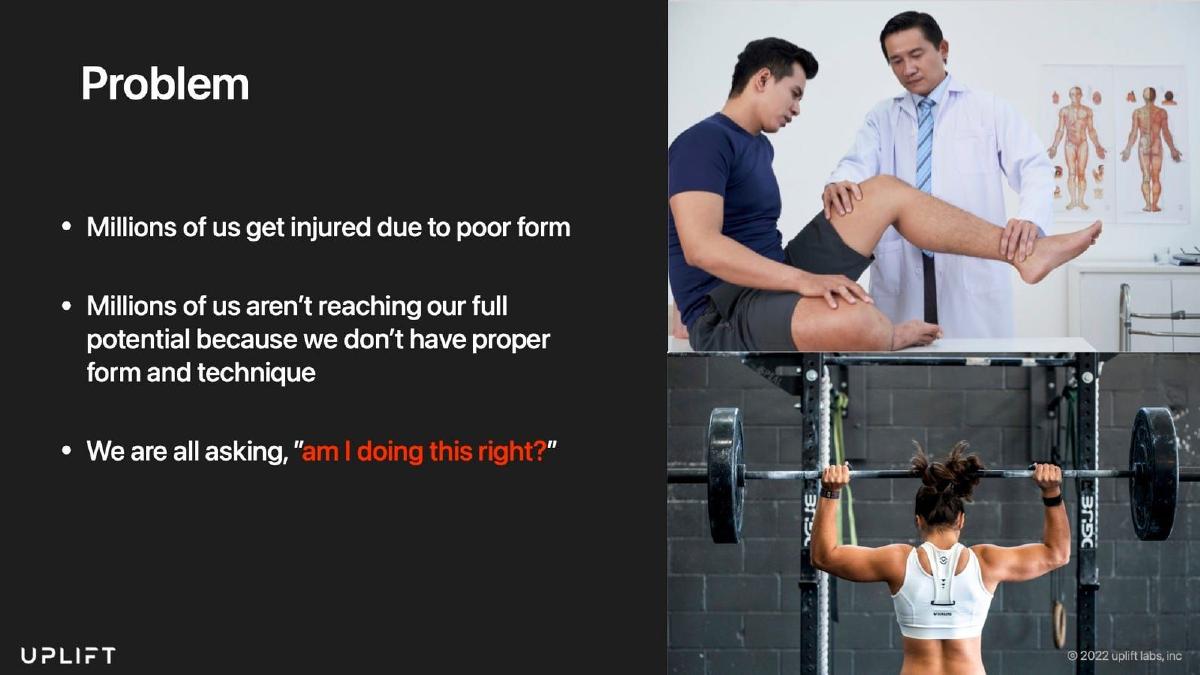
Slide 2 addresses the 'Problems in the space,' though the specific text is summarized in the following slides. Slide 3, 'Market Validation,' is the emotional hook of the deck. It uses two high-profile case studies: Phil Mickelson and Steph Curry. The slide notes that Mickelson credits his training regimen for 'lengthening his career,' and Keke Lyles (who is later revealed to be on the Uplift team) worked with Curry to 'correct his ankle injuries.' The critical insight on this slide is highlighted in red: "Benefits of this intelligence and insight are limited to professionals and elite athletes." This creates the 'Why Now'—the technology exists, but it is not yet accessible.
Slide 4 & 5: The Solution Gap
Slide 4 characterizes existing solutions as "cumbersome, delayed and generic." This is a direct attack on traditional motion capture labs that require markers, multiple calibrated cameras, and hours of data processing. Slide 5 introduces the fix: "Uplift fixes all of that." It defines the product as AI-powered technology providing analytics to improve performance and minimize injuries. The imagery shifts from professional stadiums to a collage of everyday users, reinforcing the democratization theme.
Slide 6, 7 & 8: Product and Tech in Action
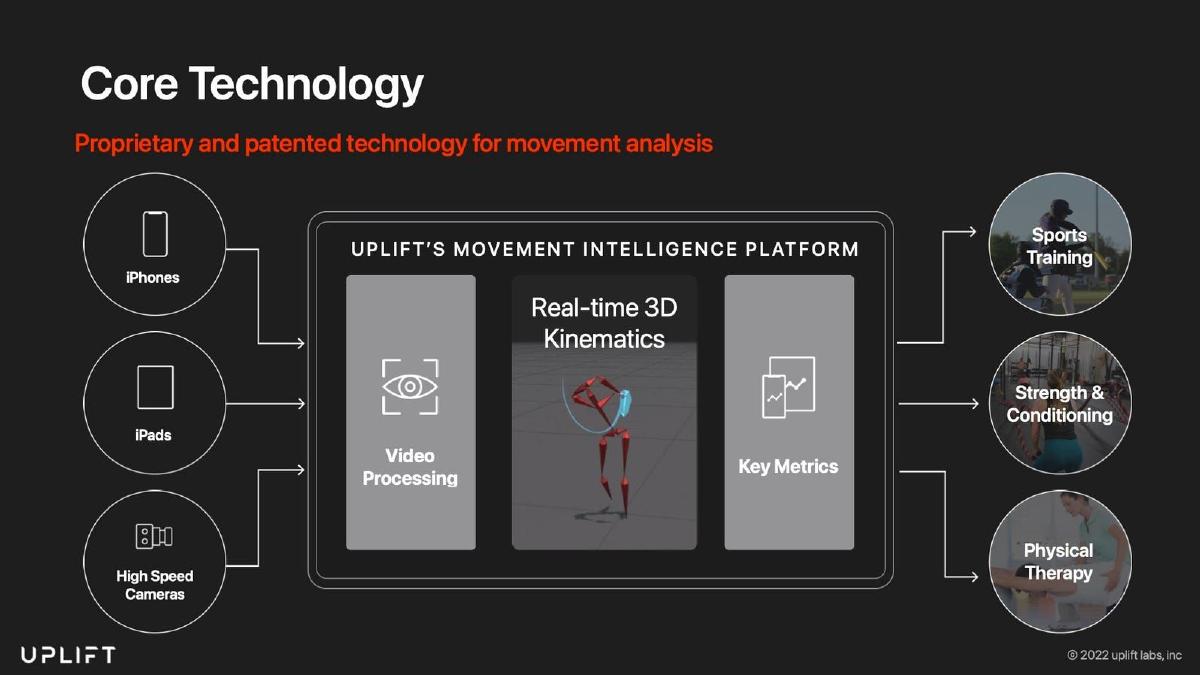
Slide 6 provides a 'Technology Diagram' (text not fully detailed in the provided list), while Slide 7 shows a 'Motion Capture Sample.' Slide 8, titled 'Uplift Capture,' is a crucial visualization. It shows a trainer in a field setting using a simple tripod and smartphone to capture a player's movement. The text "Motion Capture & Video Analytics On The Go" emphasizes the portability and ease of use that differentiates them from legacy lab-based systems.
Slide 9 & 10: Coaching and Connectivity
These slides move beyond simple data capture into the service layer. Slide 9 shows an iPad interface with the headline "Live Coaching & Training From Anywhere." This suggests a B2B2C model where coaches can use the Uplift platform to manage remote clients. By including 'Live Coaching,' Uplift positions itself not just as a data tool, but as a platform for the entire training ecosystem.
Slide 11: The Multi-Phase Market Strategy
This is arguably the most important slide for a Seed stage investor. It breaks down the expansion strategy into three distinct phases:
Phase 1: Sports, Fitness, & Performance - Serviceable: $19.7B, TAM: $94.4B. · Phase 2: Physical Therapy & Rehabilitation - Serviceable: $3B, TAM: $166B. · Phase 3: Broadcast, Media & Entertainment - Serviceable: $40.7B, TAM: $144B.
The slide argues that the technology is 'accessible' and can easily pivot into physiotherapy and media. The total TAM presented is staggering, totaling over $400B across the three phases.
Slide 12 & 13: Recognition and The 'All-Star' Team
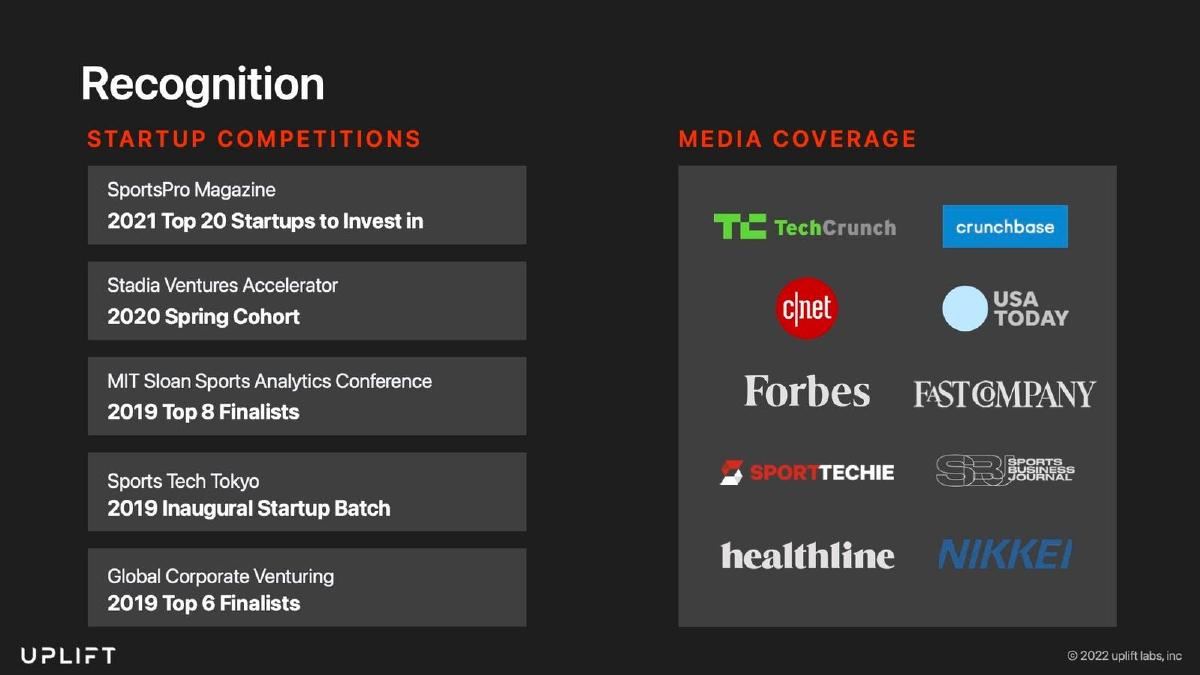
Slide 12 covers 'Uplift Recognition,' likely featuring logos of early partners or press mentions. Slide 13, 'Team with Strong Track Record,' is the deck’s strongest asset. The roster includes:
Sukemasa Kabayama (CEO): Former President of Tesla Japan and Director of Education at Apple Japan. · Jonathan Wills (CTO): 2-time Academy Award nominee and former Sr. Manager at GoPro. · Dr. Rahul Rajan (CAIO): Former Microsoft Researcher with a PhD from Carnegie Mellon. · Keke Lyles: The Director of Performance for the Golden State Warriors mentioned in the validation slide.
For a Seed round, this level of executive experience significantly de-risks the execution side of the investment.
Slide 14: The Mission
The deck concludes with a 'Mission Slide,' reiterating the goal of improving movement. Notably, the deck ends without a specific 'Ask' slide in the provided sequence, which is a common omission in public versions of decks but a critical component for actual fundraising meetings.
What Uplift Labs Does Well
1. Expert Positioning: By including Keke Lyles on the team slide after mentioning his work with Steph Curry on the validation slide, the company creates an immediate sense of authority. They aren't just building a tool; they have the person who used these methods to win NBA championships.
2. Clear Market Segmentation: The three-phase approach on Slide 11 is excellent. It shows investors that the founders have a 'land and expand' strategy. They start with the obvious (sports) but have a clear path to the much larger healthcare and media markets.
3. Visual Proof: Slide 8 effectively communicates the product's simplicity. Showing a smartphone on a tripod in a park is a powerful contrast to the 'cumbersome' solutions mentioned earlier. It proves the 'On The Go' claim without needing a wall of text.
What is Missing from the Deck
1. The Financial Ask: As noted, there is no slide detailing the $5.5M raise reported by Business Insider. A standard deck should include the amount sought, the milestones that capital will hit, and the current runway.
2. Competitive Landscape: While they mention 'existing solutions' are generic, they do not name competitors like Mustard, HomeCourt, or traditional players like Vicon. A sophisticated investor would want to see how Uplift defends its position against other AI-driven computer vision startups.
3. Unit Economics: There is no mention of how they make money. Is it a SaaS subscription for coaches? A per-use fee for athletes? A licensing deal for broadcasters? The lack of a business model slide is a significant gap.
Founder Takeaways
Pedigree Matters at Seed: If your team has worked at companies like Tesla, Apple, or GoPro, lead with it. Uplift Labs used their team slide to prove they have the technical and operational chops to handle a $400B TAM.
Use 'The Why Now': The deck successfully argues that biomechanics are currently trapped in elite labs. The 'Why Now' is the ubiquity of high-quality smartphone cameras and the advancement of AI. Founders should always highlight why their solution wasn't possible five years ago.
Phase Your Growth: Don't try to conquer every market at once. By labeling their markets 'Phase 1, 2, and 3,' Uplift shows focus while still presenting a massive long-term opportunity. This prevents the 'boiling the ocean' critique from investors.
Frequently asked questions
- What is the core technology behind Uplift Labs?
- According to Slide 5 and Slide 6, Uplift Labs uses AI-powered technology and everyday device cameras to provide 3D motion capture and video analytics. This allows for 'on the go' tracking (Slide 8) without the need for the cumbersome, expensive equipment typically found in elite sports laboratories.
- Who are the key members of the Uplift Labs team?
- Slide 13 details a high-pedigree team including CEO Sukemasa Kabayama (formerly of Tesla and Apple), CTO Jonathan Wills (GoPro and Academy Award nominee), and Chief AI Officer Dr. Rahul Rajan (Microsoft Research). They also include Keke Lyles, who is credited with fixing Steph Curry’s injuries.
- How large is the market Uplift Labs is targeting?
- Slide 11 breaks the market into three phases. Phase 1 (Sports/Fitness) has a TAM of $94.4B. Phase 2 (Physical Therapy) has a TAM of $166B. Phase 3 (Broadcast/Media) has a TAM of $144B. The combined serviceable market across all three phases is cited as over $63B.
- Does the deck show any traction or revenue?
- The deck is light on hard financial traction. While Slide 12 mentions 'Uplift Recognition,' the provided slide content does not list specific revenue figures, customer counts, or growth percentages. It relies heavily on the team's track record and the theoretical market size.
- What is missing from the Uplift Labs pitch deck?
- The deck lacks a formal 'Ask' slide detailing how much they are raising and how the funds will be spent. It also omits a detailed competitor matrix, specific unit economics (CAC/LTV), and a clear roadmap of technical milestones achieved to date.