Upstream’s 12-slide deck is a masterclass in brevity, relying on a clear value proposition and strong early traction to secure a $2.5M Seed round in 2021. By positioning the product as 'what LinkedIn Groups would be if it was started today' (Slide 2), the founders leveraged a recognizable pain point in professional networking. The deck prioritizes qualitative success stories (Slide 3) and impressive retention data, such as a 72% event return rate (Slide 4), over granular financial projections. While the deck lacks a formal team slide, business model, or specific 'Ask' in the provided material…
Key takeaways
- The deck uses a direct competitive comparison, framing Upstream as a modern successor to LinkedIn Groups on Slide 2.
- Social proof is prioritized early, with Slide 3 showcasing four specific user success stories ranging from job hunting to investor relations.
- Retention is the core metric highlighted, with 72% of members who attend one event returning for a second, according to Slide 4.
- The platform demonstrates significant pent-up demand, citing a waiting list of over 100,000 members across 100+ communities on Slide 4.
- Market sizing is framed through both user volume (640 million professionals) and historical M&A activity ($26.2 billion LinkedIn acquisition) on Slide 5.
- The deck is visually sparse, using a high-contrast black, white, and blue color palette to maintain focus on short, punchy text blocks.
- Engagement frequency is high for a networking app, with Slide 4 reporting that the average user attends one event per week.
- There is a notable absence of a team slide, revenue model, or detailed roadmap in the 12-slide sequence provided.
The Power of Simplicity in Seed Rounds
Upstream’s 2021 Seed deck is an exercise in restraint. In an era where decks often bloat to 25+ slides filled with complex data visualizations, Upstream raised $2.5M using a 12-slide presentation that feels more like a brand manifesto than a corporate report. The deck relies on a clean aesthetic and a few 'knockout' metrics to convince investors that the professional networking space is ripe for a community-driven alternative to LinkedIn.
Slide 1: Title and Brand Identity
The opening slide features the Upstream logo—a blue dolphin—and the tagline: 'The best way to grow your professional network.' It is minimalist, utilizing white space to establish a professional yet modern brand identity. There are no distracting background images or complex subtitles, forcing the viewer to focus solely on the brand name and its primary function.
Slide 2: The 'What is Upstream?' Slide
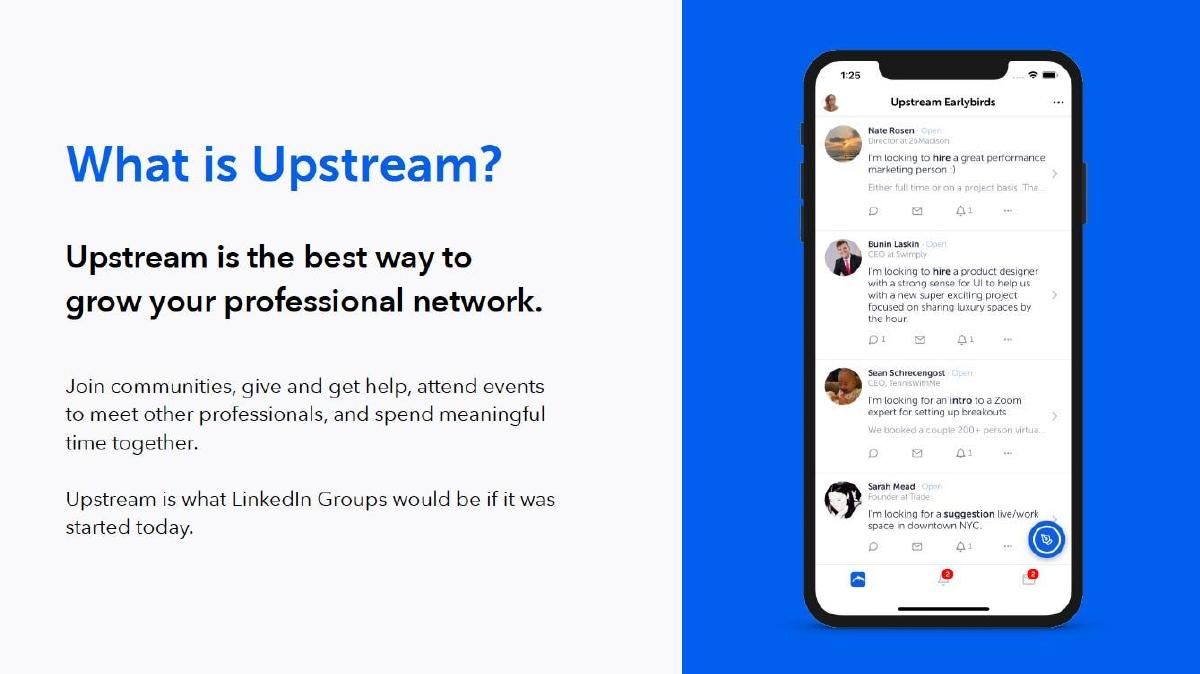
Slide 2 serves as both the definition and the 'hook.' It repeats the tagline but adds a crucial comparison: 'Upstream is what LinkedIn Groups would be if it was started today.' This is a classic 'X for Y' or 'Better version of X' strategy. By anchoring the product to a known but widely criticized feature of a dominant incumbent (LinkedIn Groups), Upstream immediately communicates its purpose without needing a lengthy technical explanation. The slide also includes a mobile mockup showing a feed of 'Asks'—users looking for performance marketers, product designers, or Zoom experts—which illustrates the 'give and get help' nature of the platform.
Slide 3: Social Proof and User Success Stories
Instead of a traditional 'Problem' slide, Upstream uses Slide 3 to show the 'Solution' in action through four specific user testimonials. Omer closed investors for his startup; Sarah received gift suggestions for speakers; Melissa found a job as a UX designer; and Joe met new customers for his nonprofit. By showcasing diverse use cases, the deck proves that the platform’s utility spans across different professional needs, making the value proposition feel tangible rather than theoretical.
Slide 4: Traction and Retention Metrics
This is the 'meat' of the deck. Slide 4 lists the company's achievements and key performance indicators. The most significant figure is that 72% of Upstream members that have come to one event, attend a second one . In the world of social networking, retention is the ultimate validator. The slide also notes that the average user attends one event per week and that there are over 100,000 members across 100+ communities on a waiting list . This combination of high retention and massive top-of-funnel demand is exactly what Seed investors look for to justify a $2.5M check.
Slide 5: Market Size and Valuation Benchmarks
Slide 5 quantifies the opportunity. It breaks the market down into four quadrants:
640 million business professionals in the world. · Over 2 billion active users monthly in group products. · $26.2 billion LinkedIn acquisition price paid by Microsoft. · $52.7 billion market size of social networking measured by revenue.
By including the LinkedIn acquisition price, Upstream isn't just showing the number of users; they are showing the potential exit value of a successful professional network.
Slide 6: The Vision
The final slide in the provided sequence is a simple vision statement: 'Upstream becomes the place for your professional relationships.' It is a bold, expansive goal that suggests the company intends to move beyond just 'events' or 'groups' to become the primary infrastructure for professional networking. The use of a faded background image of a person using a smartphone keeps the focus on the human element of the technology.
What Works in the Upstream Deck
1. The LinkedIn Comparison: The phrase 'what LinkedIn Groups would be if it was started today' is a perfect pitch hook. It identifies a massive, underserved market (professional communities) and implies that the current market leader is failing to innovate in that specific niche.
2. Retention-First Data: Highlighting the 72% return rate for events is much more powerful than simply stating total registered users. It proves that the product is 'sticky' and that the virtual events are providing real value to the participants.
3. Use of Real Faces: Slide 3 uses real names and photos. This builds trust and makes the platform feel like a living community rather than a cold software tool. It humanizes the data presented later in the deck.
What is Missing from the Upstream Deck
1. The Team Slide: In the 12 slides provided, there is no mention of the founders' backgrounds. For a Seed round, the 'Why this team?' question is usually as important as the 'Why this product?' question. Investors want to know if the founders have experience in social scaling, community management, or technical infrastructure.
2. Business Model: There is no explanation of how Upstream intends to make money. While many social platforms focus on growth before monetization, a Seed deck usually hints at future revenue streams (e.g., premium communities, ticketed events, or recruitment tools).
3. Competitive Landscape: While they mention LinkedIn, they don't address other emerging competitors like Lunchclub, Clubhouse (which was peaking in 2021), or specialized Slack/Discord communities. A slide showing how Upstream differs from these platforms would have strengthened the 'moat' argument.
4. The Ask: The deck concludes without a specific funding request or a breakdown of how the capital will be deployed. While the publisher reports a $2.5M raise, the deck itself doesn't state the target amount or the milestones they hope to reach with the funding.
Lessons for Founders
Founders can learn a great deal from Upstream’s focus on qualitative traction . If your startup is in the early stages and your revenue is zero, focus on the behavioral metrics that suggest your product is indispensable. Upstream’s 'one event per week' and '72% return rate' are much more compelling than a projected revenue chart that everyone knows is a guess. Additionally, the deck proves that you don't need complex design to win; you need a clear message and proof that people actually want what you are building.
Frequently asked questions
- What is the primary value proposition of Upstream?
- According to Slide 2, Upstream positions itself as the 'best way to grow your professional network' by allowing users to join communities, give and get help, and attend virtual events. It specifically targets the dissatisfaction with existing tools by claiming to be the modern version of LinkedIn Groups.
- What metrics did Upstream use to prove product-market fit?
- Upstream focused on engagement and retention metrics on Slide 4. They highlighted that 72% of event attendees return for a second event, the average user attends one event per week, and they have a waiting list exceeding 100,000 members.
- How does Upstream define its market opportunity?
- On Slide 5, the company looks at the market through four lenses: the 640 million global business professionals, the 2 billion users in group products, the $52.7 billion social networking revenue market, and the $26.2 billion valuation benchmark set by Microsoft's acquisition of LinkedIn.
- Is there a business model included in the deck?
- No. The provided 12 slides do not contain information regarding monetization strategies, unit economics, or revenue projections. The deck focuses entirely on user growth, engagement, and the vision for the platform.
- What is missing from the Upstream pitch deck?
- The deck omits several standard components, including a team slide (biographies of founders), a competitive landscape matrix, a detailed product roadmap, a business model, and a specific financial 'Ask' detailing how the $2.5M would be spent.