Urban Logiq’s 8-slide deck from 2016 is a rare example of a 'show, don't tell' strategy in the GovTech sector. Rather than explaining the complexities of data silos and machine learning in prose, the deck uses a stark visual contrast between physical paper maps on cubicle walls and high-fidelity digital dashboards. This visual narrative, supported by the logos of major municipal partners like San Francisco and Surrey, effectively communicates the value proposition of modernizing city planning. While the deck lacks traditional slides for market size, business model, and competition, its brevit…
Key takeaways
- The deck uses only 8 slides, prioritizing visual impact over detailed text or financial projections.
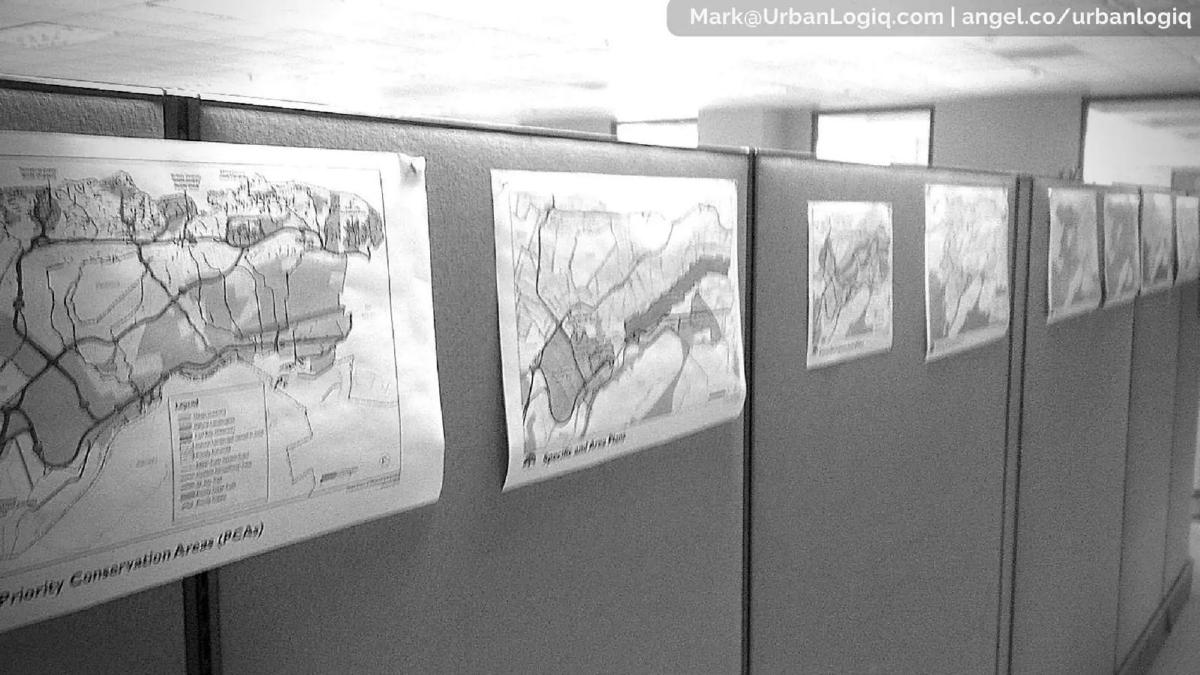
- Slide 2 serves as a powerful 'Problem' slide without using a single word, showing outdated paper maps pinned to office cubicles.
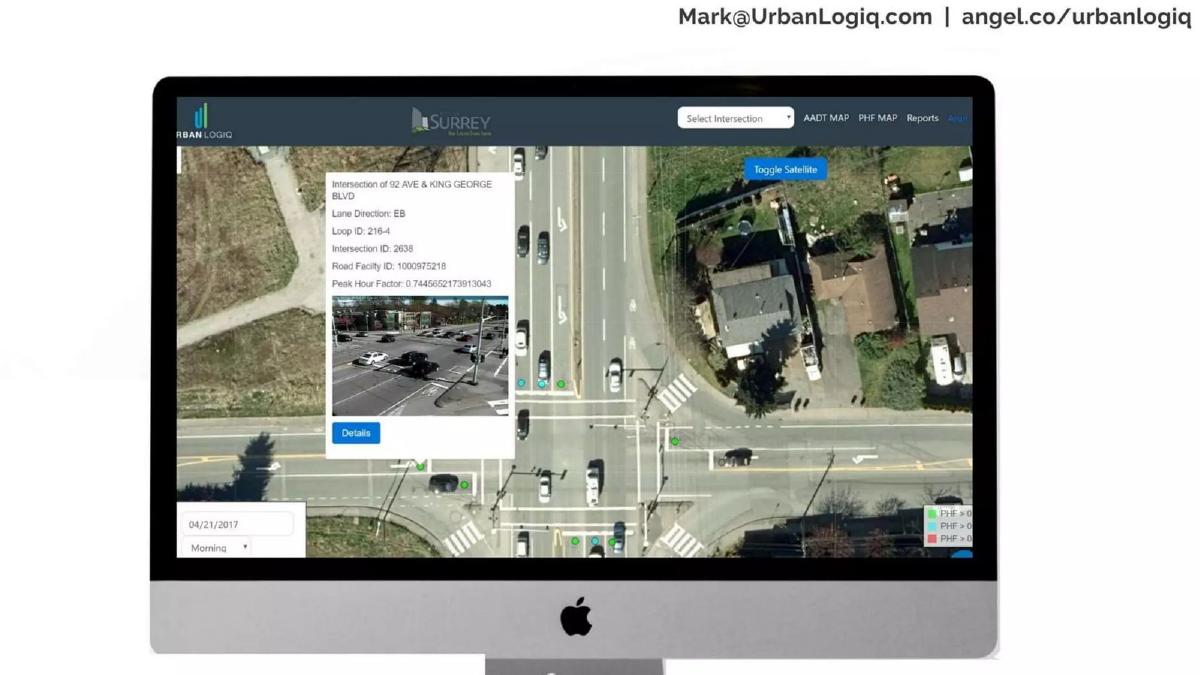
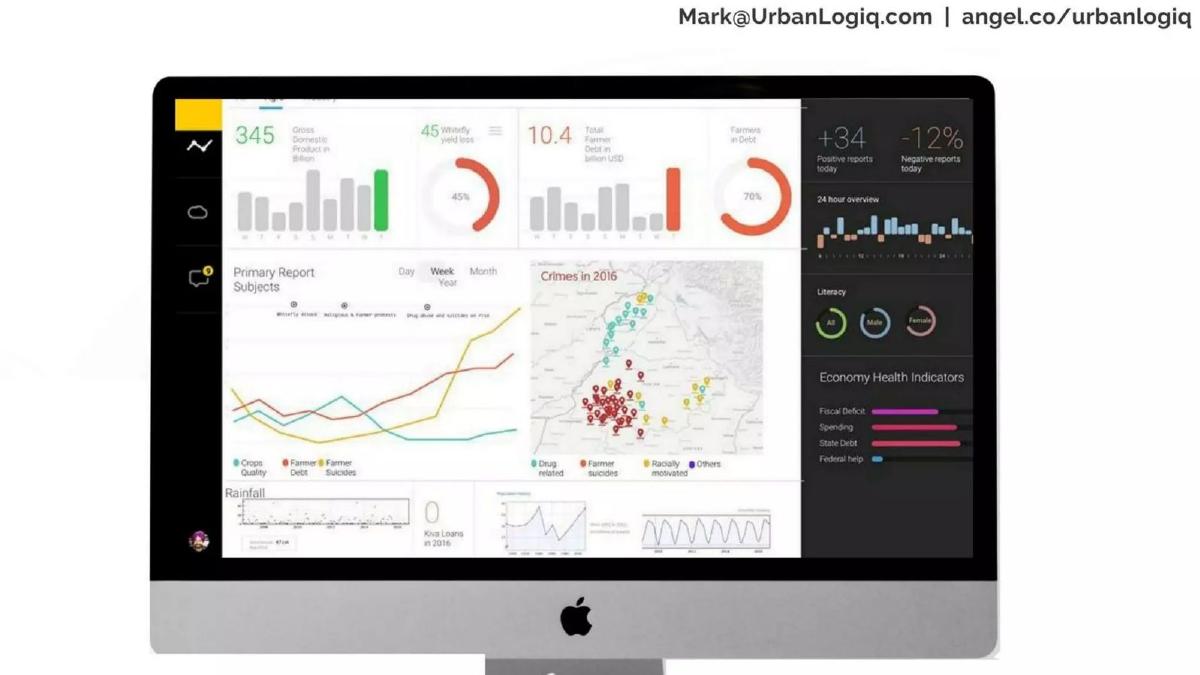
- Product functionality is demonstrated through high-resolution screenshots on Slides 3 and 4, showing real-world intersection data and economic dashboards.
- The company highlights a strategic partnership or integration with General Motors on Slide 5, signaling access to private sector mobility data.
- The team slide (Slide 6) identifies four co-founders but omits their professional backgrounds or previous exits.
- Social proof is concentrated on Slide 7, featuring logos from the City of San Francisco, City of Surrey, and City of Richmond.
- The deck completely omits a formal 'Ask' slide, financial forecasts, or a competitive landscape analysis.
- The contact information is consistently placed in the top right header of every slide, including an AngelList profile link.
The Visual Narrative of GovTech Modernization
Urban Logiq (formerly CommunityLogiq) presents a pitch deck that is remarkably light on text. In an industry like GovTech, which is often bogged down by bureaucratic jargon and complex procurement cycles, this deck chooses to focus on the end result: the transition from analog to digital. The deck consists of only 8 slides, and most of them contain fewer than ten words. This teardown examines how a company can communicate a complex data integration value proposition through visual storytelling and social proof.
Slides 1-2: The Hook and the Problem
Slide 1: Title Slide The deck opens with a clean, professional title slide. It features the Urban Logiq logo—a stylized 'U' and 'L' that resembles a bar chart—and the tagline 'Analytics for Urban Planning.' The background is a high-contrast, black-and-white aerial view of a dense city (New York City). Notably, the contact information for 'Mark' and a link to their AngelList profile are placed in the top right corner, a placement that remains consistent throughout the deck.
Slide 2: The Silent Problem Slide This is perhaps the most effective slide in the deck. It contains no text. It is a grainy, black-and-white photo of an office cubicle wall covered in physical, paper maps. For an investor, this immediately communicates the 'before' state of the industry: fragmented, manual, and stuck in the 20th century. It sets the stage for a digital solution without needing to list bullet points about 'data silos' or 'inefficient workflows.'
Slides 3-5: The Solution and Data Sources
Slide 3: Transportation Analytics Product The first 'Solution' slide shows a high-fidelity screenshot of the platform on an iMac. The interface shows a satellite view of an intersection (92 Ave & King George Blvd). A data overlay displays specific metrics like 'Peak Hour Factor: 0.7445652173913043' and 'Lane Direction: EB.' The City of Surrey logo is visible within the software interface, proving that this is a live implementation rather than a mockup. This slide addresses the transportation use case mentioned in the company's description.
Slide 4: Economic Intelligence Dashboard The second product slide shows a different dashboard focused on economic data. It includes metrics such as 'Gross Domestic Product in Billion,' 'Total Farmer Debt,' and 'Crimes in 2016.' There are heat maps and trend lines for 'Economy Health Indicators' like Fiscal Deficit and Spending. This slide demonstrates the breadth of the platform, moving beyond traffic to broader policy-making tools.
Slide 5: The Data Partnership This slide features the 'General Motors' logo prominently over a wireframe of a connected vehicle. Icons representing SOS, connectivity, and location data float above the car. Given the company's mission to integrate private data, this slide serves as a placeholder for their relationship with OEMs (Original Equipment Manufacturers). It suggests that Urban Logiq isn't just using government data, but is enriching it with proprietary automotive data to provide better insights.
Slides 6-8: Team, Traction, and Closing
Slide 6: The Team The team slide introduces four co-founders: Mark Masongsong (CEO), Arvinder Kang (CTO), Herman Chandi, and Arun Dawit. The slide uses casual, circular headshots against a city background. However, the slide is missing any biographical information, past company experience, or educational credentials. In a $150k round, the team's pedigree is often the primary driver of the investment, making this omission a significant risk for a cold deck.
Slide 7: Traction and Social Proof This slide displays three logos: The San Francisco Office of Economic and Workforce Development, the City of Surrey, and the City of Richmond. As noted in the catalogue facts, Urban Logiq was part of the 2016 Startup in Residence Program with San Francisco. These logos are the 'validation' for the product shown in Slides 3 and 4. For a GovTech startup, showing that you have already bypassed the difficult government procurement process in three major jurisdictions is a powerful signal of de-risking.
Slide 8: Closing The final slide is a duplicate of the title slide, reinforcing the branding and providing the contact information one last time.
What Works in the Urban Logiq Deck
Powerful Visual Contrast: The jump from the paper maps on Slide 2 to the sophisticated digital dashboards on Slides 3 and 4 creates a clear narrative of progress. It makes the 'why now' of the investment obvious: cities are finally ready to move from paper to pixels.
Real Product Evidence: By showing the City of Surrey logo inside the actual software interface, the founders prove that they have a working product that is already in the hands of users. This is much more persuasive than a list of 'planned features.'
Strategic Minimalism: The deck can be 'read' in under 30 seconds. This is ideal for a first-touch deck intended to secure a meeting. It doesn't overwhelm the investor with technical details about machine learning algorithms, focusing instead on the utility of the output.
What Is Missing from the Urban Logiq Deck
The Business Model: There is no information on how Urban Logiq makes money. Is it a per-seat license? A population-based annual subscription? A data-as-a-service model? Investors need to know if the revenue model is scalable or if it requires heavy consulting and implementation hours.
The Market Size (TAM): The deck assumes the investor already understands that 'cities are a big market.' It fails to quantify the opportunity. There is no mention of the number of mid-to-large sized cities globally or the total spend on urban planning software.
Competitive Landscape: Urban planning and GIS (Geographic Information Systems) is a crowded field with legacy giants like Esri. The deck does not explain how Urban Logiq differentiates itself from existing tools or why a city would choose them over a module from a larger ERP provider.
The Ask: The deck does not state how much money they are looking to raise or what the milestones for that capital will be. While the catalogue facts state they raised $150,000, that information is nowhere to be found on the slides.
What a Founder Should Copy
The 'Problem' Photo: Founders should look for a single, visceral image that represents the 'old way' of doing things. If you are replacing spreadsheets, show a messy, multi-tabbed Excel file. If you are replacing paper maps, do exactly what Urban Logiq did. It is more memorable than any bulleted list.
Consistent Header Info: Keeping the contact email and a link to a platform like AngelList or LinkedIn in the header of every slide is a smart move. It ensures that no matter which slide an investor screenshots or shares, the path back to the founder is clear.
Contextual Traction: Don't just list logos on a 'Customers' slide. If possible, show the customer's logo inside a screenshot of your product. It proves the relationship is active and the product is deployed, rather than just being a 'pilot' or a 'letter of intent.'
Final Thoughts
The Urban Logiq deck is a 'teaser' deck in the truest sense. It provides just enough visual evidence of product-market fit and government traction to pique interest without getting bogged down in the details. While it would likely fail as a standalone 'send-ahead' for an institutional Series A, it was perfectly calibrated for a 2016 pre-seed environment where the goal was to demonstrate that a team of four could actually get software into the hands of city planners.
Frequently asked questions
- How much did Urban Logiq raise with this deck?
- According to the catalogue listing from pitchdeckhunt.com, Urban Logiq raised $150,000 in 2016. This was a relatively small seed or pre-seed round, likely intended to bridge the gap between their participation in the Startup in Residence Program and a larger institutional round.
- What is the primary problem Urban Logiq is solving?
- The deck visually identifies the problem as the reliance on manual, paper-based processes in urban planning. Slide 2 shows physical maps on cubicle walls, which the company aims to replace with integrated digital analytics that combine siloed government data with private and public sources.
- Who are the target customers for this platform?
- The target customers are municipal governments and urban planners. This is evidenced by the logos on Slide 7, which include the San Francisco Office of Economic and Workforce Development and the cities of Surrey and Richmond.
- Is there a business model included in the deck?
- No, the deck does not include a business model slide. There is no mention of SaaS pricing, contract lengths, or implementation fees. The focus is entirely on the product's utility and the company's existing government traction.
- What role does General Motors play in the deck?
- Slide 5 features a large General Motors logo and a wireframe of a connected car. While the slide has no text, the catalogue listing mentions integrating 'private data sources.' This suggests a data partnership where GM provides vehicle telemetry to help Urban Logiq optimize traffic light timing and infrastructure planning.