This 2021 investor presentation from Circle Internet Financial Limited serves as a roadmap for the company's attempted $9 billion SPAC merger. The deck positions Circle not merely as a crypto company, but as a 'digital currency native commercial financial institution' aimed at disrupting the $130 trillion M2 money supply. Key highlights include aggressive 2023 projections of $190 billion USDC in circulation and $885 million in total revenue. The presentation leans heavily on institutional credibility, showcasing partnerships with Visa and Coinbase, while providing a rare look at the unit econ…
Key takeaways
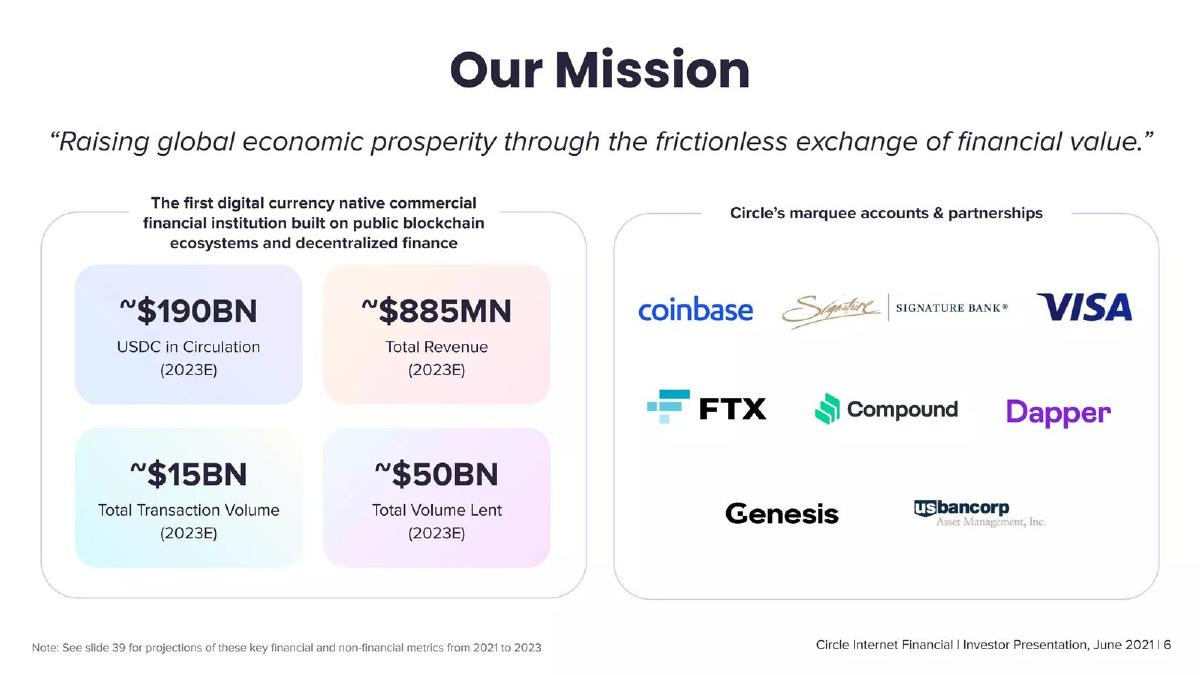
- Circle projected USDC in circulation to reach ~$190BN by 2023, a massive leap from its 2021 levels (Slide 6).
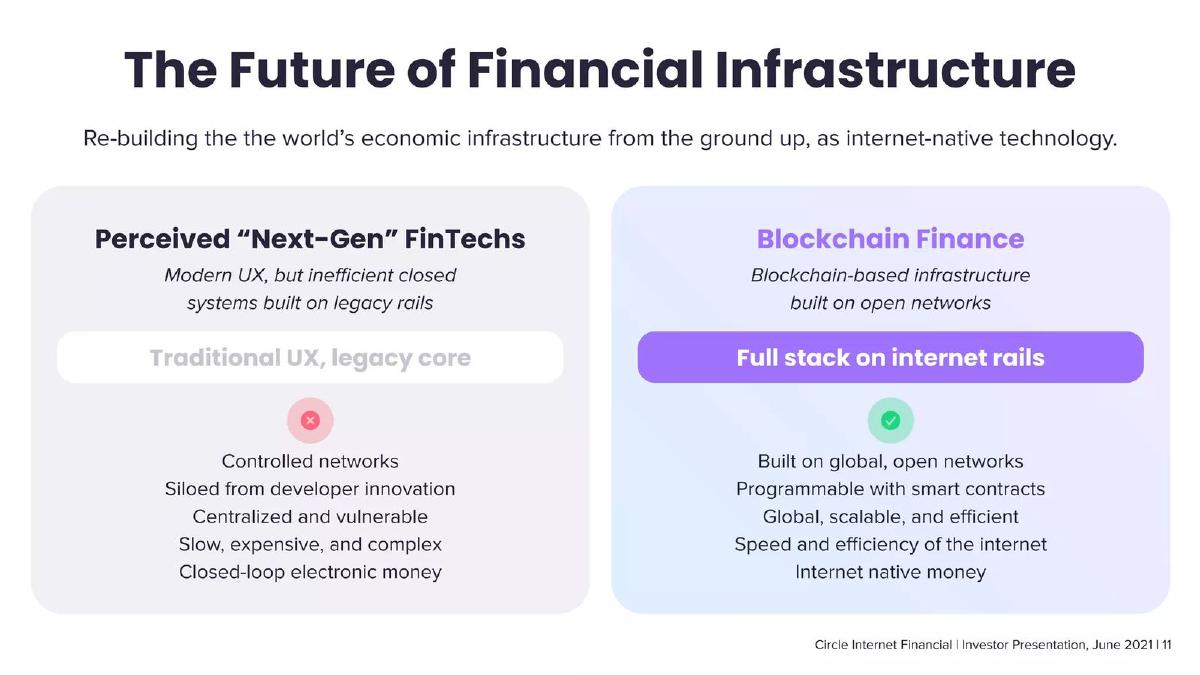
- The company positioned itself against 'Perceived Next-Gen FinTechs,' arguing that legacy rails are inefficient compared to 'Full stack on internet rails' (Slide 11).
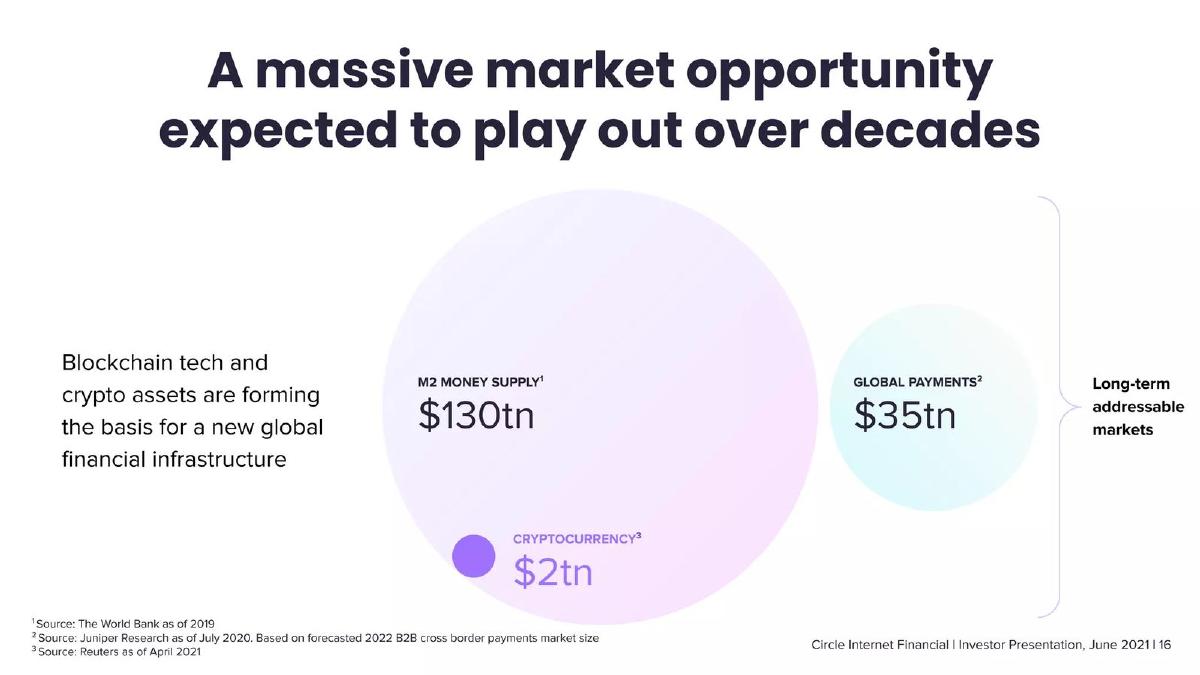
- Circle identified a $130TN M2 money supply and $35TN global payments market as its long-term addressable targets (Slide 16).
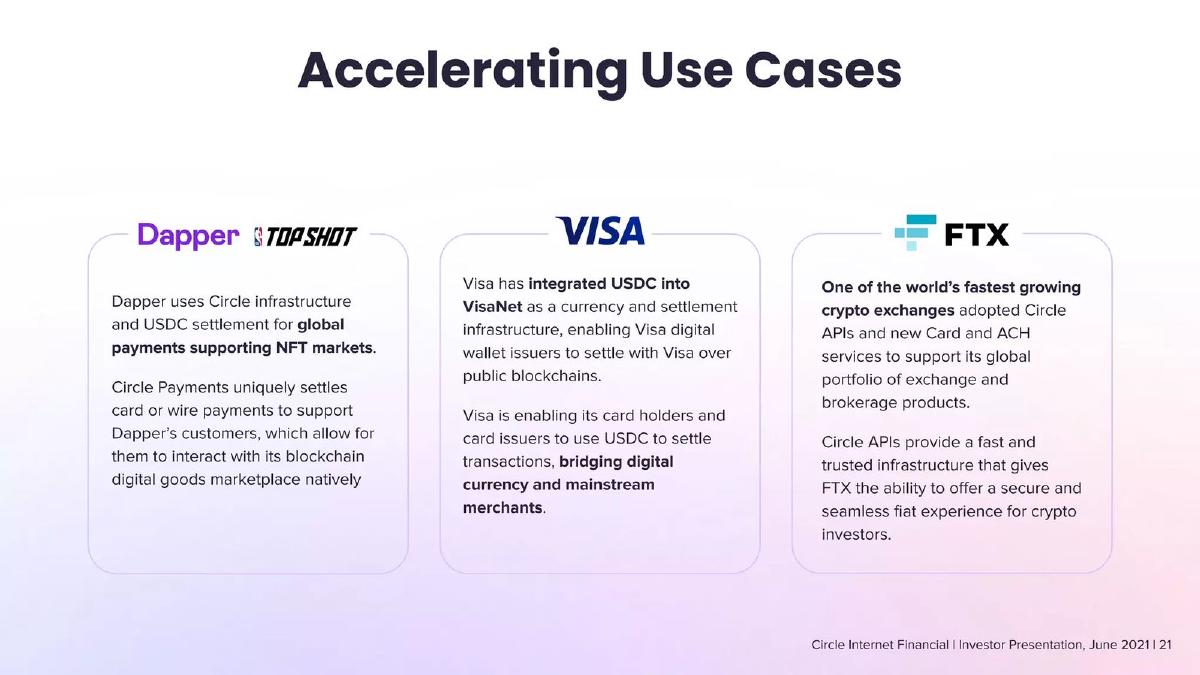
- The deck highlights marquee partnerships with Visa, Coinbase, and FTX to validate its infrastructure (Slide 6, Slide 21).
- A critical financial lever revealed is interest rate sensitivity: a +200bps shift was projected to generate $2.22BN in incremental USDC interest income in 2023 (Slide 41).
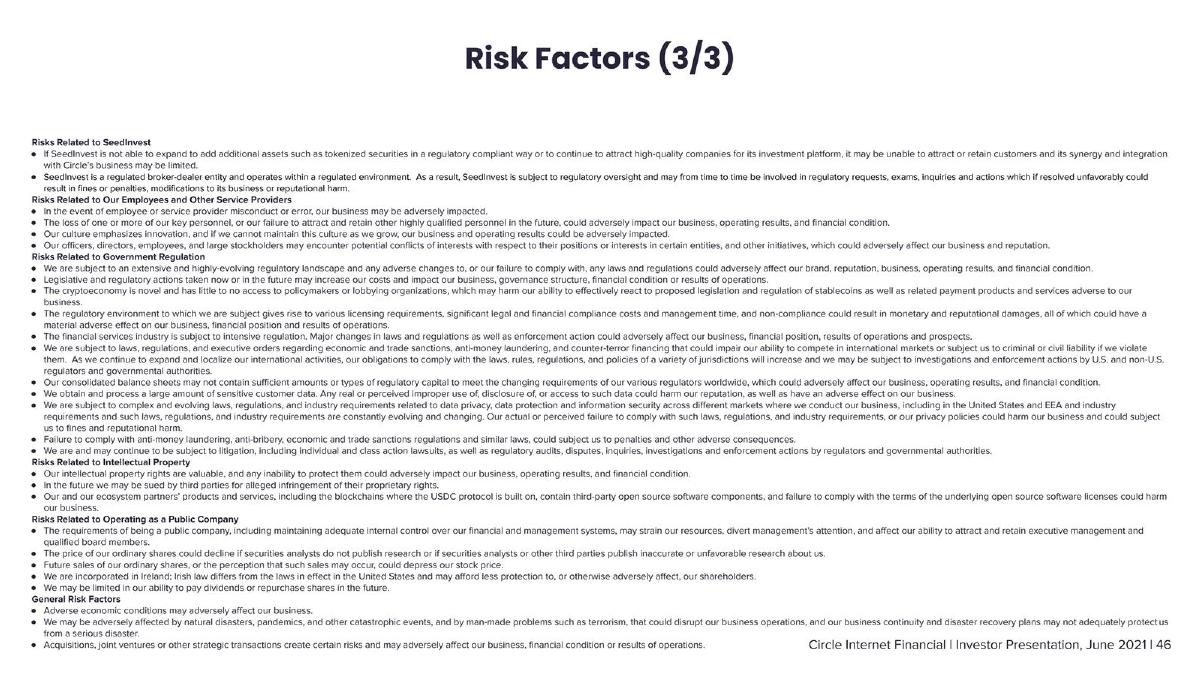
- The presentation explicitly mentions SeedInvest as a regulated broker-dealer entity within its ecosystem (Slide 46).
- Circle frames its mission as 'Raising global economic prosperity through the frictionless exchange of financial value' (Slide 6).
- The deck includes a comprehensive 'Risk Factors' section covering regulatory, intellectual property, and public company risks (Slide 46).
Circle Investor Presentation: The $9 Billion Vision
The 2021 investor presentation for Circle Internet Financial Limited is a significant artifact from the height of the SPAC (Special Purpose Acquisition Company) boom. At the time, Circle was positioning itself to go public via a merger with Concord Acquisition Corp at a valuation that eventually climbed to $9 billion. This deck is designed to bridge the gap between the complex world of decentralized finance (DeFi) and the traditional expectations of institutional public market investors.
Slide 1: Title Slide
The deck opens with a clean, minimalist title slide. It identifies the entity as 'Circle Internet Financial Limited' and is dated '2021.' The branding is professional and avoids the typical 'crypto-punk' aesthetic, signaling a move toward institutional maturity.
Slide 6: Our Mission and Key Metrics
This slide establishes the company's core identity. The mission statement is 'Raising global economic prosperity through the frictionless exchange of financial value.' This is a classic 'Big Hairy Audacious Goal' (BHAG) that frames the company as a social and economic utility rather than just a software provider. Crucially, the slide provides 2023 projections: ~$190BN USDC in circulation, ~$885MN Total Revenue, ~$15BN Total Transaction Volume, and ~$50BN Total Volume Lent. The right side of the slide is a 'who's who' of 2021 finance and crypto, featuring Coinbase, Visa, FTX, and Signature Bank. The inclusion of FTX and Signature Bank serves as a reminder of the volatility of the sector in the years following this presentation.
Slide 11: The Future of Financial Infrastructure
Circle uses this slide to perform a competitive 'frame-up.' They categorize existing successful startups (like Stripe or Revolut, though not named) as 'Perceived Next-Gen FinTechs.' They label these as 'Traditional UX, legacy core' and mark them with a red 'X.' They contrast this with 'Blockchain Finance,' which they describe as 'Full stack on internet rails.' The key arguments for their model are that it is 'Programmable with smart contracts' and 'Internet native money.' This slide is intended to convince investors that Circle isn't just a better bank, but a fundamentally different species of financial institution.
Slide 16: A Massive Market Opportunity
To justify a multi-billion dollar valuation, Circle points to the largest possible TAM (Total Addressable Market). They display three circles: Cryptocurrency at $2tn, Global Payments at $35tn, and M2 Money Supply at $130tn. By placing their 'Long-term addressable markets' bracket next to the $130tn and $35tn figures, they are suggesting that USDC is a replacement for the very concept of money and global settlement, not just a tool for trading digital assets.
Slide 21: Accelerating Use Cases
This slide provides concrete examples of how their infrastructure is used. Dapper Labs is cited for NFT market settlement; Visa is highlighted for integrating USDC into VisaNet to enable digital wallet issuers to settle over public blockchains; and FTX is noted for using Circle APIs for card and ACH services. This slide is vital for proving that USDC has 'utility' beyond speculative trading.
Slide 30-31: Financial Opportunity and Investment Highlights
Slide 30 acts as a section divider for 'Financial Opportunity.' Slide 31 summarizes the bull case for the investment. It lists seven key highlights, including 'Massive network effects,' a 'Differentiated product suite,' and an 'Executive leadership team with decades of industry experience.' It frames the company as having an 'Attractive economic model with scale, growth and profitability.'
Slide 40-41: Appendix and Interest Rate Sensitivity
After the 'Appendix' divider on slide 40, slide 41 provides perhaps the most important financial data in the deck. It shows how Circle’s income is tied to interest rates. The table shows that a +200bps (basis point) shift in interest rates would generate an incremental $940 million in 2022 and $2.22 billion in 2023. This illustrates that Circle is, in many ways, a massive treasury management play. When rates go up, the interest they earn on the cash and treasuries backing USDC flows directly to the bottom line.
Slide 46: Risk Factors (3/3)
The final slide shown is a dense wall of text detailing risks. It specifically mentions SeedInvest , a subsidiary at the time, noting that it is a 'regulated broker-dealer entity.' It also highlights the 'highly-evolving regulatory landscape' and the risk that 'the crypto-economy is novel and has little to no access to policymakers.' This level of disclosure is standard for SPAC filings but provides a sobering counterpoint to the aggressive growth projections earlier in the deck.
What Circle Does Well
Circle excels at 'Institutional Translation.' They take concepts that are often viewed as opaque or risky—like stablecoins and DeFi—and rebrand them using the language of traditional finance. Terms like 'M2 Money Supply,' 'Treasury Infrastructure,' and 'Settlement Rails' are designed to make a hedge fund manager feel comfortable. The deck is also exceptionally good at showing, not just telling, its market dominance through the use of high-tier partner logos.
What is Missing from the Deck
While the deck is comprehensive, there are notable omissions in this specific 10-slide selection. There is no detailed breakdown of the Reserve Composition . While they mention being 'backed,' investors today would demand a slide-by-slide audit of exactly what percentage is in cash versus short-term treasuries. Additionally, the Unit Economics of the 'Total Volume Lent' ($50BN projection) are not detailed here, leaving questions about the credit risk associated with their lending products. There is also no specific Team Slide in this selection, which is a missed opportunity to showcase the 'decades of experience' mentioned in the highlights.
Lessons for Founders
Founders should study how Circle uses Macro Trends to justify their valuation. They don't just say 'we are growing'; they say 'the world is moving to internet-native money, and here is the $130 trillion pool we are tapping into.' Another lesson is the Sensitivity Analysis on slide 41. Showing investors how your business performs under different macroeconomic conditions (like interest rate changes) builds immense credibility and shows that you understand the fundamental levers of your revenue model. Finally, the use of Case Studies (Slide 21) is a powerful way to move from abstract technology to real-world business value.
Frequently asked questions
- What was Circle's projected revenue for 2023 according to the deck?
- Circle projected total revenue of approximately $885 million for the year 2023. This figure was part of a broader set of projections that included $190 billion in USDC circulation and $15 billion in total transaction volume. These estimates were intended to show the rapid scaling potential of the stablecoin ecosystem as it moved into mainstream financial infrastructure.
- How does Circle differentiate itself from traditional FinTech companies?
- On slide 11, Circle contrasts 'Blockchain Finance' with 'Perceived Next-Gen FinTechs.' It argues that traditional FinTechs are merely modern user interfaces built on 'legacy rails' that are slow, expensive, and siloed. In contrast, Circle claims to offer a 'Full stack on internet rails' that is programmable, global, and efficient, utilizing open networks rather than controlled, centralized ones.
- What is the significance of the interest rate sensitivity table on slide 41?
- This slide reveals the core profit engine of a stablecoin issuer. Because Circle holds reserves against USDC, rising interest rates significantly increase their income. The deck shows that a 200 basis point increase in rates would result in an additional $2.22 billion in interest income by 2023, demonstrating that the business model is highly leveraged to macroeconomic environments.
- Which major financial and crypto partners are highlighted in the deck?
- Circle emphasizes its institutional reach by showcasing logos and case studies for Visa, Coinbase, Signature Bank, and US Bancorp. It also highlights its role in the crypto ecosystem through partnerships with FTX, Dapper Labs (specifically for NFT markets), and Compound. These partnerships serve as social proof of Circle's infrastructure reliability.
- What are the primary risks Circle identified regarding its business model?
- The deck includes three pages of risk factors, with slide 46 focusing on regulatory and public company risks. Key concerns include the 'highly-evolving regulatory landscape,' potential litigation, the novelty of the 'cryptoeconomy,' and the specific risks associated with operating SeedInvest, their regulated broker-dealer arm. It also notes risks related to maintaining intellectual property and the volatility of being a public company.