Urjakart’s 12-slide deck from 2013 is a straightforward exercise in identifying a massive, unorganized market and proposing a digital solution. The company addresses the $10 billion Indian home improvement retail market, which was growing at 18% per annum at the time. The deck highlights a clear revenue model based on a 10-20% service fee and projects $30 million in revenue between 2015 and 2018. While the traction slides show early promise with 1,000+ customers and 100% revenue growth, the deck is notably thin on operational details, specific unit economics, and a clear 'Ask' for investors.…
Key takeaways
- The Indian home improvement retail market is valued at $10 billion with an 18% annual growth rate (Slide 5).
- The business model relies on a service fee ranging from 10% to 20% on transactions (Slide 7).
- Urjakart projects reaching $30 million in revenue between 2015 and 2018 (Slide 7).
- Early traction as of 2014 included 1,000+ customers and 2,500+ products (Slide 8).
- The company reported 100% revenue growth and expected a 2014 turnover exceeding $200,000 (Slide 9).
- Competitive strategy includes a private brand named 'SolUrja' and a franchisee model (Slide 11).
- The founders hold degrees from Delhi College of Engineering and Georgia Tech (Slide 12).
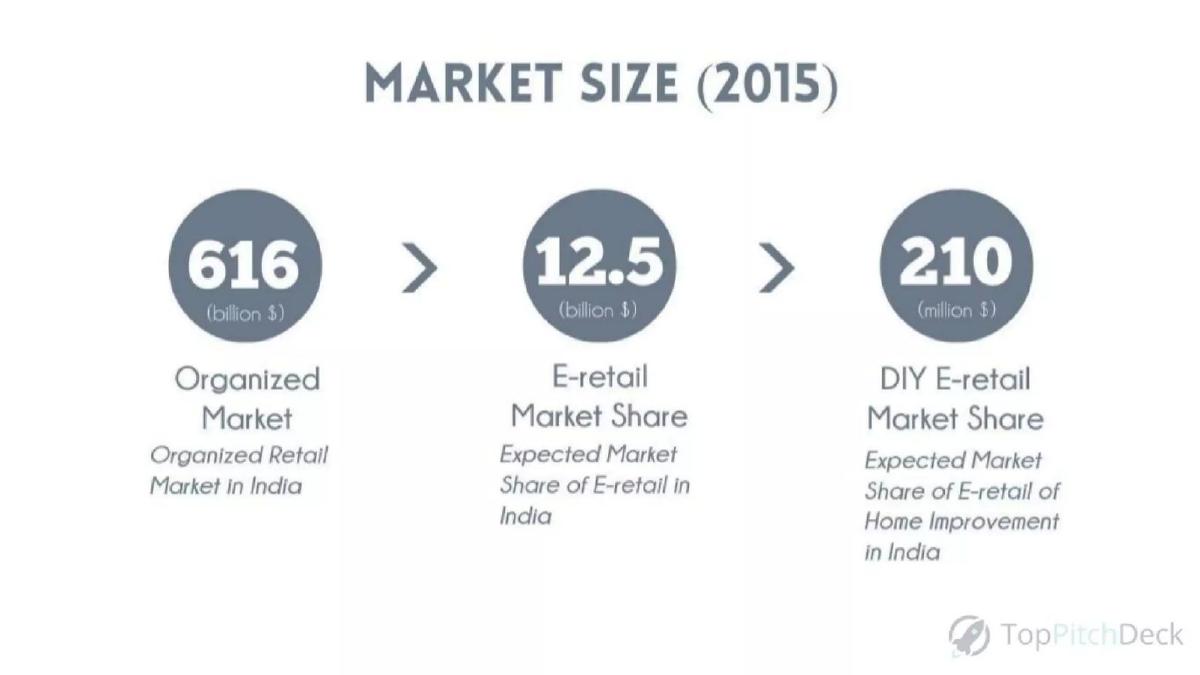
- The deck identifies the 'DIY E-retail' market share in India at $210 million as of 2015 (Slide 6).
The Urjakart Pitch Deck: Organizing the Unorganized
Urjakart entered the Indian startup ecosystem in 2013 with a clear mission: to digitize the procurement of construction, electrical, and industrial supplies. At the time, the Indian home improvement sector was almost entirely offline and highly fragmented. This 12-slide deck serves as a blueprint for their early-stage fundraising efforts, focusing on market size and the transition from unorganized to organized retail.
Slides 1-4: Problem, Solution, and Value Proposition
Slide 1 is a minimalist title slide featuring the company logo and the tagline: "India's Fastest Growing Online Home Improvement Store." It establishes the brand identity immediately without unnecessary clutter.
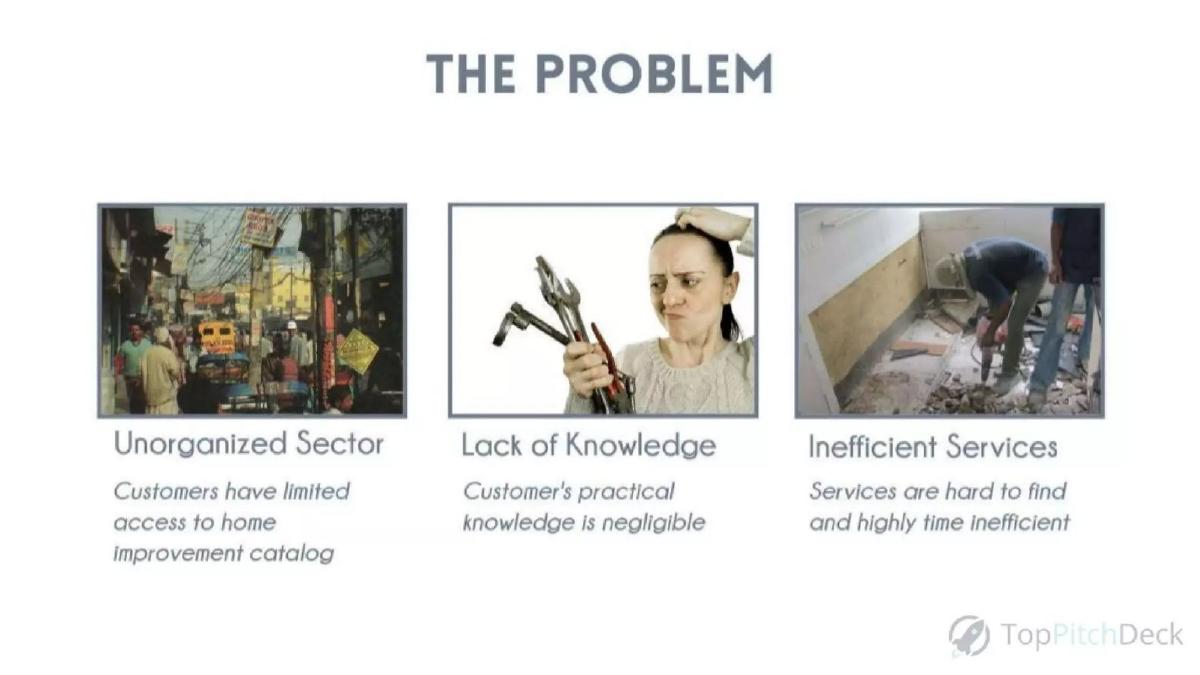
Slide 2 , titled "The Problem," uses three images to illustrate the pain points of the current market. It cites an "Unorganized Sector" where customers have limited catalog access, a "Lack of Knowledge" among customers, and "Inefficient Services" that are hard to find and time-consuming. This slide effectively sets the stage by highlighting the friction in the traditional Indian hardware and tool buying process.
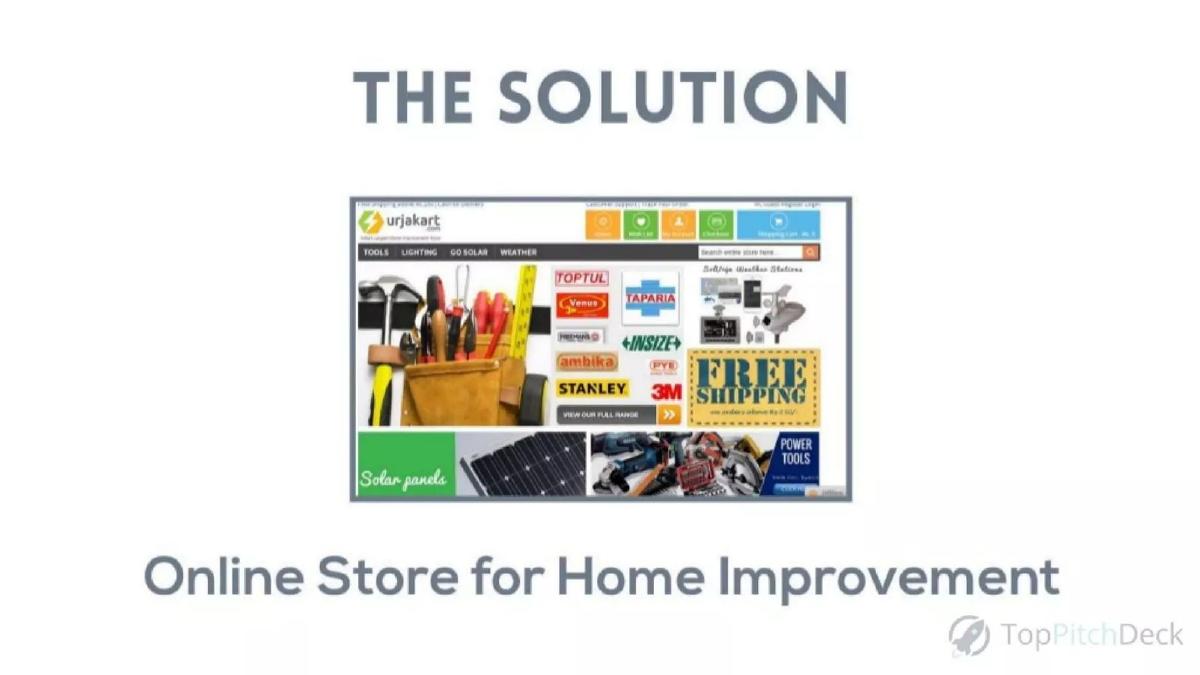
Slide 3 presents "The Solution" with a screenshot of the Urjakart.com website. The interface shown includes categories like Tools, Lighting, Go Solar, and Weather. By showing the actual platform, the founders demonstrate that the product is live and functional, rather than just a concept. The caption simply reads: "Online Store for Home Improvement."
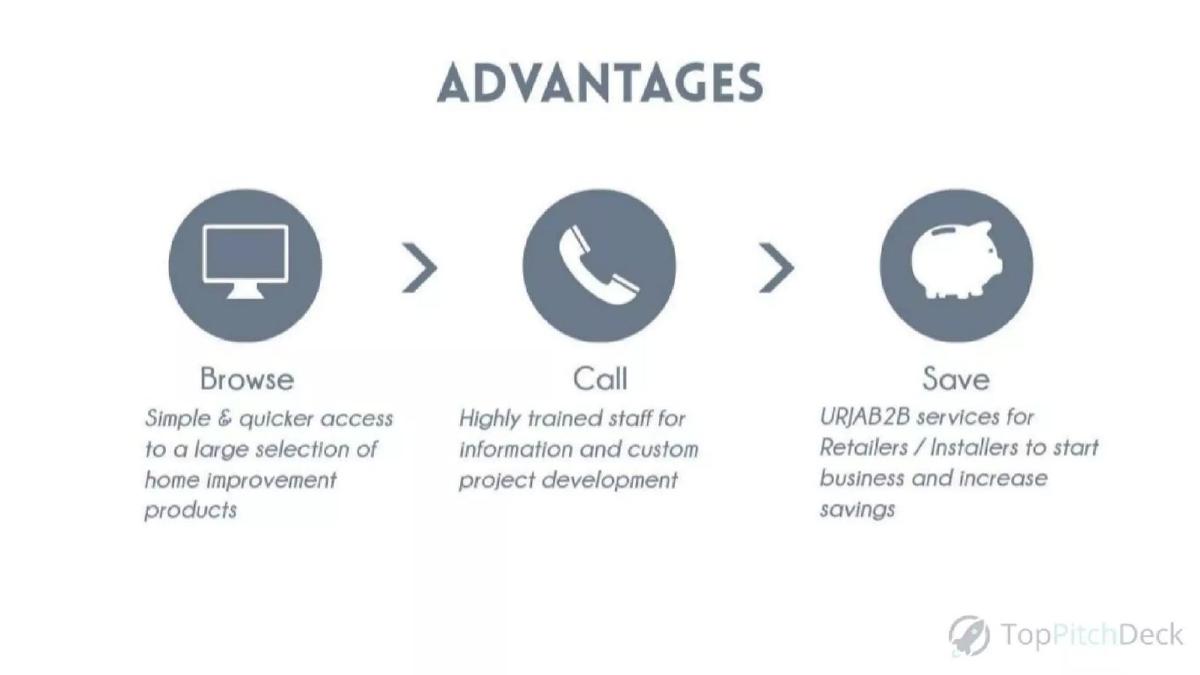
Slide 4 outlines the "Advantages" of the platform using a three-step flow: Browse, Call, and Save. It mentions "Highly trained staff for information and custom project development" and "URJAB2B services for Retailers / Installers to start business and increase savings." This indicates that Urjakart isn't just a passive storefront but offers a service layer to help B2B clients manage complex projects.
Slides 5-7: Market Opportunity and Financial Projections
Slide 5 delivers the big-picture market stat: a "$10 Billion" Indian Home Improvement Retail Market growing at 18% per annum. This is a classic venture capital slide designed to show that the "pond" is large enough to support a massive "fish."
Slide 6 provides a more granular breakdown of the market size for 2015. It moves from the total Organized Retail Market in India ($616 billion) to the E-retail Market Share ($12.5 billion) and finally to the DIY E-retail Market Share ($210 million). This transparency is helpful as it shows the founders understand their immediate addressable market (TAM/SAM/SOM) within the broader retail landscape.
Slide 7 , titled "Business Plan," explains the revenue model. It shows the $210 million organized market being filtered through a "Service Fee" that varies from 10% to 20%. Based on these figures, the company expects to generate $30 million in revenue between 2015 and 2018. This is a bold projection that assumes significant market capture in a short timeframe.
Slides 8-9: Traction and Growth
Slide 8 focuses on "Urjakart.com Analytics." The slide lists four key metrics: 1,000+ Customers since July '14, 1,500+ Daily Visitors, 2,500+ Products, and 10+ Registered Installers. These numbers suggest a healthy start for a niche B2B marketplace, particularly the product count, which is critical for a "one-stop-shop" value proposition.
Slide 9 shows a bar chart titled "+100% Revenue Growth." The chart tracks turnover across Q1, Q2, and Q3 of 2014. While the Y-axis lacks specific dollar amounts, the footer states: "Urjakart Turnover 2014 (expected): $ +200K." This provides a baseline for the company's early financial performance and demonstrates upward momentum.
Slides 10-12: Competition, Advantage, and Team
Slide 10 identifies the "Competition." It includes logos for Tolexo, Industrybuying.com, and MachpowerTools.com, alongside the major players Amazon.in, Snapdeal, and Flipkart. Acknowledging the giants (Amazon/Flipkart) shows the founders are realistic about the competitive landscape and the need to differentiate through specialization.
Slide 11 lists the "Competitive Advantage." The points include being the first complete online store in the category, introducing a franchisee model, providing superb after-sales service, and launching a private brand called "SolUrja." Private labeling is a common strategy for marketplaces to increase margins and build brand loyalty, and its inclusion here is a sophisticated touch for an early-stage deck.
Slide 12 introduces the "Founders." Vikram Varshney (Co-Founder) is listed with a BE from DCE (Delhi College of Engineering), and Gaurav Singh Rana (Co-Founder) is listed with an MS from Georgia Tech. The slide is brief, focusing on their academic credentials rather than their professional history, which is a common omission in early-stage Indian startup decks from this era.
What Works in the Urjakart Deck
Market Specificity: The deck does a good job of narrowing down a massive $10 billion market into a specific $210 million actionable e-retail segment (Slide 6). · Clear Revenue Model: Investors don't have to guess how the company makes money. The 10-20% service fee is clearly stated (Slide 7). · Visual Problem Statement: Using real-world photos of unorganized markets (Slide 2) helps investors who may not be familiar with the daily realities of the Indian construction supply chain. · Traction Transparency: Providing specific numbers for visitors, customers, and product SKUs (Slide 8) builds credibility.
What is Missing from the Urjakart Deck
The Ask: The deck completely omits how much money they are looking to raise and what they intend to do with the funds. This is a critical component of any pitch. · Unit Economics: While they mention a 10-20% service fee, there is no mention of Customer Acquisition Cost (CAC) or Lifetime Value (LTV), which are vital for marketplace businesses. · Operational Logistics: In a B2B marketplace for heavy industrial goods, logistics and warehousing are massive challenges. The deck does not explain how they handle fulfillment or shipping. · Professional Backgrounds: The team slide (Slide 12) lists degrees but no past work experience. Investors want to know if the founders have worked in supply chain, retail, or tech before.
What a Founder Should Copy
The "Service Layer" Mention: Mentioning "Highly trained staff" (Slide 4) is a smart move for B2B startups. It signals that you understand your customers need more than just a website; they need expertise. · Private Label Strategy: Including a plan for a private brand (Slide 11) early on shows you are thinking about long-term profitability and margin expansion beyond just being a middleman. · Market Growth Context: Highlighting that the market is growing at 18% (Slide 5) adds urgency to the investment. It's not just a big market; it's a fast-moving one. · Simple Traction Layout: The grid layout on Slide 8 is an excellent way to present multiple KPIs at once without overwhelming the reader.
Frequently asked questions
- What is Urjakart's primary business model?
- Urjakart operates as a B2B marketplace for home improvement and industrial supplies. According to slide 7, they charge a service fee ranging from 10% to 20% on transactions. Their goal is to connect Indian manufacturers and suppliers directly with retailers, contractors, and SMEs, effectively organizing a traditionally fragmented supply chain.
- How large is the market Urjakart is targeting?
- Slide 5 identifies the Indian Home Improvement Retail Market as a $10 billion opportunity, growing at 18% per year. Slide 6 further breaks this down, noting an 'Organized Market' of $616 billion in total retail, with the specific DIY E-retail market share estimated at $210 million by 2015.
- What traction did Urjakart have at the time of this deck?
- Slide 8 and 9 detail their analytics: 1,000+ customers since July 2014, 1,500+ daily visitors, and a catalog of over 2,500 products. They also claimed 100% revenue growth with an expected 2014 turnover of more than $200,000.
- Who are Urjakart's main competitors?
- Slide 10 lists several competitors, including niche players like Tolexo, Industrybuying.com, and MachpowerTools.com. It also acknowledges major horizontal e-commerce giants like Amazon.in, Snapdeal, and Flipkart as indirect competition in the space.
- What are Urjakart's unique competitive advantages?
- As stated on slide 11, the company claims to be the first 'complete' online home improvement store in India. Their advantages include a franchisee model, dedicated after-sales support, and the launch of a private brand called SolUrja to capture higher margins.