The Urjakart.com pitch deck, dating to approximately 2014, outlines a strategy to organize India's fragmented home improvement sector through an e-commerce platform. The company identifies three primary pain points: an unorganized sector, lack of consumer knowledge, and inefficient services. With a reported catalog of over 2,500 products and 1,000+ customers since July 2014, the deck projects a revenue target of $30 million between 2015 and 2018. The business model relies on a service fee of 10-20% on transactions. While the deck provides clear market sizing and early traction metrics, it not…
Key takeaways
- The Indian home improvement retail market is valued at $10 billion, growing at 18% per annum as of slide 5.
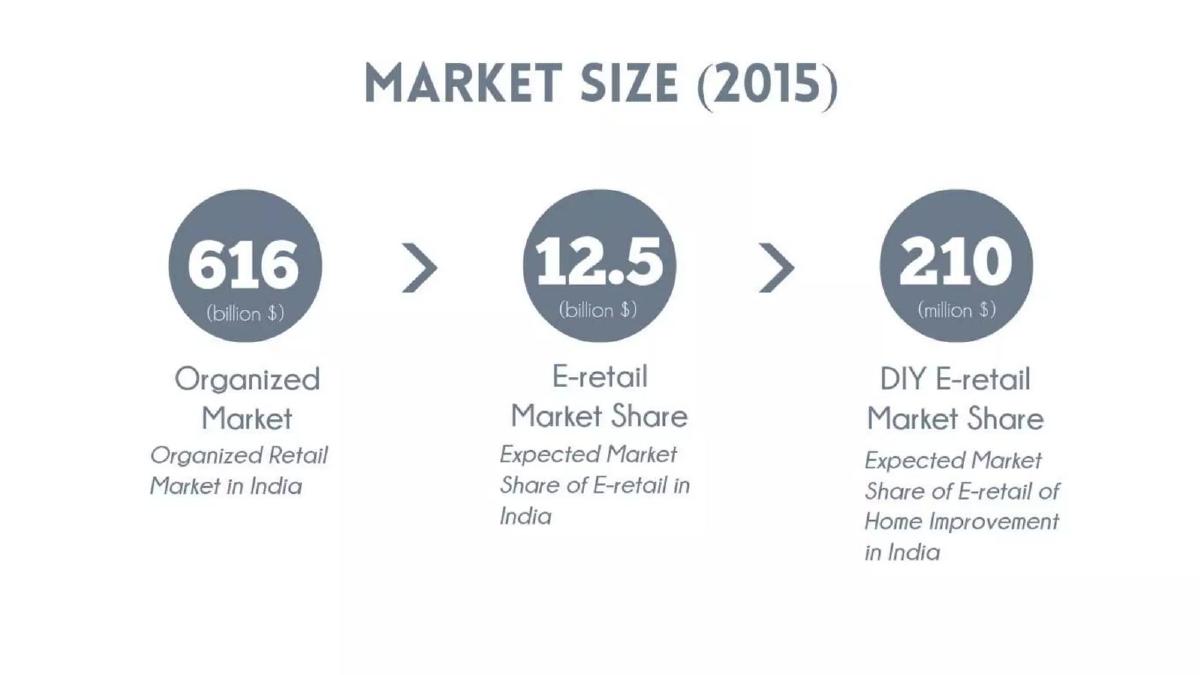
- Urjakart identifies the DIY e-retail market share in India at $210 million for 2015 on slide 6.
- The business model is based on a service fee that varies from 10% to 20% per transaction according to slide 7.
- Expected revenue for the period of 2015-2018 is stated as $30 million on slide 7.
- Traction metrics as of the deck's creation include 1,000+ customers since July 2014 and 1,500+ daily visitors on slide 8.
- The company claims a private brand named SolUrja as a competitive advantage on slide 11.
- The deck lists major competitors including Tolexo, Industrybuying.com, Amazon.in, Snapdeal, and Flipkart on slide 10.
- There is no slide detailing the specific investment amount requested or the planned allocation of capital.
Executive Summary
Urjakart.com positions itself as a digital solution for the highly fragmented Indian home improvement market. The deck, likely produced in late 2014, focuses on the transition from unorganized local retail to a centralized online platform. By targeting both B2C and B2B segments (retailers and installers), the company aims to capture a slice of a $10 billion market. The presentation is structured traditionally, moving from problem and solution to market size, traction, and competition.
Slide 1: Title Slide
The deck opens with the company name, URJAKART.COM , and the tagline "India's Fastest Growing Online Home Improvement Store." The branding is minimal, using a gray and white color palette that persists throughout the presentation.
Slide 2: The Problem
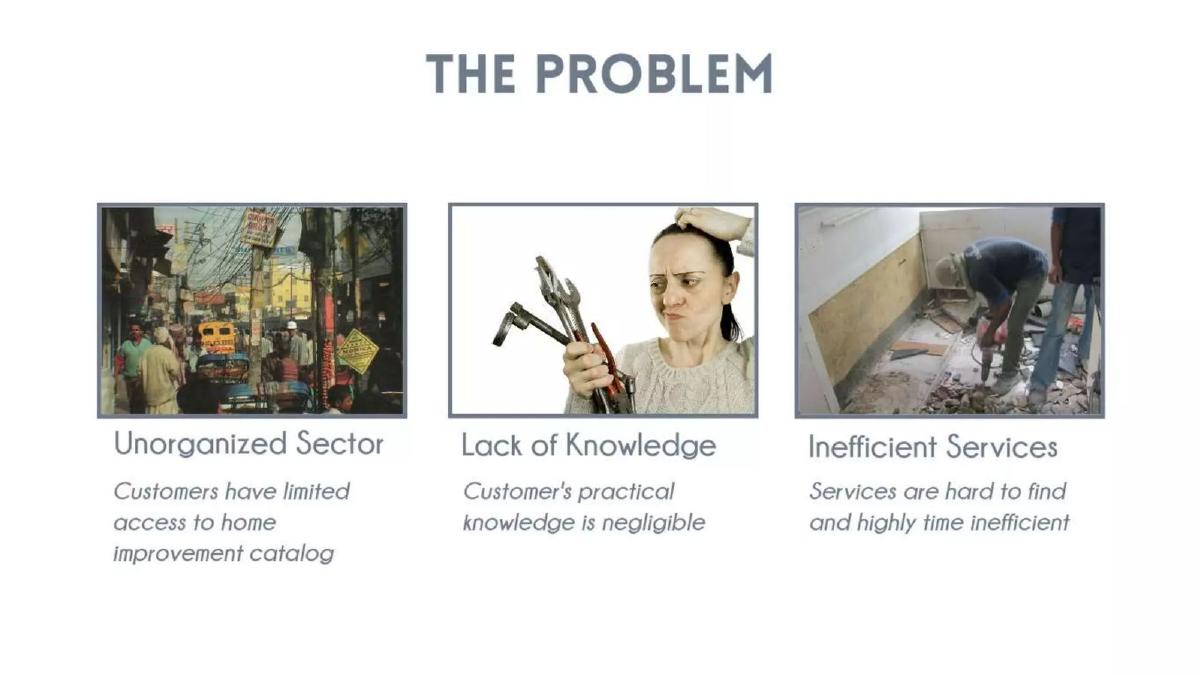
The problem is categorized into three distinct buckets: Unorganized Sector , Lack of Knowledge , and Inefficient Services . The slide notes that customers have limited access to a comprehensive catalog and that their practical knowledge regarding home improvement is "negligible." It also highlights that finding reliable services is time-inefficient.
Slide 3: The Solution
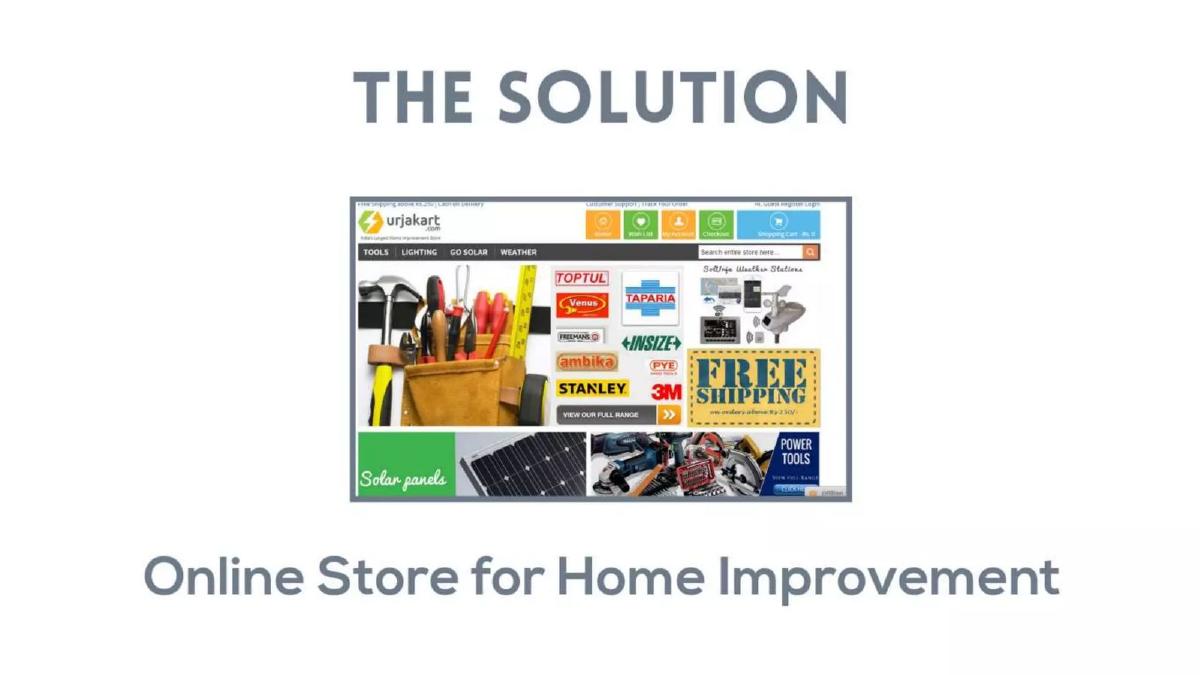
The solution is presented simply as an "Online Store for Home Improvement." A screenshot of the Urjakart website is shown, featuring categories like tools, lighting, solar, and weather stations. Notable brands visible in the screenshot include Stanley, 3M, and Taparia, suggesting a multi-brand retail approach.
Slide 4: Advantages
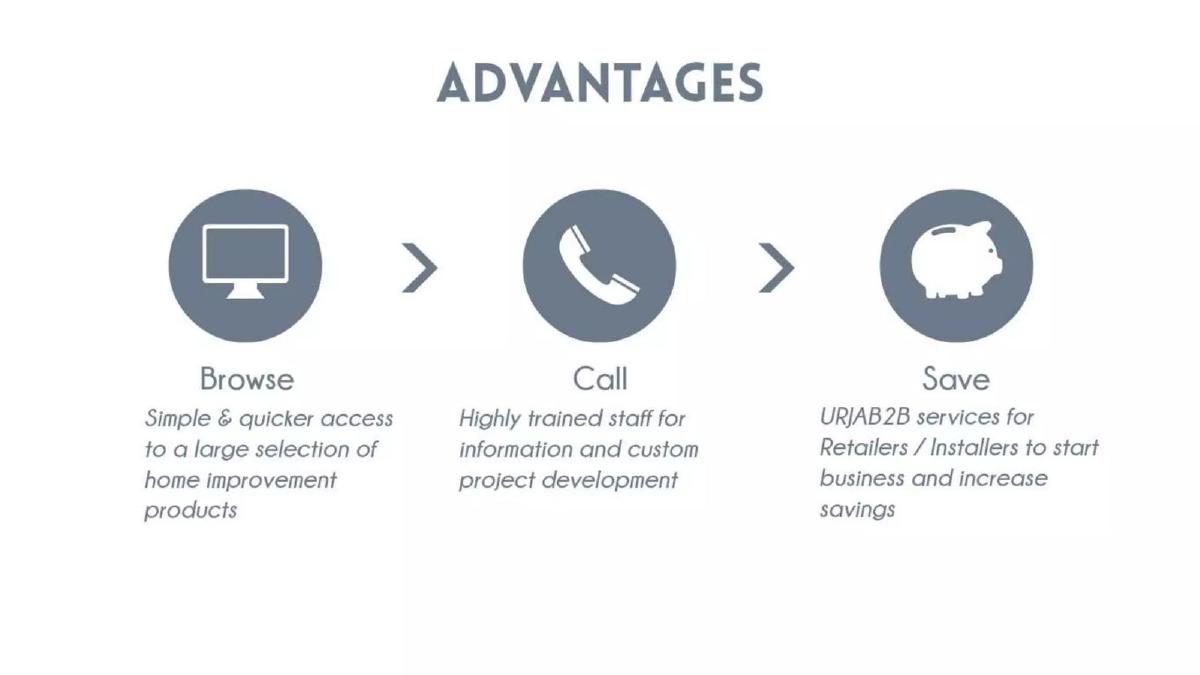
This slide outlines the user journey and value proposition through three steps: Browse (access to a large selection), Call (trained staff for custom project development), and Save (B2B services for retailers and installers to increase savings). This indicates a hybrid model that combines e-commerce with consultative support.
Slide 5: Market Size
The deck identifies a $10 Billion Indian Home Improvement Retail Market. It notes that this market is growing at a rate of 18% per annum. This is a high-level TAM (Total Addressable Market) figure intended to show the scale of the opportunity.
Slide 6: Market Size (2015)
This slide drills down into more specific segments for the year 2015. It lists the Organized Market at $616 billion (likely referring to total retail in India, though the slide says "Organized Retail Market in India"), the E-retail Market Share at $12.5 billion, and the DIY E-retail Market Share for home improvement at $210 million. The flow suggests the company is targeting the $210 million niche within the broader e-commerce landscape.
Slide 7: Business Plan
The revenue model is explained as a service fee. Based on the $210 million organized market, Urjakart applies a Service Fee that varies from 10% to 20%. The slide projects an expected revenue of $30 million for the period between 2015 and 2018.
Slide 8: Urjakart.com Analytics
Traction is demonstrated through four key metrics: 1,000+ Customers since July 2014, 1,500+ Daily Visitors , 2,500+ Products , and 10+ Registered Installers . These figures provide a snapshot of the company's early operational scale.
Slide 9: Revenue Growth
A bar chart shows quarterly growth in 2014, claiming +100% Revenue Growth . The slide states an expected turnover for 2014 of +$200K . While the chart lacks specific Y-axis denominations, the upward trend is meant to signal momentum.
Slide 10: Competition
The competitive landscape is divided into specialized players and horizontal giants. Listed competitors include Tolexo , Industrybuying.com , and MachpowerTools.com , as well as major platforms like Amazon.in , Snapdeal , and Flipkart .
Slide 11: Competitive Advantage
Urjakart lists four points of differentiation: being the first "complete" home improvement store online, introducing a franchisee model, providing "superb" support, and owning a private brand called SolUrja . The mention of a private brand is significant as it typically implies higher margins than third-party retail.
Slide 12: Founders
The final slide introduces the leadership team. Vikram Varshney (Co-Founder) is listed with a BE from DCE. Gaurav Singh Rana (Co-Founder) is listed with an MS from Georgia Tech. The slide includes photos but lacks professional history or specific roles within the company.
What Urjakart.com Does Well
The deck is highly readable and avoids clutter. By breaking the market down from a $10 billion macro figure to a $210 million target segment, the founders demonstrate an understanding of their immediate reachable market. The inclusion of a B2B angle (retailers and installers) on slide 4 shows a sophisticated approach to a sector where professional influencers often drive purchasing decisions. Furthermore, the mention of a private brand (SolUrja) on slide 11 addresses the common investor concern regarding the thin margins of pure-play retail arbitrage.
What is Missing from the Deck
The most glaring omission is the Ask . There is no mention of how much money the company is seeking to raise, the valuation they are targeting, or what the capital will be used for (e.g., marketing, inventory, technology). Additionally, the Team slide is underdeveloped; while educational credentials from reputable institutions like Georgia Tech are valuable, investors need to see relevant industry experience or previous entrepreneurial success to gauge execution risk. There is also a lack of Unit Economics . In e-commerce, understanding the Customer Acquisition Cost (CAC) versus the Lifetime Value (LTV) is critical, yet these metrics are absent. Finally, the logistics of shipping heavy tools and home improvement equipment across India is a major operational challenge that is not addressed in the strategy.
Founder Takeaways: What to Copy and What to Avoid
Copy the market segmentation: Slide 6 is a good example of how to narrow down a massive headline number into a realistic target market. Founders should always show the "slice of the pie" they are actually competing for. Copy the traction snapshot: Slide 8 uses a simple four-box grid to show scale across different axes (customers, traffic, inventory, and service providers). This is an effective way to show multi-dimensional growth.
Avoid vague growth charts: Slide 9 shows a bar chart without specific numbers on the bars or the axis. While it shows a trend, it feels "designed" rather than "reported." Always include absolute numbers on your traction charts to build trust. Avoid omitting the Ask: A pitch deck without a funding request is just a company profile. If you are using a deck to raise money, you must clearly state the amount, the milestones that capital will help you reach, and the runway it provides. Avoid thin founder bios: Your degrees are a starting point, not a destination. Use the founder slide to highlight specific achievements, such as "Managed $50M P&L at [Company]" or "Built and sold [Previous Startup]."
Frequently asked questions
- What is the primary problem Urjakart aims to solve?
- According to slide 2, Urjakart addresses three main issues: an unorganized sector where customers have limited access to catalogs, a lack of practical knowledge among customers, and inefficient services that are difficult to find and time-consuming.
- How does Urjakart generate revenue?
- Slide 7 explains the business plan, which centers on a service fee model. The company charges a fee ranging from 10% to 20% of the transaction value. Based on an organized market size of $210 million, they projected $30 million in revenue between 2015 and 2018.
- What early traction metrics does the deck provide?
- Slide 8 lists several key analytics: 1,000+ customers since July 2014, 1,500+ daily visitors, a catalog of 2,500+ products, and 10+ registered installers. Slide 9 further claims +100% revenue growth with an expected 2014 turnover of over $200,000.
- Who are the founders and what are their backgrounds?
- Slide 12 introduces two co-founders: Vikram Varshney and Gaurav Singh Rana. Their backgrounds are listed primarily by education: Varshney holds a BE from DCE, and Rana holds an MS from Georgia Tech. No previous professional experience is detailed.
- What is missing from the Urjakart pitch deck?
- The deck is missing a 'The Ask' slide, which would typically specify the amount of capital being raised. It also lacks a 'Use of Funds' slide, unit economics (CAC/LTV), a detailed roadmap, and a deep dive into the logistics or supply chain management required for heavy home improvement goods.