Uptime’s pitch deck is a masterclass in 'pedigree-led' fundraising. With only 11 slides, the company secured $20 million by positioning itself at the intersection of education, wellness, and entertainment. The deck avoids complex financial modeling and instead focuses on the 'Knowledge Hacker' brand identity and the founders' history of successful exits and executive roles at tech giants like Facebook and YouTube. While it lacks a clear business model or unit economics slide, it compensates with high-quality visual assets and a strong 'Why Now' argument centered on the digital antidote to 'do…
Key takeaways
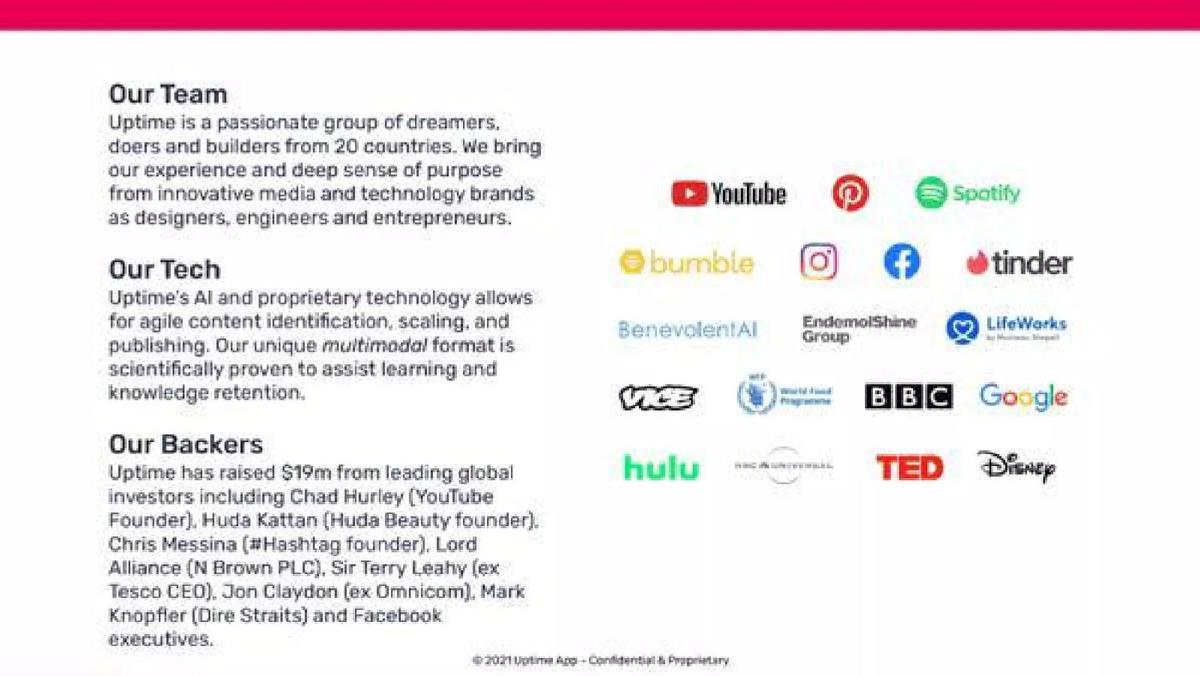
- The deck highlights a combined $19m already raised from high-profile angel investors including the founders of YouTube and Huda Beauty (Slide 6).
- Founder Patrick Walker brings executive experience from Facebook, Instagram, and YouTube, while Jamie True claims four successful exits (Slide 2).
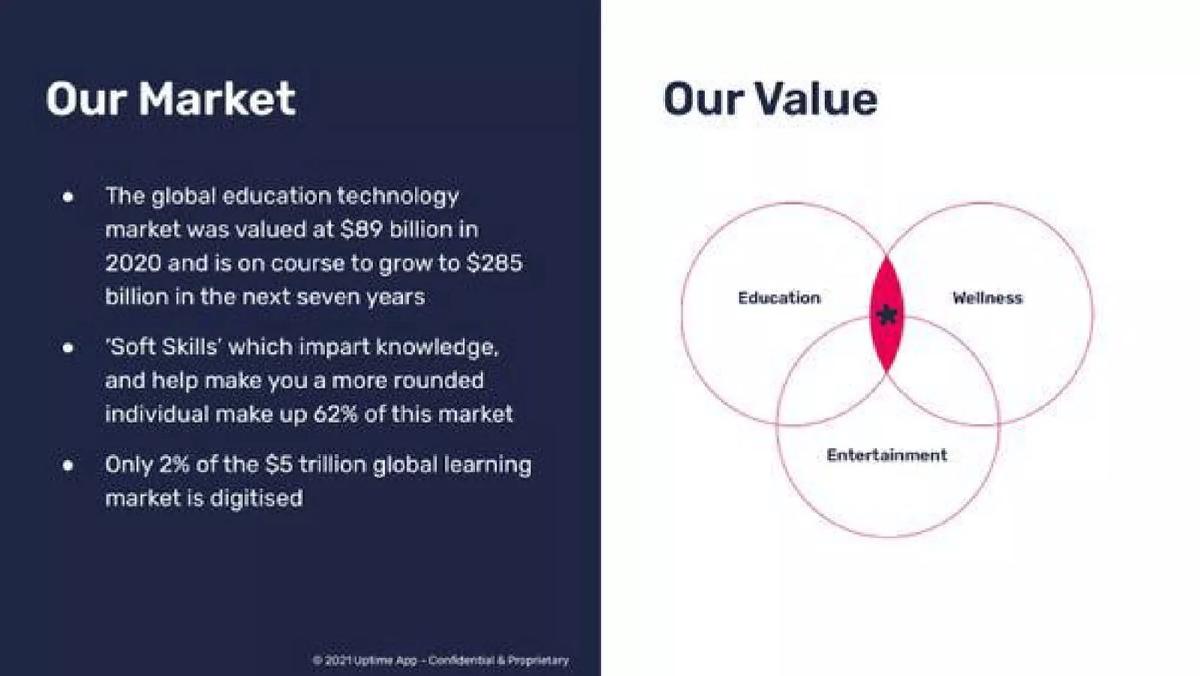
- The market opportunity is defined by a global education technology market valued at $89 billion in 2020, with only 2% of the $5 trillion learning market digitized (Slide 5).
- Uptime positions itself as a 'digital antidote' to addictive tech and doom-scrolling, targeting limited attention spans with 5-minute stories (Slide 8).
- The product is described as a 'multimodal' format using AI and proprietary technology for content scaling and publishing (Slide 6).
- Aspirations for the end of 2022 include reaching over 2M users and 200K premium subscribers (Slide 10).
- The deck utilizes social proof through logos of former employers like Google, Spotify, and Disney to validate the team's expertise (Slide 6).
- Product validation is shown through a 4.8-star App Store rating and 'App of the Day' features (Slide 9).
The Pedigree Play: How Uptime Sold a Vision
Uptime’s pitch deck is a classic example of a 'Team-First' presentation. In the world of venture capital, especially at the Seed stage, investors are often buying the founders' history rather than the company's current balance sheet. With a $20,000,000 raise (according to catalogue data), Uptime represents the upper echelon of Seed rounds. The deck itself is lean, visually loud, and focused on the macro-trends of the 'attention economy.'
Slides 1-2: The Power of the Founders
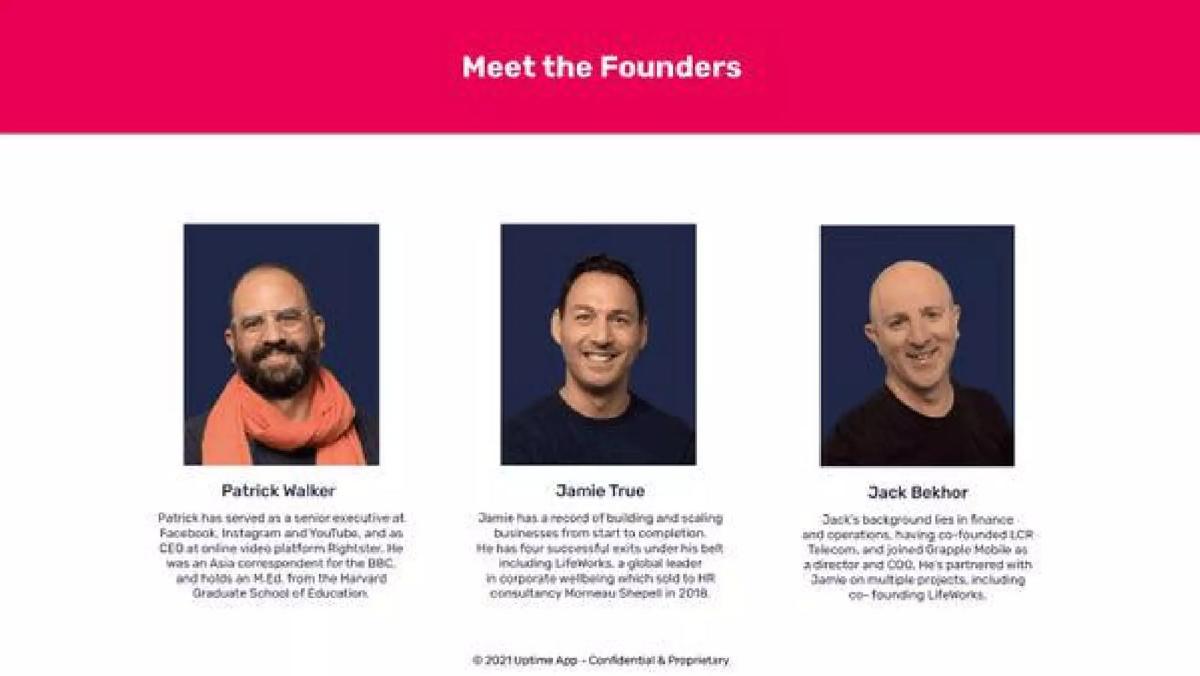
The deck opens with a minimalist title slide (Slide 1) dated May 2021, featuring the three founders: Jamie True, Patrick Walker, and Jack Bekhor. Immediately, Slide 2, 'Meet the Founders,' does the heavy lifting. This isn't a standard bio slide; it is a list of high-impact credentials. Patrick Walker is noted as a former senior executive at Facebook, Instagram, and YouTube. Jamie True is credited with four successful exits, including LifeWorks, which sold to Morneau Shepell in 2018. Jack Bekhor adds operational depth with a background in finance and telecom. For an investor, these bios reduce 'execution risk' significantly.
Slides 3-4: The Product and User Experience
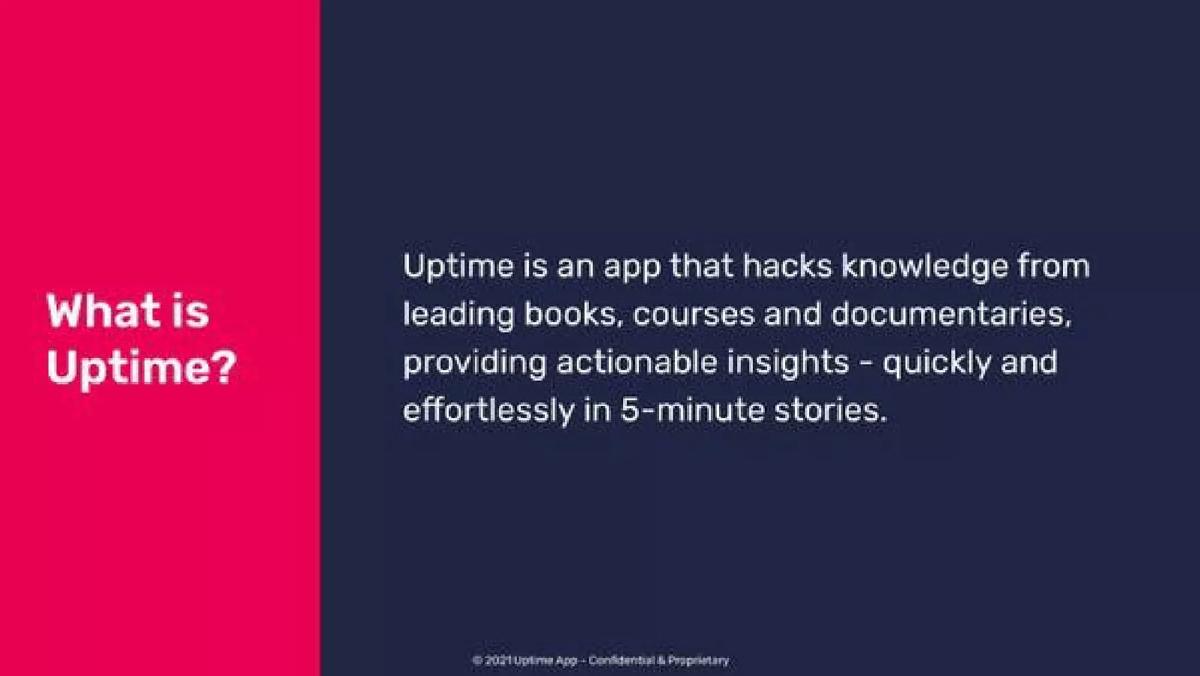
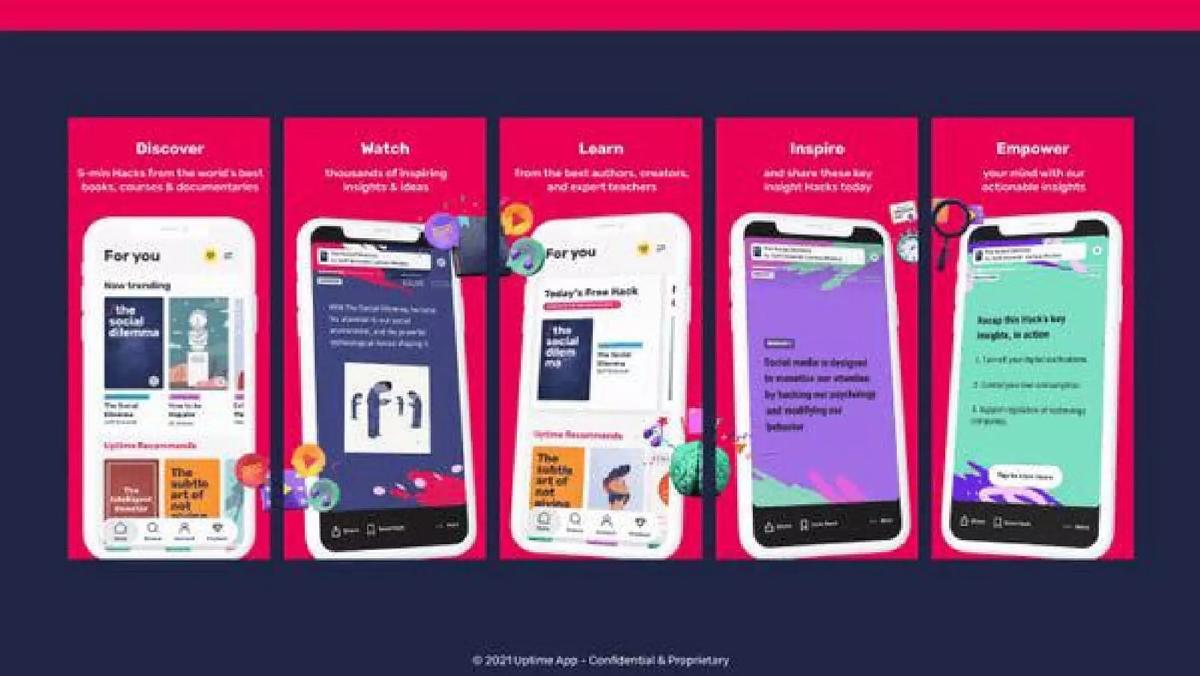
Slide 3 defines Uptime as an app that 'hacks knowledge' into 5-minute stories. The use of the word 'hacks' is a deliberate branding choice, positioning the app as a productivity tool rather than just another e-reader. Slide 4 provides a visual walkthrough of the app interface using five pillars: Discover, Watch, Learn, Inspire, and Empower. The UI shown is highly visual, mimicking the 'Stories' format popularized by Instagram and Snapchat, which aligns with their goal of fighting 'doom-scrolling' by using the same addictive UI patterns for educational content.
Slides 5-6: Market Opportunity and Strategic Backing
Slide 5, 'Our Market,' provides the necessary 'Big Number' context. It values the global EdTech market at $89 billion in 2020, projected to grow to $285 billion. Crucially, it notes that only 2% of the $5 trillion global learning market is digitized, suggesting a massive 'blue ocean' for digital transformation. The 'Our Value' Venn diagram on the same slide places Uptime at the intersection of Education, Wellness, and Entertainment.
Slide 6 is perhaps the most important slide for the $20M raise. Titled 'Our Team / Our Tech / Our Backers,' it reveals that the company had already raised $19m from a 'who's who' of tech and media. Mentioning Chad Hurley (YouTube Founder) and Huda Kattan (Huda Beauty) by name provides immense social proof. The right side of the slide is a logo wall featuring YouTube, Spotify, Facebook, Google, and Disney—not as partners, but as the former employers of the team. This 'Alumni' validation is a powerful tool in high-stakes fundraising.
Slides 7-8: Mission and The 'Why Now'
Slide 7 outlines a broad mission: 'To inspire anyone to learn and thrive in our fast-changing world.' Slide 8, 'Why Now?' , addresses the problem of the modern consumer. It identifies four pain points: limited time, information overload, limited resources (expensive courses), and limited attention spans. By positioning Uptime as the 'digital antidote,' the founders tap into the growing cultural sentiment against mindless social media consumption.
Slides 9-11: Traction and Future Aspirations
Slide 9, 'Endorsement,' focuses on external validation. It lists features by TechCrunch and Product Hunt, alongside a 4.8-star App Store rating. It also includes quotes from celebrities and academics, such as Mark Knopfler and James Doty, MD. This slide aims to prove that the product isn't just a concept—it has a following.
Slide 10, 'Our aspirations by end 2022,' serves as the roadmap. The targets are aggressive: a Top 5 global Education App ranking, over 2M users, and 200K premium subscribers. It also mentions a goal for 'B Corp Certification,' which aligns with the 'Wellness' and 'Social Impact' themes mentioned earlier in the deck. The deck concludes on Slide 11 with a simple 'Thank You' and the brand sign-off 'Onwards & Uptime.'
What Works in the Uptime Deck
1. Credibility Density: The deck manages to mention Facebook, YouTube, Google, and Disney multiple times. For a Seed round, this level of professional pedigree is the primary driver of the valuation. They aren't just saying they can build an app; they are saying they helped build the apps that currently dominate the world's attention.
2. Visual Storytelling: The deck practices what it preaches. The design is clean, using a bold pink and navy palette that feels modern and 'premium.' The app mockups on Slide 4 clearly communicate that this is not a text-heavy reading app, but a visual media platform.
3. Clear Positioning: By using the term 'Knowledge Hacks' and positioning themselves as the 'antidote to doom-scrolling,' they create a clear category in the investor's mind. They aren't competing with libraries; they are competing with TikTok for the user's 'boredom minutes.'
What is Missing from the Uptime Deck
1. Business Model Specifics: While Slide 10 mentions 'Premium Subscribers,' there is no detail on the subscription price, the conversion rate from free to paid, or the cost of acquiring those users. For a $20M round, one would expect a deeper dive into the unit economics, even if they are just projections.
2. Content Acquisition Strategy: Distilling 'thousands of sources' is a massive operational challenge. The deck mentions 'AI and proprietary technology' (Slide 6), but it doesn't explain if the content is licensed, summarized by humans, or generated entirely by AI. This is a significant legal and operational risk that is left unaddressed.
3. Competitive Landscape: The deck ignores existing players like Blinkist, GetAbstract, or Masterclass. While Uptime's 'visual story' format is a differentiator, a slide acknowledging the competition and explaining why Uptime's 'multimodal' approach wins would have strengthened the case for a $20M valuation.
What a Founder Should Copy
1. The 'Why Now' Slide: Slide 8 is a perfect example of how to frame a problem. It doesn't just say 'people want to learn'; it identifies specific psychological and cultural shifts (attention spans, information overload) that make the solution necessary today.
2. Leveraging Past Success: If you or your team have worked at prestigious companies, do not hide those logos in a small footer. Uptime puts them front and center on Slide 6. Use the 'halo effect' of established brands to validate your own startup's potential.
3. Aspirational Milestones: Instead of a complex 5-year financial spreadsheet that everyone knows is a guess, Slide 10 uses a bulleted list of 'Aspirations.' This is much easier for an investor to digest and provides a clear set of KPIs to measure the team against in the coming 18 months.
Final Thoughts
Uptime’s deck is a high-signal, low-noise document. It assumes the investor is already aware of the 'micro-learning' trend and focuses entirely on why this team is the one to capture it. While it lacks the rigorous data of a Series A or B deck, its success in raising $20M proves that at the early stages, the 'Who' and the 'Why' are often more valuable than the 'How much.'
Frequently asked questions
- How did Uptime raise $20M with such a short deck?
- The $20M figure, while high for a seed round, is largely supported by the founders' extraordinary professional backgrounds. Slide 2 and Slide 6 showcase a team with deep roots at YouTube, Facebook, and Google, alongside a list of 'Backers' that includes the YouTube founder. Investors at this stage are often betting on the team's ability to execute in a massive market ($89B EdTech market cited on Slide 5) rather than existing revenue metrics.
- What is Uptime's actual business model according to the deck?
- The deck is notably vague on the specific mechanics of its business model. Slide 10 mentions a goal of '200K Premium Subscribers' by the end of 2022, implying a SaaS or subscription-based revenue stream. However, there is no slide dedicated to pricing tiers, customer acquisition costs (CAC), or lifetime value (LTV) projections, which is common for vision-heavy seed decks.
- Who are Uptime's main competitors?
- The deck does not include a traditional competitor matrix. Instead, it positions itself against 'addictive tech' and 'doom-scrolling' (Slide 8). While it competes with apps like Blinkist or Masterclass, Uptime attempts to differentiate by blending 'Education, Wellness, and Entertainment' (Slide 5) and using a 'multimodal' visual story format rather than just text or audio summaries.
- What is 'multimodal' content in the context of this deck?
- According to Slide 6 and Slide 8, 'multimodal' refers to a format that combines text, image, and audio. The founders claim this format is 'scientifically proven to aid retention' and is designed to combat the limited attention spans of modern users who find it hard to focus on traditional long-form books or courses.
- What are the primary risks missing from this pitch?
- The deck ignores the high cost of content production and licensing. Distilling 'thousands of sources' (as per the listing) into high-quality 5-minute hacks requires significant editorial overhead or advanced AI. The deck mentions 'proprietary technology' for scaling (Slide 6) but does not explain how they protect against copyright issues or how they plan to achieve the 7,000+ hacks target mentioned on Slide 10 profitably.