Uplift’s pitch deck focuses on the transition from plastic to biodegradable straws, highlighting three specific product lines: bamboo, grass, and sugarcane. The deck provides a clear market overview, citing a global bamboo straw market of $115 million in 2020 with a projected growth to $170.7 million by 2026. However, the presentation is structurally thin. It lacks a dedicated problem slide, a team slide, and any mention of a specific funding ask or valuation. While it lists high-level KPIs like a 75% monthly account growth rate, it fails to provide the underlying raw data or unit economics n…
Key takeaways
- The company offers three distinct biodegradable straw types: bamboo, grass, and sugarcane (Slide 3).
- Uplift targets two primary segments: individuals aged 16-35 and B2B food service points like restaurants and hotels (Slide 5).
- Global bamboo straw market size was valued at 115 million USD in 2020 (Slide 4).
- The deck claims a 75% monthly account growth rate but does not specify the starting number of accounts (Slide 6).
- Products are manufactured using resources from Vietnam, specifically bamboo trees and grass from the Mekong Delta (Slide 3).
- The presentation omits a team slide, leaving the founders' backgrounds and expertise unknown.
- There is no financial 'Ask' slide, meaning the amount of capital sought and its intended use are not disclosed.
- The deck lacks a competitive analysis, failing to address how Uplift differentiates itself from other eco-friendly straw manufacturers.
Uplift Pitch Deck Analysis
The Uplift pitch deck is a 13-slide presentation (with 7 slides provided for this analysis) that focuses on the sustainable consumer goods sector, specifically biodegradable drinking straws. The deck utilizes a clean, nature-oriented aesthetic but follows a non-traditional structure that prioritizes product descriptions over business mechanics. It positions the company as a solution to waste problems through the use of natural Vietnamese resources.
Slide 1: Title Slide
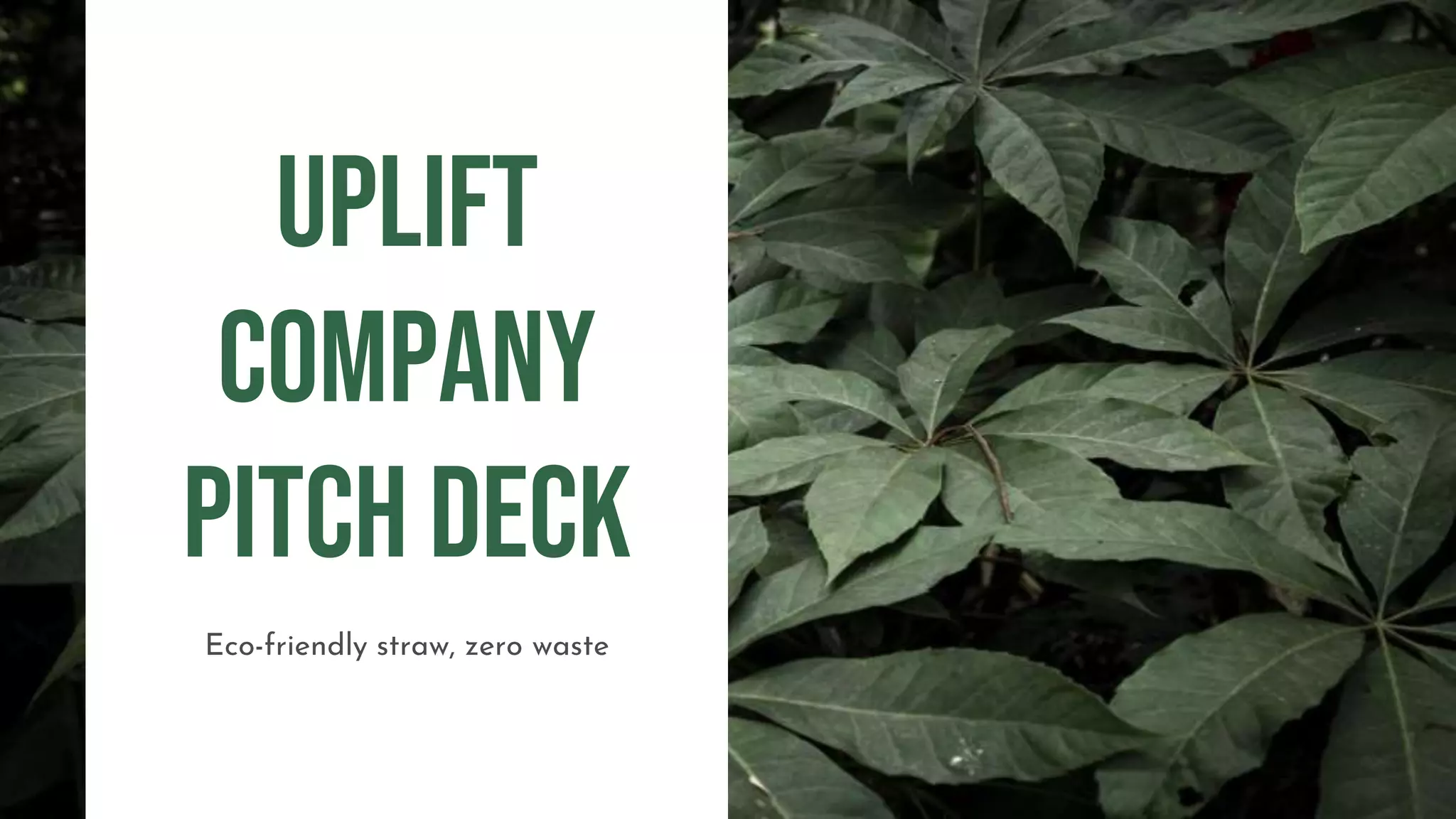
The cover slide introduces the company name, UPLIFT , with the subtitle "Eco-friendly straw, zero waste." The visual design uses a split-screen layout with a high-resolution image of tropical leaves, establishing the brand's environmental focus immediately. There is no mention of the founding year or the specific location on this slide, though the product focus is unambiguous.
Slide 2: Solution
Slide 2 presents the "SOLUTION" in a minimalist format. It states: "A biodegradable straw can solve the problem." It lists four key attributes: 100% natural , Eco-friendly , and Chemical-free . Notably, this slide appears before a formal "Problem" slide in the provided sequence. While the problem of plastic waste is implied by the product type, the deck misses an opportunity to quantify the scale of plastic straw pollution to create urgency for the solution.
Slide 3: Product Portfolio
This slide provides the most technical detail in the deck. It specifies that all products come in three different sizes: 9 cm, 12 cm, and 15 cm . It also mentions value-added services such as "engraving name, brands or ordering design." The slide highlights three specific product lines:
Bamboo Straw: Made from bamboo trees around Vietnam. · Grass Straw: Made from grass that grows around the Mekong Delta region in south-western Vietnam. · Sugarcane Straw: Made with 100% plant-based ingredients using real sugarcane.
The inclusion of the Mekong Delta as a sourcing location suggests a localized supply chain advantage, though the deck does not explicitly discuss manufacturing capacity or cost of goods sold (COGS).
Slide 4: Market Size
Slide 4 attempts to quantify the opportunity. It cites the "Global Bamboo Straw Market Size" with the following figures:
115 Million USD: Statistic in 2020. · 170,7 Million USD: Projected by 2026. · 6,8%: CAGR 2021-2026.
At the bottom of the slide, it notes a "Potential market size: approximately 15 billion." This 15 billion figure is likely referring to the total addressable market (TAM) for all straws (including plastic and paper), but the lack of a source or definition makes it less credible than the specific bamboo market stats. The use of a comma in "170,7" suggests a European or international formatting style.
Slide 5: Target Audience
This slide breaks down the customer base into "Individual Purchases" and "Wholesellers." For individuals, it shows a gender-neutral approach (indicated by male and female icons) and focuses heavily on the 16-35 age demographic (75%) compared to the 36-50 demographic (50%) . The "Wholesellers" section lists "Food Service Points" including Restaurant , Hotel , and Bar/Café Store/Cinema . The use of progress bars here is somewhat ambiguous; it is unclear if these represent current market share, target priority, or market interest levels.
Slide 6: Key Performance Indicators
The "Key Performance" slide lists three metrics intended to show traction:
7,5/10: Net Promoter Score (NPS) to measure customer happiness. · 75%: Monthly Account Growth Rate. · 10,5%: Conversion Rate Optimization (CRO).
While a 75% monthly growth rate is impressive, without a baseline (e.g., growing from 10 to 17 accounts vs. 1,000 to 1,750), the figure lacks context. Similarly, a 10.5% conversion rate is high for e-commerce, but the deck does not specify if this is for B2B inquiries or B2C sales.
Slide 7: Contact and Credits
The final slide provides contact information: an email (info.uplift@gmail.com), a Polish phone number (+48 789 561 275), and a URL (uplift.biostraw.com). The presence of a Polish phone number alongside Vietnamese sourcing suggests an import/export business model between Southeast Asia and Europe. The slide also credits Slidesgo, Flaticon, and Freepik for the template and assets, confirming this is a modified presentation template.
What Works
The deck excels at product clarity. By the third slide, the investor knows exactly what is being sold, what it is made of, and where the raw materials are sourced. The focus on three distinct materials (bamboo, grass, sugarcane) shows a diversified product strategy that can appeal to different price points or use cases. The market slide uses specific, dated statistics (2020 and 2026 projections), which provides a grounded sense of the niche market size.
What is Missing
The omissions in this deck are significant and would likely prevent a successful venture capital raise without a follow-up document. First, there is no Team slide. Investors fund people, and there is zero information regarding who is running Uplift or their experience in logistics, manufacturing, or sustainability. Second, there is no 'Ask'. The deck never specifies how much capital is being raised or what the valuation is. Third, there are no financials. There is no mention of revenue, profit margins, or the cost to produce a single straw. Finally, there is no Competitive Analysis . The eco-straw market is highly saturated with paper, metal, and silicone alternatives; Uplift fails to explain why their grass or sugarcane straws are superior to existing market leaders.
Founder Takeaways
Founders should look at Slide 3 as a good example of how to present a physical product line clearly and concisely. However, they should avoid the mistake of using a generic Gmail address (info.uplift@gmail.com) on a pitch deck, as it undermines professional credibility. Furthermore, if you are going to cite a 75% growth rate, you must include the absolute numbers to back it up. A 75% growth on a base of zero is meaningless to an analyst. Always include a slide detailing the specific amount of money you need and exactly how those funds will be allocated to reach the next milestone.
Frequently asked questions
- What are the specific materials used in Uplift's products?
- According to Slide 3, Uplift produces straws from three primary sources: bamboo trees sourced from across Vietnam, grass grown in the Mekong Delta region of south-western Vietnam, and 100% plant-based ingredients derived from real sugarcane. The deck emphasizes that these materials are 100% natural, eco-friendly, and chemical-free, positioning them as a direct alternative to plastic or synthetic disposables.
- What is the projected growth for the bamboo straw market?
- Slide 4 outlines the market dynamics, stating the global bamboo straw market was $115 million USD in 2020. It projects this will reach $170.7 million USD by 2026, representing a Compound Annual Growth Rate (CAGR) of 6.8% for the period of 2021-2026. The slide also mentions a 'potential market size' of approximately 15 billion, though it does not define the parameters of this larger figure.
- Who is Uplift's primary target audience?
- Slide 5 divides the target audience into individual purchasers and wholesalers. For individuals, they focus on two age brackets: 16-35 (representing 75% of their focus) and 36-50 (representing 50%). For wholesalers, they target 'Food Service Points,' which include restaurants, hotels, bars, cafes, stores, and cinemas. The slide uses progress bars to suggest varying levels of penetration or priority for these segments.
- What performance metrics does the company track?
- Slide 6 lists three key performance indicators: a Net Promoter Score (NPS) of 7.5/10 to measure customer happiness, a Monthly Account Growth Rate of 75%, and a Conversion Rate Optimization (CRO) of 10.5%. While these percentages are high, the deck does not provide the absolute numbers (such as total users or total traffic) required to validate the significance of these growth rates.
- What critical information is missing from the Uplift deck?
- The deck is missing several standard venture capital requirements. There is no 'Problem' slide to establish the pain point, no 'Team' slide to verify execution capability, and no 'Financials' slide showing revenue or burn. Most importantly, there is no 'Ask' slide, leaving potential investors unaware of how much money the company is raising or what the milestones for the next round will be.