Sporthold’s 2013 seed deck is a masterclass in simplicity and metric-driven storytelling. By positioning a free-to-play game as a data-collection engine rather than just entertainment, the company reframed a crowded consumer space into a high-value B2B or arbitrage opportunity. The deck centers on a single, powerful claim: a 60.5% prediction accuracy rate, which sits comfortably above the 52.4% required for profitability in sports betting. While the deck lacks traditional financial projections, a competitive landscape, and a clear 'ask,' it successfully leverages the 'Wisdom of Crowds' theory…
Key takeaways
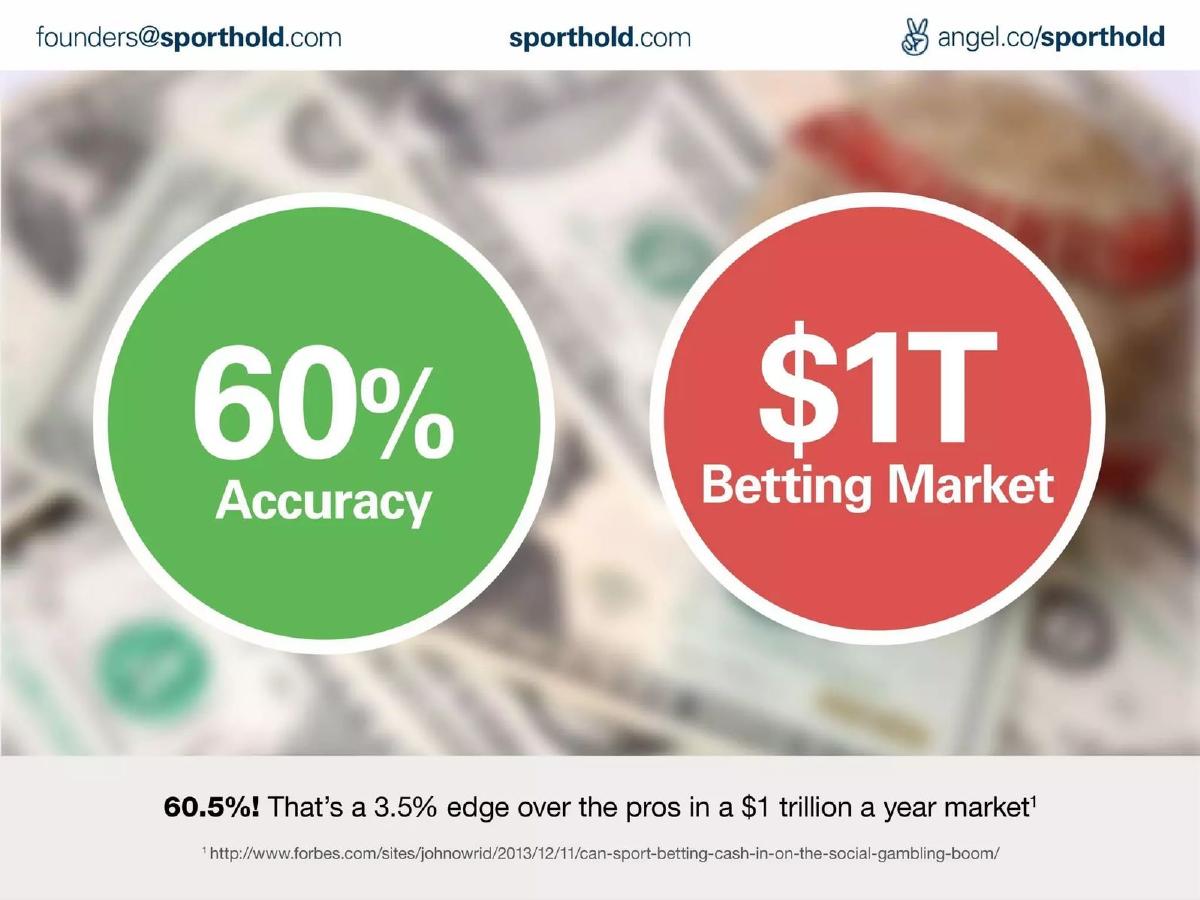
- The company claims a 60.5% prediction accuracy, which is 3.5% higher than what professional bettors aim for (Slide 6).
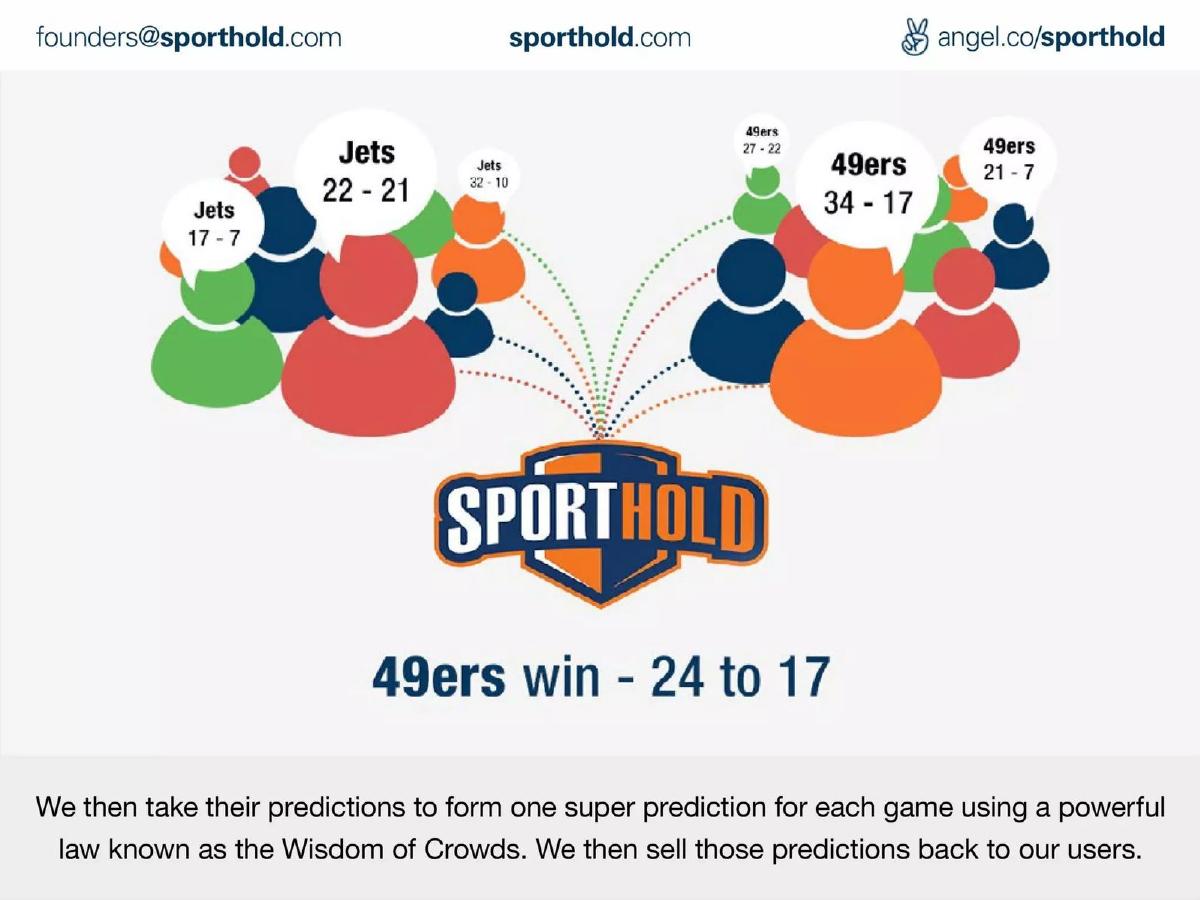
- Sporthold uses a free prediction game to collect data, which is then aggregated into a 'super prediction' (Slide 3).
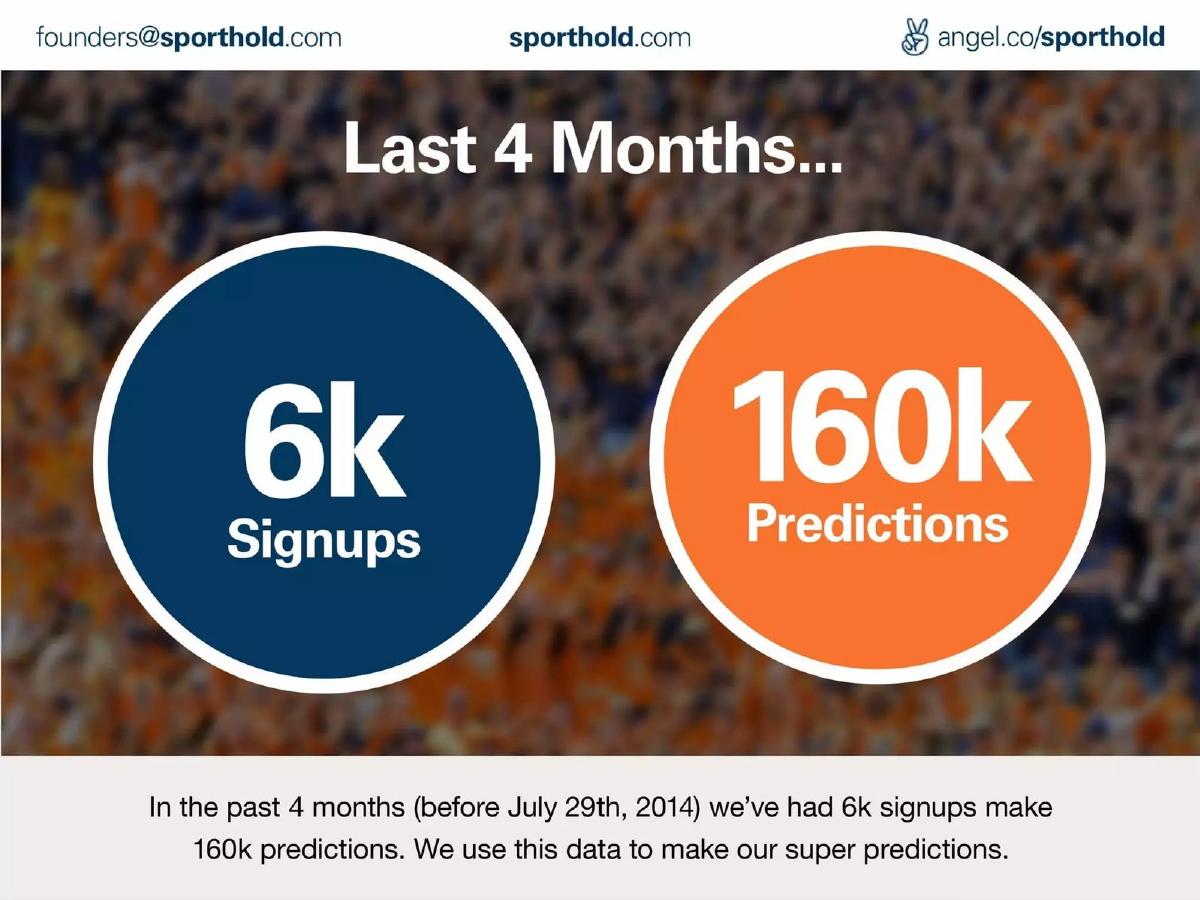
- Traction is demonstrated by 6k signups and 160k predictions generated in the four months leading up to July 29th, 2014 (Slide 4).
- The total addressable market for sports betting is cited at $1 trillion annually (Slide 6).
- The business model involves selling these 'super predictions' back to the users who provided the initial data (Slide 3).
- The founders suggest the technology is applicable to quarterly earnings predictions for publicly traded stocks (Slide 7).
- The team consists of three founders with backgrounds in Business & Mathematics, Backend/Mobile Dev, and Design/Web Dev (Slide 9).
- The deck omits a specific funding ask, use of funds, and detailed financial projections.
The 60.5% Edge: A Teardown of Sporthold
Sporthold’s 2013 pitch deck is a fascinating relic of the early 'Big Data' and 'AI' era. At just 10 slides, it is remarkably brief, yet it managed to secure $150,000 in seed funding. The deck doesn't follow the traditional Sequoia-style flow; instead, it focuses almost entirely on a single metric: accuracy. By proving they can predict the future better than the pros, the founders argue that the rest of the business details—monetization, market size, and expansion—are inevitable successes.
The Hook and the Product (Slides 1-3)
Slide 1: Title The deck opens with a high-resolution image of a stadium and the tagline 'Crowd Sourced Predictions.' It includes contact info and a link to their AngelList profile, which was standard for the era. The branding is clearly sports-centric, using a shield logo that mimics professional league aesthetics.
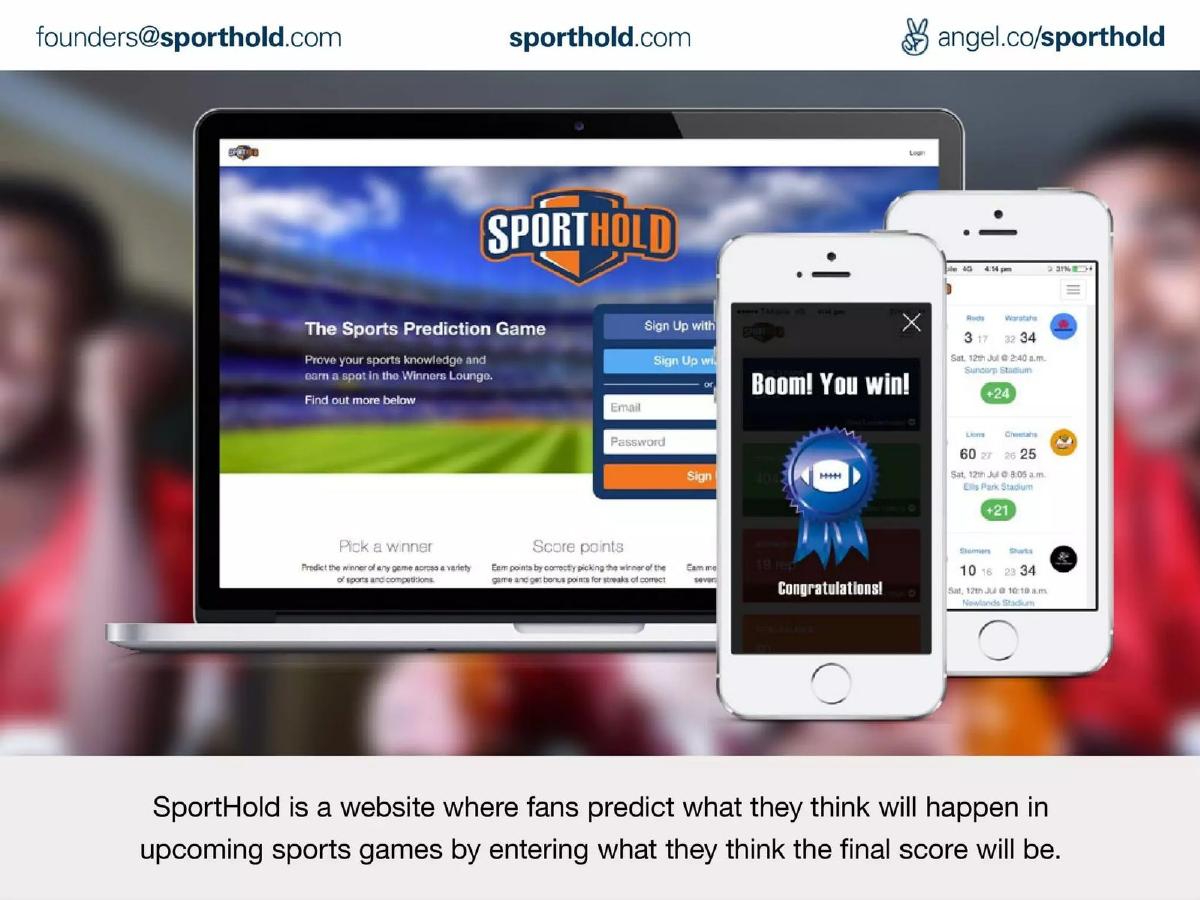
Slide 2: The Interface Sporthold immediately shows the product. It is described as a website where fans predict final scores. The visual shows a laptop and two iPhones, emphasizing a multi-platform approach. The UI appears simple: 'Pick a winner' and 'Score points.' This slide establishes that the 'game' is the entry point for the user, but not necessarily the end goal for the company.
Slide 3: The Mechanism This is the most important conceptual slide in the deck. It illustrates how individual, disparate predictions (e.g., Jets 22-21 vs. 49ers 34-17) are funneled into Sporthold to create a 'super prediction' of 49ers winning 24 to 17. The text introduces the 'Wisdom of Crowds' and states the business model: 'We then sell those predictions back to our users.' This is a classic data-loop: users provide the raw material for free, and the company sells the refined product back to them.
Traction and The 'Crushing Edge' (Slides 4-6)
Slide 4: Last 4 Months The company shows respectable early traction for a seed-stage startup in 2013/2014. They report 6,000 signups and 160,000 predictions. This averages out to roughly 26 predictions per user, suggesting high engagement and a solid data set for their algorithm to process. The date 'July 29th, 2014' provides a specific snapshot in time for the data.
Slide 5: The Benchmark Before revealing their own performance, Sporthold sets the stage by defining success in the industry. They note that 52.4% accuracy is the break-even point for profitability, while 'pros aim for' 57%. This creates a 'gap' in the market that the next slide intends to fill.
Slide 6: The Reveal The deck hits its climax here: '60.5% Accuracy.' They claim a 3.5% edge over professional bettors in a '$1 trillion a year market.' By framing a 3.5% difference as a 'crushing edge,' they appeal to the mathematical reality of high-volume gambling, where even a 1% improvement in accuracy can result in millions of dollars in profit. They cite a Forbes article to back up the $1T market size, adding third-party credibility to a staggering number.
Expansion and The Team (Slides 7-9)
Slide 7: Beyond Sports To avoid being pigeonholed as a 'gambling app,' the founders pivot to financial markets. They suggest their 'Wisdom of Crowds' model could predict quarterly earnings for publicly traded stocks. This is a common tactic to increase the perceived TAM (Total Addressable Market) and attract investors who might be wary of the regulatory hurdles in sports betting.
Slide 8: Enterprise Use Cases The expansion narrative continues with internal corporate operations. The example given is having employees predict unit sales. This slide feels slightly disconnected from the 'sports fan' data source mentioned earlier, but it serves to reinforce the idea that Sporthold is an 'algorithm company,' not just a 'sports company.'
Slide 9: The Team The team slide is lean. Three founders are listed: Christian Thurston (Business & Mathematics), Tom Horn (Backend & Mobile Dev), and Adam Dill-Macky (Design & Web Dev). All three are associated with Australian universities (University of Sydney and University of Technology Sydney). The roles are well-balanced for a three-person seed-stage team, covering the three pillars of a tech startup: business/math, engineering, and design.
The Conclusion (Slide 10)
Slide 10: The Jellybean Jar The deck ends on a cliffhanger. Using the classic jellybean jar metaphor for crowd wisdom, they invite investors to 'Contact us to find out how' they use the law of crowd wisdom to create predictions. It’s a 'teaser' ending designed to secure a meeting rather than explain the entire secret sauce on the page.
What Works in This Deck
The 'Magic Number' Strategy: The entire deck is built around the 60.5% figure. By establishing the industry standard first (52.4% and 57%), they make their own metric feel like a breakthrough. Founders often bury their best metric; Sporthold makes it the centerpiece.
Clear Data Loop: The deck explains exactly how the data is acquired (free game) and how it is processed (Wisdom of Crowds). This makes the 'AI' claims feel grounded in a tangible process rather than just buzzwords.
Simplicity: There is almost no clutter. Each slide has one job. Slide 4 is for traction. Slide 6 is for the edge. Slide 9 is for the team. This makes the deck very easy to digest in under two minutes.
What is Missing
The Ask: There is no slide stating how much money the company is raising or what they plan to do with it. While this might have been handled in the email body or the AngelList profile, a pitch deck should generally stand on its own as a request for capital.
Competition: The deck ignores the existence of other sports prediction sites, betting syndicates, or financial data giants like Bloomberg or Estimize (which uses a similar crowd-sourced model for earnings). Investors want to know why Sporthold’s crowd is 'wiser' than the others.
Unit Economics: While they mention selling predictions back to users, there is no data on what a user is willing to pay, the cost of acquiring a user (CAC), or the lifetime value (LTV). Without this, it’s hard to judge if the 6,000 signups represent a viable business or just a popular hobby site.
What a Founder Should Copy
Benchmark Your Metrics: Don't just say your product is 'good.' Say what the industry standard is, what the 'pros' do, and then show how you exceed that. Sporthold’s use of the 52.4% break-even point is a perfect example of providing context to make a number meaningful.
Use Visual Metaphors: The jellybean jar and the stadium background are simple, evocative images that reinforce the brand and the core scientific concept without requiring walls of text.
The 'Super Prediction' Framing: If you are building a platform that aggregates data, don't just call it a 'dashboard' or a 'report.' Give it a name that implies value, like a 'Super Prediction.' It sounds proprietary and powerful.
Frequently asked questions
- How does Sporthold actually make money according to the deck?
- Slide 3 explicitly states that the company takes individual user predictions, aggregates them into a 'super prediction' using the Wisdom of Crowds, and then sells those predictions back to the users. The catalogue listing also mentions using the algorithm to 'arbitrage what we know will happen versus what the sports books think,' suggesting a potential proprietary betting or hedge fund model alongside the B2C sales.
- What is the significance of the 60.5% accuracy rate?
- In the world of sports betting, the 'vig' or house edge usually requires a bettor to win approximately 52.4% of their bets just to break even. Slide 5 and 6 highlight that professional bettors aim for 57%. By claiming 60.5%, Sporthold is pitching a 'crushing edge' that theoretically guarantees significant long-term profitability in a $1 trillion market.
- Does the deck explain the technology behind the predictions?
- Only at a high level. The deck references the 'Wisdom of Crowds' (Slide 3) and mentions an algorithm in the catalogue listing. The final slide (Slide 10) uses a jellybean jar image—a classic reference to the experiment where the average of many guesses is more accurate than any single expert—to explain the concept without revealing the technical specifics of their AI.
- What are the potential expansion markets mentioned?
- Sporthold positions itself as more than a sports company. Slide 7 suggests predicting quarterly earnings for publicly traded stocks, and Slide 8 proposes internal corporate use, such as having employees predict unit sales for the next six months. This pivots the company from a gambling tool to a broader predictive analytics platform.
- What is missing from this pitch deck that investors usually expect?
- This is a very lean deck. It lacks a 'Problem' slide (it jumps straight to the solution), a 'Competitor' slide, a 'Business Model' breakdown (beyond a one-sentence mention), and most importantly, a 'Fundraising Ask.' There is no mention of how much money they are raising or what the milestones for that capital would be.