Spora Health’s 11-slide Seed Plus deck is a concise exercise in mission-driven storytelling. Raising $3M in 2021, the presentation focuses on the systemic failure of the American healthcare system to serve people of color. It effectively transitions from a moral argument to a massive market opportunity, citing a $1T primary care market for people of color. While the deck is light on detailed unit economics and specific financial projections, it compensates with a high-caliber team slide featuring experience from Salesforce and Lambda School, and a staggering 1800% month-over-month growth metr…
Key takeaways
- The deck leads with a provocative problem statement on slide 2: 'In America, being Black is bad for your health.'
- Racial healthcare disparities are framed as a 'product of design' rather than an accident on slide 3.
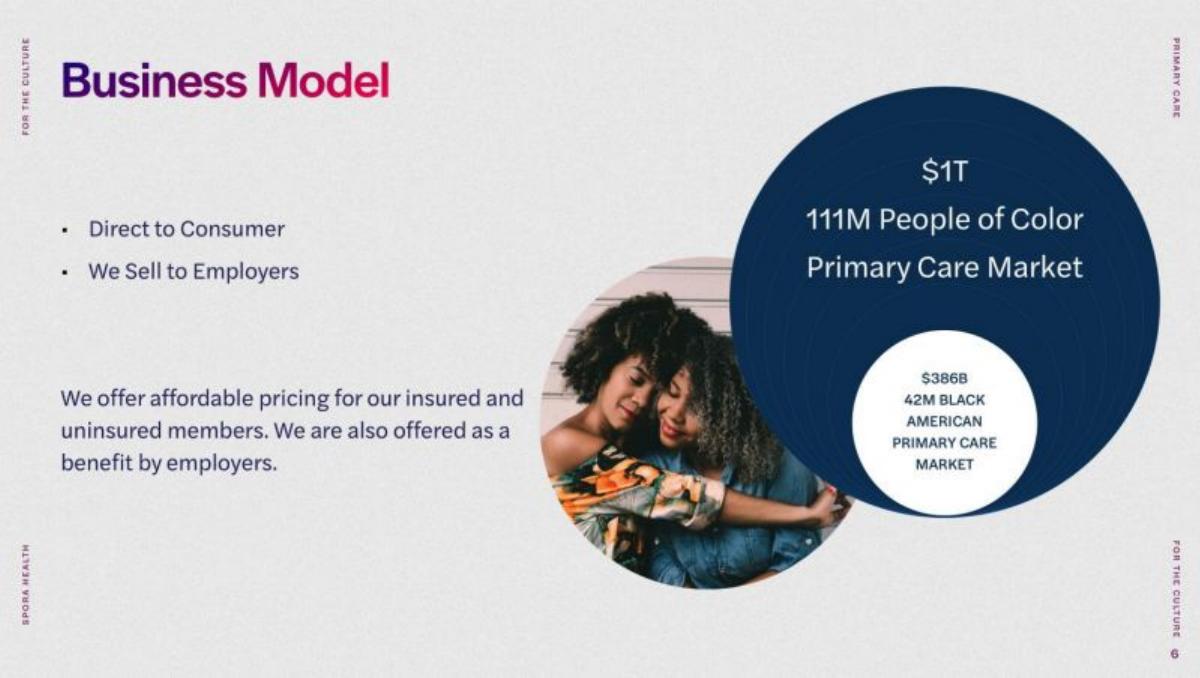
- The company identifies a $386B primary care market specifically for Black Americans on slide 6.
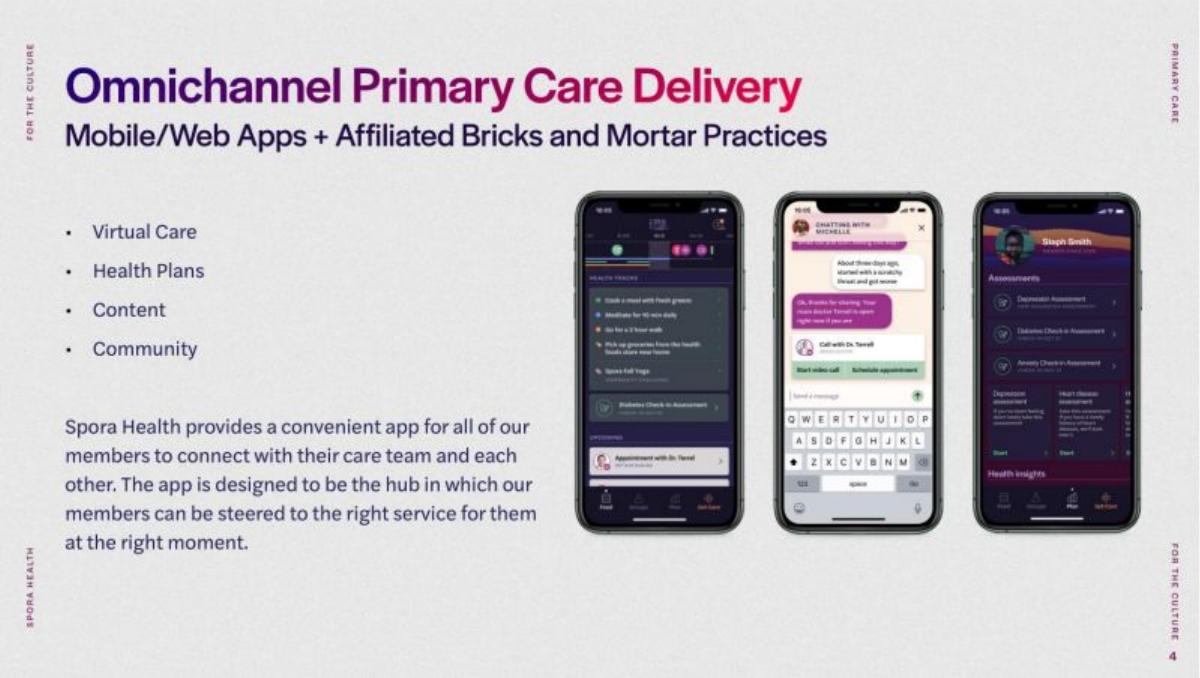
- Spora Health utilizes an omnichannel approach, combining mobile/web apps with affiliated physical practices as shown on slide 4.
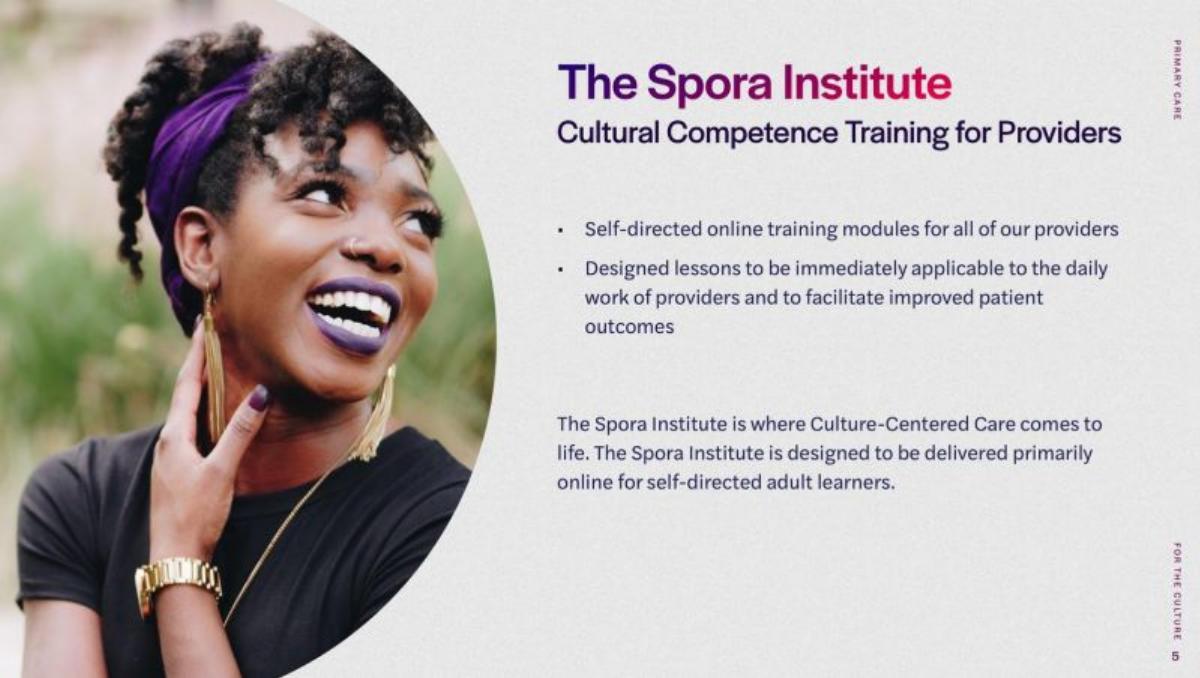
- The 'Spora Institute' is introduced on slide 5 as a proprietary cultural competence training platform for providers.
- The team boasts over 15 years of experience building digital health products, including alumni from SurveyMonkey and Salesforce (slide 8).
- Traction is demonstrated by a single, high-impact metric: 1800% month-over-month membership growth on slide 9.
- The deck omits a specific 'Ask' slide, though catalogue data confirms a $3M raise.
The Narrative Arc: From Systemic Failure to Market Solution
Spora Health’s pitch deck is a lean, 11-slide presentation that prioritizes emotional resonance and market scale over granular financial modeling. In the 2021 venture landscape, this 'Seed Plus' raise was designed to capitalize on the momentum of mission-driven investing and the urgent need for healthcare equity. The deck does not waste time on pleasantries; it immediately confronts the investor with the life-and-death consequences of the current healthcare status quo.
Slides 1-3: The Problem and the Provocation
Slide 1 is a minimalist title slide. It establishes the brand’s visual identity—a gradient of purple and blue—and identifies the round as a 'Seed Plus Raise' led by Dan Miller. The tagline 'For the Culture' appears in the margins, signaling the company's specific demographic focus from the outset.
Slide 2 is arguably the most powerful in the deck. It contains a single sentence in large, bold type: 'In America, being Black is bad for your health.' This is a classic 'hook' slide. It forces the reader to acknowledge a systemic reality before the deck offers a commercial solution. It sets a somber, urgent tone that justifies the existence of the company.
Slide 3 provides the data to back up the provocation of the previous slide. Titled 'Racial Healthcare Disparities: A product of design,' it lists three devastating statistics: Black children have a 500% higher death rate from asthma; Black women are 40% more likely to die from breast cancer despite lower incidence rates; and 100,000 fewer Black people would die annually if mortality rates were equalized. Crucially, the slide introduces the 'weathering effect,' attributing rapid biological aging to cumulative stress. By framing these issues as a 'product of design,' Spora Health implies that a new design—their design—can solve them.
Slides 4-5: The Product and the 'Secret Sauce'
Slide 4 introduces the 'Omnichannel Primary Care Delivery' model. It shows the Spora Health app interface across three mobile screens. The product is described as a hub for virtual care, health plans, content, and community. The slide explicitly mentions 'Affiliated Bricks and Mortar Practices,' indicating that Spora is not a pure-play software company but a full-stack healthcare provider that bridges the digital and physical worlds.
Slide 5 focuses on 'The Spora Institute.' This is the company’s primary differentiator. Rather than just providing a platform for existing doctors, Spora Health creates its own standard of care through 'Cultural Competence Training for Providers.' The slide describes self-directed online modules designed to facilitate improved patient outcomes. This addresses the 'design' flaw mentioned in slide 3 by re-educating the providers themselves.
Slides 6-7: Market Size and Competitive Landscape
Slide 6 breaks down the 'Business Model' and market opportunity. It uses a nested circle graphic to show a $1T primary care market for 111M people of color, with a $386B subset for 42M Black Americans. The text confirms a dual-track revenue strategy: Direct to Consumer (DTC) and B2B (selling to employers). This slide is vital for venture investors because it proves that a mission-driven company can operate at a massive scale.
Slide 7 addresses 'Competition.' It divides the field into 'Startups' (Kiira Health, ConsejoSano, Juno Medical) and 'Incumbents' (One Medical, Amwell, Doctor On Demand). While it doesn't provide a feature-by-feature comparison, the implication is that incumbents lack the cultural specificity of Spora, and other startups may lack their comprehensive omnichannel approach.
Slides 8-9: Team and Traction
Slide 8 presents the team, emphasizing 'Over 15 years experience Building digital health products.' The pedigree is strong: CEO Dan Miller (Lambda School, SurveyMonkey, Salesforce), Dr. Terrell Smith (UVA, Cal Berkeley), and Maria Cortez (formerly the first employee at Paloma Health). This slide is designed to de-risk the investment by showing that the founders have both clinical expertise and experience scaling high-growth tech companies.
Slide 9 is the 'Traction' slide, though it is titled 'Membership Growth.' It features a single, massive figure: '1800% MoM' (Month-over-Month). While 1800% growth is mathematically spectacular, the deck does not provide the baseline number. Growing from 1 member to 19 is 1800% growth, just as growing from 1,000 to 19,000 is. However, in a Seed Plus deck, this level of momentum is intended to show that the market is responding aggressively to the product launch.
Slides 10-11: Closing and Contact
Slide 10 serves as the closing slide with the tagline 'Healthcare for the culture' and Dan Miller’s email address. Slide 11 is a standard promotional slide for the platform where the deck was hosted and is not part of the Spora Health presentation itself.
What Works in This Deck
The Moral Imperative: By starting with the 'Problem' in such a stark, data-driven way, Spora Health makes it difficult for an investor to argue against the necessity of the business. · Market Specificity: Instead of claiming to be a general primary care provider, they lean into a specific, underserved demographic. This allows them to define a $1T market that incumbents are currently failing to capture. · The Institute as a Moat: Introducing the Spora Institute (Slide 5) suggests that the company isn't just a middleman for doctors; they are building proprietary intellectual property and a unique standard of care that is hard to replicate. · High-Signal Team: The combination of top-tier tech companies (Salesforce, SurveyMonkey) and elite medical/public health credentials (UVA, Berkeley) creates a balanced 'builder' and 'expert' profile.
What Is Missing
The Ask: The deck never explicitly states how much they are raising or how they intend to use the funds. While catalogue data says $3M, a founder should typically include a slide detailing the use of proceeds (e.g., hiring, geographic expansion, R&D). · Unit Economics: There is no mention of Customer Acquisition Cost (CAC), Lifetime Value (LTV), or the specific price points for the DTC or employer models. · Baseline Traction: The 1800% MoM growth figure is impressive but lacks context. Investors generally want to see absolute numbers (total members, ARR) alongside percentage growth. · Geographic Strategy: Since they mention 'Bricks and Mortar Practices,' the deck should ideally specify which markets they are currently in and where they plan to expand next, given the regulatory and physical complexities of healthcare.
What a Founder Should Copy
The 'Hook' Slide: Slide 2 is a perfect example of how to use a single, provocative statement to command attention. If your startup solves a visceral problem, don't bury it in bullet points. · Framing the TAM: Slide 6 does an excellent job of showing how a niche focus (Black Americans) is actually a massive market ($386B), which then rolls up into an even larger opportunity (People of Color, $1T). This 'concentric circles' approach is highly effective for mission-driven decks. · Visual Consistency: The deck uses a consistent color palette and high-quality photography that reflects the target demographic. It feels like a premium healthcare brand, not a clinical white-label service.
Frequently asked questions
- What is Spora Health's primary business model?
- According to slide 6, Spora Health operates a dual-revenue model. They utilize a Direct to Consumer (DTC) approach, offering affordable pricing for both insured and uninsured members. Simultaneously, they sell their services to employers as a corporate benefit, tapping into the B2B healthcare market.
- How does Spora Health differentiate itself from traditional telehealth providers?
- Spora Health differentiates through 'Culture-Centered Care.' As detailed on slide 5, they operate the Spora Institute, which provides self-directed online training modules for healthcare providers to improve cultural competence. This is paired with an omnichannel delivery model (slide 4) that integrates virtual care with physical 'bricks and mortar' practices.
- What market size does Spora Health target?
- Slide 6 outlines a massive Total Addressable Market (TAM). They identify a $1T primary care market for 111 million people of color in the United States. Within that, they highlight a $386B market specifically for 42 million Black Americans.
- Who are Spora Health's main competitors?
- Slide 7 categorizes competition into two groups. 'Startups' include Kiira Health, ConsejoSano, and Juno Medical. 'Incumbents' include established telehealth and primary care giants such as One Medical, Amwell, and Doctor On Demand.
- What is the background of the founding team?
- The team (slide 8) features diverse expertise. CEO Dan Miller has experience at Lambda School, SurveyMonkey, and Salesforce. Founding Physician Dr. Terrell Smith holds an MD from the University of Virginia and an MPH from Cal Berkeley. The team also includes specialists in data science, engineering, and clinical operations.