Splash Beverage Group (SBEV) utilizes a multi-brand strategy focused on high-growth segments like flavored tequila, functional beverages, and single-serve wine. The October 2022 presentation emphasizes a management team with 140 years of combined experience at industry giants like Red Bull and Coca-Cola. By acquiring brands with 'pre-existing awareness'—such as Tapout, which has 23 years of brand equity—Splash aims to bypass the high costs of early-stage brand building. The deck highlights a robust distribution network including Budweiser DSDs and major retailers. While the presentation provi…
Key takeaways
- The management team and board claim 140 years of combined beverage industry experience from companies like Red Bull, Diageo, and Coca-Cola (Slide 9).
- Splash targets brands with either 20+ years of pre-existing awareness or 'pure innovation' in packaging and formulation (Slide 9).
- Distribution is secured through DSD networks like Budweiser and broad-liners including McLain and UNFI (Slide 9).
- The portfolio includes Tapout Performance Drink, which features NFL star Drew Brees as an investor and brand ambassador (Slide 30).
- Market data shows Tequila volume has grown 72% over the last 10 years, supporting the SALT Tequila brand (Slide 9).
- Copa di Vino is positioned as a 'category creator' for single-serve wine and serves as an entry point into the Anheuser Busch network (Slide 35).
- Pulpoloco Sangria utilizes 'CartoCan' technology, an eco-friendly aseptic packaging innovation (Slide 38).
- Comparable company analysis shows spirits companies command a mean 2023E EV/Revenue multiple of 3.5x and 11.2x EV/EBITDA (Slide 18).
Executive Summary and Brand Positioning
The Splash Beverage Group (SBEV) investor presentation from October 2022 outlines a sophisticated portfolio play in the highly competitive beverage sector. Rather than betting on a single product, Splash has built a house of brands designed to capture growth across spirits, wine, and functional non-alcoholic drinks. The deck leans heavily on the 'pedigree' of its leadership, positioning the company as a group of industry veterans who know how to navigate the complex three-tier distribution system in the United States.
Slide 1: Title Slide
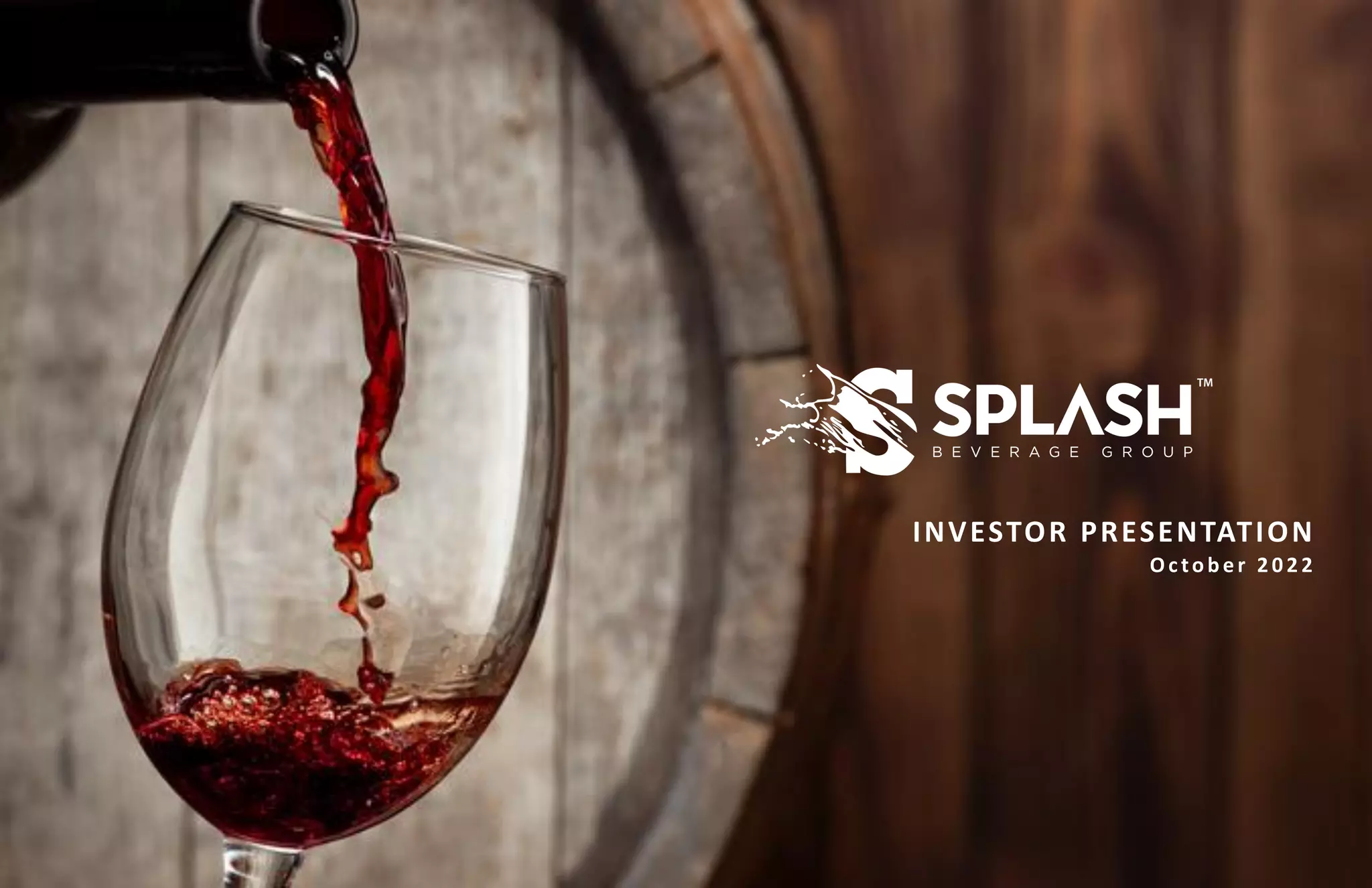
The opening slide features high-quality lifestyle imagery of wine being poured, establishing a premium aesthetic. It clearly identifies the company as Splash Beverage Group and dates the presentation to October 2022. The presence of the EF Hutton logo at the bottom suggests this deck was used for formal investor roadshows or capital markets activity.
Slide 9: Investment Highlights
This is the most information-dense slide in the deck, broken into four pillars: Management, Distribution, Brand Awareness, and Industry Growth. Management Team & Board are credited with 140 years of combined experience, citing brands like Red Bull, Gallo, and Coca-Cola. Robust Distribution highlights that products are already on shelves via DSD distributors (Budweiser) and broad-liners (UNFI, KEHE). Pre-existing Brand Awareness is a key differentiator; they note Tapout has 23 years of awareness. Finally, Industry Growth cites that Tequila volume has grown 72% in 10 years and functional beverages have grown 32% in the last 5 years.
Slide 13: Splash Formula for Success
This slide attempts to codify the company's operational strategy. It explicitly states the goal is to 'Replicate the CEO’s success at Red Bull.' The strategy involves bringing selected opportunities into their 'wheelhouse,' leveraging sales channel adoption, and utilizing celebrity/athlete 'reference value.' A notable strategic point is mentioned at the bottom: Splash may 'entertain larger exits by selling a more mature brand,' indicating they are as much a brand incubator/accelerator as they are a long-term operator.
Slide 18: Comparable Company Analysis
Splash uses this slide to justify the sector's attractiveness to investors. It breaks down 2023E EV/Revenue and EV/EBITDA multiples across Spirits, Wine, Beer, and Soft Drinks. Spirits command the highest premiums, with a mean EV/Revenue of 3.5x (Diageo at 4.9x and Brown-Forman at 8.7x). The slide notes that spirits companies command premium valuations due to 'superior margin profiles.' By including this, Splash implies that their SALT Tequila brand sits within the most valuable segment of the market.
Slide 28: Tapout Performance Drink (Visual)
This is a lifestyle slide showing four athletes in a gym setting performing planks with Tapout bottles positioned in front of them. It serves to reinforce the brand's positioning in the 'Performance Drink' category, emphasizing its utility in high-intensity training environments.
Slide 30: Investor and Brand Ambassador - Drew Brees
This slide focuses on the partnership with NFL legend Drew Brees. It lists his accolades (Multiple MVP awards, 7x passing yards leader) but, more importantly, describes his role as an 'athletic and fitness industry entrepreneur.' The text claims Brees approached Tapout after 'loving the clean-label ingredients.' His role involves using his platforms to promote the brand with a focus on youth athletics. This is a classic 'social proof' slide intended to show that the brand has top-tier backing.
Slide 32: SALT Tequila
Focusing on the spirits segment, this slide introduces SALT Tequila. It highlights '3 Flavors of 100% Blue Agave, 80 Proof Infused Tequila.' The slide reiterates market trends: Tequila is the #1 spirits segment among young consumers, and flavored spirits are showing 'explosive growth.' The imagery is bright and youthful, targeting a different demographic than the traditional, rugged tequila branding.
Slide 35: Copa di Vino
Copa di Vino is described as the 'Single-serve wine category creator.' The slide lists five key value propositions: 7 premium varietals, omni-channel capability, scalable packaging tech, and—crucially—acting as an 'Entre for Splash to Anheuser Busch network.' This suggests the brand is a strategic door-opener for the rest of the portfolio.
Slide 38: Pulpoloco Sangria
The final slide in the reviewed set covers Pulpoloco Sangria. It emphasizes the 'highly innovative, ecofriendly package known as the CartoCan.' It mentions an aseptic process that preserves flavors. This slide targets the growing consumer demand for sustainable packaging and 'ready-to-drink' (RTD) convenience.
What Works in This Deck
Strong Industry Context: The deck does an excellent job of explaining why these specific beverage categories were chosen. By citing the 72% growth in tequila and the 32% growth in functional drinks, they align their portfolio with proven macro trends.
Distribution Clarity: Most beverage startups fail at distribution. Splash addresses this head-on by naming their partners (Budweiser DSDs, UNFI, McLain). This gives investors confidence that the products can actually reach the shelf.
Management Pedigree: The 140 years of collective experience is a powerful metric. In a 'relationship business' like beverages, who you know is often as important as what you make.
What Is Missing
Internal Financials: The most glaring omission in these slides is the company's own performance. While they show comparable company multiples, they do not show their own revenue growth, gross margins, or EBITDA. Investors cannot verify if the 'Formula for Success' is currently yielding results.
The Ask: There is no slide in this set detailing how much capital is being raised, the valuation, or how the funds will be allocated (e.g., $X for marketing, $Y for inventory). Without this, it functions more as a general corporate overview than a specific fundraising pitch.
Unit Economics: For a multi-brand portfolio, understanding the contribution margin of each product is vital. The deck mentions 'superior margin profiles' for the industry but doesn't confirm if Splash’s brands have achieved them yet.
Founder Takeaways
Leverage 'Category Creators': If you have a product that defined a niche (like Copa di Vino), lead with that. It establishes your company as an innovator rather than a copycat.
Use 'Social Proof' Wisely: The Drew Brees slide works because it explains why he is involved (clean labels, youth athletics) rather than just showing a photo of a celebrity holding a bottle. Founders should ensure their ambassadors have a logical connection to the brand mission.
Address the 'Moat' of Distribution: If you are in CPG, your distribution network is your moat. Splash’s inclusion of specific distributor names (Slide 9) is a tactic every CPG founder should emulate to prove market readiness.
Frequently asked questions
- What is Splash Beverage Group's core investment thesis?
- The company focuses on acquiring and scaling beverage brands that already possess significant market awareness or unique innovations. By leveraging a management team with deep ties to major distributors (like Budweiser and UNFI) and high-profile ambassadors like Drew Brees, they aim to accelerate market penetration faster than traditional startups. They specifically target high-growth categories like flavored spirits and functional drinks.
- Which brands are currently in the Splash Beverage portfolio?
- Based on the presentation, the portfolio includes Tapout Performance Drink (hydration/recovery), SALT 100% Agave Tequila (flavored spirits), Copa di Vino (single-serve wine), and Pulpoloco Sangria (eco-friendly canned sangria). Each brand addresses a specific market trend, such as the 72% growth in tequila volume or the rise of functional beverages.
- How does the company handle distribution?
- Splash utilizes a multi-channel distribution strategy. This includes Direct Store Delivery (DSD) through partners like Budweiser distributors, as well as 'broad-liner' distribution through entities like McLain, Cormark, KEHE, and UNFI. The deck notes that their management’s past relationships allow them to bring retail chains aboard quickly.
- What role do celebrities play in their strategy?
- Celebrity and professional athlete involvement is a core pillar of their 'Formula for Success.' For example, former NFL quarterback Drew Brees is not just a brand ambassador but also an investor in Tapout. The company uses these platforms to build credibility and reach specific demographics, such as youth athletics.
- What financial metrics are provided in the deck?
- The provided slides are light on internal financial data. There are no slides showing Splash's specific revenue, burn rate, or profitability. Instead, the deck provides 'Comparable Company Analysis,' showing valuation multiples for industry leaders like Diageo (8.7x EV/Revenue) and Brown-Forman (25.6x EV/EBITDA) to provide context for the sector's potential.