Spinach’s Seed deck is a lean, 10-slide presentation that successfully secured $3.5M in funding. The narrative centers on the inefficiency of meetings for high-cost product development teams. Rather than over-explaining the AI technology, the deck focuses on proof of utility: a 50% reduction in standup time and a DAU/WAU ratio of 66%. The team slide highlights deep experience with acquisitions (Drippler to Asurion) and early-stage growth at Uber. While the deck lacks a formal financial model or detailed competitive landscape, it compensates with a high-signal 'Plan' slide that sets clear 18-m…
Key takeaways
- The deck highlights a 5x growth in weekly active users over a four-month period leading into May 2022 (Slide 6).
- Spinach reports a DAU/WAU ratio of 66%, indicating exceptionally high product stickiness for a B2B SaaS tool (Slide 6).
- The product claims a specific value proposition: cutting standup meeting time by 50% (Slide 6).
- The team features a founder who previously led a company (Drippler) through an acquisition by Asurion (Slide 2).
- The customer base includes notable tech companies such as Wix, Fiverr, Snyk, and Rappi (Slide 7).
- The 'Our Plan' slide sets a specific 18-month goal of reaching $1M in ARR and 10,000 seats (Slide 9).
- The problem is framed as a cost-efficiency issue, contrasting $16/hour frontline workers with >$100k/year product developers (Slide 3).
- The deck omits a traditional 'Ask' slide, though catalogue data confirms a $3.5M raise (Slide 9/Catalogue).
Executive Summary: The Power of Brevity
The Spinach pitch deck is a textbook example of a 'traction-first' Seed deck. At just 10 slides, it doesn't waste time on industry fluff or generic 'AI is the future' platitudes. Instead, it relies on the pedigree of its founders and the undeniable stickiness of its early product. By the time an investor reaches the final slide, the message is clear: the product works, the users are staying, and the team knows how to scale to an exit.
Slide 1: Title Slide
The cover slide is minimalist, featuring the spinach.io branding and a date of May 2022. It labels the presentation as an 'Overview.' The geometric design language established here carries through the entire deck, signaling a high level of professional design polish which is often equated with product quality in the SaaS world.
Slide 2: Team Pedigree
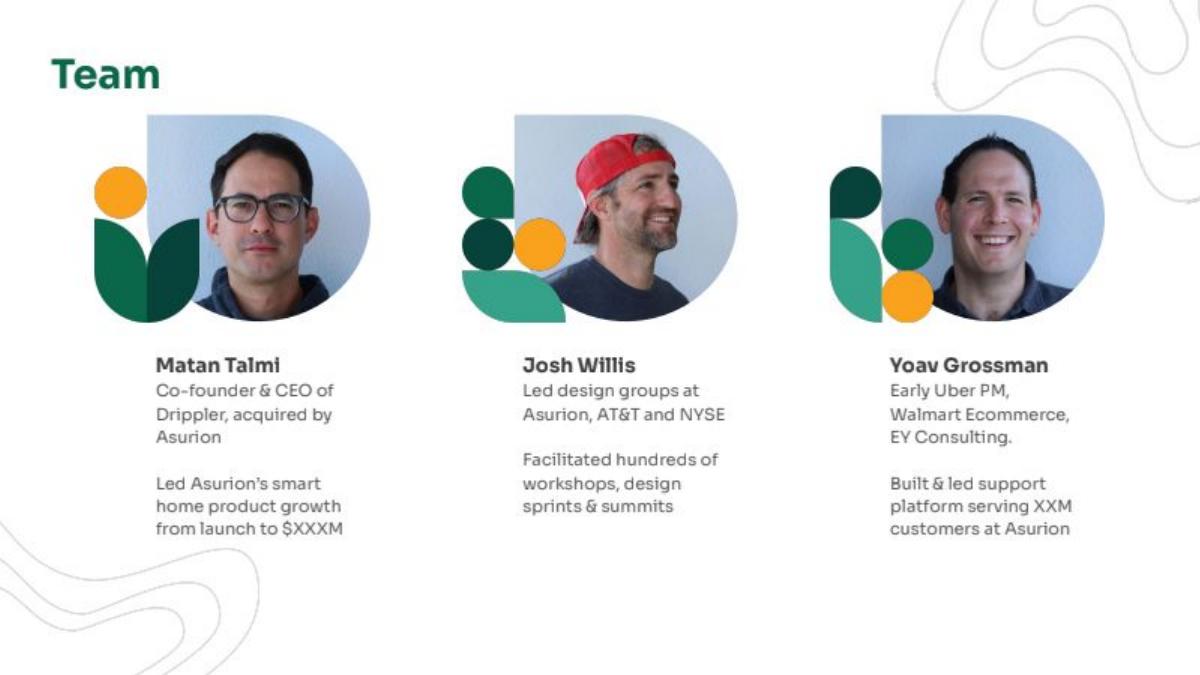
Spinach places the team slide second, a strategic move for founders with previous exits. Matan Talmi is highlighted as the Co-founder & CEO of Drippler, which was acquired by Asurion. The slide notes he led smart home product growth to '$XXXM' (figures redacted). Josh Willis brings design leadership from Asurion and AT&T, while Yoav Grossman adds 'Early Uber PM' and Walmart Ecommerce to the resume. This slide establishes 'Founder-Market Fit' by showing a history of building platforms that serve millions of customers.
Slide 3: The Problem - The High Cost of Inefficiency
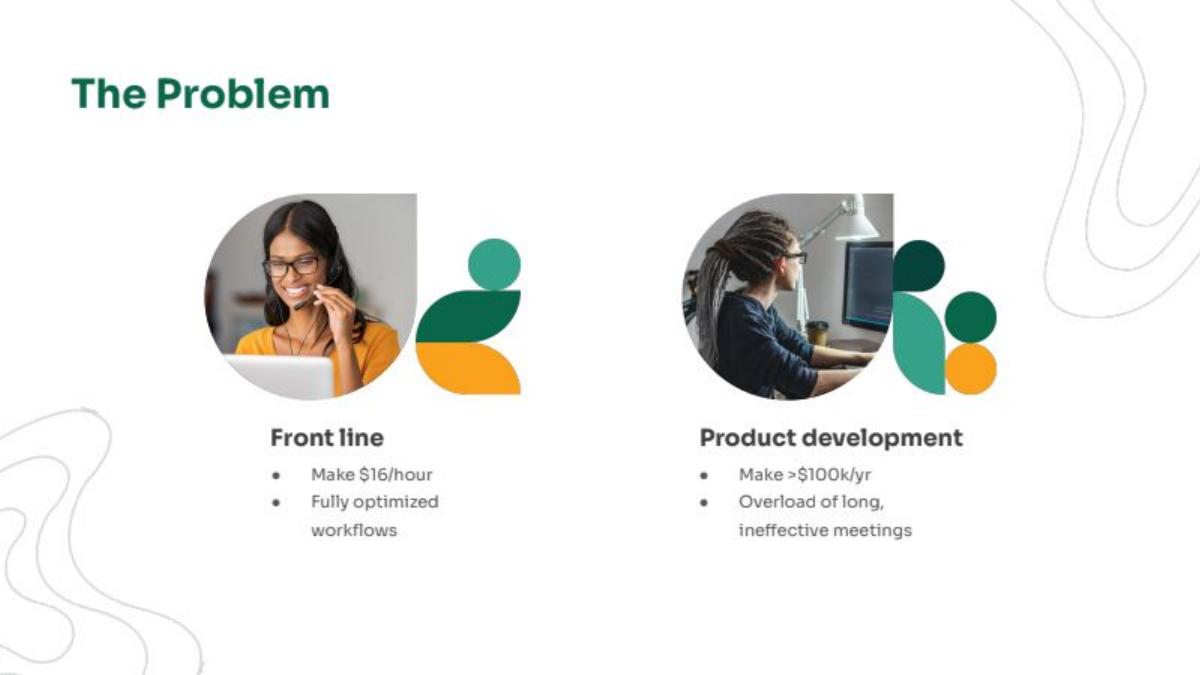
Slide 3 uses a clever comparison to frame the problem. It contrasts 'Front line' workers (making $16/hour with optimized workflows) against 'Product development' staff (making >$100k/year). The pain point for the latter is an 'Overload of long, ineffective meetings.' This frames the solution not just as a convenience, but as a massive cost-saving measure for high-salary R&D departments.
Slide 4: Our Mission
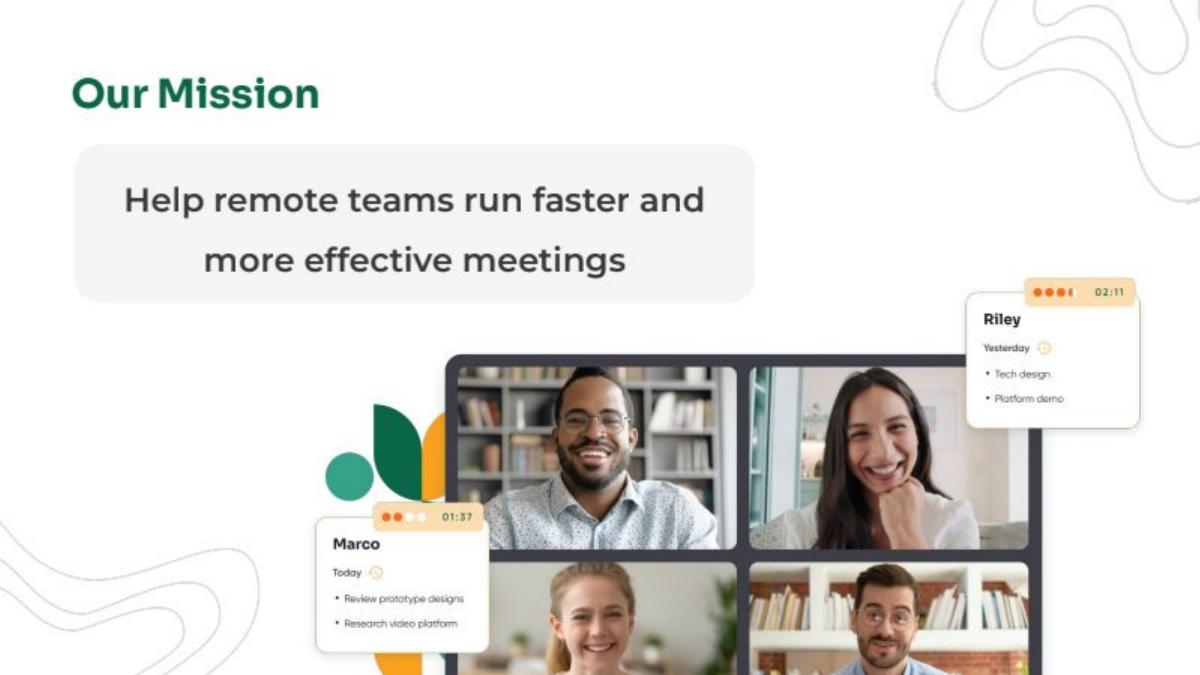
The mission is stated simply: 'Help remote teams run faster and more effective meetings.' The slide includes a UI mockup showing an integrated meeting interface where participants (Marco, Riley) have their 'Today' and 'Yesterday' tasks visible as overlays. This hints at the product's core functionality—bringing structure to the chaos of video calls.
Slide 5: Our Product
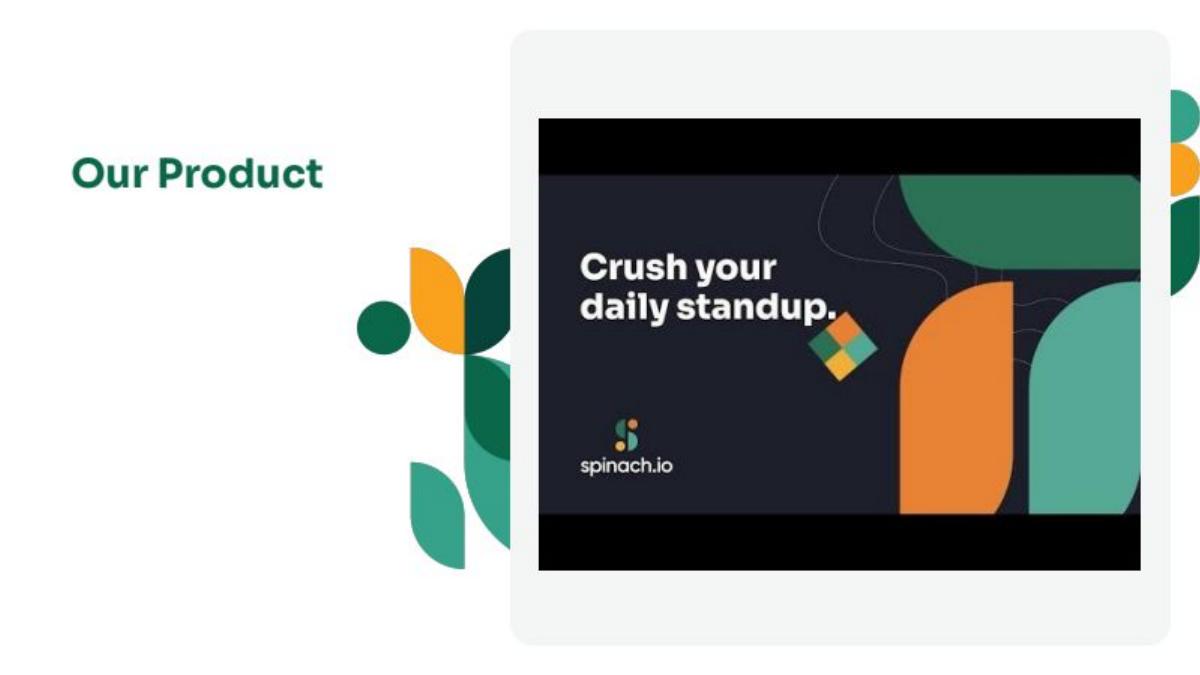
This slide is essentially a placeholder for a product demo, featuring the tagline 'Crush your daily standup.' It reinforces the initial focus of the company: the agile standup meeting. By narrowing the focus to a specific meeting type, Spinach avoids the 'boil the ocean' trap that many AI assistants fall into.
Slide 6: Traction and Stickiness
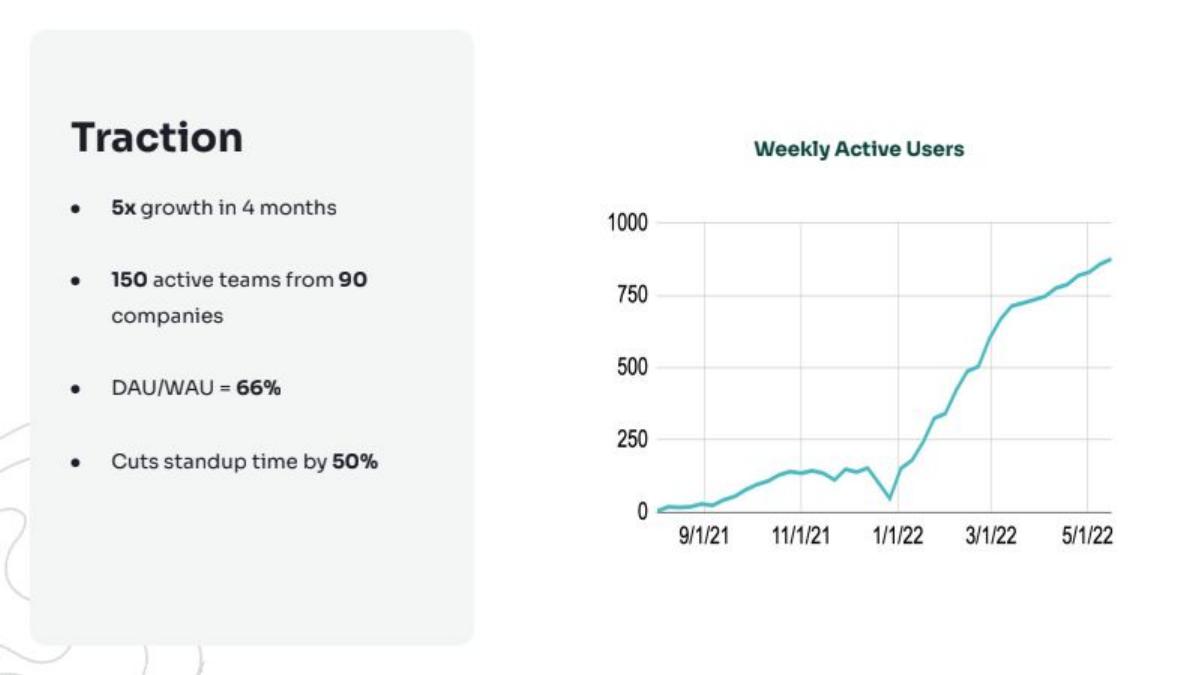
This is the 'money slide' of the deck. Spinach presents four compelling data points:
5x growth in 4 months. · 150 active teams from 90 companies. · DAU/WAU = 66% : This is a world-class retention metric, suggesting that users who try the tool for one standup make it a daily habit. · Cuts standup time by 50% : A direct, quantifiable ROI.
The accompanying line graph shows a sharp inflection point in Weekly Active Users starting around January 2022.
Slide 7: Social Proof (Logos)
The 'Teams Running on Spinach.io' slide features heavy hitters in the tech space. Logos include Wix, Fiverr, Snyk, Rappi, Zoominfo, Asurion, Blend, Impact, and eToro . Having these names as early adopters validates that the tool can penetrate enterprise-grade engineering and product organizations.
Slide 8: The Investor Syndicate
The investor slide lists Y Combinator, Cardumen Capital, Maven Ventures, Zoom, and Tuesday Capital . The inclusion of Zoom is particularly significant, as it represents a strategic partnership with the primary platform Spinach likely operates on.
Slide 9: Our Plan (The 18-Month Roadmap)
Instead of a traditional 'Ask' slide, Spinach presents a roadmap. The goals are divided into Product and Growth:
Product: Increase engagement 10x through meeting workflows, more integrations, and additional meeting types. · Growth: Reach 200 paid accounts, 10,000 seats, and $1M in ARR .
This gives investors a clear 'North Star' for what the Seed funding is intended to achieve.
Slide 10: BestPitchDeck.com Outro
The final slide is a standard promotional slide for the source library and does not contain company-specific information.
What Spinach Does Well
The Spinach deck excels at quantifying value . Many AI startups struggle to explain exactly how they save time; Spinach claims a '50% reduction' in a specific meeting type (standups). This specificity makes the sales pitch much easier for a VC to underwrite. Furthermore, the DAU/WAU ratio of 66% is a powerful rebuttal to the common criticism that AI meeting tools are 'gimmicky' or 'one-time use.' It proves the product is an essential part of the daily workflow.
What is Missing from the Deck
Despite its success, the deck leaves several questions unanswered:
Competition: There is no mention of Otter.ai, Fireflies, or the native AI features being built by Zoom and Microsoft Teams. · Business Model: While it mentions 'paid accounts' and 'ARR' on Slide 9, it doesn't explain the pricing tiers or the 'B2C' (likely Prosumer/PLG) motion mentioned in the catalogue. · The Technology: There is zero mention of the underlying LLMs or proprietary tech. In the 2023 AI gold rush, most decks spend at least one slide on their 'moat.' Spinach relies entirely on its traction and UX as its moat.
Founder Takeaway: Copy the Focus
Founders should emulate Spinach’s narrow targeting . They didn't pitch a 'General AI Assistant'; they pitched a tool to 'Crush your daily standup.' By solving a specific, recurring pain point for a high-value demographic (developers), they were able to generate the high-engagement metrics that VCs crave. If you have a 66% DAU/WAU ratio, you don't need 20 slides to explain why you're a good investment—the numbers do the talking for you.
Frequently asked questions
- How much did Spinach raise with this deck?
- According to the catalogue data, Spinach raised $3.5M in a Seed round in 2023. The deck itself does not state the specific dollar amount being sought, which is common in decks shared publicly after a round closes, but it does outline an 18-month execution plan to reach $1M ARR.
- What is the core problem Spinach is solving?
- Spinach targets the 'overload of long, ineffective meetings' specifically for product development teams. Slide 3 contrasts the optimized workflows of frontline workers with the high-cost, unoptimized time of developers earning over $100k per year, suggesting that meeting inefficiency is a significant financial drain on R&D.
- Who are the key investors in Spinach?
- The round was led by Cardumen Capital. Other participants listed in the catalogue and on Slide 8 include Zoom (a strategic investor), Y Combinator, Maven Ventures, Tuesday Capital, and individual angels like Liron Petrushka and Yoni Assia.
- What are Spinach's key engagement metrics?
- Spinach displays very strong engagement signals on Slide 6. They report a DAU/WAU (Daily Active Users to Weekly Active Users) ratio of 66%. They also claim to have 150 active teams across 90 different companies and achieved 5x user growth in the four months prior to the deck's date.
- What is missing from the Spinach pitch deck?
- The deck is notably brief at only 10 slides. It lacks a detailed competitive analysis, a breakdown of unit economics (CAC/LTV), a formal balance sheet or burn rate summary, and a specific 'Ask' slide detailing how the $3.5M would be allocated across departments.